// SPECIES PROFILE · SPRING EPHEMERAL · NATIVE · OZARK SPECIALTY
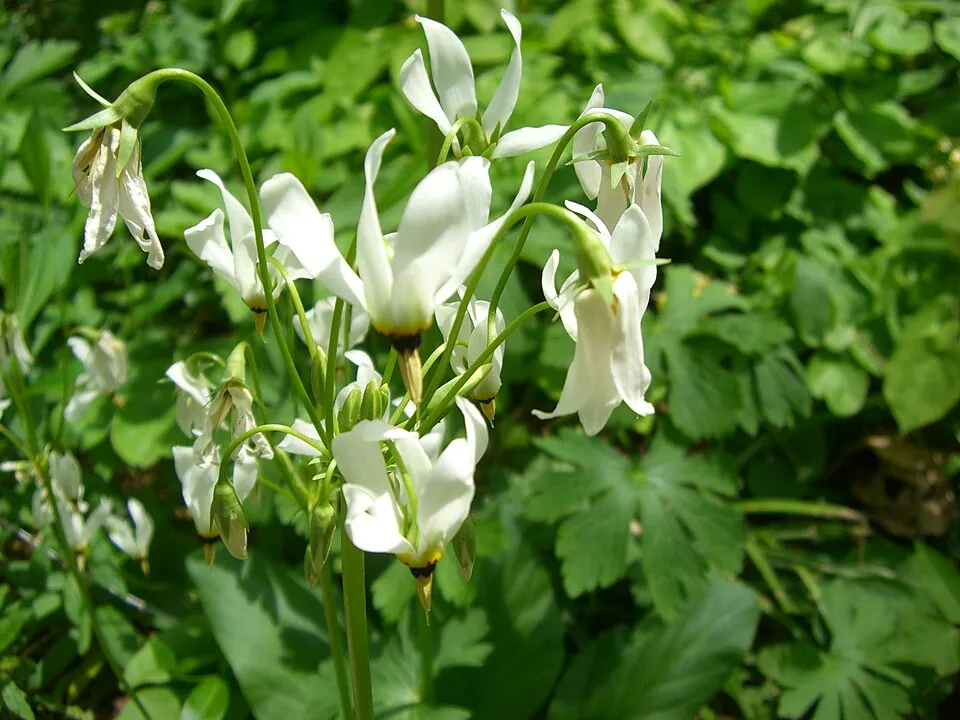
Shooting Star is one of those spring wildflowers that stops you mid-stride on a woodland walk — a cluster of nodding, swept-back flowers balanced on a slender stem like a troupe of tiny ballerinas frozen in mid-leap. Each blossom has five white-to-rose-pink petals reflexed sharply backward and a pointed yellow tube of stamens thrust forward, the whole flower resembling a shooting star (or, if you are less poetic, a badminton shuttlecock). The blooms are buzz-pollinated by bumblebees, which grasp the cone of stamens and vibrate their wing muscles at a specific frequency to shake pollen loose — a specialized pollination mechanism shared with tomatoes, blueberries, and a handful of other plants. In NE Oklahoma, Shooting Star occupies a narrow ecological niche: moist, north-facing wooded slopes and limestone bluffs in the Ozark foothills, at the extreme western edge of the species' range. It is a spring ephemeral, blooming in April–May and going completely dormant by mid-summer, leaving no trace above ground. For the woodland gardener in Tulsa or the Illinois River valley, establishing a colony of Shooting Star beneath a Sugar Maple or Pawpaw is one of the highest expressions of the native plant craft.

[ field key — rosette · stem · flower · fruit · dormancy · distinguishing features ]
Shooting Star is a spring ephemeral perennial, meaning it emerges early, blooms rapidly, sets seed, and goes completely dormant by mid-summer — a life-history strategy shared with many woodland wildflowers that grow on the forest floor before the canopy leafs out. The plant consists of a basal rosette of smooth, oblong leaves that emerges in March and a single upright, leafless flowering stem (scape) that rises 8–20 in from the rosette center. After setting seed in May–June, the leaves yellow and wither, and the plant retreats entirely underground to a small, fibrous-rooted crown; by July there is no sign it was ever there. This dormancy is normal and essential — the plant is not dead, only resting.
All leaves are basal, forming a loose rosette at ground level. Leaves are oblong to oblanceolate (spoon-shaped), 3–10 in long, with smooth (entire) or slightly wavy margins. The blade surface is smooth and hairless, medium green with a slightly paler underside, and often has a faint reddish tinge at the base. The midrib is prominent and pale. Leaves emerge in early spring (March in NE Oklahoma), are fully developed by the time the flowering scape appears, and begin to yellow and wither shortly after flowering concludes. There are no stem leaves at all — the flowering stalk is completely naked except for the flowers at the top.
The inflorescence is an umbel of 3–20 nodding flowers borne at the top of a single, unbranched, leafless scape. Each flower is distinctive and instantly recognizable: five white, pink, or deep rose-colored petals are swept sharply backward (reflexed) away from the center, and a pointed yellow tube of five fused stamens thrusts forward and downward. The overall effect is of a badminton shuttlecock, a miniature cyclamen, or — as the name suggests — a shooting star plunging earthward. Flowers are about ¾–1 in across (petal tip to petal tip) and are held on slender, arching pedicels. The color varies by population: plants in the eastern part of the range tend toward white, while Ozark and prairie populations tend toward deeper pink. In NE Oklahoma, expect soft pink to rose.
After pollination, the flowers become erect (the pedicels straighten and point upward) and develop into small, upright, cylindrical capsules that split open at the tip when mature, releasing numerous tiny brown seeds. The seeds are dispersed by wind and gravity, typically falling within a few feet of the parent. The plant then rapidly senesces: leaves yellow and collapse, the scape dries, and by late June or early July in NE Oklahoma, the entire plant is completely dormant and invisible above ground. This dormancy is a key consideration for cultivation — mark your plants carefully so you do not accidentally dig into the crown when the site looks empty in August.
Dodecatheon meadia has a broad eastern North American distribution, from Pennsylvania and the southern Great Lakes south to northern Florida and west to the eastern edge of the Great Plains — eastern Texas, eastern Kansas, and far eastern Oklahoma. In Oklahoma, it is rare and local, confined almost entirely to the Ozark foothills and Springfield Plateau region of the far northeastern corner of the state — Delaware, Ottawa, and eastern Mayes and Craig Counties. This is the extreme western edge of the species' range, and populations here are disjunct from the main body of distribution to the east.
The habitat in NE Oklahoma is specific and limited: moist, north-facing wooded slopes, limestone bluffs, rich alluvial woods, and the sheltered bases of dolomite and limestone outcroppings where the soil is deep, dark, and consistently moist through spring. These are the same mesic forest sites that support other Ozark-eastern disjuncts like Cucumber Tree, Twinleaf, and American Witch Hazel. The species is notably absent from the drier Cross Timbers uplands west of the Grand River and from the Arkansas River floodplain proper; it requires the humid microclimate and calcareous parent material of the Ozark landscape. In the Illinois River corridor and along the spring-fed tributaries of the Grand Lake o' the Cherokees watershed, Shooting Star can form locally abundant colonies on sheltered slopes, especially where groundwater seeps maintain soil moisture into May.
Outside its native Ozark foothill refugia, Shooting Star does not occur naturally in the Tulsa metropolitan area or the Cross Timbers. However, it can be successfully cultivated in Tulsa gardens if its specific soil and moisture requirements are met — a north-facing bed amended with leaf mold and limestone chips, kept evenly moist in spring, and allowed to dry in summer when the plant is dormant.
[ buzz pollination · bumblebee specialists · spring phenology · woodland ecology ]
Shooting Star is one of the classic examples of buzz pollination (sonication) in the eastern North American flora. The flowers produce no nectar — the reward is pure protein-rich pollen, which is held tightly inside the fused stamen tube and released only through a small terminal pore. To extract it, a bumblebee grasps the pointed yellow cone of stamens with its legs and mandibles and vibrates its indirect flight muscles at a frequency of roughly 100–400 Hz while decoupling the wings from the muscles — producing the characteristic high-pitched buzz you hear when a bee works a Shooting Star flower. The vibration shakes pollen loose from the anthers inside the tube, and it showers out through the pore onto the bee's underside. When the bee visits the next flower, pollen is transferred to the stigma. This mechanism is shared with relatively few plant groups: Solanum (tomatoes, nightshades), Vaccinium (blueberries), Dodecatheon, and a handful of others. If you grow tomatoes, you have seen the same pollination strategy in action.
The primary pollinators in our region are queen bumblebees that have emerged from hibernation in early spring and are foraging to provision their first brood. Species observed on Shooting Star in the central US include the Common Eastern Bumblebee (Bombus impatiens), Brown-belted Bumblebee (B. griseocollis), and Two-spotted Bumblebee (B. bimaculatus). Because the flowers provide only pollen (no nectar), they serve as an early-spring protein source for developing bumblebee colonies at a critical time when few other pollen-rich woodland flowers are available. Small halictid bees and occasional syrphid flies also visit, but they are ineffective pollinators — only large, strong bees capable of buzz pollination reliably transfer pollen between flowers.
Shooting Star does not serve as a larval host for any Lepidoptera species of significance in our region. The foliage is chemically defended by triterpenoid saponins that deter most generalist herbivores. White-tailed deer will occasionally browse the leaves and flowering stems, but the plant is not a preferred forage species. In areas with heavy deer pressure, a small exclusion cage may be necessary to protect a establishing colony. The seeds have an elaiosome (a small, lipid-rich appendage) that attracts ants, which disperse the seeds to their nests — a mutualism (myrmecochory) shared with many spring ephemerals, including Bloodroot, Wild Ginger, and Toadshade.
Shooting Star's spring ephemeral life history is tightly coupled to the deciduous forest light cycle. The plant emerges in March–April, completing its entire above-ground life cycle — leaf-out, flowering, pollination, seed set, and senescence — in the 8–10 week window between soil thaw and full canopy closure. By the time the oaks and hickories are in full leaf and the forest floor is deep shade, Shooting Star has already produced seed and gone dormant. This temporal niche reduces competition for light with taller perennials and allows the species to coexist with a dense community of other spring ephemerals. In the Ozark foothills, typical co-flowering species include Wild Columbine, False Solomon's Seal, Marsh Marigold, and various Trillium species.
[ site selection · planting · dormancy · propagation · companion design ]
Shooting Star is not a plant-you-can-stick-anywhere native. It demands a specific set of conditions that replicate the moist, shaded, calcareous slopes of its native Ozark habitat. The ideal site in a NE Oklahoma garden is a north-facing or east-facing bed that receives dappled spring sun through leafless deciduous trees but is shaded during the heat of summer. The soil must be deep, rich in organic matter, consistently moist in spring, and well-drained — heavy, unamended Tulsa red clay that bakes to brick in July will kill it. Work in copious amounts of leaf mold, composted hardwood bark, and crushed limestone or dolomite chips to raise pH into the 6.5–7.5 range and improve structure. A site at the base of a north-facing foundation wall or near a downspout discharge (where soil stays damp through May) often works better than an open bed.
The single biggest cultivation challenge with Shooting Star is managing its complete summer dormancy. By late June in Tulsa the leaves will yellow, collapse, and disappear entirely. The plant is not dead. The underground crown and roots are alive but quiescent. Critical rules for the dormant period:
Shooting Star is a centerpiece of the spring woodland garden and should be planted with species that share its moist, humus-rich, shaded conditions and respect its summer dormancy. Excellent companions include: Wild Columbine and Wild Ginger for early-spring co-bloom; Bloodroot and Toadshade as fellow spring ephemerals with similar phenology; Woodland Phlox for a soft blue carpet beneath the Shooting Star blooms; Maidenhair Fern and Christmas Fern for structural greenery that fills the space when Shooting Star goes dormant; and Spicebush or Pawpaw as the understory shrubs that provide the dappled spring light and heavy summer shade the species requires. On a north-facing limestone slope, add Heartleaf (Hexastylis arifolia) as an evergreen groundcover that marks the site year-round.
Shooting Star has a modest ethnobotanical record compared to many other native wildflowers. The plant was known to several eastern tribes, though its use was primarily medicinal. The Cherokee used a root infusion as a eye wash for sore eyes and as a mild sedative for children. The Iroquois prepared a root decoction for urinary complaints. The plant's triterpenoid saponin content likely accounts for these applications; saponins are surfactant compounds with mild antimicrobial and expectorant properties found widely in the Primulaceae.
Unlike its relative Primula veris (European Cowslip, which is used in sedative teas and wines), Shooting Star has no significant culinary use and should not be consumed without expert guidance — the saponin content can cause gastrointestinal distress in quantity. The flowers and foliage are not browsed by livestock and are considered mildly toxic to grazing animals.
The species has been in cultivation in European and American gardens since the late 18th century. Thomas Jefferson grew Shooting Star at Monticello, where it was listed in his garden books under the name "American Cowslip." It remains a prized plant among native plant enthusiasts, rock gardeners, and collectors of spring ephemerals, though commercial availability is limited compared to more easily propagated woodland species.
Hero photo: Rooted Revival. Strip photos courtesy of Wikimedia Commons contributors under their respective licenses (linked under each image).