// SPECIES PROFILE · PERENNIAL · NATIVE · WOODLAND GROUNDCOVER · EVERGREEN
The first time you notice Heartleaf in the woods, it will likely be the leaves that stop you: glossy, dark green, distinctly heart-shaped, each one marked with a network of silvery veins that look like they were painted on with a fine brush. The plant hugs the ground in the deep shade of mature pine-oak woods, forming a low carpet of evergreen foliage that persists through winter and provides one of the few touches of green in the dormant forest floor. But the real curiosity — the thing that makes Hexastylis arifolia unforgettable once you know about it — is the flower. Or rather, the fact that most people who walk past a colony of Heartleaf in bloom never see a flower at all. The blossoms are brown, leathery, and shaped like tiny jugs or urns, and they form at ground level, hidden beneath the leaf litter, where they emit a faint fungal odor to attract their pollinators: fungus gnats and ants. This is a plant whose entire reproductive life takes place in the hidden interface between soil and leaf litter, a creature of the forest floor's most intimate layer. In Oklahoma, Heartleaf reaches the northwestern edge of its range in the acidic woods of the southeastern counties and the southern margins of the Cross Timbers, and it deserves a place in any shade garden that values subtlety, texture, and the quiet drama of close observation.

[ field key — leaves · flowers · rhizome · distinction from Asarum ]
The leaves are the plant's most conspicuous feature and the reason it is valued in the garden. Each leaf is simple, heart-shaped (cordate) to arrow-shaped (hastate), 2–5 in long and nearly as wide, with a long petiole (leaf stalk) that rises 3–6 in from the rhizome. The upper surface is glossy, dark green, and leathery, marked with a striking pattern of silvery-white to pale green veins that form an irregular network between the primary veins — a pattern that is highly variable between individual plants. The lower leaf surface is paler green and dull. The foliage is evergreen, persisting through winter in a flattened posture (prostrate) to avoid wind and cold damage, then rising on the petioles as temperatures warm in spring. Each spring the plant produces a flush of new, lighter green leaves that gradually darken and develop their full silver pattern over the summer.
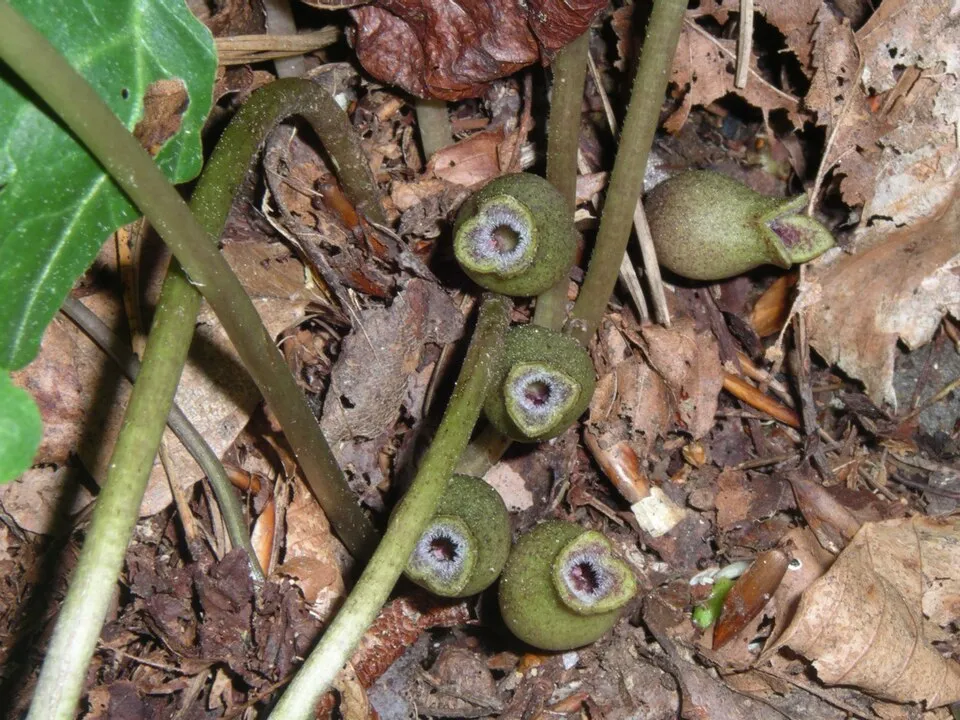
If you want to see the flowers, you have to look for them — literally on hands and knees, parting the leaf litter at the base of the plant in March and April. The flowers are solitary, borne on very short peduncles at ground level, and they are cryptic in the extreme: brown to purplish-brown, leathery, and shaped like a small jug, urn, or bell, typically ¾–1½ in long and ½–¾ in wide. The flower has three triangular, spreading to reflexed lobes at the opening, which is otherwise constricted (the "neck" of the jug). Inside, the flower is lined with a glossy, somewhat sticky surface. The color, the odor (faintly fungal or yeasty), and the ground-level, litter-concealed position all serve the same purpose: to attract fungus gnats that crawl into the flower seeking a mushroom to lay eggs on, get temporarily trapped, and effect pollination before escaping.
Heartleaf grows from a short, creeping rhizome that runs at or just below the soil surface, branching occasionally to produce new rosettes of leaves. The growth rate is slow to moderate — a mature colony a foot across may represent 5–10 years of growth. The rhizome is slender (about the diameter of a pencil), aromatic when crushed (the scent is described as spicy, reminiscent of ginger or sassafras), and covered with the remnants of old leaf bases. This growth habit is very similar to the closely related Asarum (wild ginger) species, and the two genera are often confused. The key vegetative distinction: Hexastylis species have evergreen, leathery leaves with silver venation, while most Asarum species have deciduous, softer, uniformly green leaves.
Hexastylis arifolia and the wild gingers (Asarum canadense, A. caudatum) are closely related members of the Aristolochiaceae and share the same ecological niche as low, shade-loving woodland groundcovers. The main distinctions: Leaves — Heartleaf: evergreen, leathery, prominently silver-veined; Wild ginger: deciduous, thinner-textured, uniformly green (occasionally faintly mottled). Flowers — Heartleaf: jug-shaped, brown, with three spreading triangular lobes, odor faintly fungal; Wild ginger: cup-shaped, reddish-brown to maroon, with three long, pointed, spreading lobes, odor more distinctly fungal or carrion-like. Range — Heartleaf occurs in the southeastern US and reaches NW Oklahoma at the edge of its range; Wild ginger (A. canadense) is more cold-hardy and extends much farther north into Canada, with a broader presence in NE Oklahoma. Both species can coexist in the same garden and complement each other's textures beautifully.
Hexastylis arifolia is a species of the southeastern US that reaches the northwestern limit of its range in Oklahoma. It is most reliably found in the acidic, sandy to loamy soils of oak-hickory-pine forests across southeastern Oklahoma — the Ouachita Mountain foothills, the Kiamichi River drainage, and the pine-oak uplands of McCurtain, Pushmataha, and Le Flore counties. From there, the species follows suitable habitat westward along the southern margin of the Cross Timbers, where pockets of acidic, sandstone-derived soils beneath post oak and blackjack oak support small populations as far west as Atoka and Coal counties.
In the Tulsa region, Heartleaf is not a common wild plant — the calcareous, clay-rich soils that dominate the area are not its preferred substrate. However, it is perfectly cultivable in a prepared woodland garden bed with amended, acidified soil, and it will thrive where the gardener has taken the time to recreate the loose, humus-rich, well-drained conditions of its native habitat. The plant's association with acid substrates means it is a natural companion to blueberries, azaleas, and other ericaceous plants that demand low pH. In the wild, Heartleaf is often found growing beneath shortleaf pine (Pinus echinata), loblolly pine, and various oaks, where the accumulated pine needle and oak leaf litter maintains the acidic soil chemistry and the loose, well-aerated surface duff that the shallow rhizomes prefer.
[ fungus-gnat pollination · ant-mediated seed dispersal · evergreen cover · myrmecochory ]
The pollination biology of Hexastylis is a textbook example of brood-site deception. The flowers are positioned at ground level beneath leaf litter, where they emit a cocktail of volatile compounds that mimic the odor of decaying fungal tissue — the preferred oviposition (egg-laying) substrate of fungus gnats (Mycetophilidae and Sciaridae). Female gnats, searching for a mushroom on which to lay their eggs, enter the flower through the constricted opening. Inside, the glossy, slippery walls and downward-pointing hairs make exit difficult, and the trapped insect thrashes about, inadvertently transferring pollen from previous flowers and picking up fresh pollen from the current flower before eventually managing to escape. Ants are also documented as secondary pollinators, entering the flowers to forage on the small amounts of nectar secreted at the base of the floral tube and carrying pollen between clonal patches. This ground-level, litter-concealed pollination system is one of the more specialized and fascinating in the eastern North American flora.
Like many woodland spring-flowering plants (trilliums, bloodroot, violets, wild ginger), Heartleaf seeds are dispersed by ants (myrmecochory). Each seed bears a small, fleshy, oil-rich appendage called an elaiosome that is highly attractive to ants. Ants carry the seeds back to their nests, consume the elaiosome, and discard the intact seed in the nutrient-rich refuse pile of the colony, where it germinates. This dispersal mechanism explains the plant's tendency to form dense, discrete colonies — the seeds are moved only as far as the ant foraging territory (typically a few meters), and the discarded seeds are concentrated in favorable germination microsites. In Oklahoma, several ant species in the genus Aphaenogaster (the "woodland ants") are the primary dispersers.
Heartleaf's contribution to vertebrate wildlife is modest. The evergreen foliage provides winter cover for small arthropods, which in turn are foraged by wintering birds (Carolina wrens, brown creepers, and winter wrens probe the leaf litter for the insects that shelter beneath the Heartleaf rosettes). White-tailed deer browse is generally light; the leathery, aromatic foliage is not preferred forage, and the plant's low stature places it below the most convenient browsing height. In the deep southeastern part of its range (Georgia, Alabama, Florida), the seeds are occasionally consumed by wild turkey and bobwhite quail, which eat them as part of the general litter-seed diet.
In the deciduous forests of the South, the evergreen foliage of Hexastylis fills a critical seasonal niche: it is one of the very few herbaceous plants that photosynthesizes through the winter in the leafless deciduous forest. From late November through late March, while hardwood trees are dormant and most herbs have retreated to underground storage organs, Heartleaf's glossy green leaves are capturing sunlight and storing carbohydrates. This winter photosynthesis gives the plant a competitive advantage in the race to flower and set seed before the canopy closes, and it contributes to the year-round nutrient cycling in the forest-floor community. The dense mat of leaves also helps to suppress winter annual weeds and reduce soil erosion on sloping woodland sites.
[ woodland garden · soil pH · establishing colonies · companion planting · container culture ]
Heartleaf is a plant for the deep shade of mature deciduous trees, and in the Tulsa region, the primary challenge is replicating its preferred acidic, humus-rich soil. The heavy, alkaline-to-neutral red clay that is the default garden soil in much of the region is not suitable without significant amendment. The preparation:
Once established, Heartleaf is a low-maintenance, long-lived groundcover that asks little of the gardener beyond an annual refresh of the leaf-litter mulch layer. Do not rake leaves off the planting in fall — the natural leaf drop from the canopy trees is the plant's preferred mulch and nutrient source. The evergreen foliage will accumulate some cosmetic blemishes (leaf spot, minor insect damage) over the winter, but these are generally not serious. The biggest threat in a Tulsa garden is alkaline irrigation water — municipal water in the region tends to be mildly alkaline, and over years of watering, the soil pH in an irrigated bed can drift upward. An annual soil pH test and occasional application of elemental sulfur or iron sulfate can correct this. Alternatively, collected rainwater (which is naturally acidic in this region) is an excellent irrigation source for the woodland garden.
Heartleaf pairs beautifully with other acid-loving woodland plants, and as a low groundcover it serves as a living mulch beneath taller perennials and shrubs. Excellent companions include: wild ginger (Asarum canadense) for a textural counterpoint — the glossy, silver- veined Heartleaf against the dull, uniformly green wild ginger leaves — maidenhair fern (Adiantum pedatum) for delicate, vertical foliage rising above the leaf mat, Christmas fern (Polystichum acrostichoides) for winter structural contrast, spicebush (Lindera benzoin) as a shrub canopy that provides dappled shade and drops the rich leaf litter the fern loves, and underplanted beneath downy serviceberry (Amelanchier arborea), eastern redbud (Cercis canadensis), and black hickory (Carya texana), which provide the high, filtered canopy and the acidic leaf litter that Heartleaf requires. For spring ephemeral companions, the plant pairs well with bloodroot and mayapple, which emerge, bloom, and senesce before the Heartleaf expands its new spring foliage.
Like its cousin wild ginger (Asarum canadense), the rhizome of Hexastylis arifolia is aromatic and has a spicy, ginger-like scent when crushed. In the folk medicine of the rural Southeast, the rhizome was used as a mild carminative (digestive aid) and for chest colds, steeped as a tea or chewed fresh. However, the plant should not be used as a wild ginger substitute in cooking or medicine without expert guidance: members of the Aristolochiaceae contain aristolochic acid, a compound that is nephrotoxic (damaging to the kidneys) and carcinogenic with sustained consumption. Traditional use typically involved small, infrequent doses, but modern medical understanding cautions against any internal consumption of plants in this family.
The Cherokee name for the plant translates roughly to "little jug," a reference to the flower shape, and the plant was used externally as a poultice for skin sores and minor wounds. The ground rhizome was also applied to the temples as a headache remedy. Much of the Cherokee ethnobotanical knowledge associated with Hexastylis and Asarum species was carried into eastern Oklahoma during the Trail of Tears and persists in the traditional plant knowledge of the Cherokee Nation today. Gardeners who are interested in the ethnobotanical context of this plant should recognize that its primary value in the 21st century garden is ornamental and ecological, not culinary or medicinal.
Hero photo: Rooted Revival. Strip photos courtesy of Wikimedia Commons contributors under their respective licenses (linked under each image).