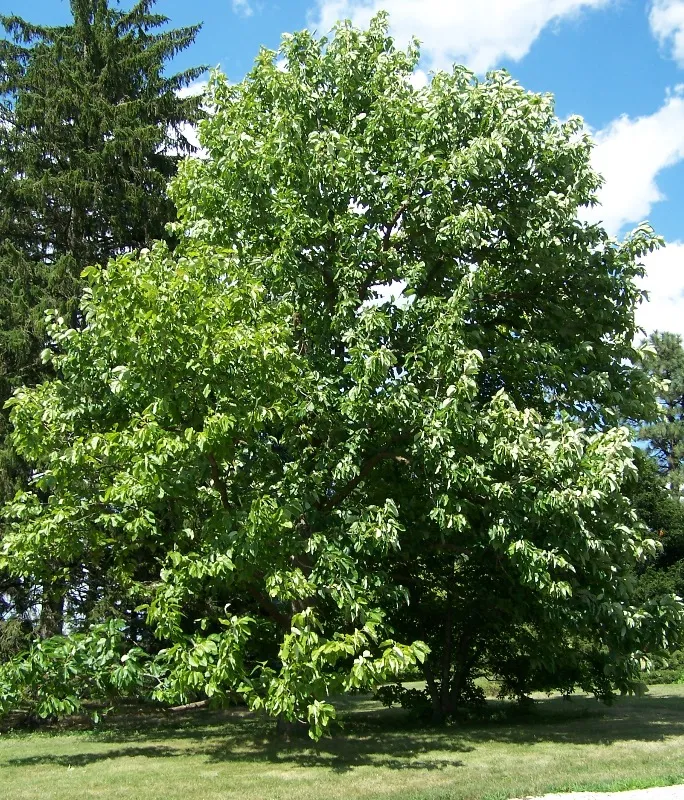
// SPECIES PROFILE · TREE · NATIVE · OZARK FOOTHILLS
The Cucumber Tree is the largest native magnolia north of Mexico — a straight-trunked hardwood that can reach 80 ft in the rich coves of the southern Appalachians and, more modestly, 50–60 ft in the Ozark foothills of eastern Oklahoma. It is named for its cone-like aggregate fruit, which when immature bears a strong resemblance to a warty green cucumber. Unlike the showy-flowered southern magnolia (Magnolia grandiflora), the Cucumber Tree's flowers are greenish-yellow, upright, and tulip-shaped, appearing in late spring after the leaves have emerged — understated and easily overlooked unless you know where to look. Magnolia acuminata is one of the most cold-hardy magnolias in existence, and its natural range arcs from the Appalachians through the Ohio Valley and into the Ozark highlands, with outlying populations in the richer woods of far eastern Oklahoma. In our region, it is an uncommon tree of moist, sheltered coves and north-facing slopes, where it grows alongside Sugar Maple, Northern Red Oak, and Bur Oak. For the Tulsa gardener, the Cucumber Tree offers a towering, straight-form native magnolia with clean large leaves, an unusual fruit, and yellow fall color — a genuine conversation piece and a link to the ancient magnolia lineage that has persisted since the Cretaceous.

[ field key — leaf · flower · fruit · bark · bud · habit ]
A large deciduous tree with a tall, straight, single trunk and a pyramidal crown that becomes more spreading and irregular with age. In the Appalachians, trees to 100 ft are known; in Oklahoma, 50–70 ft is typical. The bark is a useful winter ID feature: on young trees it is smooth and brownish-gray; on mature trunks it develops narrow, scaly ridges separated by shallow fissures, and the bark plates are notably flaky and loose. Twigs are stout, reddish-brown, and aromatic when scraped. The large, silky terminal buds are another magnolia hallmark — pointed, pale green to tan, and covered with soft, silvery hairs.
Alternate, simple, deciduous, 5–10 in long and 3–6 in wide — the largest leaves of any native deciduous tree in our region after pawpaw and catalpa. The blade is broadly elliptic to ovate, with an entire (untoothed) margin, an abruptly pointed tip, and a rounded to slightly heart-shaped base. The upper surface is bright green and smooth; the underside is paler and softly hairy. Leaves turn a consistent soft yellow in fall. Crushed leaves have a mild, pleasant, spicy-resinous scent characteristic of the magnolia family.
Flowers appear after the leaves have expanded in late spring (May to early June in the Ozark foothills), a timing that distinguishes Cucumber Tree from many magnolias that flower on bare branches. The flowers are upright and tulip-shaped, 2–3 in long, with 6–9 greenish-yellow tepals (petals and sepals that look alike). They are less showy than the classic magnolia blossom — the color blends with emerging foliage, and the flowers are often borne high in the crown where they are not easily seen from the ground. The scent is mild and cucumber-like. Like most magnolias, the flowers are beetle-pollinated — an ancient pollination system that predates the evolution of bees by tens of millions of years.
The name "Cucumber Tree" comes from the fruit: an aggregate of follicles (individual seed-bearing chambers) arranged in an elongated, cone-like structure 2–3 in long. When young and green, it looks remarkably like a small, warty cucumber hanging from the twig. As it matures in late summer, it turns from green to pinkish-red, and the individual follicles split open to reveal bright orange-red seeds that dangle on thin, silken threads (funiculi) before dropping. The seeds are an important wildlife food.
Magnolia acuminata is at the westernmost edge of its range in eastern Oklahoma, where it occurs as disjunct populations in the Ozark foothills and richer woodland coves. In NE Oklahoma it is uncommon and local, found primarily in the deep, moist, sheltered hollows of the Ozark Plateau where cool air drains and soil moisture remains consistent through summer. These are sites with deep, rich, slightly acidic woodland soils — typically north-facing slopes and stream headwaters in the Spavinaw Hills and upper Grand River watershed. The Cucumber Tree is absent from the drier Cross Timbers uplands and from floodplain sites with heavy clay.
Across its broader range, M. acuminata is a component of the mixed mesophytic forest, growing alongside maples, beech, basswood, yellow poplar, and northern red oak. It is one of the most cold-hardy magnolias, thriving in USDA zones 3–8, and has been used extensively in magnolia hybridization programs to impart cold tolerance to showier-flowered cultivars (notably the yellow-flowered 'Butterflies' and 'Elizabeth' hybrids, which are M. acuminata crosses).
[ beetle pollination · seed dispersal · Lepidoptera host · ancient lineage ]
Magnolias are among the most ancient flowering plant lineages on Earth, with a fossil record extending to the early Cretaceous (~100 million years ago). Their flowers predate the evolution of bees. Instead, magnolias are adapted for beetle pollination (cantharophily): the flowers produce a mild odor, the tepals are tough enough to withstand beetle chewing, and the numerous stamens and pistils provide abundant pollen and reward. The primary pollinators are sap beetles (Nitidulidae) and rove beetles (Staphylinidae), with occasional visits from flower longhorn beetles and early-season bees. This is pollination as it worked before bees rewrote the rules.
The bright orange-red seeds are suspended on thin, silken threads from the splitting follicles, presenting a conspicuous "eat me" signal to birds. Documented seed dispersers include eastern towhee, wild turkey, gray catbird, brown thrasher, and several woodpeckers. Eastern chipmunks and gray squirrels also gather fallen seeds. The seeds are high in fat and protein and provide late-summer energy for pre-migration fattening and winter caching.
As a magnolia, M. acuminata is the larval host for the sweetbay silkmoth (Callosamia securifera) and the tulip-tree silkmoth (Callosamia angulifera), both large, showy Saturniidae. The magnolia scale (Neolecanium cornuparvum) is a common insect associate; while unattractive on ornamentals, the honeydew it produces is harvested by ants and wasps. Overall, magnolias support fewer Lepidoptera species than oaks or cherries, but their unique chemistry adds valuable diversity to the woodland insect community.
At the western edge of its range, the Cucumber Tree occupies a narrow ecological niche in cool, moist coves — sites that serve as microclimatic refugia for a suite of mesophytic species that are more common in the Appalachians and Ozarks. The presence of Cucumber Tree in an eastern Oklahoma woodland signals a site with deep soil, reliable moisture, and a microclimate buffered from the extremes of the prairie to the west. As our climate warms, these cove refugia may become increasingly important for the persistence of mesic forest species at the edges of their ranges.
[ site selection · moisture · pH · companion design ]
The Cucumber Tree needs a cool, moist, sheltered location in the Tulsa climate — it cannot handle the full force of an Oklahoma summer on a dry, exposed south-facing slope. Select a site on the north or east side of a building or larger tree, or in a low draw where cool air and moisture accumulate. The soil should be deep, rich, well-drained, and slightly acidic (pH 5.5–6.8). Heavy clay should be amended with composted leaf mold and pine bark to improve drainage and organic matter. This is a large tree at maturity; allow at least 25–30 ft of space.
In a woodland garden setting, Cucumber Tree pairs beautifully with other mesic-site natives: Sugar Maple, Northern Red Oak, and Shagbark Hickory in the canopy. The mid-story can include Pawpaw, Spicebush, and Red Buckeye. For the ground plane, Maidenhair Fern, Solomon's Seal, Mayapple, Wild Ginger, and spring ephemerals like Virginia Bluebells thrive in the dappled shade and rich leaf litter beneath a magnolia.
The Cucumber Tree has limited direct edible use for humans. The green fruits are inedible and unpalatable. The wood is light, soft, and close-grained, similar to yellow-poplar (Liriodendron tulipifera), and has been used for millwork, furniture, crates, and pulp. It is not an economically important timber species, but in the landscape it is valued for its unique appearance and cold-hardiness.
The Cucumber Tree's greatest contribution has been in ornamental magnolia breeding. Its extreme cold tolerance and yellow flower pigmentation have been used to create some of the most celebrated hybrid magnolias in the nursery trade, including 'Elizabeth' (creamy yellow), 'Butterflies' (rich yellow, fragrant), and 'Yellow Bird' — all crosses of M. acuminata with Asian magnolia species. These hybrids bring yellow magnolia flowers to gardens across USDA zones 4–7, far beyond the range of any naturally yellow-flowered magnolia.
For the ecological gardener in NE Oklahoma, the Cucumber Tree offers something rarer than showy flowers: a direct connection to the ancient magnolia lineage, a tree that has persisted since the time of the dinosaurs, and a towering native with clean, handsome foliage that asks only for a cool, moist spot and room to grow.
Hero photo: Rooted Revival. Strip photos courtesy of Wikimedia Commons contributors under their respective licenses (linked under each image).