// SPECIES PROFILE · SHRUB/TREE · NATIVE · WOODLAND UNDERSTORY
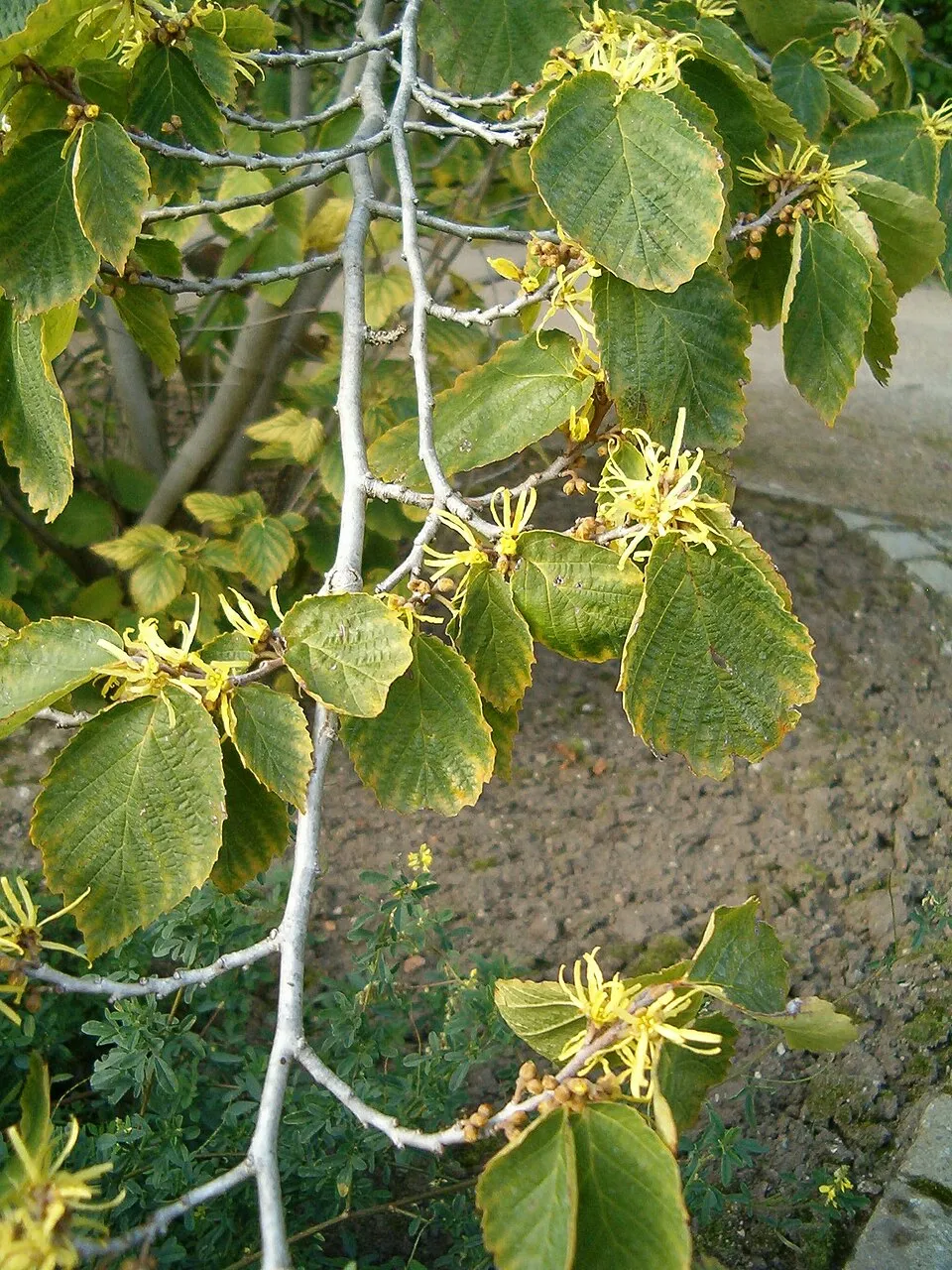
American Witch Hazel is the last native woody plant to bloom in the eastern deciduous forest — a large shrub or small tree whose spidery, fragrant, yellow flowers appear in late October and November, long after every other tree has shed its leaves and gone dormant. The four strappy, crinkled petals unfurl on crisp autumn days when few insects are flying, and yet the plant is reliably pollinated by owlet moths (Noctuidae) that remain active on mild late-fall nights. Hamamelis virginiana is a plant of quiet, layered virtues: the wavy-edged, hazel-like leaves turn a clear golden-yellow in fall, often while the flowers are opening on the same branches; the woody seed capsules ripen the following year and explosively eject two shiny black seeds up to 30 feet; and the bark and leaves are the source of one of the most enduring herbal remedies in North America — witch hazel astringent. In NE Oklahoma, you will find it in the moist, rocky woods and shaded stream banks of the Ozark foothills, growing as a multi-stemmed understory shrub beneath oaks and hickories. For the gardener, it is a plant of subtle, off-season interest: a quiet, golden presence in the autumn woods that blooms when nearly everything else is finished.

[ field key — leaf · flower · fruit · bark · habit ]
Usually a multi-stemmed large shrub or sometimes a small tree with a crooked, irregular trunk, reaching 10–20 ft in NE Oklahoma. The crown is open and spreading, often wider than tall in open-grown specimens. The bark is smooth and light brown to gray on young stems, becoming slightly scaly with age. The overall habit is graceful and irregular — never formal, always naturalistic. In the wild, it grows as an understory plant beneath taller hardwoods.
Alternate, simple, deciduous, 3–6 in long, broadly oval to obovate with a wavy, coarsely toothed margin that gives the leaf a distinctive, undulating appearance. The base is strongly asymmetrical (oblique) — a trait shared with elms and hackberries. The upper surface is medium green, smooth; the underside is paler. The straight, parallel lateral veins are prominent and extend to the teeth. Fall color is a consistent, clear golden-yellow, one of the best autumn displays among understory shrubs. Leaves emerge relatively late in spring.
The bloom of American Witch Hazel is one of the strangest and most wonderful sights in the eastern woodland year. Flowers appear in clusters of 3 in the leaf axils, each with four narrow, crinkled, ribbon-like yellow petals about 3⁄4 in long that curl and twist like lemon-yellow confetti. The flowers are fragrant — a spicy, clean scent that carries on cool autumn air. They open in October–November alongside or after the golden fall leaves, frequently persisting well into December. Pollination is by owlet moths and other late-season flying insects that remain active on mild late-fall days and nights. The flowers can also self-pollinate if insect visits fail.
The fruit is a woody, two-beaked capsule that matures over a full year, ripening in the fall simultaneously with the next year's flowers — you can see flowers and last year's ripening capsules on the same branch. When mature, the capsule dries and splits, building internal pressure until the two glossy black seeds are ballistically ejected with an audible pop, launching them 10–30 ft from the parent plant. This explosive dehiscence is one of the most dramatic seed dispersal mechanisms in the temperate flora. Look for the empty split capsules on winter twigs; they persist like tiny wooden bird beaks.
Hamamelis virginiana reaches the southwestern edge of its range in eastern Oklahoma, occurring in the Ozark foothills and adjacent mesic woodlands. In our region, it is a plant of moist, rocky, north-facing slopes, shaded stream banks, and rich woodland coves — sites with consistent soil moisture, good drainage, and partial shade. It grows alongside Spicebush, Eastern Hophornbeam, and Downy Serviceberry in the understory of oak–hickory woodlands, often on soils derived from sandstone or chert that hold moisture without waterlogging.
Witch Hazel is intolerant of prolonged drought and of full, baking sun in the Tulsa summer. In a garden setting, site it where it receives morning sun or dappled light and afternoon shade — the north or east side of a building or larger tree is ideal. It is broadly adaptable to soil types as long as the soil is well-drained and retains consistent moisture.
[ moth pollination · seed dispersal · browse resistance · late-season niche ]
American Witch Hazel occupies a nearly unique pollination niche among temperate woody plants: it blooms in late October and November when almost no other flowering plants are active. The primary pollinators are owlet moths (Noctuidae) that forage on mild autumn nights, their activity triggered by temperatures above 50°F. These moths are attracted to the pale yellow flowers' fragrance and UV-reflective petals. During warm spells in November, you may also see late-season honey bees and syrphid flies visiting the flowers. This late-fall bloom provides a critical nectar resource for the few insects still foraging, closing the year's pollination calendar.
The ballistically ejected seeds are sought by ruffed grouse, wild turkey, northern bobwhite, and various small mammals. Gray squirrels will chew open the capsules before they eject in an attempt to reach the seeds. The foliage is moderately deer-resistant; deer will browse young twigs in winter when other forage is scarce, but witch hazel is not a preferred browse species. The dense, multi-stemmed habit provides good cover for ground-nesting birds and small mammals.
[ site selection · moisture · pruning · companion design ]
In the Tulsa climate, American Witch Hazel needs partial shade, particularly afternoon shade, and consistent soil moisture. The north or east side of a house, under the high shade of mature oaks, or along a shaded stream or pond margin are all suitable positions. Soil should be well-drained, slightly acidic (pH 5.5–6.8), and rich in organic matter. This plant will not tolerate heavy, poorly drained clay or extended drought.
In a woodland garden, plant American Witch Hazel with Spicebush, Red Buckeye, Wild Ginger, Maidenhair Fern, Woodland Phlox, Solomon's Seal, and Christmas Fern. The golden fall foliage of witch hazel pairs beautifully with the reds and purples of Smooth Sumac and Fragrant Sumac.
The medicinal use of witch hazel is one of the oldest and most enduring herbal traditions in North America. Indigenous peoples of the Eastern Woodlands, including the Cherokee, Iroquois, and Menominee, used a decoction of the bark and twigs as an astringent wash for wounds, sores, bruises, skin inflammations, and eye irritations. The inner bark was also used as a tea for internal bleeding, colds, and fevers. European colonists adopted these practices, and "witch hazel water" became one of the first widely commercialized herbal remedies in the United States in the mid-19th century. It remains one of the few botanical drugs approved by the FDA as an over-the-counter astringent ingredient, and witch hazel distillate is still a common component of skincare products (toners, aftershaves, hemorrhoid treatments, and first-aid sprays).
The name "witch hazel" derives from the Old English wice (pliant or bendable), referring to the supple branches; it has no connection to witchcraft. The forked branches were historically used as dowsing rods ("water-witching") to locate underground water — a folk practice that persists in some rural communities to this day. The plant's habit of blooming at the very end of the growing season, when all else is dormant, has given it a symbolic association with resilience, last things, and the threshold between fall and winter.
Hero photo: Rooted Revival. Strip photos courtesy of Wikimedia Commons contributors under their respective licenses (linked under each image).