home/ plants/ false-solomons-seal

// SPECIES PROFILE · PERENNIAL · NATIVE · WOODLAND

False Solomon's Seal

Maianthemum racemosum

False Solomon's Seal is the elegant, arching lily of the rich eastern deciduous forest understory — a plant that defines the floor of mature oak-hickory woods in the Ozark foothills of northeastern Oklahoma from mid-spring through fall. The common name is a classic case of botanical confusion: Maianthemum racemosum looks superficially like true Solomon's seal (Polygonatum biflorum) when both are in leaf, but the inflorescence tells the whole story at a glance. Instead of discrete pairs of pendulous bells dangling beneath the stem, False Solomon's Seal produces a terminal plume of dozens of tiny, creamy-white, star-shaped flowers — hence the better vernacular names "Solomon's Plume" and "False Spikenard." By late summer the flower cluster transforms into a handsome spray of ruby-red speckled berries that persist into early autumn and feed a host of woodland birds.

// QUICK FACTS
Family
Asparagaceae (asparagus family), formerly placed in Liliaceae and Ruscaceae
Life cycle
Herbaceous perennial
Native range
Eastern and central North America — Nova Scotia to Florida, west to E. Oklahoma, Nebraska, and Arizona
USDA hardiness
Zones 3–8 (Tulsa = 7a/7b)
Mature size
18–36 in tall, 18–24 in wide; clumps slowly expand via rhizome
Bloom
Late April – early June (NE OK)
Flower
Terminal panicle 2–5 in long with 20–80 tiny white flowers
Fruit
Clusters of ruby-red speckled berries ripening August–September
Sun
Part shade to full shade; tolerates dappled morning sun
Soil
Rich, moist, well-drained woods soil; pH 5.5–7.0; leaf-mold preferred
Water
Medium; consistent moisture through growing season
Wildlife
Berries eaten by grouse, thrushes, and woodland songbirds; flowers visited by small bees and flies
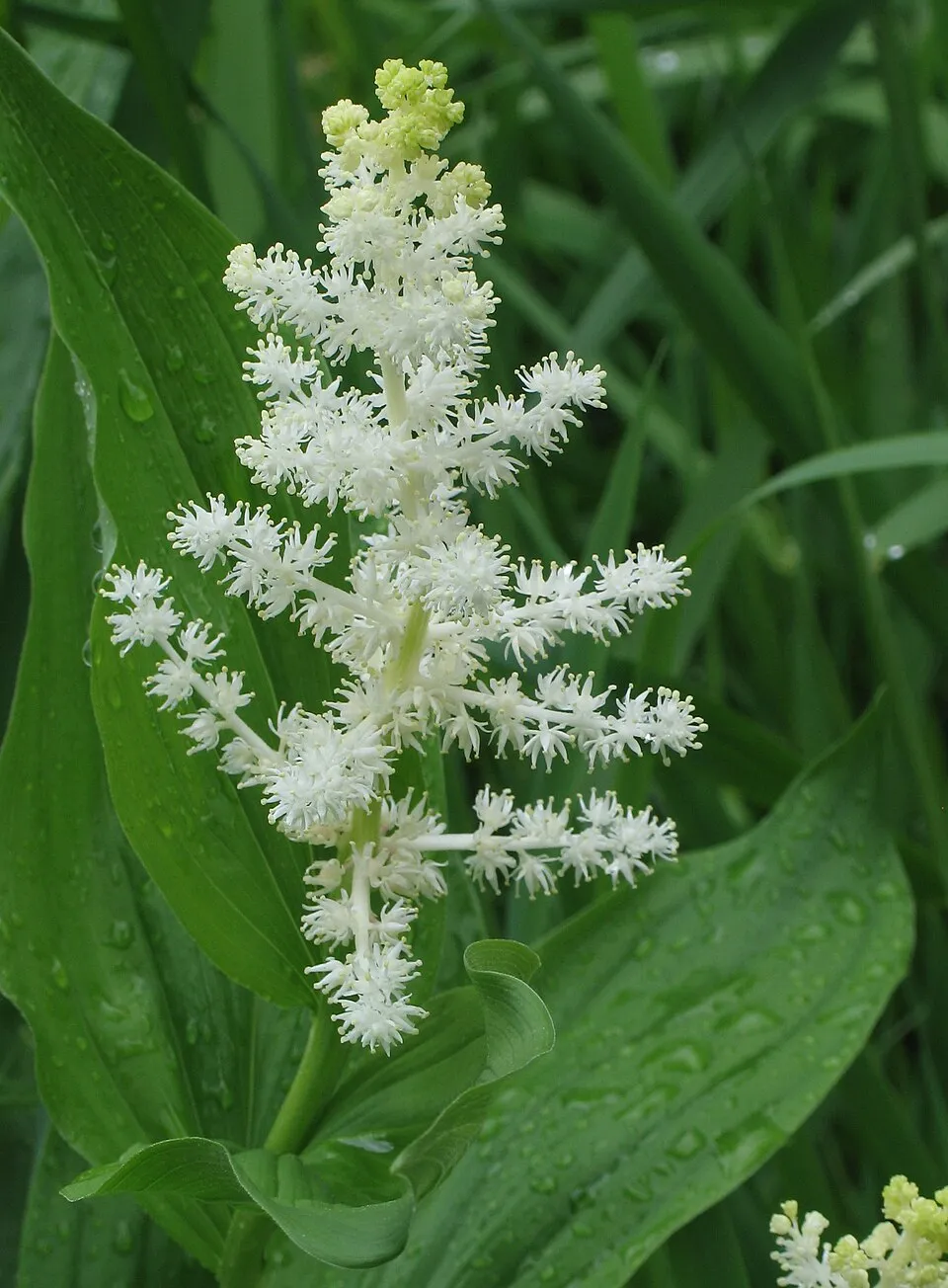
False Solomon's Seal (Maianthemum racemosum) with terminal plume of creamy-white flowers above arching leaves
Maianthemum racemosum in bloom — the terminal flower plume distinguishes it immediately from true Solomon's seal. Photo: Rooted Revival.

Identification

[ field key — stem · leaf · inflorescence · fruit · distinguishing from Polygonatum ]

Habit & Stem

Arching, unbranched perennial, 18–36 in tall, with a characteristic zigzag stem that bends gracefully under the weight of foliage and flowers. The stem is smooth (not hairy) and arises singly or in small clumps from a creeping, knobby rhizome. Each year's growth emerges as a tightly furled spear that unfurls into the characteristic arching form; the stem stiffens through the season and persists into early winter as a tan stalk.

Leaves

Alternate, sessile (no petiole) or nearly so, 4–8 in long, broadly elliptical to ovate-lanceolate with conspicuous parallel veins running the length of the blade. The leaves clasp or sheath the stem at the base, and the lower surface is typically finely hairy (pubescent). The foliage is a clean medium green through summer, turning clear yellow in autumn — one of the better fall-color contributions in a woodland ground layer.

Inflorescence & Flower

The terminal panicle (raceme-like cluster) is the diagnostic feature: a dense, pyramidal plume 2–5 in long at the tip of the arching stem, carrying 20 to 80 tiny flowers. Each flower is about ¼ in across, with six creamy-white tepals (not true petals) and prominent stamens that give the cluster a feathery, frothy appearance. Flowers open from the bottom of the panicle upward over a 2–3 week window. The fragrance is faint but sweet — something like clover honey — and becomes noticeable on warm afternoons in a still woodland.

Fruit & Distinction from Polygonatum

By late summer each flower gives way to a round, green berry that ripens through August into a translucent ruby-red fruit heavily speckled with purple dots. The berries are edible (see Uses section) but mildly laxative in quantity. The simplest field mark separating Maianthemum from Polygonatum: False Solomon's Seal carries its flowers and fruit in a terminal cluster at the very tip of the stem, while true Solomon's seal has paired pendulous flowers hanging from each leaf axil along the underside of the stem. In fruit the difference is even more obvious — the dangling blue-black berries of Polygonatum versus the upright red plume of Maianthemum.

Habitat & Range in NE Oklahoma

Maianthemum racemosum is a species of rich, mature deciduous forests across eastern North America, reaching the southwestern edge of its continuous range as it follows the Ozark uplift into northeastern Oklahoma. Here it is most reliably encountered in the deep-shade understory of oak-hickory and oak-sugar maple woods of the Ozark foothills in Adair, Cherokee, Delaware, and eastern Mayes counties. Look for it on north-facing slopes, cool ravines, and shaded creek benches where deep leaf litter has built up over decades — the kind of woodland floor that stays moist well into June and smells of humus after a rain.

The species is less common in the drier, rockier Cross Timbers post-oak woods that characterize most of the Tulsa region, but it will establish and persist in a heavily shaded, irrigated garden setting with amended soil. In the wild, the best populations in Oklahoma are associated with the Illinois River valley and the drainages of the Baron Fork and Flint Creek, where the microclimate retains the humid, sheltered character of the Missouri Ozarks. At the very edge of its range in central Oklahoma, it becomes increasingly rare and restricted to the deepest, coolest coves.

Ecology & Wildlife Value

[ berries · pollinators · Lepidoptera · woodland-floor architecture ]

Pollinators

The small, open, fragrant flowers attract a modest but ecologically important suite of small bees, syrphid flies (flower flies), and beetles. Unlike sun-loving prairie composites, this is not a plant that draws charismatic bumblebees or butterflies en masse — it works in the subtle economy of the forest floor. Small halictid bees (sweat bees) and andrenid mining bees are the primary pollen vectors. The fragrance peaks in warm afternoon air and draws pollinators from surprising distances in otherwise still woods.

Lepidoptera & Herbivory

Maianthemum foliage is eaten by the larvae of several moths, including the intractable quaker moth (Kocakina fidelis) and at least two species of slug moths (Limacodidae). The young unfolding leaves in spring are browsed moderately by white-tailed deer, though the plants are not a preferred forage — a colony in a mixed understory will usually suffer less deer pressure than neighboring trilliums or mayapples. Rabbits occasionally nip young shoots.

Birds & Mammals

The bright red, speckled berries are an important late-summer and early-fall food source for woodland birds. Ruffed grouse (in the Ozark portion of their range), wild turkey, wood thrushes, American robins, and brown thrashers all take the fruit. Small mammals including eastern chipmunks and white-footed mice also consume and cache the berries, contributing to seed dispersal. The berries contain saponins and should not be eaten in quantity by humans, but birds metabolize them without issue.

Ecological Role in the Woodland Floor

False Solomon's Seal is a mid-layer structural plant in the eastern deciduous forest understory — it occupies the niche between ground- hugging ephemerals (bloodroot, spring beauty) and the shrub layer (spicebush, witch-hazel). Its arching form and broad overlapping leaves intercept light that would otherwise hit the ground, helping to suppress invasive species like Japanese stiltgrass when the colony is dense. The thick rhizome network contributes to soil stabilization on slopes, especially along wooded creek banks where spring runoff erodes unprotected soil. In late autumn the senescing foliage adds a pulse of rich, fast-decomposing leaf litter to the forest floor.

Horticulture & Care

[ shade garden · soil prep · planting · companion design ]

Site selection & planting

Choose a location that mimics the plant's native habitat: dappled to full shade beneath deciduous trees, ideally on the east or north side of a building or large canopy tree. Morning sun is tolerated; hot western afternoon sun will scorch the foliage and stunt growth. The ideal soil is rich, woodsy loam with abundant organic matter — think decades of decomposed leaf litter. In Tulsa-area gardens, the default red clay needs amendment: work in 3–4 in of composted leaf mold, shredded hardwood mulch, or well-rotted compost to a depth of 12 in before planting. Plant container-grown specimens or bare-root rhizomes in early spring (March–April) or in fall (October–November) after the foliage has yellowed and gone dormant.

Ongoing care

This is a low-maintenance perennial once sited correctly. The primary chore is maintaining leaf litter or coarse hardwood mulch over the root zone — this suppresses weeds (the rhizomes run shallow and do not compete well with turfgrass or aggressive ground ivy) and replicates the natural nutrient cycling of a forest floor. Do not rake leaves off the planting in fall; let them decompose in place. A light top-dressing of compost each spring at the first sign of new shoots is all the fertility the plants need. If deer pressure is high in your area, a physical barrier or repellent may be necessary on new shoots, but established colonies typically outgrow moderate browsing.

Companion planting in the woodland garden

False Solomon's Seal pairs naturally with the full suite of eastern woodland perennials that share its habitat. Excellent companions include: true Solomon's seal (Polygonatum biflorum) for textural contrast and continuous bloom, wild ginger (Asarum canadense) for a glossy evergreen ground layer beneath the arching stems, maidenhair fern (Adiantum pedatum) for exquisite foliage contrast, and wild columbine (Aquilegia canadensis) for a splash of red in the dappled-spring light. Under high-canopy trees such as American hornbeam (Carpinus caroliniana) and sugar maple (Acer saccharum), a sweep of False Solomon's Seal interplanted with bloodroot (Sanguinaria canadensis) and mayapple (Podophyllum peltatum) creates a layered woodland floor that is rich, varied, and ecologically legible across the entire growing season. For a more diverse spring display, add the ephemerals Dutchman's Breeches and Cut-leaved Toothwort.

Edible & Cultural Uses

The young, unfurled shoots of Maianthemum racemosum can be harvested in early spring (when 4–8 in tall and still tightly coiled), cooked, and eaten like asparagus — a practice recorded among multiple eastern Indigenous groups. The flavor is mild and slightly sweet. The ripe red berries are edible raw in moderate quantities, with a flavor that has been described as a combination of molasses, raspberry, and treacle (hence the folk name "Treacleberry"). They contain saponins, however, and eating more than a handful at a time can cause gastrointestinal upset — a warning well known to foraging traditions. The berries were more commonly used dried and ground into a meal additive or cooked into a jelly.

In Cherokee ethnobotanical tradition (the Five Civilized Tribes — Cherokee, Chickasaw, Choctaw, Creek, and Seminole — having deep historical presence in what is now eastern Oklahoma), related Maianthemum species were used medicinally. The root was applied as a poultice for skin sores and rheumatism; a decoction was taken as a mild sedative and for coughs. As with many members of the Asparagaceae (and the former Liliaceae), the root contains steroidal saponins that have mild anti-inflammatory properties. The plant appears in the ethnobotanical record of the Iroquois, Ojibwe, and other Woodland peoples across the species' eastern range, frequently as part of women's herbal medicine.

Photo Reference

Maianthemum racemosum terminal flower plume with tiny creamy-white blossoms
// Terminal inflorescence — the diagnostic spray of 50+ tiny white flowers
Wikimedia Commons
Wikimedia Commons
Ripe ruby-red speckled berries of Maianthemum racemosum in late summer
// Mature fruit — speckled red berries, August–September, prized by woodland birds
Wikimedia Commons
Wikimedia Commons
Arching stems of Maianthemum racemosum in full leaf in a shaded woodland understory
// Habit — arching clump in a rich deciduous forest understory
Wikimedia Commons
Wikimedia Commons
Close-up of the parallel-veined, elliptical leaf of Maianthemum racemosum
// Leaf detail — parallel veins, sessile attachment, finely pubescent underside
Wikimedia Commons
Wikimedia Commons

Sources & Further Reading

Hero photo: Rooted Revival. Strip photos courtesy of Wikimedia Commons contributors under their respective licenses (linked under each image).