home/ plants/ toadshade

// SPECIES PROFILE · PERENNIAL · NATIVE · SPRING EPHEMERAL

Toadshade

Trillium sessile

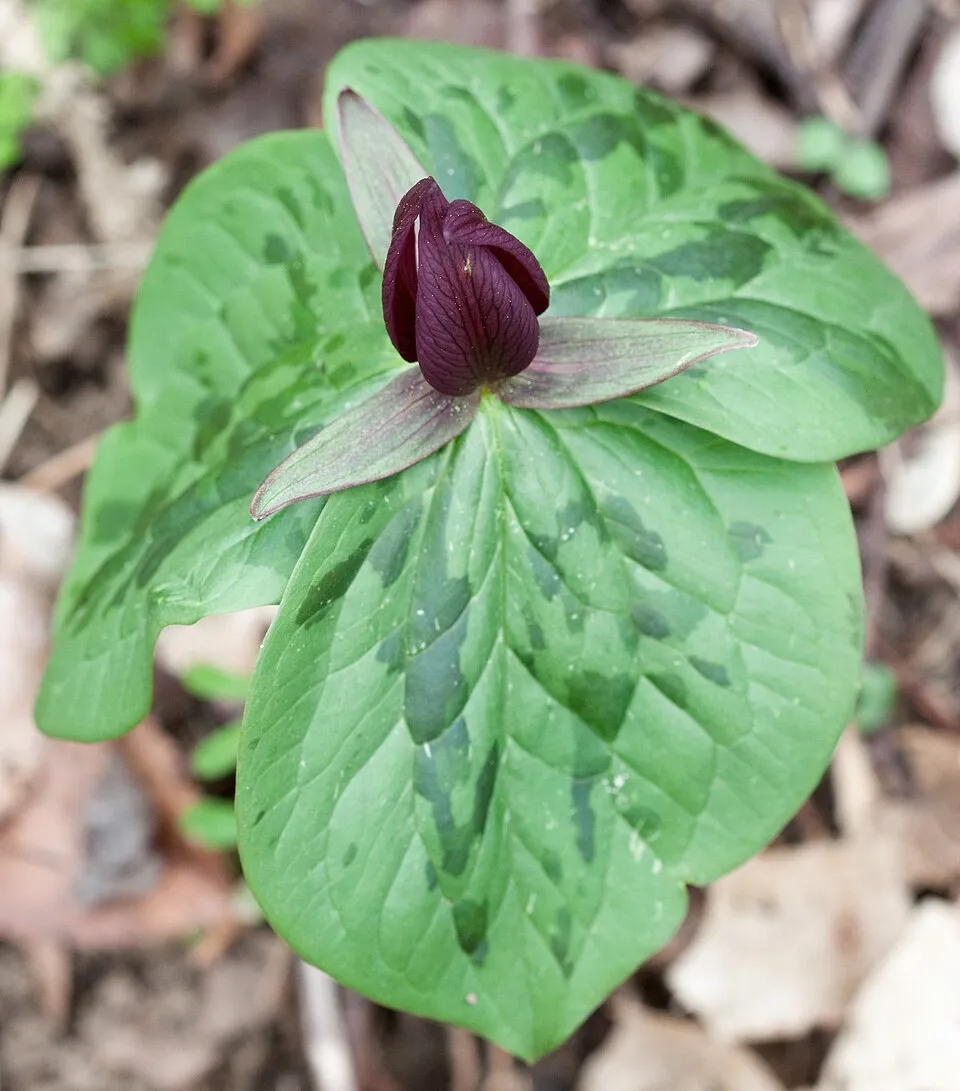
The trilliums are the royalty of the eastern deciduous forest floor, and Toadshade is the one that rewards the gardener who pays attention to small, strange, beautiful things. Trillium sessile is a spring ephemeral — a plant that emerges in March, grows, blooms, sets seed, and vanishes back underground by June, spending more than three-quarters of the year as a dormant rhizome beneath the leaf litter. For the few weeks it is above ground, it is unmistakable: three broadly ovate leaves, mottled in shades of green, silvery-gray, and bronze, sit directly atop the stem without petioles (hence "sessile"), and from the center of the trio rises a single upright, maroon to brownish-purple flower with three narrow, upright petals that never fully open. The flower emits a faint, musty odor reminiscent of decaying meat — an adaptation to attract its primary pollinators, carrion flies and fungus gnats. The common name "Toadshade" evokes the image of a toad sheltering beneath the broad, mottled leaves on a damp spring day, which is as good a description as any of the plant's ecological posture. In NE Oklahoma, T. sessile is found in the rich, moist alluvial soils of floodplain forests along the Arkansas and Illinois rivers and their tributaries, where it blooms in April and is gone by the time the summer heat arrives.

// QUICK FACTS
Family
Melanthiaceae (formerly placed in Liliaceae and Trilliaceae)
Life cycle
Spring ephemeral perennial; emerges March–April, goes dormant by June–July
Native range
Central and eastern US — W. New York to Alabama, west to E. Kansas, E. Oklahoma, and Arkansas
USDA hardiness
Zones 4–8 (Tulsa = 7a/7b)
Mature size
6–15 in tall, 8–12 in wide; slow to establish, long-lived once settled
Bloom
April – early May (NE OK)
Flower
Single, upright, maroon to brownish-purple, 3 narrow petals 1–1½ in long; faint carrion odor
Fruit
Six-angled green berry turning yellowish, then brown-black; contains seeds with elaiosomes for ant dispersal
Sun
Part shade to full shade; requires deciduous canopy with spring sun before leaf-out
Soil
Rich, moist, well-drained, near-neutral woods soil; pH 6.0–7.0
Water
Medium during active growth (March–May); tolerates summer drought during dormancy
Pollination
Carrion flies (Calliphoridae), fungus gnats, and occasionally beetles
Toadshade (Trillium sessile) showing three mottled sessile leaves and an upright maroon flower at the center
Trillium sessile — the mottled leaves and maroon flower of this spring ephemeral appear for only a few weeks before the plant retreats underground. Photo: Rooted Revival.

Identification

[ field key — leaves · flower · fruits · distinction from other Oklahoma trilliums ]

Leaves & Habit

Like all trilliums, Toadshade is a monocot with its parts arranged in threes. A single, smooth, unbranched stem rises 6–15 in from a stout, tuber-like rhizome, topped by a whorl of three leaves. The leaves are sessile (lacking petioles) — they attach directly to the stem at the top, forming a flat to slightly cupped platform. Each leaf is broadly ovate to nearly circular, 2–5 in long, with a pointed tip and smooth margins. The leaf surface is heavily mottled — the base color is a rich green overlaid with irregular patches and splashes of silvery- gray, pale green, and bronze. The degree and pattern of mottling varies significantly between populations and individual plants. This mottling may serve as camouflage (the dappled pattern blends with the shifting light of the forest floor, making the plant less visible to herbivores) or as a light-scattering adaptation that improves photosynthesis in the low-intensity, highly variable light of the early-spring understory.

Flower

The flower sits directly in the center of the three leaves, arising on a very short, erect pedicel (flower stalk). It has the classic trillium "3+3+3" arrangement: three narrow, green to maroon sepals that spread or droop outward, and three narrow, upright to slightly spreading petals that are maroon, brownish-purple, or occasionally greenish-yellow (the yellow form, forma viridiflorum, is rare but known from scattered locations within the species' range). The petals are typically 1–1½ in long and about ¼ in wide, with a somewhat waxy, stiff texture. They never fully open — the flower remains somewhat closed, with the petals held upright or slightly apart, creating a narrow tube around the reproductive parts. The odor is faint but characteristically carrion-like, a musky, slightly sweet- rotting scent that becomes more apparent on warm, still days in mid-April and is designed to attract flies.

Fruit & Seed

After pollination (if successful), the flower develops into a six-angled, green berry-like capsule about ½–¾ in across that sits hidden among the fading leaves. The fruit ripens slowly through late May, turning yellowish to brownish-black as it matures. Each capsule contains numerous small, brown seeds, each equipped with a prominent white, oily elaiosome — a fleshy appendage that is highly attractive to ants. The fruit typically remains attached to the senescing plant until the ants find it, and the seeds are dispersed by the same myrmecochory (ant dispersal) mechanism used by bloodroot, wild ginger, and many other woodland spring flowers. Trillium seeds require double dormancy to germinate: the first winter after dispersal, the seed coat breaks down and a small root (radicle) emerges; the second winter, the shoot finally emerges and a single cotyledon leaf appears. It can take 5–7 years from seed to first flower — one reason trilliums are slow to establish and vulnerable to overcollection.

Distinction from Other Oklahoma Trilliums

Several trillium species occur in the Ozark and Ouachita regions that reach into or near Oklahoma. The main distinctions: Petiole vs. sessile leavesT. sessile has leaves attached directly to the stem (sessile); T. recurvatum (prairie trillium), also found in NE Oklahoma, has petiolate leaves and strongly recurved (bent backwards) sepals. Flower positionT. sessile has an upright flower sitting directly in the leaf whorl; T. recurvatum has a flower on a short stalk held above the leaves, with petals that curl inward. Flower colorT. sessile is typically maroon to purplish-brown (greenish-yellow forma rare); T. viridescens (Ozark trillium), which reaches into far NE Oklahoma, has greenish-yellow petals with a purple base. Leaf mottling — Both T. sessile and T. recurvatum have mottled leaves, but T. sessile is typically more heavily and consistently mottled. In the garden, any of these trilliums that occur in the Oklahoma flora are worth growing, but T. sessile is the most reliably available in the nursery trade.

Habitat & Range in NE Oklahoma

Trillium sessile reaches the western edge of its range in eastern Oklahoma, where it is associated primarily with the rich, moist, alluvial soils of floodplain forests and lower terraces along the Arkansas River, the Illinois River, and their larger tributaries. The most reliable populations in the region are found in:

In Oklahoma, T. sessile is considered uncommon to rare and is at the southwestern periphery of its continuous range. Populations are vulnerable to habitat loss (floodplain forest clearing for agriculture and development), deer overbrowsing (trilliums are preferentially browsed by white-tailed deer), and illegal collection by wildflower enthusiasts. The species is an excellent candidate for conservation through cultivation: establishing nursery-propagated plants in appropriate garden settings reduces collection pressure on wild populations while preserving the species' genetic presence in the region.

Ecology & Wildlife Value

[ carrion-fly pollination · myrmecochory · deer browse · spring ephemeral strategy ]

Carrion-Fly Pollination

The maroon color, the musky, rotting-flesh odor, and the tendency of the petals to trap heat (thermogenesis, generating temperatures slightly above ambient on sunny spring days) all converge on a single pollination target: carrion flies (Calliphoridae) and related saprophagous dipterans. These are the same flies that lay eggs on dead animals and fungi, and the flower of T. sessile mimics the visual, olfactory, and thermal cues of a small, decaying carcass. The flies crawl into the partially closed flower, searching for a place to oviposit (lay eggs), discover there is nothing to lay eggs on, but in the process become dusted with pollen and carry it to the next flower. This is a form of brood-site deception, a pollination strategy that has evolved independently in many plant lineages (including the Araceae, the Aristolochiaceae, and the Rafflesiaceae). Fungus gnats (Sciaridae) and occasional beetles serve as secondary pollinators.

Ant Dispersal (Myrmecochory)

Trillium seeds are among the classic examples of myrmecochory in the eastern deciduous forest. The elaiosome attached to each seed is rich in lipids and proteins, and ants in the genus Aphaenogaster are the primary dispersers. An ant carries the seed back to the nest, where the elaiosome is removed and fed to larvae; the intact seed is then discarded in the colony's midden (refuse pile), a nutrient-rich, protected microhabitat that is ideal for germination. This mutualism has profound implications for trillium population biology: seeds are dispersed short distances (typically less than 3–10 meters from the parent plant), colonies expand slowly, and fragmentation of woodland habitat that separates ant colonies from trillium populations can halt seed dispersal entirely. The presence of a healthy Aphaenogaster ant population is, as a practical gardening matter, a prerequisite for trillium colonies to expand naturally through seeding.

Herbivory & Deer Pressure

White-tailed deer preferentially browse trilliums, and in many parts of the eastern US, trillium populations have declined by more than 50% in the last several decades due to deer overpopulation. The emerging shoots in March are rich in nutrients and lack the chemical defenses that many other woodland herbs deploy. A single deer bite removes the above-ground portion of the plant, and repeated browsing over multiple years can kill the rhizome by depleting its carbohydrate reserves. In eastern Oklahoma, where deer densities are moderate to high, protecting trilliums with physical barriers (wire cages) or deer repellents during the active growth period (March–May) is recommended for garden plantings. Small mammals (voles, chipmunks) occasionally dig up and consume the rhizomes during winter dormancy.

Spring Ephemeral Strategy

The spring ephemeral life history — emerge, photosynthesize, flower, fruit, and senesce all within 8–12 weeks — is an adaptation to the high-light, low-competition window that occurs in deciduous forests between snowmelt (or, in Oklahoma, the end of winter) and canopy leaf-out. In NE Oklahoma, the leaves of the dominant hardwoods (oaks, hickories, elms, maples) typically expand in mid-to-late April. Trilliums emerge in March, when sunlight still reaches the forest floor through bare branches, and they complete their reproductive cycle before the canopy closes and shades them out. Once the canopy is full, the plants go dormant, storing the season's photosynthate in the rhizome and waiting out the hot, dry summer and the cold winter underground. This strategy makes trilliums exceptionally drought-tolerant during dormancy — a summer without rain does not harm a dormant rhizome — but it also means that any disturbance to the plant during its brief active period (trampling, deer browse, late freeze) can eliminate the entire year's growth and reproduction.

Horticulture & Care

[ ephemeral garden · rhizome planting · patience · companion design · conservation cultivation ]

Site selection & planting

Toadshade needs a site that mimics its native floodplain forest habitat: rich, moist, well-drained soil in dappled to full shade beneath deciduous trees. The ideal location receives unfiltered spring sun (March–April) before the canopy closes, then deep shade through summer and fall. In Tulsa gardens, this typically means the south side of a building beneath a deciduous shade tree (where the tree leafs out just as the trillium is finishing its season), or the east side of a large canopy tree where morning sun in early spring is followed by filtered light. The soil should be deep, loose, and high in organic matter — work in 3–4 in of leaf mold, composted hardwood bark, and well-rotted compost. Trilliums prefer near-neutral pH (6.0–7.0), unlike many woodland plants that demand acidic conditions.

Patience and the long view

Trilliums are not instant-gratification garden plants. A newly planted rhizome may take 1–2 years to produce its first full-sized flower, and a colony large enough to fill a small bed may take a decade or more to develop from a handful of plants. The flip side: once established, trilliums are exceptionally long-lived — individual rhizomes can persist for decades, and a well- sited colony will expand slowly but reliably over generations. This is a plant you install for the garden you will tend for the rest of your life, not for the Instagram post next spring. When a trillium finally produces its first flower after years of patient waiting, the gardener feels something closer to pride than to satisfaction.

Companion planting for spring ephemeral gardens

Toadshade belongs in a dedicated spring ephemeral bed — a planting that packs all of its visual interest into March through May and then transitions to a quiet, dormant, mulched space through summer and fall. Companion plants should share the same early-season activity pattern and the same ability to tolerate summer drought during dormancy: bloodroot (Sanguinaria canadensis) for the earliest white flowers in March, mayapple (Podophyllum peltatum) for the distinctive umbrella-like foliage and a white flower under the leaves, Dutchman's Breeches (Dicentra cucullaria) for the white, pantaloon-shaped blooms that overlap with trillium season, and Cut-leaved Toothwort (Cardamine concatenata) for delicate white-to-pink flowers at the same height. To extend the season of interest in the same bed after the ephemerals go dormant, interplant with Christmas fern (Polystichum acrostichoides), which stays evergreen and fills the visual void without competing for the same spring light. Under a canopy of eastern redbud, American hornbeam, or spicebush, a trillium planting becomes a spring destination — a patch of the forest floor that you check every day in April to see who has emerged overnight.

Edible & Cultural Uses

Trilliums occupy a special place in the folk culture and ethnobotany of eastern North America. Trillium sessile was used medicinally by several Indigenous groups, including the Cherokee (with whom the species' range overlapped historically before forced removal to what is now Oklahoma). The root was used as a uterine stimulant and aid in childbirth (hence the folk name "birthroot" applied to several trillium species), as an astringent for wounds and sores, and as a treatment for eye inflammation. The plant was also reportedly used as a love charm and in ceremonial contexts among some Woodland peoples. In Appalachian folk medicine, a decoction of the root was used for menstrual disorders and to stop bleeding. The young, unfolding leaves were sometimes eaten as a cooked spring green in parts of the species' range, but this was a minor and occasional use.

Conservation concern. Trilliums are never abundant enough to be sustainably wild-harvested, and the species' slow growth, long maturation time, and vulnerability to overcollection make any level of wild harvest ecologically indefensible. All parts of cultivated trilliums should be treated as inedible and the plants enjoyed for their ornamental and ecological value. Gardeners should purchase only nursery-propagated trilliums, never wild-dug plants, and should verify with the seller that their stock is cultivated, not wild-collected. The trillium trade has a long and problematic history of wild poaching, and responsible nurseries now propagate trilliums from seed or tissue culture, which is expensive and slow but preserves wild populations.

Photo Reference

Close-up of the upright maroon flower of Trillium sessile surrounded by mottled leaves
// Flower detail — the maroon petals, upright and narrow, emit a faint carrion odor
Wikimedia Commons
Wikimedia Commons
The mottled leaves of Trillium sessile showing silver, green, and bronze patterning
// Leaf mottling — the distinctive pattern of silver, green, and bronze on the sessile leaves
Wikimedia Commons
Wikimedia Commons
Developing green fruit capsule of Trillium sessile among fading leaves
// Fruit — the six-angled capsule developing after pollination, containing elaiosome-bearing seeds
Wikimedia Commons
Wikimedia Commons
Small colony of Trillium sessile blooming on the forest floor in spring
// Habitat — a colony in flower on the rich, moist floor of a deciduous floodplain forest
Wikimedia Commons
Wikimedia Commons

Sources & Further Reading

  • USDA NRCS PLANTS Database — Trillium sessile: plants.usda.gov/plant-profile/TRSE2
  • Lady Bird Johnson Wildflower Center — Native Plant Database: wildflower.org — TRSE2
  • Flora of North America — Trillium (Vol. 26): efloras.org
  • Case, F.W. & R.B. Case (1997). Trilliums. Timber Press — the definitive horticultural and botanical monograph on the genus.
  • Moerman, D.E. (1998). Native American Ethnobotany. Timber Press — Cherokee and Woodland uses of Trillium species.
  • Beattie, A.J. & D.C. Culver (1981). The guild of myrmecochores in the herbaceous flora of West Virginia forests. Ecology 62(1):107–115 — on ant dispersal of trillium and other woodland herbs.
  • Wikipedia — Trillium sessile: en.wikipedia.org/wiki/Trillium_sessile (CC BY-SA 4.0; portions of the description, ecology and uses sections summarize Wikipedia content).
  • Oklahoma Biological Survey — Atlas of Oklahoma Flora: biosurvey.ou.edu

Hero photo: Rooted Revival. Strip photos courtesy of Wikimedia Commons contributors under their respective licenses (linked under each image).