home/ plants/ twinleaf

// SPECIES PROFILE · PERENNIAL · NATIVE · SPRING EPHEMERAL · RARE IN OK

Twinleaf

Jeffersonia diphylla

There are plants whose rarity is a function of their limited range, and then there are plants like Twinleaf, whose rarity is compounded by the fleeting nature of their bloom. The white, eight-petaled flower of Jeffersonia diphylla appears in early April, and each individual blossom lasts barely a day or two before the petals shatter and drop to the forest floor like fragments of porcelain. If you catch it on the right morning — cool, still, with the sun just beginning to filter through the bare branches of the sugar maple and basswood canopy — it is one of the most beautiful wildflowers in the eastern North American flora, a simple, elegant white cup rising on a leafless stalk above the plant's most distinctive feature: the leaf, divided perfectly into two mirror-image halves, like a butterfly with its wings spread flat. Twinleaf is named for Thomas Jefferson, and the story is more than botanical sycophancy — the genus Jeffersonia was erected by the botanist Benjamin Smith Barton in 1793 to honor his friend and colleague, who maintained a serious interest in natural history and whose gardens at Monticello were among the earliest to feature native American wildflowers. In Oklahoma, J. diphylla is at the extreme southwestern edge of its range, known from only a handful of sites in the richest, most protected calcareous woods of the Ozark-influenced northeastern corner of the state. To find it in the wild here is to witness a plant at the very limit of its ecological tolerance, a survivor from the cooler, wetter forests of the Pleistocene that persists today in the deep, shaded coves of the Oklahoma Ozarks.

// QUICK FACTS
Family
Berberidaceae (barberry family); a close relative of mayapple and blue cohosh
Life cycle
Spring ephemeral perennial; emerges in March–April, goes dormant by June–July
Native range
Eastern N. America — New York to Alabama, west to Wisconsin and, very rarely, NE Oklahoma
USDA hardiness
Zones 4–8 (Tulsa = 7a/7b)
Mature size
8–18 in tall, 6–12 in wide; slow to establish, long-lived once settled
Bloom
Early April (NE OK); each flower lasts 1–2 days
Flower
Solitary, white, 1–1½ in across, 8 petals, 8 stamens; borne on a leafless stalk above the leaves
Fruit
Pear-shaped green capsule that splits open at the top; seeds with elaiosomes for ant dispersal
Leaf
Distinctive: divided into two mirror-image, kidney-shaped leaflets (hence "Twinleaf")
Sun
Part shade to full shade; requires spring sun before canopy closes
Soil
Rich, moist, calcareous woods soil; pH 6.5–7.5; strongly associated with limestone
Water
Medium during active growth; tolerates summer drought during dormancy
Status in OK
Extremely rare; at southwestern range limit; known from very few sites in Adair and Cherokee counties
Twinleaf (Jeffersonia diphylla) showing the distinctive mirror-image leaf pair and a solitary white eight-petaled flower
Jeffersonia diphylla — the twin leaf halves like a butterfly's wings, and the fleeting white flower that lasts barely a day. Photo: Rooted Revival.

Identification

[ field key · leaf · flower · fruit · distinction from similar species ]

The Twin Leaf

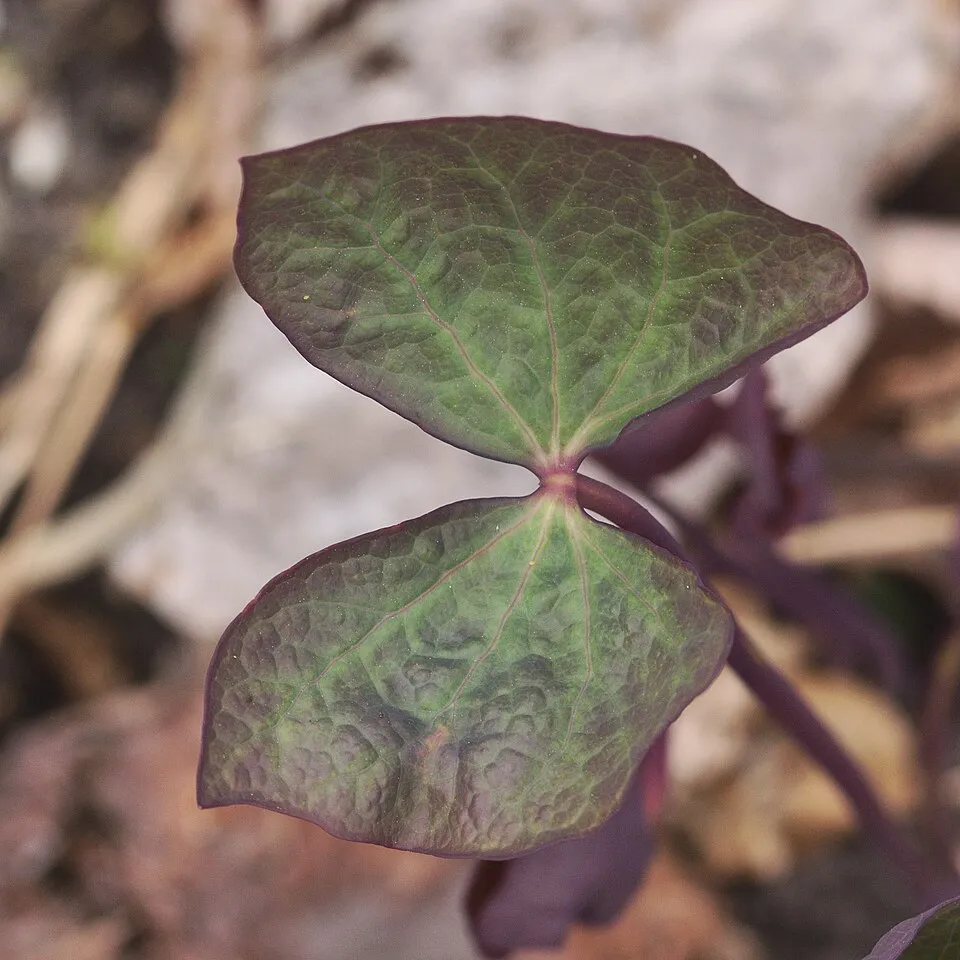
The leaf of Jeffersonia diphylla is the most reliable field character and the origin of the common name. Each plant produces one or two basal leaves on long, slender petioles (4–10 in long) that rise directly from the rhizome. The blade is divided into two symmetrical, kidney-shaped to half-ovate leaflets that sit opposite each other like the two halves of a butterfly or the wings of a biplane. Each leaflet is 1–3 in long and nearly as wide, with entire (smooth) margins and a slightly waxy, blue-green color. The division between the two leaflets is complete but the petiolules (the stalks attaching the leaflets to the petiole) are very short, so the two halves sit close together at the top of the petiole. The leaf emerges in March, unfurling from a tight, purplish bud, and reaches its full size by the time the flower opens. The foliage persists through May, gradually losing its waxy bloom as the season progresses, and yellows and senesces by June.

Flower

The flower of Twinleaf is solitary, borne on a slender, leafless stalk (scape) that rises 6–12 in above the leaves. It is a study in simple perfection: eight pure white, obovate (egg-shaped) petals, each about ½ in long, arranged in a single whorl around eight bright yellow stamens and a central green pistil. The flower is 1–1½ in across, held upright, and opens fully in the morning sun. The extreme transience of the bloom — typically 1–2 days, rarely 3 — is the plant's most remarkable and frustrating feature. The petals are held at the base by a calyx of four small, green, petal-like sepals that drop away as the flower opens. Once pollination occurs (or the flower's brief window closes), the petals fall cleanly, often forming a small white ring around the base of the plant on the leaf litter. The fleeting nature of the bloom means that to see Twinleaf in flower, you must visit the plant at precisely the right moment — a characteristic that has contributed to the plant's mystique among wildflower enthusiasts.

Fruit & Seed

After the petals fall, the pistil develops into a distinctive, leathery, pear-shaped green capsule about 1 in long, held upright on the now-stiffening flower stalk. The top of the capsule is hinged like a lid (operculum), and when the seeds are mature, the lid splits open along a horizontal line, revealing 10–20 reddish- brown seeds inside. Each seed bears a white, fleshy elaiosome that is highly attractive to ants, and the seeds are dispersed by the standard woodland myrmecochory mechanism. The capsule, now empty, can persist on the stalk into the summer, long after the foliage has senesced, providing a clue to the plant's presence in a dormant woodland bed. The combination of capsule-splitting dehiscence (the hinged lid) and ant dispersal is unusual and distinctive; few other woodland herbs combine these traits.

Distinction from Similar Species

Twinleaf's split, bi-lobed leaf is unique among eastern woodland herbs, and no other common spring ephemeral shares this feature. The most likely point of confusion is with mayapple (Podophyllum peltatum), which is in the same family (Berberidaceae) and has a similarly shaped but larger, umbrella-like, peltate (umbrella-attached) leaf that is not divided into two leaflets. Mayapple's flower is larger, waxy-white, and hidden beneath the leaf; Twinleaf's flower is smaller and held above the leaves on a visible stalk. Another potential confusion is with bloodroot (Sanguinaria canadensis), which has a similar white, eight-petaled flower that blooms at the same time, but bloodroot's leaf is a single, lobed, kidney-shaped blade wrapped around the flower stalk, not divided into two symmetrical leaflets. The combination of the bi-lobed leaf and the eight-petaled white flower on a separate stalk is diagnostic.

Habitat & Range in NE Oklahoma

Jeffersonia diphylla is at the absolute southwestern limit of its global range in northeastern Oklahoma, and its occurrence here is extraordinarily rare. The species is known from only a handful of sites in Adair and Cherokee counties, in the richest, most sheltered, most calcareous deciduous woods of the Ozark foothills. These are:

The species' strong association with calcareous substrates is one of the defining features of its ecology. Like many members of the Berberidaceae (including mayapple and blue cohosh), Twinleaf prefers soils derived from limestone, and its presence is often an indicator of high-calcium, near-neutral to slightly alkaline soil conditions. This preference for "sweet" soils distinguishes it from the many woodland species that require acid conditions, and it has practical implications for garden cultivation: Twinleaf will not thrive in the acidic, pine- needle-litter soils that suit heartleaf or interrupted fern; it wants the leaf litter of sugar maple and basswood.

In Oklahoma, Twinleaf is critically imperiled (S1) at the state level and should never be wild-collected under any circumstances. Any plants offered in the nursery trade should be verified as nursery-propagated from cultivated stock, not wild-dug. Gardeners who successfully cultivate Twinleaf in the Tulsa region are contributing to the ex-situ conservation of a species that is genuinely rare in the state and whose wild populations are vulnerable to habitat loss, deer overbrowsing, and climate change at the edge of its range.

Ecology & Wildlife Value

[ early-spring pollination · ant dispersal · calcareous indicator · conservation ]

Pollination Ecology

The short-lived flower of Twinleaf is pollinated primarily by early- emerging solitary bees, including mining bees (Andrenidae) and sweat bees (Halictidae), which visit the flowers for pollen and, to a lesser extent, nectar. The eight stamens release pollen sequentially, and the stigma is receptive for only a short period, which may contribute to the flower's brevity. Queen bumblebees have also been observed visiting the flowers. The extreme brevity of the individual bloom (1–2 days) is unusual among woodland ephemerals and may be an adaptation to reduce the window of vulnerability to florivory (flower consumption) by emerging insects and slugs, or to minimize water loss from the large, exposed petals during the cool, often windy days of early April.

Ant Dispersal & Colony Dynamics

Twinleaf seeds are dispersed by ants (myrmecochory), with the elaiosome-bearing seeds carried to ant nests and discarded in the colony midden. The seeds require cold-moist stratification to germinate, and the resulting seedlings grow slowly, requiring 3–5 years to reach flowering size. The plant's preferred ant dispersers (Aphaenogaster spp.) are themselves sensitive to habitat fragmentation, soil moisture, and the availability of suitable nesting sites, and the disruption of ant populations in fragmented Ozark woodlands may be one factor limiting Twinleaf's expansion and recolonization of suitable habitat.

Deer Browse & Herbivory

White-tailed deer browse on Twinleaf is a serious threat to wild populations. The emerging shoots in March are tender, palatable, and unprotected by thorns or chemical deterrents (unlike Dutchman's Breeches or bloodroot, which deploy alkaloids). In the small, isolated Oklahoma populations, a single deer browsing event in a critical spring can destroy the year's reproductive effort for an entire colony. Gardeners cultivating Twinleaf in areas with deer pressure should protect individual plants with wire cages during the active growth period (March–May).

Calcareous Indicator Species

Twinleaf is a calciphile (calcium-loving plant), and its presence in a woodland signals high-calcium, near-neutral to slightly alkaline soils derived from limestone or dolomite. In eastern North America, it is frequently found growing with other calciphilic species including blue cohosh (Caulophyllum thalictroides), wild ginger (Asarum canadense), large-flowered trillium (Trillium grandiflorum), and various woodland sedges. This calcareous preference has implications for the garden: Twinleaf planted in the acidic, sandstone-derived soils that suit many other woodland plants will languish and decline. A soil test before planting is advisable, and if the pH is below 6.0, the site should be amended with limestone gravel or horticultural lime to bring the pH into the preferred range.

Horticulture & Care

[ limestone soil · shade · planting · patience · conservation cultivation ]

Site selection & soil preparation

Twinleaf is demanding about soil chemistry, and the first step in growing it successfully is a soil test. The plant requires calcareous, near-neutral to slightly alkaline soil (pH 6.5–7.5) with high organic matter and excellent drainage. The heavy, acidic clay of much of the Tulsa region must be amended with limestone gravel, crushed eggshells, or horticultural lime to raise the pH, along with generous quantities of leaf mold or composted hardwood bark to improve texture and aeration. The site must be shaded by deciduous trees that leaf out in late April (sugar maple and basswood are the plant's natural companions; oaks work well; honey locust, which leafs out late, provides insufficient shade by May).

Patience & the collector's plant

Twinleaf is not a plant for the gardener who wants instant results. A newly planted rhizome may produce only a single leaf its first year, and it may be 2–3 years before the first flower appears. Even then, the bloom is so fleeting that you will likely miss it the first time unless you check the plant daily in early April. The plant's value in the garden is as a collector's specimen and a conservation contribution — a plant that, because you grew it, exists in one more place than it did before, at a time when its wild populations are under pressure across its range. For the gardener who appreciates plants with a story — named for a Founding Father, growing at the very edge of its existence, blooming for a day and then vanishing — Twinleaf offers a depth of engagement that goes well beyond the visual.

Companion planting

Twinleaf belongs in the company of other calciphilic woodland plants that share its soil preference and its calcareous Ozark habitat. Excellent companions include: wild ginger (Asarum canadense) for a glossy, evergreen groundcover, mayapple (Podophyllum peltatum) for a contrasting umbrella-like foliage form, bloodroot (Sanguinaria canadensis) for early white flowers that overlap with Twinleaf's bloom period, true Solomon's seal (Polygonatum biflorum) for arching foliage in late spring, Christmas fern (Polystichum acrostichoides) for winter structure, and spicebush (Lindera benzoin) as the understory shrub layer that provides the dappled, high shade Twinleaf prefers. Avoid planting Twinleaf with acid-loving species (ericaceous shrubs, heartleaf) — their soil chemistry is fundamentally incompatible.

Edible & Cultural Uses

The most significant cultural association of Jeffersonia diphylla is with its namesake. The genus was named by Benjamin Smith Barton in 1793 to honor Thomas Jefferson, who was then serving as Secretary of State and who maintained a substantial botanical correspondence and garden. Barton wrote that the genus was "dedicated to Thomas Jefferson, not merely as a botanist and naturalist of the first order, but as a tribute of respect." The plant was among the many native American wildflowers that Jefferson grew at Monticello, and he recorded its flowering dates in his garden diary. The connection between Twinleaf and Jefferson is one of the stronger instances of a plant serving as a living memorial to a historical figure who genuinely engaged with botany, rather than merely receiving an honorific.

In Indigenous ethnobotany, Twinleaf was used medicinally by the Cherokee and other Woodland peoples. The root was employed as a treatment for rheumatism and arthritis (hence the folk name "Rheumatism Root"), as a diuretic, and as a general tonic. The root's medicinal use was adopted by Euro-American settlers and persisted in Appalachian and Ozark folk medicine through the 19th and early 20th centuries. The root contains the alkaloid berberine (common in the Berberidaceae), which has antimicrobial and anti-inflammatory properties, though modern clinical evaluation of the plant's traditional uses is lacking. The plant should not be used for self-medication, and given its rarity in Oklahoma, any harvest of wild plants for any purpose is ecologically indefensible.

A plant of historical and conservation significance. Twinleaf sits at the intersection of early American botanical science, presidential history, and the conservation challenges facing rare species at the edges of their ranges. To grow it in a Tulsa garden is to participate in all three conversations at once — to honor a Founding Father's botanical legacy, to maintain a piece of the eastern deciduous forest's floristic heritage, and to keep a critically imperiled Oklahoma species alive in cultivation at a time when its wild refuges are shrinking.

Photo Reference

The solitary white eight-petaled flower of Jeffersonia diphylla in bloom
// Flower — the eight-petaled white bloom that lasts only 1–2 days
Wikimedia Commons
Wikimedia Commons
The distinctive bifurcated leaf of Jeffersonia diphylla, split into two mirror-image halves
// Leaf — the diagnostic "twin" leaf divided into two symmetrical, kidney-shaped halves
Wikimedia Commons
Wikimedia Commons
The pear-shaped capsule fruit of Jeffersonia diphylla opening to reveal seeds
// Fruit — the distinctive hinged capsule splitting open to release elaiosome-bearing seeds
Wikimedia Commons
Wikimedia Commons
Jeffersonia diphylla plant in its native rich calcareous woodland habitat
// Habit — in the rich, calcareous woods of the Ozark foothills
Wikimedia Commons
Wikimedia Commons

Sources & Further Reading

  • USDA NRCS PLANTS Database — Jeffersonia diphylla: plants.usda.gov/plant-profile/JEDI
  • Lady Bird Johnson Wildflower Center — Native Plant Database: wildflower.org — JEDI
  • Flora of North America — Jeffersonia (Vol. 3): efloras.org
  • Barton, B.S. (1793). Description of Jeffersonia, a new genus of plants. Transactions of the American Philosophical Society 3:334–340 — the original description of the genus, dedicated to Thomas Jefferson.
  • Moerman, D.E. (1998). Native American Ethnobotany. Timber Press — Cherokee medicinal uses of Jeffersonia.
  • Wikipedia — Jeffersonia diphylla: en.wikipedia.org/wiki/Jeffersonia_diphylla (CC BY-SA 4.0; portions of the description, ecology and uses sections summarize Wikipedia content).
  • Oklahoma Biological Survey — Atlas of Oklahoma Flora: biosurvey.ou.edu

Hero photo: Rooted Revival. Strip photos courtesy of Wikimedia Commons contributors under their respective licenses (linked under each image).