home/ plants/ woodland-phlox

// SPECIES PROFILE · PERENNIAL · NATIVE · SPRING BLOOM

Woodland Phlox

Phlox divaricata

Woodland Phlox is the quintessential spring wildflower of eastern deciduous woods — a low, loose perennial that in April and May produces masses of five-petaled, fragrant, lavender-blue flowers that seem to float above the forest floor in dappled light. The scent, noticeable on warm spring afternoons, is sweet and clean — one of the defining fragrances of the eastern woodland spring. Phlox divaricata spreads gently by creeping stems and self-seeding to form a spring carpet in moist, shady sites, where it blooms alongside Virginia bluebells, wild columbine, and trilliums. In NE Oklahoma, it is found in the rich, moist deciduous woods and wooded slopes of the Ozark foothills and riparian corridors. It is an essential plant for the shaded native garden, providing early-season color, fragrance, and nectar for butterflies at a time when few other flowers are available in the woodland understory.

// QUICK FACTS
Family
Polemoniaceae (phlox family)
Life cycle
Herbaceous perennial; spreads by creeping stems and seed
Native range
Eastern N. America — Quebec to Florida, west to Texas and eastern OK
USDA hardiness
Zones 3–8 (Tulsa = 7a/7b)
Mature size
8–16 in tall; spreading indefinitely
Bloom
April–May (NE OK)
Flower
Lavender-blue, 5 petals, 1 in across, fragrant
Sun
Part shade to full shade; best in dappled light
Soil
Moist, rich, well-drained; pH 5.5–7.0
Water
Medium; needs consistent moisture
Wildlife
Nectar for butterflies · long-tongued bees · hummingbird moths
Special feature
Spreads gently to form a spring woodland carpet
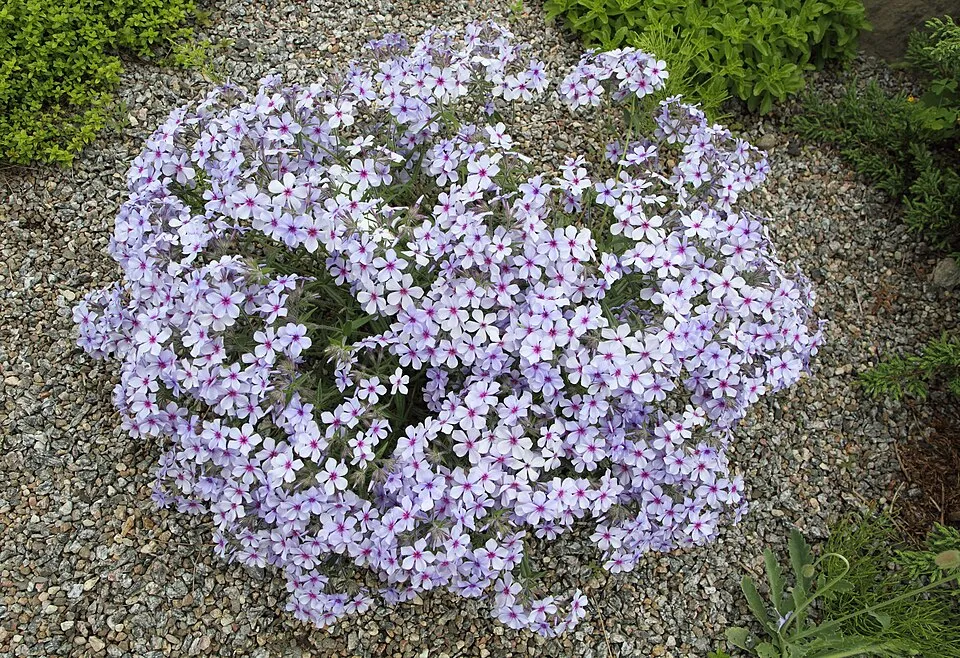
Woodland Phlox (Phlox divaricata) masses of fragrant lavender-blue flowers in spring
Phlox divaricata in spring bloom — fragrant lavender-blue flowers carpeting the woodland floor. Photo: Rooted Revival.

Identification

Habit & Leaves

Low, sprawling-to-upright perennial 8–16 in tall. The stems are slender, often creeping at the base and rooting at the nodes, then turning upward at the flowering tips. Leaves are opposite, lance-shaped to ovate, 1–2 in long, with smooth margins. Both stem and leaves are covered with fine, soft hairs. Sterile (non-flowering) shoots spread laterally to form loose colonies.

Flowers

The flowers are what woodland phlox is about: five-petaled, flat-faced, lavender-blue to pale blue, about 1 in across, with a slightly paler center. The petals are notched at the tip and spread flat from a narrow tube. Flowers are produced in loose, terminal clusters and are fragrant — a sweet, clove-like scent strongest on warm afternoons. The bloom period is roughly 3–4 weeks in April and May.

Habitat & Range in NE Oklahoma

Phlox divaricata reaches the western edge of its range in eastern Oklahoma, occurring in rich, moist deciduous woods, north-facing wooded slopes, and shaded stream terraces in the Ozark foothills and along the riparian corridors of the Grand and Illinois River systems. It requires consistently moist, humus-rich soil and dappled shade. In the Tulsa garden, it needs a shaded site with amended, moisture-retentive soil and protection from afternoon sun.

Ecology & Wildlife Value

Pollinators

The fragrant, long-tubed flowers are adapted for long-tongued pollinators, including swallowtail butterflies, hummingbird moths (Hemaris spp.), and bumblebee queens. The early bloom period provides critical nectar for these insects when few other woodland flowers are open. Small butterflies like the eastern tailed- blue and spring azure are regular visitors.

Wildlife

Woodland phlox is not a major Lepidoptera host (unlike many other natives), but its value as an early-spring nectar source is significant. The foliage is browsed by deer and rabbits — in areas with heavy deer pressure, protection may be needed.

Horticulture & Care

Site selection

Woodland phlox requires partial to full shade and consistently moist, humus-rich, well-drained soil. In the Tulsa area, a location with morning sun and afternoon shade, or the high dappled shade of mature hardwoods, is ideal. Heavy clay should be amended with composted leaf mold. The single most common cause of failure is planting in full sun with dry soil — this plant needs the cool, moist conditions of a woodland floor.

Planting & Maintenance

Companion planting

Woodland phlox is the classic companion for a spring shade garden: Virginia Bluebells, Wild Columbine, Mayapple, Solomon's Seal, Maidenhair Fern, Wild Ginger, and Christmas Fern. The blue of woodland phlox against the green of ferns and the white of Solomon's seal is one of the iconic color palettes of the eastern woodland spring.

Photo Reference

Woodland Phlox lavender-blue flowers
// Flowers — 5 petals, lavender-blue, fragrant, April–May
Wikimedia Commons
Wikimedia Commons
Woodland Phlox carpeting forest floor
// Habit — low spreading carpet, dappled shade, spring bloom
Wikimedia Commons
Wikimedia Commons
Swallowtail butterfly visiting Phlox
// Pollinator — swallowtail butterfly nectaring on phlox
Wikimedia Commons
Wikimedia Commons
Woodland Phlox opposite leaves
// Leaves — opposite, lance-shaped, softly hairy
Wikimedia Commons
Wikimedia Commons

Sources & Further Reading