home/ plants/ marsh-marigold

// SPECIES PROFILE · PERENNIAL · EARLY SPRING WETLAND BLOOM · EPHEMERAL POOL SPECIALIST

Marsh Marigold

Caltha palustris

Marsh Marigold is the herald of spring in the wet ground — a low, clump-forming perennial with glossy, dark green, kidney-shaped leaves and brilliant yellow, buttercup-like flowers that open in March and April, weeks before most other wetland perennials have stirred from dormancy. Despite the common name, it is not a marigold (Tagetes) at all but a member of the buttercup family (Ranunculaceae), and its glossy, waxy flowers — actually composed of showy sepals rather than true petals — are among the earliest and most vivid blooms in the wetland landscape. In NE Oklahoma, this species reaches a uniquely restricted niche: it is found primarily in the cold, spring-fed seeps, fens, and marshy headwaters of the Ozark-influenced northeastern corner of the state, where constant groundwater moderates temperature and provides the cool, oxygenated soil conditions the species requires. It provides critical early-season pollen for emerging native bees, hoverflies, and other spring insects when few other flowers are available.

// QUICK FACTS
Family
Ranunculaceae (buttercup family)
Life cycle
Herbaceous perennial; emerges very early in spring; goes dormant by mid-summer in warm climates
Native range
Circumboreal; throughout northern N. America, south to the Carolinas, Tennessee, and NE Oklahoma (Ozark disjunct)
USDA hardiness
Zones 3–7; marginal in zone 7b without cool, seep-fed conditions (Tulsa = 7a/7b)
Mature size
1–2 ft tall, clumps 1–1.5 ft wide; foliage expands to 2 ft wide
Bloom
March – early May (NE OK); one of the earliest wetland blooms
Flower
Brilliant, glossy yellow; 1–2 in across; 5–9 showy sepals (no true petals)
Sun
Full sun to partial shade; requires cool root zone
Soil
Constantly moist, cool, humus-rich; silty or peaty; intolerant of dry or hot soil
Water
Permanently moist to saturated; spring-fed seeps, fen margins, boggy ground
Wildlife
Critical early pollen source for native bees · hoverfly nectar · habitat for spring amphibians
Conservation
Globally secure (G5); at southern range limit in Oklahoma, restricted to specialized habitats
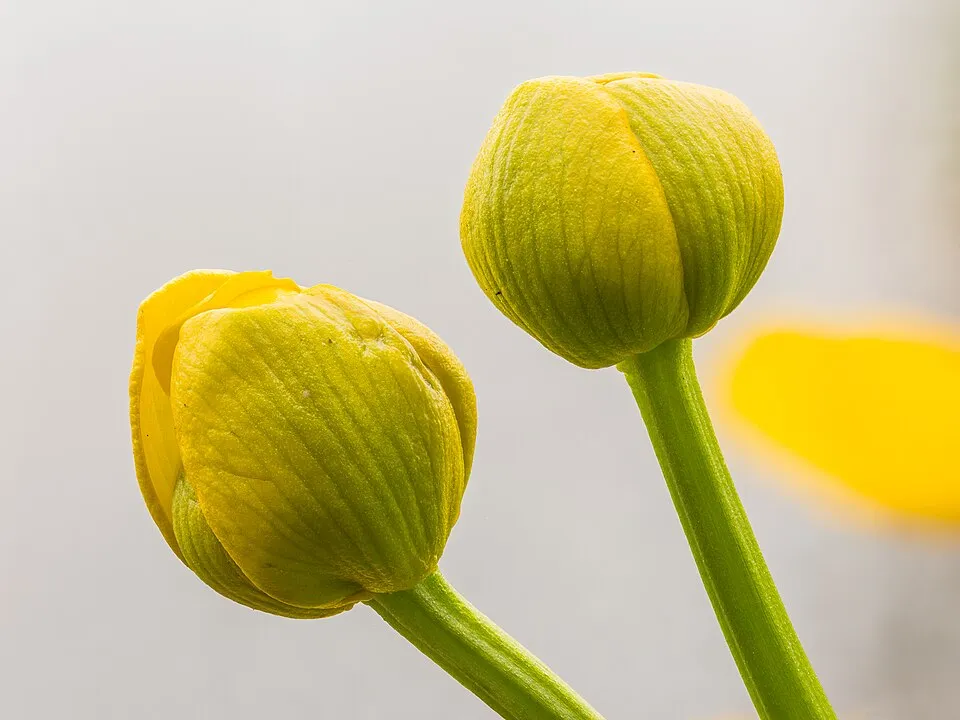
Marsh Marigold (Caltha palustris) with glossy kidney-shaped leaves and brilliant yellow flowers emerging from saturated spring soil
Caltha palustris in early spring bloom — the glossy yellow flowers and dark green, kidney-shaped leaves are unmistakable in the wet, cool ground of seeps and spring runs. Photo: Rooted Revival.

Identification

[ field key — leaf · flower · fruit · phenology · vs. lesser celandine ]

Habit & Phenology

Low, clump-forming perennial that emerges from a fibrous root system in late winter to very early spring (February–March in NE Oklahoma), well ahead of most other wetland perennials. The foliage and flowers rise from the crown simultaneously. Plants are 1–2 ft tall when in flower, with the basal foliage spreading to a similar width. After blooming and setting seed, the plant typically goes dormant by mid-summer in warm climates, with the leaves yellowing and dying back as soil temperatures rise. This early-season growth and summer dormancy is an adaptation to exploiting full sun before the canopy closes and to the seasonal hydrology of spring-fed sites, which are wettest in late winter and spring.

Leaves

The leaves are the most consistent identification feature: glossy, dark green, leathery, and kidney-shaped to heart-shaped (reniform to cordate), 3–8 in across, with shallowly scalloped (crenate) or nearly entire margins and long, succulent petioles arising from the base. The leaf surface is smooth (glabrous) and distinctly glossy — as if lacquered. The venation is palmate (radiating from the petiole attachment), giving the leaf a ribbed appearance. Basal leaves are larger and rounder; stem leaves (if present) are smaller, alternate, and more deeply notched. The glossy, kidney-shaped foliage is unique among early-spring wetland plants in NE Oklahoma.

Flowers

Flowers are brilliant, glossy, waxy yellow, 1–2 in across, borne on branching, hollow stems above the foliage. Each flower has 5–9 showy, petal-like sepals (the true petals are absent), numerous yellow stamens, and a central cluster of green carpels (the developing follicles). The glossy, almost glassy surface of the sepals is due to a waxy cuticle and optical structures that reflect light intensely — the flowers appear to glow in the dappled light of early-spring woodlands. Blooms open in succession over a period of 3–4 weeks, with individual flowers lasting about a week.

Fruit & Seed

After pollination, the carpels develop into a cluster of flattened, beaked follicles (dry fruits) 3/8–3/4 in long, arranged in a star-like cluster. At maturity in late spring to early summer, each follicle splits along one side to release several shiny, brown, slightly wrinkled seeds. The seeds are dispersed by water (hydrochory) — they float and are carried by surface flow through the seep or fen. Unlike many buttercup family members, the seeds of Caltha lack an elaiosome (ant-attracting food body), and ant dispersal is not significant. The seed requires a period of warm stratification followed by cold stratification to break dormancy.

Habitat & Range in NE Oklahoma

Caltha palustris is a circumboreal species, ranging across the cool-temperate and subarctic zones of North America, Europe, and Asia. In North America, it ranges from Alaska and Canada southward through the northern US, with disjunct populations extending southward along the Appalachian and Ozark highlands. In Oklahoma, it represents a classic Ozarkian disjunct — a cold-adapted, northern species persisting in refugia where cool, spring-fed aquatic conditions replicate its boreal habitat. It is restricted to the northeastern corner of the state in Delaware, Adair, and Cherokee counties, where the Ozark Plateau's karst geology produces the cool, permanently saturated seeps, spring runs, and calcareous fens that the species requires.

The specific habitats occupied by Marsh Marigold in NE Oklahoma are spring-fed seeps at the base of limestone bluffs, the margins of cold spring runs (spring creeks), and minerotrophic fens — wetlands fed by mineral-rich groundwater that stays a near-constant 55–60°F year-round. These sites, often dominated by sedges, mosses, and Christmas fern, provide the cool root temperatures and constant moisture that allow a boreal species to survive this far south. Marsh Marigold does not occur in the warm, stagnant ponds and ditches that characterize most of the Tulsa area — its presence is a reliable indicator of high-quality, groundwater-fed wetland habitat.

Ecology & Wildlife Value

[ early spring pollinator resource · hoverflies · amphibian habitat · fen ecology ]

Early-Season Pollinator Resource

The ecological significance of Marsh Marigold lies in its extremely early bloom period. In late March and early April in NE Oklahoma, when soil temperatures are still cool and most plants have not leafed out, Caltha palustris is already in full flower, offering abundant, easily accessible pollen to the earliest-emerging pollinators. Solitary mining bees (Andrena spp.), small carpenter bees (Ceratina), and halictid bees that have overwintered as adults and emerged with the first warm days rely on plants like Marsh Marigold for the pollen needed to provision their first brood cells of the season. The plant does not produce nectar; it is strictly a pollen resource, but the pollen is produced in copious quantities.

Hoverflies & Dipteran Pollinators

A significant portion of Marsh Marigold's pollination in boreal and montane habitats is performed by hoverflies (Syrphidae), particularly species in the genera Eristalis and Syrphus, which are active at cooler temperatures than most bees. These flies feed on the pollen and effect pollination in the process. Bee flies (Bombyliidae) and muscid flies also visit the flowers. The flower's simple, open architecture — a bowl of pollen-bearing stamens — makes it accessible to a wide range of small, early-season insects, with no specialized mouthpart requirements.

Amphibian Habitat & Fen Ecology

The cool, spring-fed habitats Marsh Marigold occupies are critical amphibian breeding sites in the Ozark region. Pickerel frogs (Lithobates palustris), southern red-backed salamanders (Plethodon serratus), and cave salamanders (Eurycea lucifuga) use these groundwater-fed wetlands for breeding, foraging, and refuge. The dense early foliage of Caltha provides cover for frog egg masses and tadpoles in the shallow, slow-flowing water of spring seeps. The plant is a component of the globally rare Ozark fen community, which hosts numerous disjunct and endemic plant and invertebrate species.

Toxicity & Herbivory

Like many Ranunculaceae, Caltha palustris contains protoanemonin, a volatile, acrid toxin produced when the plant tissues are crushed or chewed. Protoanemonin is a potent irritant to skin and mucous membranes and is toxic to mammals if ingested in significant quantities. This chemical defense makes the plant largely avoided by deer, rabbits, and livestock. Cattle poisoning has been documented in Europe where Marsh Marigold grows abundantly in wet pastures, though the toxin degrades upon drying and is absent from hay. The acrid taste deters most herbivory. Properly cooked, the young leaves have historically been eaten as a spring green (see Cultural Uses), as boiling destroys protoanemonin.

Gardening at the southern edge: In the Tulsa region (zone 7a/7b), Marsh Marigold is at the limit of its heat tolerance. Success depends on replicating the cool, spring-fed conditions of its native Ozark habitat: steady groundwater supply, cool soil temperatures, and protection from hot afternoon sun. It is not a plant for a typical rain garden or sun-baked pond margin — it requires a specialized bog garden or spring simulation to thrive.

Horticulture & Care

[ siting · soil · water · summer dormancy · propagation ]

Site selection — replicating the seep

Marsh Marigold is demanding in its cultural requirements in NE Oklahoma and will fail without precise siting. The plant requires constantly moist to saturated, cool, humus-rich soil and protection from hot afternoon sun. The best sites in the Tulsa region are the shady, constantly wet margins of a recirculating pond or stream feature, a constructed bog garden with a water reservoir below the root zone, or a north-facing slope with a constant seep or drip irrigation. Morning sun with afternoon shade from a building or deciduous tree is ideal. The soil must never dry out and must not become hot (above approximately 75°F) at the root level during summer.

Summer dormancy management

In the Tulsa climate, Marsh Marigold will naturally go dormant by mid-summer (June–July). The foliage yellows and dies back as soil temperatures rise, and the plant retreats to its underground crown and roots until the following February. Do not mistake summer dormancy for death and do not discard the plant! Mark the planting location well. During dormancy, the soil must remain evenly moist but not waterlogged. Interplant with moisture-tolerant, shade-loving plants that provide cover and interest during the dormant period: Christmas fern, maidenhair fern, Solomon's seal, and wild ginger.

Propagation

Pests & diseases

Marsh Marigold is largely trouble-free due to its protoanemonin content. Powdery mildew can appear on foliage in early summer as dormancy approaches; it is cosmetic and harmless. Slugs and snails may feed on young growth in early spring in very wet conditions; handpick or use iron phosphate bait if damage is significant.

NOT a plant for most Tulsa gardens. Marsh Marigold is a specialist's plant in NE Oklahoma — magnificent when properly sited, but it will fail in a standard rain garden, pond margin in full sun, or any site where the soil dries out or heats up in summer. Before planting, ask honestly whether your site provides the cool, constantly moist, spring-fed conditions this boreal disjunct requires to persist at the southern limit of its range.

Edible & Cultural Uses

Marsh Marigold has a long but cautionary ethno-botanical history. The young leaves and unopened flower buds have been harvested as a spring green in Europe and North America for centuries, and the plant was an important source of fresh greens after winter — the common English name "cowslip" refers to its appearance in cow pastures at the time when butter was churned in spring. However, the plant is toxic when raw or improperly prepared:

In Celtic and Germanic folklore, Marsh Marigold was associated with spring festivals, particularly Beltane (May Day), when its bright yellow flowers were gathered and strewn before doors or woven into garlands as a symbol of the returning sun and protection against negative influences.

Photo Reference

Marsh Marigold flower showing glossy yellow sepals and numerous stamens
// Flower detail — glossy yellow "petals" are actually showy sepals with numerous stamens
Wikimedia Commons
Wikimedia Commons
Clump of Marsh Marigold in full bloom with glossy kidney-shaped leaves
// Spring clump — dense mound of dark green, kidney-shaped leaves with yellow flowers
Wikimedia Commons
Wikimedia Commons
Marsh Marigold growing in its native seep habitat with flowing spring water
// Native seep habitat — the cool, spring-fed conditions required for southern persistence
Wikimedia Commons
Wikimedia Commons
Star-shaped cluster of follicles (seed pods) of Caltha palustris
// Fruit (follicles) — star-like cluster of beaked, splitting seed pods
Wikimedia Commons
Wikimedia Commons
Early-season solitary bee visiting a Marsh Marigold flower for pollen
// Early pollen resource — an Andrena mining bee collecting pollen in early spring
Wikimedia Commons
Wikimedia Commons

Sources & Further Reading

  • USDA NRCS PLANTS Database — Caltha palustris: plants.usda.gov/plant-profile/CAPA5
  • USDA NRCS Plant Guide — Marsh Marigold (CAPA5), National Plant Data Center.
  • Lady Bird Johnson Wildflower Center — Native Plant Database: wildflower.org — CAPA5
  • Oklahoma Natural Heritage Inventory — Ozark fen community description and rare element occurrence records.
  • Flora of North America, Vol. 3 — Ranunculaceae treatment, including Caltha palustris.
  • Smit, P.G. (1973). A revision of Caltha (Ranunculaceae). Blumea 21:119–155 — the definitive taxonomic treatment.
  • Niering, W.A. (1953). The past and present vegetation of High Point State Park, New Jersey. Ecological Monographs — includes bog and fen plant community descriptions.
  • Kingsbury, J.M. (1964). Poisonous Plants of the United States and Canada. Prentice-Hall — protoanemonin toxicity in Ranunculaceae.
  • Wikipedia — Caltha palustris: en.wikipedia.org/wiki/Caltha_palustris (CC BY-SA 4.0; portions of description summarize Wikipedia content).
  • Henderson, N.C. (1992). Spring Wildflowers of the Ozarks. — habitat descriptions for disjunct northern species.

Hero photo: Rooted Revival. Strip photos courtesy of Wikimedia Commons contributors under their respective licenses (linked under each image).