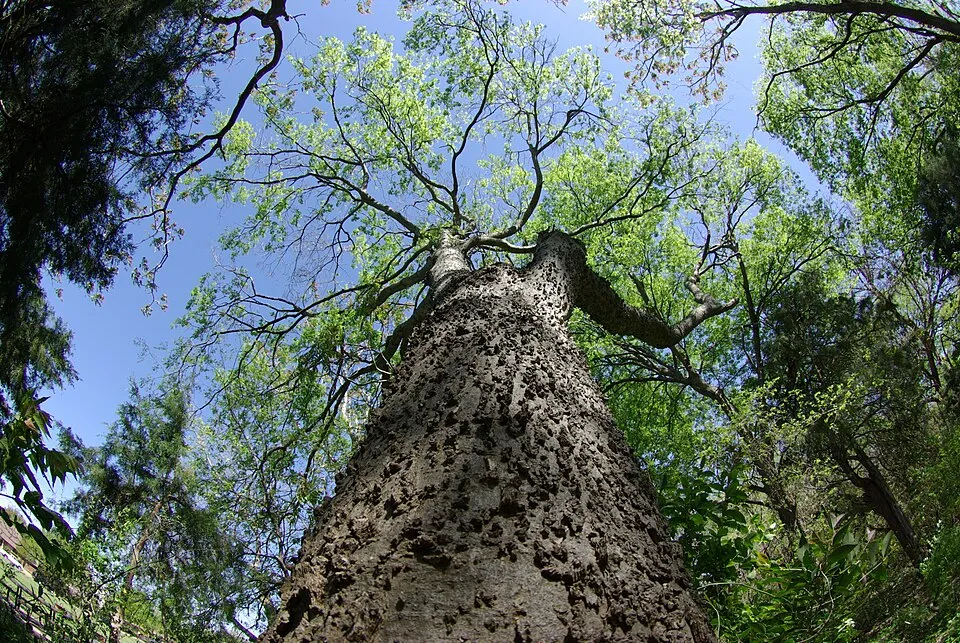
// SPECIES PROFILE · TREE · NATIVE · WILDLIFE KEYSTONE
Sugarberry is the smooth-barked southern cousin of the familiar Common Hackberry — a medium to large bottomland tree that lines the alluvial terraces and stream banks of NE Oklahoma's major river systems. Unlike its warty-barked relative Celtis occidentalis, Sugarberry's trunk is smooth and pale gray, often developing a distinctive mottled, almost beech-like appearance with age. It produces a heavy crop of small, sweet, orange-red drupes each fall that persist on the branches deep into winter — a larder that proves critical to cedar waxwings, mockingbirds, robins, and at least twenty other bird species when snow covers the ground. As a larval host for the hackberry emperor, tawny emperor, and question mark butterflies, a Sugarberry on your property is not merely a shade tree; it is a wildlife engine operating across three trophic levels.

[ field key — bark · leaf · flower · fruit · comparison to common hackberry ]
Medium to large deciduous tree with a broad, rounded to vase-shaped crown. The trunk is straight in forest-grown specimens, often shorter and more spreading in the open. Bark is the single best field mark: smooth, pale gray to almost white, sometimes with corky ridges or warts only at the very base of old trunks — never the conspicuous, warty-corky bark that covers the entire trunk of Common Hackberry (C. occidentalis). On mature Sugarberry, the smooth bark may develop a fine network of shallow fissures but remains predominantly clean and pale, reminiscent of American Beech.
Alternate, simple, lanceolate to narrowly ovate, 2–5 in long, with a characteristically asymmetrical base (one side of the leaf blade attaches lower on the midrib than the other — an obliquely cordate base, shared with all Celtis species). Margins are mostly entire or with a few scattered, shallow teeth near the apex, unlike Common Hackberry leaves which are more consistently serrated from base to tip. Upper surface is smooth and medium green; lower surface is paler with prominent veins and often fine hairs along the midrib. Fall color is a soft, unremarkable yellow.
Inconspicuous, small, greenish, wind-pollinated flowers appear in early spring (March–April in NE Oklahoma) with the emerging leaves. Flowers are monecious (separate male and female flowers on the same tree) or sometimes polygamo-monoecious (perfect flowers also present), borne singly or in small clusters in the leaf axils of new growth. They are of little ornamental interest but are visited by small bees and flies seeking early-season pollen. The species is not a significant spring pollen source for honey bees but does provide forage for native solitary bees.
The fruit is a small, spherical drupe, ¼–⅜ in in diameter, ripening from green to orange-red and eventually dark reddish-purple by late September through October. Each drupe contains a single, hard, round seed within a thin layer of sweet, date-like flesh. The fruit persists on the tree well into winter (December–February), a trait that makes Sugarberry one of the most valuable emergency food sources for frugivorous birds in NE Oklahoma when other fruits have long since been consumed. The flavor is mildly sweet and the fruits are edible raw by humans, though the seed dominates the volume and the flesh is sparse — better left for the birds.
Celtis laevigata is a tree of the southeastern and south-central United States, ranging from Virginia and Florida west to Texas and southern Oklahoma, with scattered populations north into Missouri and southern Illinois. In Oklahoma, Sugarberry is most abundant in the eastern and southern portions of the state, reaching the northwestern edge of its range roughly along a line from McCurtain County through the Arkansas River valley into Tulsa, Osage, and Pawnee Counties.
In NE Oklahoma, you will find Sugarberry on the rich alluvial soils of bottomland forests, stream terraces, and floodplain woods along the Arkansas River, Verdigris River, Grand (Neosho) River, and their major tributaries. It is a consistent component of the bottomland hardwood community in these systems, growing alongside Sycamore, Pecan, Eastern Cottonwood, Black Walnut, and Green Ash. It extends up into the lower slopes of the Cross Timbers where moisture is available on north-facing aspects and in seepage areas. In the Ozark foothills of far northeastern Oklahoma (Delaware and Ottawa Counties) it occurs on moist, sheltered limestone terraces.
Sugarberry is more common in the southern and eastern parts of Oklahoma than in the central or western regions, but the species' tolerance of urban conditions, compacted soil, and seasonal flooding makes it an excellent choice for street trees and park plantings throughout the Tulsa metropolitan area — where it is, somewhat surprisingly, underused compared to the rougher Common Hackberry.
[ Lepidoptera host · winter bird fruit · specialist insects · bottomland ecology ]
Sugarberry is a larval host plant for at least three butterfly species in NE Oklahoma. The Hackberry Emperor (Asterocampa celtis) and Tawny Emperor (Asterocampa clyton) both lay eggs on Celtis foliage; their caterpillars are gregarious when young and overwinter in groups inside rolled, dead leaves on the ground. The Question Mark (Polygonia interrogationis) also uses hackberries and sugarberries as a larval host, alongside elms and nettles. The American Snout (Libytheana carinenta) occasionally uses Celtis species as well, though it prefers true hackberry (C. occidentalis) in our region. Several moth species in the genera Automeris and Patalene feed on hackberry foliage.
The persistent winter fruit of Sugarberry is a critical cold-season food resource for frugivorous birds in NE Oklahoma. Cedar waxwings descend on Sugarberry in large, nomadic winter flocks and can strip a tree of fruit in a matter of days. Northern mockingbirds defend individual trees as winter territories. American robins switch from earthworms to Sugarberry drupes when the ground freezes. Other regular consumers include Northern flicker, yellow-bellied sapsucker, Eastern bluebird, hermit thrush, brown thrasher, and at least a dozen other species. Because the fruit clings to branches long after most other wild fruits have fallen or been consumed, Sugarberry acts as a winter famine food during ice storms and deep cold snaps.
Although wind-pollinated, Sugarberry flowers attract a modest collection of small, early-season pollinators including mining bees (Andrena spp.), small halictid bees, and various flies. More significantly, Celtis foliage supports a specialized guild of gall-forming psyllids (jumping plant lice) in the genus Pachypsylla, which create distinctive nipple-galls on the leaves. These galls are a nuisance to no one and feed a cascade of parasitoid wasps that, in turn, help regulate pest insects throughout the garden. The psyllids themselves are eaten by warblers, chickadees, and other insectivorous birds during spring migration.
In bottomland forest systems, Sugarberry occupies the mid-canopy to sub-canopy layer, typically beneath taller cottonwoods, sycamores, and pecans. Its dense, fibrous root system helps stabilize stream banks and alluvial terraces against erosion during flood events on the Arkansas and Verdigris Rivers. The leaf litter is relatively high in calcium and decomposes readily, contributing to the rich, dark alluvial soils characteristic of NE Oklahoma bottomlands. Sugarberry also acts as a nurse tree in disturbed floodplain sites: its fast juvenile growth and tolerance of partial shade allow it to establish quickly on sandbars and slough edges, creating conditions that facilitate the slower recruitment of oak, hickory, and pecan.
[ site selection · planting · care · pest/disease · companion design ]
Sugarberry is a forgiving tree. Select a site with full sun to light shade and adequate room for a 50–80 ft tree with a broad crown. It performs best on deep, moist, alluvial soils but is remarkably adaptable to the heavy red clay common in the Tulsa region, provided drainage is at least moderate. Because it tolerates compacted soil, urban pollution, and occasional flooding, Sugarberry is an excellent choice for street tree plantings, park settings, and the lower, wetter portions of a residential lot where other large native trees (oaks, hickories) might struggle. Avoid planting directly over underground utilities, as with any large tree; the root system is extensive but not notorious for lifting sidewalks.
Established Sugarberries are among the lowest-maintenance native shade trees for NE Oklahoma. Annual tasks are minimal:
As a bottomland canopy tree, Sugarberry pairs well with other moisture-tolerant natives. In a riparian buffer or rain garden backdrop, plant it with Buttonbush, Winterberry, Rose Mallow, and Inland Sea Oats in the shrub and herbaceous layers. In a larger food forest context, Sugarberry works in the canopy layer above Pawpaw, Spicebush, American Elderberry, and Rusty Blackhaw. Its light shade is less dense than an oak's, allowing productive understory planting. For a wildlife-focused "bird garden" composition, plant Sugarberry together with Common Hackberry (extending the fruit season earlier and later), American Persimmon, Sassafras, and Roughleaf Dogwood — this combination feeds fruit-eating birds from August through March.
The fruits of Sugarberry are edible to humans — small, sweet, and date-like in flavor, with a single hard seed that makes up most of the drupe's volume. They can be eaten raw directly from the tree in fall, though the ratio of flesh to seed is poor. Indigenous peoples of the southeastern US, including the Creek (Muscogee), Choctaw, and Seminole, used hackberry and sugarberry fruits as a minor food source, often pounding the whole drupes into a paste (seed included) that was mixed with fat or cornmeal and formed into cakes. The seeds were sometimes extracted and ground separately, though this is labor-intensive for the caloric return.
The wood of Sugarberry is moderately heavy, close-grained, and pale yellow — similar to Common Hackberry but somewhat softer. Historically it was used for fence posts, furniture, and barrel hoops, and more recently for pallets and inexpensive millwork. Unlike Common Hackberry, Sugarberry wood was rarely used for flooring due to its slightly softer character. The bark and leaves have been used in traditional medicine by several southeastern tribes as a topical astringent and a treatment for sore throat.
Hero photo: Rooted Revival. Strip photos courtesy of Wikimedia Commons contributors under their respective licenses (linked under each image).