home/ plants/ rose-mallow

// SPECIES PROFILE · PERENNIAL · GIANT WETLAND WILDFLOWER · POLLINATOR BEACON

Rose Mallow

Hibiscus lasiocarpos

Rose Mallow is the commanding presence of the marsh edge — a towering native perennial hibiscus that sends up stout, cane-like stems 4–6 feet tall, topped from mid-summer through fall with an astonishing succession of enormous pink-to-white blossoms, each up to 6 inches across with a deep crimson eye. Every flower opens for a single day, but the plant produces dozens in sequence, ensuring a continuous display from July through October. The large, velvety-soft leaves are densely covered in fine hairs (the specific epithet lasiocarpos means "woolly-fruited"). Found in marshes, pond edges, and wet ditches across eastern Oklahoma, Hibiscus lasiocarpos is a pollinator spectacle visited by an extraordinary diversity of native bees — including hibiscus-specialist species — plus hummingbirds and numerous butterflies.

// QUICK FACTS
Family
Malvaceae (mallow / hibiscus family)
Life cycle
Herbaceous perennial; dies back to ground in winter, re-emerges from crown in spring
Native range
Mississippi drainage and Gulf Coast; Missouri to Texas, east to Alabama; eastern Oklahoma
USDA hardiness
Zones 5–9 (Tulsa = 7a/7b, reliably hardy)
Mature size
4–6 ft tall (occasionally 8 ft), 2–3 ft wide per stem cluster
Bloom
July – October (NE OK); peak in August–September
Flower
5–6 in across; 5 broad petals, pink to white, with prominent crimson eye
Sun
Full sun (6+ hrs); fewer flowers and leggy growth in shade
Soil
Moist to wet; rich loam to heavy clay; tolerates seasonal flooding
Water
Wet to consistently moist; tolerates brief drought but wilts dramatically
Wildlife
Hibiscus-specialist bees · bumblebees · hummingbirds · checkered skipper host
Conservation
Globally secure (G5); local in Oklahoma wetland habitats
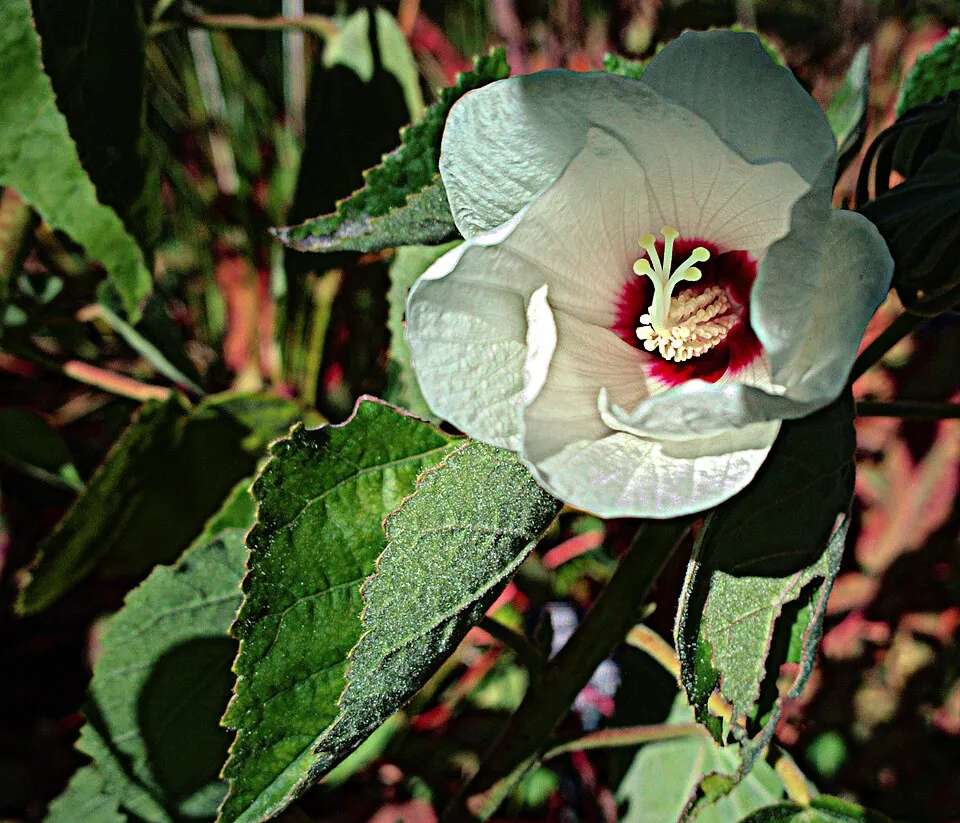
Rose Mallow (Hibiscus lasiocarpos) with an enormous pink flower and prominent crimson center eye
Hibiscus lasiocarpos in full glory — the 5–6 in flowers with their dark red central eye are among the largest blossoms of any native North American perennial. Photo: Rooted Revival.

Identification

[ field key — stem · leaf · flower · fruit · habit ]

Habit & Stem

Tall, upright herbaceous perennial producing multiple stout, cane-like stems from a woody crown each spring. Stems are 4–6 ft (occasionally taller in rich, wet soil), mostly unbranched below the flowering zone, and covered with a dense coat of soft, velvety hairs (pubescence) that gives the plant a gray-green haze. Stems are round in cross-section and relatively sturdy, though in the windiest Tulsa exposures they may benefit from a discrete stake. The plant dies completely back to the ground after the first hard frost and re-emerges from the root crown in late spring — typically later than most perennials; be patient in April and May.

Leaves

Leaves are large (4–8 in long), alternate, broadly ovate to heart-shaped (cordate at base), with a long petiole and a coarsely toothed margin. The blade is densely soft-hairy (tomentose) on both surfaces, especially beneath — the feel is like fine wool or velvet, quite unlike the rough sandpaper texture of the related H. moscheutos (Crimson-eyed Rose Mallow). This pubescence is a reliable field character distinguishing H. lasiocarpos from other native hibiscus species. Leaves reduce in size upward along the stem.

Flowers

The flowers are spectacularly large (5–6 in diameter), solitary in the upper leaf axils, each opening for a single day in early morning and closing by late afternoon. The corolla consists of 5 broad, overlapping petals that are pale pink to white (occasionally deep pink) with a conspicuous, sharply defined crimson-magenta eye at the base — a nectar guide that directs pollinators to the center. The reproductive column (staminal column) is a hallmark of the Malvaceae: a conspicuous, protruding central structure bearing numerous yellow anthers along its length and topped by five spreading, fuzzy stigmas. Flowers produce abundant nectar at the base of the petals.

Fruit & Seed

After pollination, the flower produces a densely hairy, ovoid capsule 1–1.5 in long, surrounded by the persistent calyx. At maturity, the capsule splits into 5 sections, releasing numerous hard, dark-brown, kidney-shaped seeds about 3–4 mm across. The hairs on the capsule (which give the species its name lasiocarpos — "hairy fruit") are dense and persistent through seed release. Seeds can be collected for propagation after the capsule turns brown and begins to split; they remain viable for several years if stored cool and dry.

Habitat & Range in NE Oklahoma

Hibiscus lasiocarpos is native to the central and lower Mississippi River drainage and Gulf Coastal Plain, ranging from Missouri and Illinois southward through Arkansas, Louisiana, Mississippi, and Alabama into Texas. In Oklahoma, it occurs in the eastern third of the state, primarily along the Arkansas and Red River drainages and their major tributaries. It reaches into NE Oklahoma's Green Country region through the Arkansas River Valley, the Grand River system, and the broad alluvial bottoms of the Verdigris River.

The plant's natural habitat is the open, sunny edge of freshwater marshes, oxbow lakes, sluggish streams, and vegetated pond margins — settings where the soil is persistently saturated but not deeply submerged. It thrives in the transition zone between standing water and dry ground, often in association with cattails (Typha spp.), water willow (Justicia americana), and buttonbush. In the Tulsa region, it is also found in roadside ditches that hold water through summer, low spots in bottomland pastures, and the margins of farm ponds constructed in clay-rich soils.

Ecology & Wildlife Value

[ specialist bees · generalist pollinators · hummingbirds · Lepidoptera host · seed ecology ]

Hibiscus-Specialist Bees (Oligolectic)

Hibiscus lasiocarpos and its relatives support a remarkable guild of oligolectic (pollen-specialist) bees that forage exclusively or primarily on plants in the genus Hibiscus and closely related Malvaceae genera. The most notable specialist is the hibiscus turret bee (Ptilothrix bombiformis), a large, fuzzy, golden-brown solitary bee that looks like a miniature bumblebee and constructs turreted nest entrances in compacted soil near hibiscus plants. Other specialists include Diadasia species and several specialist Melitoma bees. These bees are entirely dependent on Hibiscus pollen for larval provisioning, making rose mallows a keystone plant for native bee diversity.

Generalist Pollinators

Beyond the specialists, rose mallow flowers attract an enormous diversity of generalist pollinators. Common eastern bumblebees (Bombus impatiens) and American bumblebees (B. pensylvanicus) are regular visitors, often emerging from the flowers dusted white with pollen. Ruby-throated hummingbirds visit for nectar throughout the day. Swallowtail butterflies, fritillaries, skippers, and various moths feed at the flowers. The large, open flowers with their prominent landing platform make the plant exceptionally accessible as a pollinator resource.

Lepidoptera Host

Hibiscus species are larval host plants for the checkered skipper (Pyrgus communis), the gray hairstreak (Strymon melinus), and the painted lady (Vanessa cardui). Several moth species also use rose mallow as a larval host, including the pearly wood nymph (Eudryas unio) and the hibiscus looper (Anomis impasta). The large leaves provide substantial caterpillar forage with minimal visible damage on a robust 6-ft plant.

Seed Dispersal & Persistence

The hard-coated seeds of H. lasiocarpos are adapted for hydrochory (water dispersal) — they float and are carried by floodwater across the marsh landscape to establish new colonies, an important strategy in the dynamic, flood-prone wetland habitats the species occupies. Seeds exhibit physical dormancy (hard seed coat) and can persist in the wetland seed bank for years until scarified by freeze-thaw cycles or mechanical abrasion. This seed banking allows populations to rebound after disturbance.

Pollinator garden strategy: A single mature Rose Mallow can be the anchor of a pollinator-focused wetland planting. Plant it where its flowers can be seen from a window or seating area — the flower-by-flower daily turnover means there is always something new to observe, and the diversity of bee visitors (from tiny sweat bees to the large Ptilothrix specialist) is unmatched by most other native perennials.

Horticulture & Care

[ siting · soil · water · pruning · propagation · cultivars ]

Site selection & planting

Rose Mallow demands full sun and moist to wet soil. In NE Oklahoma, plant in the wettest portion of a rain garden, at the edge of a pond, in a low-lying bed that receives roof runoff, or in a consistently irrigated border. The plant tolerates periods of standing water (several inches for days to weeks) without issue, but it is the transition zone — the water's edge — where it performs best. Amend heavy clay with compost at planting; in sandy soils, incorporate copious organic matter for moisture retention.

Water & fertility

Consistent moisture is non-negotiable — plants in dry soil will wilt dramatically, drop developing buds, and produce small, poor-quality flowers. Provide supplemental water during Tulsa's dry spells (July and August are typically the most demanding). A 3–4 in layer of shredded bark or leaf mulch helps retain soil moisture and keeps roots cool. Rose Mallow is a heavy feeder; apply a balanced organic fertilizer or compost topdressing in early spring when new growth emerges and again in mid-June as flower buds form.

Pruning & winter care

Propagation

Seed propagation is straightforward: collect seeds when capsules open in October–November. To break physical dormancy, nick the hard seed coat with a file or sandpaper (mechanical scarification) and sow outdoors in fall for natural cold-moist stratification, or stratify indoors (30–60 days at 35–40°F) and sow in spring. Germination is typically 60–80% with scarification. Stem cuttings taken in early summer root reliably in moist sand or perlite under mist or high humidity. Division of the root crown is possible but less commonly practiced due to the deep, woody crown.

Notable cultivars & relatives

Cultivar / Species Type Distinguishing feature Notes for Tulsa
H. lasiocarpos (straight species) Native perennial Pink-to-white with crimson eye; velvety leaves Best for ecological plantings; attracts specialist bees.
H. moscheutos (Crimson-eyed Rose Mallow) Native perennial White/pink with crimson eye; smooth leaves Also Oklahoma native; less hairy; interchangeable in garden use.
'Lord Baltimore' Hybrid cultivar Brilliant deep red, 4–5 ft Stunning red; sterile (no seedlings); needs consistent moisture.
'Blue River II' Hybrid cultivar Pure white with small red eye, 4–5 ft Clean white accent for pond edges and formal borders.
'Kopper King' Hybrid cultivar Copper-red foliage; enormous pink-white flowers Foliage color adds interest before and after bloom.

Companion planting

For a layered wetland garden, plant Rose Mallow as the tall focal point with: cardinal flower and great blue lobelia at its feet for red-and-blue contrast; swamp milkweed for pollinator synergy (milkweed-specialist butterflies and hibiscus-specialist bees do not overlap but attract complementary visitors); pickerelweed at the water's edge for purple-blue summer blooms; Joe Pye weed for August–September pink-mauve clouds; and buttonbush as a taller shrub backdrop. This combination creates a powerful pollinator-attracting ensemble at the wet margins of any pond or rain garden.

Cultural Uses & Ethnobotany

While Rose Mallow lacks the food uses of its tropical relatives (roselle, Hibiscus sabdariffa, used for sorrel tea), the flowers and young leaves of native hibiscus species were consumed as a cooked green or garnish by several Indigenous groups of the Southeast. The mucilaginous quality of the leaves (common throughout the Malvaceae) made them useful as a thickening agent in soups and stews, analogous to the use of okra (Abelmoschus esculentus), a close relative.

The fibrous, bark-like tissue of the mature stems was traditionally used by the Choctaw and other Southeastern peoples for cordage and rough weaving fiber. Medicinally, preparations of hibiscus root were used as a demulcent (soothing agent) for sore throats and irritated mucous membranes. In modern horticulture, H. lasiocarpos and its hybrids are among the most dramatic native perennials available and are featured in rain gardens, pond-side plantings, and formal perennial borders across the eastern US.

Photo Reference

Full open flower of Hibiscus lasiocarpos showing pink petals and dark red central eye
// Flower — 5–6 in pink blossom with prominent central eye
Wikimedia Commons
Wikimedia Commons
Close-up of the staminal column of Hibiscus lasiocarpos with anthers and stigmas
// Staminal column — the diagnostic fused structure bearing anthers and stigmas
Wikimedia Commons
Wikimedia Commons
Full plant of Hibiscus lasiocarpos showing 5–6 ft stature with multiple flowers
// Habit — tall, multi-stemmed plant in full bloom at pond margin
Wikimedia Commons
Wikimedia Commons
Ptilothrix bombiformis (hibiscus turret bee) visiting a rose mallow flower
// Ptilothrix bombiformis — the hibiscus turret bee, a pollen specialist
Wikimedia Commons
Wikimedia Commons
Hairy seed capsule of Hibiscus lasiocarpos splitting to release seeds
// Fruit capsule — densely hairy fruit splitting into 5 sections
Wikimedia Commons
Wikimedia Commons

Sources & Further Reading

  • USDA NRCS PLANTS Database — Hibiscus lasiocarpos: plants.usda.gov/plant-profile/HILA7
  • Lady Bird Johnson Wildflower Center — Native Plant Database: wildflower.org — HILA7
  • Missouri Botanical Garden Plant Finder — Hibiscus lasiocarpos cultivation guide.
  • Fowler, J. & S. Droege. Pollen Specialist Bees of the Eastern United StatesHibiscus specialist guild.
  • Cane, J.H. et al. (2011). Specialist bees collect Malvaceae pollen. Journal of the Kansas Entomological Society.
  • Oklahoma Biological Survey — Flora of Oklahoma: distribution records for Hibiscus spp. in eastern Oklahoma.
  • Flora of North America, Vol. 6 — Hibiscus treatment, including H. lasiocarpos.
  • Wikipedia — Hibiscus lasiocarpos: en.wikipedia.org/wiki/Hibiscus_lasiocarpos (CC BY-SA 4.0; portions of the description summarize Wikipedia content).
  • Moerman, D.E. (1998). Native American Ethnobotany. Timber Press — Hibiscus entries.

Hero photo: Rooted Revival. Strip photos courtesy of Wikimedia Commons contributors under their respective licenses (linked under each image).