home/ plants/ common-hackberry

// SPECIES PROFILE · TREE · NATIVE · WILDLIFE KEYSTONE · URBAN-TOUGH

Common Hackberry

Celtis occidentalis

Common hackberry is a medium to large tree 40–60 ft tall with distinctive corky, warty bark and elm-like leaves that turn a muted, buttery yellow in fall. It produces small, sweet, date-like orange-brown drupes that hang on bare branches deep into winter — a critical cold-weather food for cedar waxwings, robins, and over two dozen bird species. The hackberry is the larval host for at least five butterfly species including the hackberry emperor, tawny emperor, and question mark. Celtis occidentalis is found in bottomlands, fencerows, and upland woods across all of NE Oklahoma, and it is exceptionally tolerant of urban conditions, clay soils, and drought — one of the most resilient and ecologically valuable native shade trees available for the Tulsa landscape.

// QUICK FACTS
Family
Cannabaceae (hemp family; formerly Ulmaceae — elm family)
Life cycle
Deciduous perennial tree; moderately long-lived (100–150+ years in favorable sites)
Native range
Eastern and central North America — southern Canada to Georgia, west to the Great Plains including all of OK
USDA hardiness
Zones 2–9 (Tulsa = 7a/7b — very hardy)
Mature size
40–60 ft tall, 30–50 ft spread; occasionally to 100 ft on exceptional sites
Bloom
April – May (NE OK); wind-pollinated, inconspicuous
Flower
Inconspicuous, greenish-yellow, in small clusters at leaf bases; male and female/perfect flowers on same tree (polygamo-monoecious)
Fruit
Small, spherical drupe ⅓–½ in; orange-brown to dark purple; thin sweet flesh, single hard seed; ripens September–October, persistent into winter
Sun
Full sun to partial shade; best form in full sun
Soil
Extremely adaptable — clay, loam, sand, compacted urban fill; pH 5.5–8.0; tolerates occasional flooding and significant drought
Water
Low to medium; drought-tolerant once established; tolerant of periodic inundation
Wildlife
Winter fruit for 25+ bird species · larval host for 5+ butterfly species · pollinator-support · cavity-nesting habitat
Conservation
G5 — Secure; abundant and widespread throughout native range
Common Hackberry (Celtis occidentalis) — mature tree with corky, warty bark and elm-like leaves
Celtis occidentalis — the wildlife keystone hackberry: corky warty bark, small sweet drupes, and host to five butterfly species. Photo: Rooted Revival.

Identification

[ field key — habit · bark · leaf · flower · fruit · distinguishing features ]

Habit, Bark & Form

A medium to large deciduous tree 40–60 ft tall with a broad, rounded to somewhat irregular crown and often a short, thick trunk that divides into several large ascending branches. The bark is the tree's most distinctive feature: gray to light brown, smooth on young trees, but soon developing conspicuous corky ridges, warts, and knobs that form a unique, rough-textured pattern — once learned, hackberry bark is unmistakable at any distance. On very old trunks, the bark becomes deeply furrowed and somewhat scaly. The overall form tends to be more open and "stiffer" than the graceful, vase-shaped American elm, and the tree's silhouette in winter is recognizable by its twiggy, somewhat chaotic branching pattern and the small, witches'-broom-like clusters of twig growth that often form at branch tips.

Leaves

Leaves are simple, alternate, ovate to broadly lance-shaped, 2–5 in long and 1–3 in wide, with a strongly asymmetrical (oblique) base — one side of the leaf base is noticeably larger and attaches lower on the petiole than the other, a trait shared with elm leaves. The margins are sharply serrated, especially from the midpoint to the tip, and the leaf tip is long-acuminate (drawn out to a narrow point). The upper surface is rough and sandpapery to the touch (scabrous); the underside is paler and hairy along the veins. Fall color is a soft buttery yellow — not spectacular compared to maples or black tupelo, but pleasant in the landscape. The rough upper leaf surface is a good way to distinguish hackberry from slippery elm (which has consistently rough leaves) vs. American elm (smooth upper surface).

Flowers & Pollination

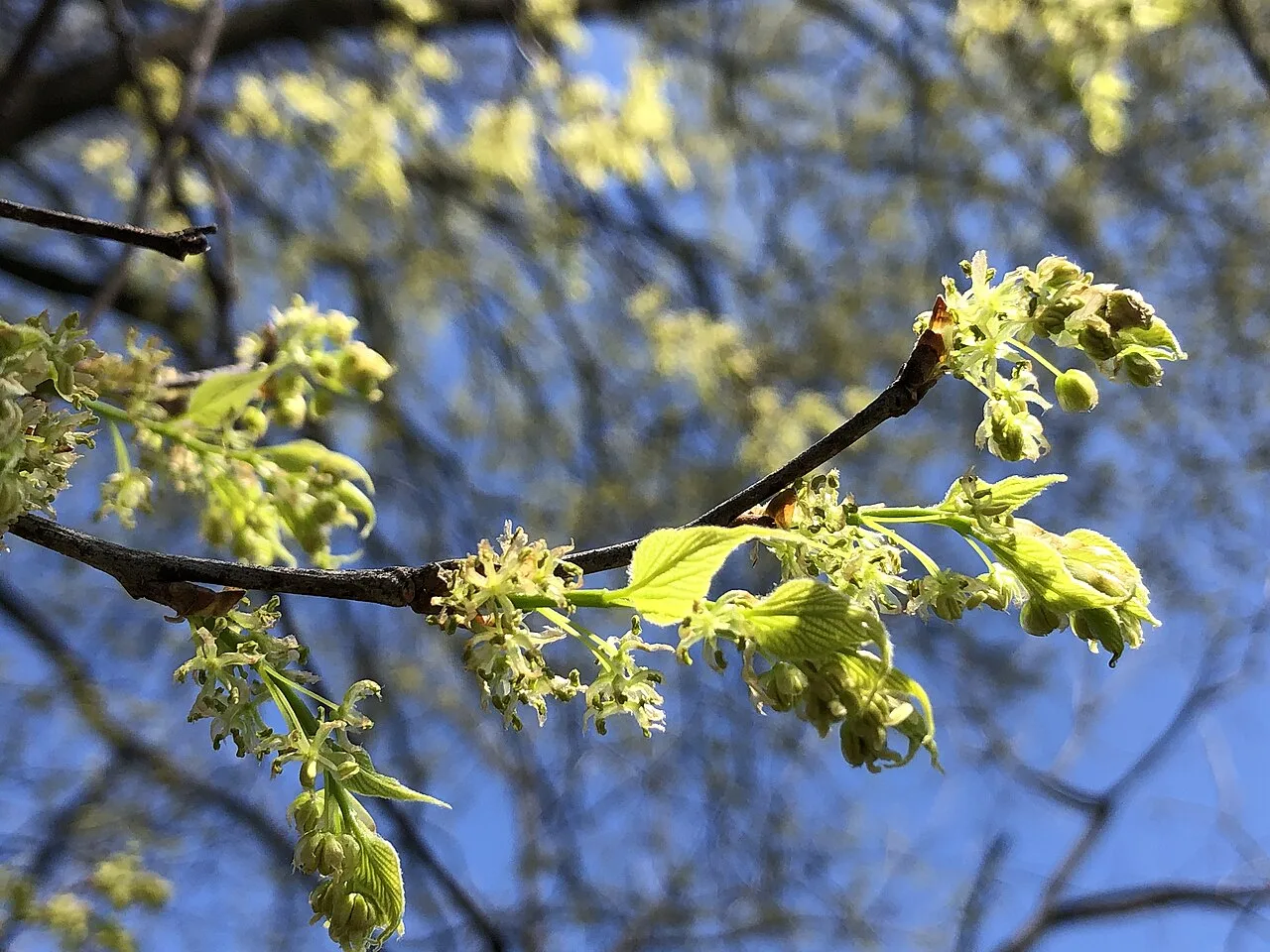
Hackberry flowers are inconspicuous and easy to overlook — small, greenish-yellow blossoms borne in the leaf axils in April–May, appearing as the leaves are expanding. The tree is polygamo-monoecious: it carries both male (staminate) and female/perfect flowers on the same tree, often in the same cluster. Pollination is by wind, and a single tree can set fruit without a partner, though cross-pollination improves fruit set. The flowers lack showy petals, and the entire blooming event is subtle enough that most people never notice it — the fruit, not the flower, is how hackberry announces itself.

Fruit & Distinguishing Features

The fruit is a small, spherical drupe ⅓–½ in in diameter, borne on a slender stalk (pedicel) ½–1 in long. In fall (September–October), the drupes turn orange-brown to dark reddish-purple and the thin, sweet flesh surrounds a single large, hard, stony seed. The flavor is mildly sweet and pleasant, reminiscent of a date or a raisin with a hint of molasses. The fruit persists on the tree well into winter — you will see hackberry trees in December and January with bare branches studded with dark drupes, an instantly recognizable winter silhouette. Key distinguishing features: the unique corky/warty bark; the asymmetrical leaf base combined with a rough-sandpapery upper surface; and the tiny, date-like, persistent winter fruits.

Habitat & Range in NE Oklahoma

Celtis occidentalis has one of the widest distributions and broadest habitat tolerances of any North American tree, ranging from southern Canada to the Gulf Coast. It is common throughout Oklahoma, and in the northeast part of the state it occurs in bottomland hardwood forests, floodplain terraces, fencerows, upland woods, limestone glades, and urban/suburban landscapes in essentially every county. You will find hackberry growing alongside pecan, sycamore, and black willow in the Arkansas River bottomlands; mixed with post oak and blackjack oak in the drier uplands of the Cross Timbers; and as a volunteer tree in alleys, vacant lots, and neglected corners throughout the city of Tulsa.

Hackberry's ecological flexibility is extreme: it tolerates seasonal flooding in river bottoms and prolonged drought on rocky ridge tops. It grows in soils ranging from deep alluvial silt to heavy, compacted urban clay. It recovers from being partially blown over in windstorms and resprouts vigorously when cut. This is not a fussy tree that requires careful site selection — it is a tree that you plant because it will thrive in the difficult spot where nothing else grows well: the hot, compacted parking lot island, the clay-heavy suburban yard, the degraded fencerow, the low corner of a property that floods briefly after every heavy spring rain.

Ecology & Wildlife Value

[ winter bird fruit · Lepidoptera hosts galore · cavity nesting · urban wildlife ecology ]

Winter Fruit: Birds & Mammals

Hackberry fruit is one of the most important winter wildlife foods in eastern North America. Because the drupes persist on the tree from October through February (and sometimes into March), they provide a reliable food source during the leanest months of the year when virtually all other fruits and insects are gone. The list of bird species that depend on hackberry fruit includes cedar waxwings, American robins, Northern mockingbirds, Eastern bluebirds, yellow-rumped warblers, hermit thrushes, Northern flickers, red-bellied woodpeckers, starlings, blue jays, and wild turkeys. Over two dozen documented bird species consume the fruit. Mammals including raccoons, opossums, squirrels, foxes, and white-tailed deer also feed on fallen hackberries. The fruit is calorie-dense for its size, with a relatively high fat content (from the seed) compared to many other small fruits.

Lepidoptera Hosts

Hackberry is one of the most important Lepidoptera host trees in North America. It is the larval food plant for at least five butterfly species that are entirely or largely restricted to Celtis: the hackberry emperor (Asterocampa celtis), the tawny emperor (A. clyton), the question mark (Polygonia interrogationis), the mourning cloak (Nymphalis antiopa), and the American snout (Libytheana carinenta). The hackberry emperor, in particular, is rarely found far from its host tree, and a mature hackberry in a Tulsa yard will reliably host a population. The tree also supports numerous moth species, and the dense foliage provides forage for a wide insect community that in turn feeds insectivorous birds, especially during the nesting season.

Cavity Nesting & Habitat Structure

Hackberry is prone to developing heartwood decay as it ages, which creates natural cavities that are used by woodpeckers, chickadees, titmice, nuthatches, Eastern screech owls, flying squirrels, and bats. A dead or dying hackberry limb left in place (as long as it does not pose a safety risk) is a wildlife apartment building. The tree's dense, twiggy branching provides excellent nesting substrate for songbirds, and the rough bark hosts lichens, mosses, and a diverse community of small arthropods that are gleaned by foraging birds year-round.

Nipple Gall & Insect Ecosystem

Hackberry leaves are famously host to the hackberry nipple gall psyllid (Pachypsylla celtidismamma), a small insect that induces the formation of small, round, nipple-like galls on the underside of the leaves. The galls are conspicuous and sometimes alarming to homeowners who notice them, but they are entirely harmless to the tree — hackberry and its gall-makers have been co-evolving for millions of years, and a heavily galled tree is a healthy, ecologically functional tree. The psyllid larvae inside the galls are an important food source for chickadees, warblers, and other small insectivorous birds. The galls themselves are a fascinating miniature ecosystem, with parasitoid wasps, mites, and inquilines all living inside and on them. In the ecological sense, hackberry nipple galls are a feature, not a bug.

Horticulture & Care

[ site selection · planting · urban tolerance · maintenance · companion planting · food forest role ]

Site selection & planting

Hackberry is one of the most bulletproof native shade trees available for the NE Oklahoma landscape. It accepts nearly any soil, pH, moisture regime, and exposure, and it transplants readily from container or ball-and-burlap stock.

Maintenance

Pests & diseases

Companion planting & food forest integration

Hackberry functions as a canopy or sub-canopy tree in a multi-story food forest or native landscape planting. Pairs well with: pecan, American sycamore, black cherry, and Shumard oak in a bottomland/high-canopy layer; pawpaw, American persimmon, and red mulberry in the understory layer beneath; roughleaf dogwood, American hazelnut, and spicebush in the shrub layer; and wild ginger, Solomon's seal, and Christmas fern as shade-tolerant groundcovers. Hackberry's light, dappled shade is easier to plant beneath than the deep shade of a dense-canopied oak or maple, making it a good choice for a food forest where you want productive understory plants.

Edible & Cultural Uses

Hackberry fruit is small — mostly seed with a thin layer of sweet flesh — but it is perfectly edible and has been consumed by Indigenous peoples across North America for thousands of years. The tree is not a "fruit tree" in the orchard sense, but its drupes are a genuinely useful wild food, especially in winter when little else is available.

One tree, dozens of species. If you were to plant exactly one native tree in a NE Oklahoma landscape for maximum wildlife benefit, hackberry would be on the very short list, alongside oaks and black cherry. It feeds winter birds when nothing else does, hosts five butterfly species, provides cavity nesting and roosting habitat, supports a micro-ecosystem of gall insects and their predators, and will survive the soil compaction, drought, and neglect that kill lesser trees. It is not the prettiest tree, but it may be the hardest-working.

Photo Reference

Celtis occidentalis — flowering habit
// Celtis occidentalis — flowering habit
Wikimedia Commons
Celtis occidentalis — foliage & form
// Celtis occidentalis — foliage & form
Wikimedia Commons
Celtis occidentalis — flower detail
// Celtis occidentalis — flower detail
Wikimedia Commons
Celtis occidentalis — in habitat
// Celtis occidentalis — in habitat
Wikimedia Commons
Celtis occidentalis — fruit / seed
// Celtis occidentalis — fruit / seed
Wikimedia Commons

Sources & Further Reading

  • USDA NRCS PLANTS Database — Celtis occidentalis: plants.usda.gov/plant-profile/CEOC
  • Lady Bird Johnson Wildflower Center — Native Plant Database: wildflower.org — CEOC
  • Oklahoma State University Extension — Native Tree Selection for Oklahoma Landscapes (hackberry highly recommended for urban sites).
  • Tallamy, D.W. (2007). Bringing Nature Home. Timber Press — Celtis as a premier Lepidoptera host genus.
  • Dirr, M.A. (2009). Manual of Woody Landscape Plants. Stipes Publishing — thorough treatment of hackberry in cultivation.
  • Moerman, D.E. (1998). Native American Ethnobotany. Timber Press — extensive records of indigenous food and medicinal uses of Celtis fruit.
  • Wheeler, A.G. (2001). Biology of the Hackberry Nipplegall Maker. Cornell University Press — the ecology of the hackberry-psyllid relationship.
  • Wikipedia — Celtis occidentalis: en.wikipedia.org/wiki/Celtis_occidentalis (CC BY-SA 4.0; portions of the description, ecology and uses sections summarize Wikipedia content).

Hero photo: Rooted Revival. Strip photos courtesy of Wikimedia Commons contributors under their respective licenses (linked under each image).