// SPECIES PROFILE · PERENNIAL · NATIVE · WOODLAND AROID
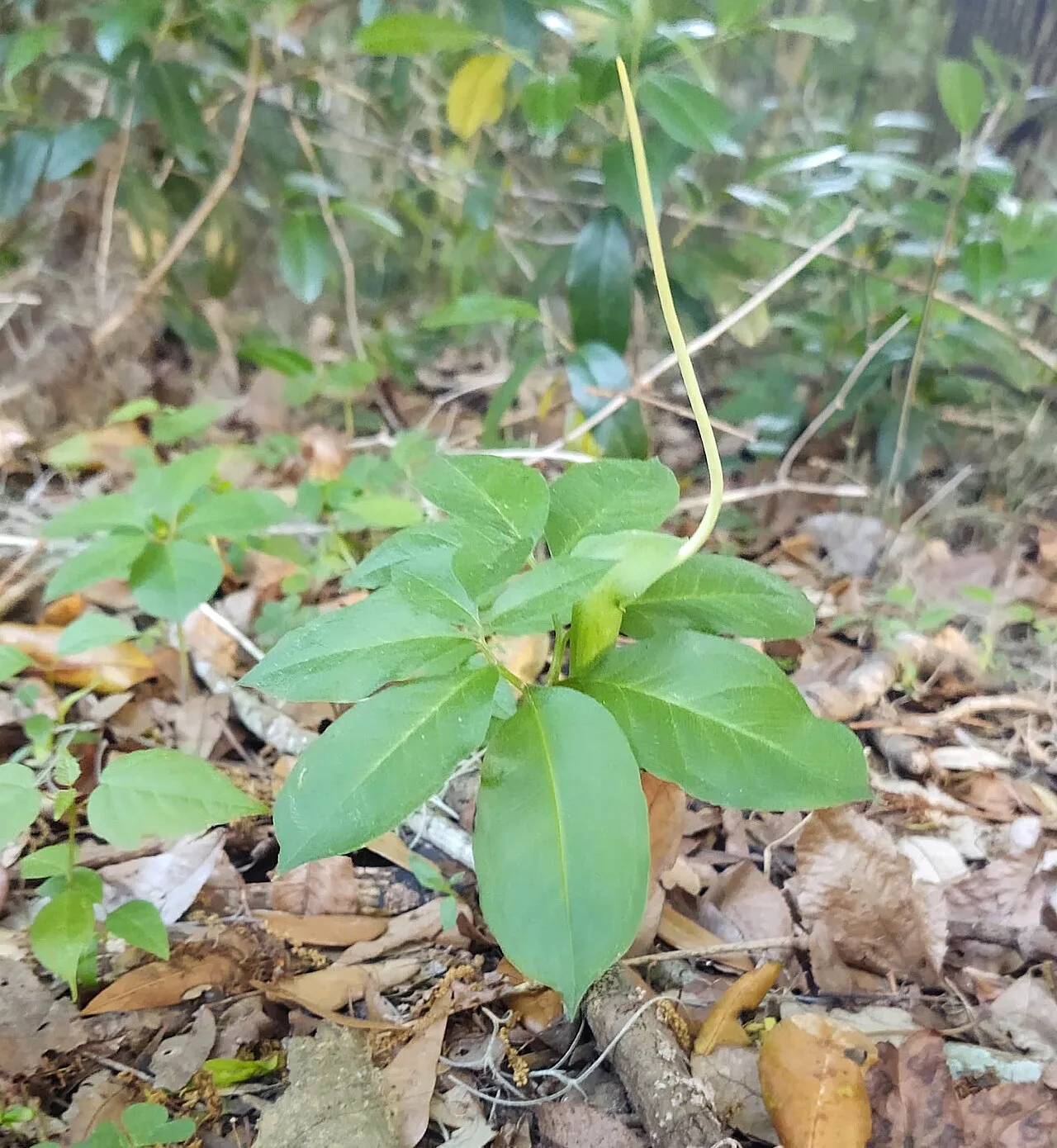
The Green Dragon is one of those plants that stops a woodland walker dead in their tracks — not because it is showy in the conventional sense, but because it looks like something a botanist dreamed up after too much coffee. Arisaema dracontium is a native woodland aroid, a close cousin to the more familiar Jack-in-the-pulpit (Arisaema triphyllum), but taller, stranger, and considerably less common in the wild. Its single compound leaf, typically divided into 7–13 narrow leaflets radiating like spokes from a central hub, rises on a tall petiole above the forest floor. Beside it, on a separate stalk, the inflorescence is a narrow greenish-yellow spathe from which emerges a long, whip-thin spadix that extends 3–8 inches beyond the opening — the "dragon's tongue" that gives the plant its common name. In Tulsa's river-bottom forests it flowers in May and June, then develops a cylindrical cluster of orange-red berries by late summer that is striking against the fading green of the woodland floor.

[ field key — leaf · spathe · spadix · fruit · distinction from Jack-in-the-pulpit ]
A single compound leaf (occasionally two on robust plants) emerges on a tall, smooth petiole 12–30 in long. The blade is divided into 7–13 narrow, lanceolate to elliptic leaflets, each typically 4–12 in long and arranged in a palmate-umbellate fashion — all arising from a central point like the spokes of an umbrella. This is the key vegetative distinction from Jack-in-the-pulpit, whose leaves are typically divided into only 3 leaflets (two large lateral + one terminal). The leaflets of Green Dragon are narrower, more numerous, and more finely textured, with a glossy dark green upper surface and a paler, dull underside. The petiole is smooth and often sheathed at the base with a few scale-like cataphylls.
The inflorescence rises on a separate, shorter peduncle near the base of the leaf petiole. The spathe (the modified bract that encloses the inflorescence in all aroids) is narrow, tubular, and pale green to greenish-yellow, typically 2–3 in long, with a pointed, hood-like tip that arches forward over the opening. Emerging from within is the spadix, a thin, cylindrical fleshy spike that carries the tiny true flowers at its base (hidden inside the tube) and extends as a long, whip-like sterile appendage 3–8 in long that hangs out of the spathe like a tongue — the "dragon" feature. The appendage is yellowish-green and gradually tapers to a fine thread. The true flowers are unisexual, with separate male and female zones on the lower spadix; plants may change sex from year to year depending on stored energy in the corm.
If pollination is successful (see Ecology), the spadix develops into a cylindrical cluster of bright orange-red berries, each about ¼–⅓ in across, maturing in August and September. The fruit cluster rises on the same stalk that held the spathe and stands out vividly against the now-tattered leaf and the brown leaf litter of the woodland floor. Each berry contains 1–3 seeds. The fruit is attractive and tempting to children — a warning: like all aroids, all parts of Arisaema dracontium contain calcium oxalate crystals that cause intense burning and swelling of the mouth and throat if consumed raw. The bright color is a signal to birds, not a dinner invitation for humans.
Two closely related Arisaema species grow in NE Oklahoma, and confusing them is common. The key differences are: Leaflets — Green Dragon: 7–13 narrow leaflets; Jack-in-the-pulpit (A. triphyllum): 3 broad leaflets. Spathe — Green Dragon: pale green, narrow, hood arches gently; Jack-in-the-pulpit: often striped green and purple-brown, larger, with a more pronounced hood that curves over the opening like a canopy. Spadix appendage — Green Dragon: long, thin, whip-like, extending well beyond the spathe; Jack-in-the-pulpit: shorter, club-shaped and thickened. Habitat — Green Dragon favors wetter, lower-elevation bottomland sites; Jack-in-the-pulpit tolerates drier upland woods and is more common throughout the region.
Arisaema dracontium reaches the southwestern limit of its range in eastern Oklahoma, where it is associated with the region's major river systems. The strongest populations are found in moist alluvial woods and bottomland forests along the Arkansas River, the Verdigris River, and the Neosho/Grand River — especially in the floodplain terraces that experience periodic spring flooding and maintain deep, silty, organic-rich soils. The species also occurs in smaller populations along tributary creeks with consistent groundwater seepage, including drainages of the Illinois River basin in Cherokee and Adair counties.
Within these bottomland forests, Green Dragon grows in the herbaceous understory beneath a canopy of sycamore, pecan, American elm, green ash, and sugarberry — the classic floodplain forest assemblage of the Arkansas River valley. It is typically found in the more mesic microsites: slight depressions that hold moisture, the base of low natural levees, and the margins of sloughs and oxbow lakes where the water table stays within a few feet of the surface through the growing season. The species is less common in the drought-prone Cross Timbers uplands of the immediate Tulsa vicinity but can be cultivated successfully in a heavily amended shade garden with consistent supplemental irrigation.
[ fungus-gnat pollination · sex change · calcium oxalate defense · birds · Myodochilus ]
Like many woodland aroids, Arisaema dracontium employs a deceptive fungus-gnat pollination syndrome. The spathe emits a faint, mushroom-like odor that attracts Mycetophilidae and Sciaridae (fungus gnats) seeking oviposition sites on fungi. The gnats enter the spathe tube, become trapped temporarily by the slick inner walls and downward-pointing hairs, and in their confused movements transfer pollen from male-phase flowers to female-phase flowers. The plant is protandrous (male flowers mature first), and individual plants can switch between male, female, and non-flowering states from year to year. This sequential hermaphroditism is tied to the carbohydrate reserves in the corm: well-fed, robust plants produce female flowers (which are energetically expensive due to fruit production); smaller or stressed plants produce male flowers or none at all.
The foliage of Arisaema species is host to the larvae of several sphinx moth (Sphingidae) species in parts of the range, though documentation for Oklahoma specifically is sparse. The more significant relationship is with slugs and snails, which feed heavily on the tender emerging shoots in wet springs — one reason wild populations are often patchy. The calcium oxalate crystals (raphides) that protect mature tissues develop fully only as the leaf hardens, so early-season emergence is the plant's most vulnerable window. White-tailed deer browse is generally light due to the oxalate content, but hungry deer in high-density populations will sample young leaves.
The bright orange-red berry clusters are consumed and dispersed by wild turkey, wood thrushes, American robins, and several other woodland bird species. The seeds pass through the gut intact and are deposited with a dose of fertilizer. This bird-mediated dispersal explains how a plant with heavy, non-wind-dispersed seeds manages to colonize new floodplain sites — birds carry the fruit from one bottomland fragment to another along riparian corridors. The berries are also eaten by box turtles, which are important secondary dispersers in floodplain habitats.
Green Dragon is a mesic-site indicator species — its presence signals moist, fertile, seasonally dynamic soils that support high floristic diversity. In the Arkansas River bottomlands, it grows in association with several species of conservation concern and is part of a distinctive guild of floodplain-adapted aroids, ferns, and spring ephemerals that collectively define the herbaceous layer of this increasingly fragmented habitat. The species is sensitive to hydrologic alteration: dredging, levee construction, and lowered water tables due to agricultural drainage all reduce or eliminate populations. In Oklahoma it is not state-listed but is considered uncommon and local, warranting protection of remaining bottomland forest fragments on private land.
[ corm planting · moisture · shade · companion design · container culture ]
Site Green Dragon where it will receive dappled to full shade and consistent soil moisture through the growing season. The ideal location mimics the floodplain understory: a low, sheltered area on the north or east side of a house, beneath deciduous canopy, or along a shaded drainage swale. In Tulsa gardens, this often means a rain-garden basin, a shaded corner where downspouts discharge, or an artificially irrigated woodland bed. Soil should be deep, loose, and high in organic matter — amend heavy clay with 4–6 in of leaf mold, composted hardwood bark, and coarse sand worked into the top 12 in. Plant dormant corms in fall (October–November) or potted plants in spring. Set corms 3–4 in deep with the growing point (the small depression or bud at the top) oriented upward.
Green Dragon fits beautifully into a moist woodland planting alongside other bottomland-adapted perennials. Excellent companions include: ostrich fern (Matteuccia struthiopteris) for a tall, lush textural backdrop, maidenhair fern (Adiantum pedatum) for delicate contrast, wild ginger (Asarum canadense) for a low evergreen ground layer, cardinal flower (Lobelia cardinalis) for a burst of red in the damp soil at the woodland edge, and true Solomon's seal (Polygonatum biflorum) for arched foliage complementing the umbrella-like leaf of the Green Dragon. Under taller canopy species such as American sycamore (Platanus occidentalis), pecan (Carya illinoinensis), and river birch (Betula nigra), a drift of Green Dragon mixed with sensitive fern (Onoclea sensibilis) and Virginia Bluebells creates an authentic bottomland ground layer that is as ecologically sound as it is visually distinctive.
Important caution: Unlike some native plants with edible parts after proper preparation, Arisaema dracontium should be treated as inedible and potentially dangerous if mishandled. All parts contain needle-sharp calcium oxalate crystals (raphides) that cause immediate, intense burning and swelling of the mouth, throat, and digestive tract if consumed raw. Some ethnobotanical sources report that the corm was dried and used medicinally by the Cherokee and other Eastern Woodland peoples after extensive processing (prolonged drying, roasting, or repeated boiling) to break down the oxalate crystals, but even then the primary use was medicinal, not culinary. Traditional applications included poultices for skin ailments and a dried-root preparation for respiratory complaints, though the efficacy and safety of these uses have not been clinically evaluated.

Hero photo: Rooted Revival. Strip photos courtesy of Wikimedia Commons contributors under their respective licenses (linked under each image).