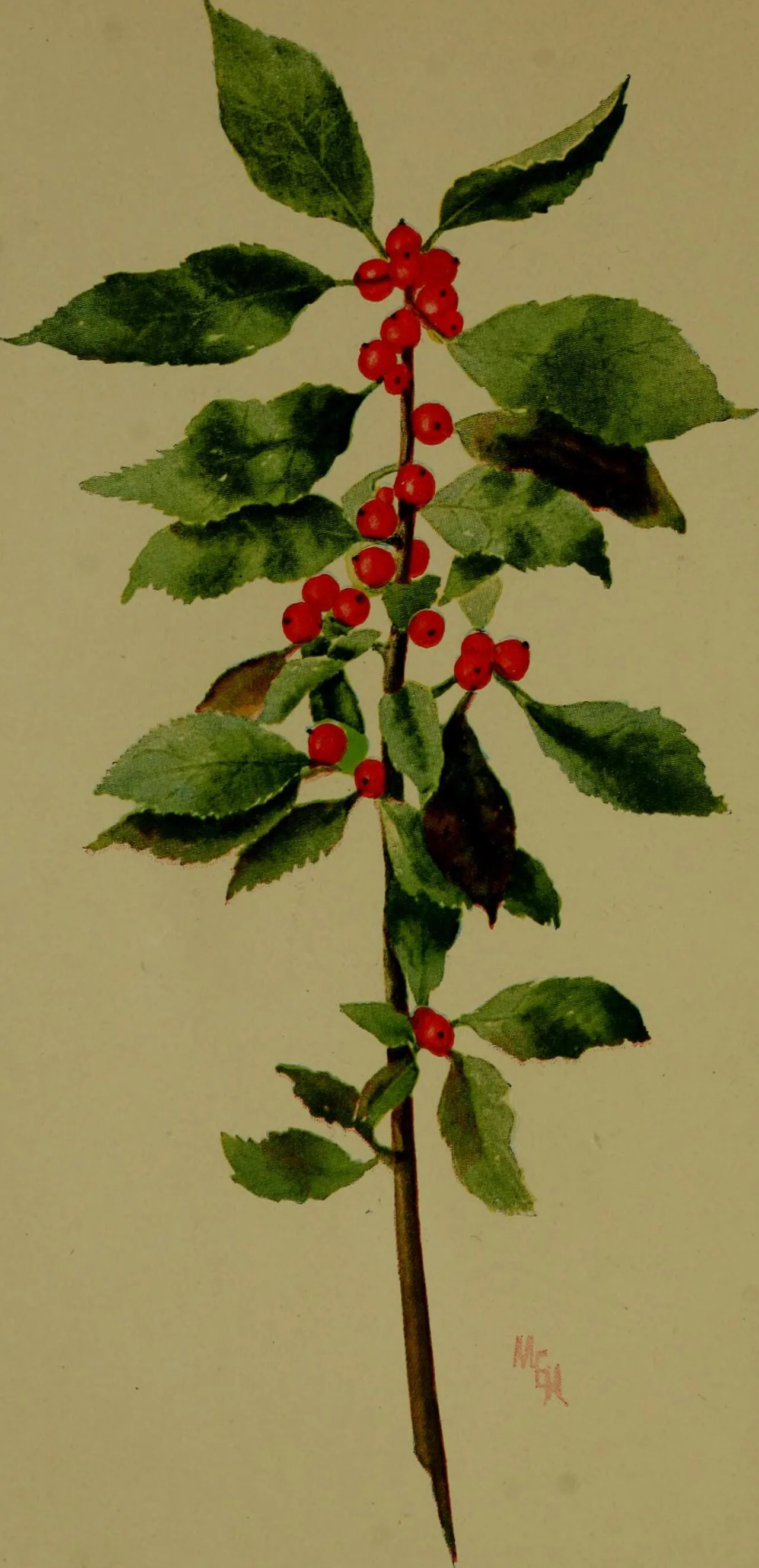
Horticulture & Care
[ acidic wet soil · male pollinator · cultivars · pruning · propagation ]
Site selection & soil
Winterberry requires acidic, consistently moist to wet soil and full sun to part shade. In NE Oklahoma, its success depends almost entirely on soil chemistry: winterberry is an obligate acidophile and will develop severe iron chlorosis (yellowing between leaf veins) in neutral or alkaline soils. Test your soil pH before planting; if it is above 6.5, you must either amend or grow winterberry in an alternative setup. The species tolerates heavy clay and poor drainage better than most woody ornamentals, which is one reason it thrives in rain gardens and detention basins — it can handle both saturated spring conditions and the occasional dry summer spell once established.
- Acidifying amendments: Work elemental sulfur (slow-release: 1–2 lbs per 100 sq ft), peat moss, or cottonseed meal into the planting hole and surrounding soil. Aluminum sulfate works faster but is harsher on soil biology. Top-dress annually with pine needles or shredded oak leaves to help maintain acidity over time.
- Container/raised-bed alternative: If your native soil is above pH 7.0, grow winterberry in a large half-barrel or raised bed filled with a 50:50 mix of acidic potting soil and peat moss. This is the most reliable approach for Tulsa's alkaline-clay soils.
- Sun exposure: Full sun (6+ hrs) yields the heaviest berry set. Winterberry will grow in partial shade but produces significantly fewer flowers and fruit. In NE Oklahoma, afternoon shade can reduce heat stress on the foliage during July–August.
- Spacing: 4–8 ft between plants depending on cultivar size; plant a male within 40 ft of each group of females.
- Water: During the first two growing seasons, provide supplemental water weekly if rainfall is insufficient. Once established, winterberry tolerates occasional drought but will drop leaves and abort fruit under sustained dry conditions.
Pollination requirements
Winterberry is strictly dioecious — you must plant at least one male pollinator for fruit set. Males do not produce berries themselves, so expect some wasted space in your planting for the sake of the show. Matching bloom time is critical: early-flowering female cultivars (e.g., 'Red Sprite') need early-blooming males (e.g., 'Jim Dandy'); late-flowering females (e.g., 'Winter Red', 'Berry Heavy') need late-blooming males (e.g., 'Southern Gentleman', 'Apollo'). One male can pollinate 5–10 females within a 40–50 ft radius. If you plant a lone female with no male nearby, you will get no berries — this is the single most common reason for winterberry disappointment.
Pruning & maintenance
- Renewal pruning: Remove up to one-third of the oldest, thickest stems at ground level in late winter (February–March) before new growth begins. This stimulates vigorous new suckers from the base and keeps the colony youthful. Winterberry blooms and fruits on new wood (current-year growth), so a hard prune in late winter will not sacrifice that year's berry display.
- Shape pruning: If the colony is expanding beyond its designated space, simply cut unwanted suckers at ground level at any time of year.
- Harvesting for cut stems: Cut berry-laden stems any time after the berries have fully colored (late October onward). They will last 2–3 weeks in water indoors. Remove leaves by hand or they will wilt before the berries do.
- Fertilizer: Winterberry is not a heavy feeder. An annual spring top-dressing of compost or a light application of an acidic fertilizer (formulated for azaleas/rhododendrons, e.g., 10-10-10 with iron) is sufficient. Over-fertilizing with nitrogen produces rank, soft growth that is prone to wind damage and reduces flowering.
Pests & diseases
- Iron chlorosis: The most common problem in NE Oklahoma. Yellow leaves with green veins = the soil is too alkaline and iron is unavailable. Correct with sulfur and iron chelate.
- Leaf spot (Phyllosticta and Septoria spp.): Small brown spots on leaves in wet summers. Cosmetic; rake up fallen leaves in autumn to reduce inoculum.
- Powdery mildew: White powdery coating on leaves in late summer, especially in shaded sites with poor air circulation. Rarely serious; thin the shrub to improve airflow if persistent.
- Scale insects: Occasionally appear on stems; horticultural oil applied in dormancy controls them.
- Deer browsing: Winterberry is rated as moderately deer-resistant — deer will browse it under severe pressure but generally prefer other shrubs (arborvitae, hosta, daylily). Newly planted specimens are most vulnerable.
Notable cultivars
| Cultivar |
Sex |
Fruit / Pollen |
Size |
Bloom group |
Notes |
| 'Winter Red' | Female | Abundant bright red berries, persistent | 6–8 ft | Late | Industry standard; extremely heavy fruiting; needs 'Southern Gentleman' or 'Apollo' |
| 'Red Sprite' (a.k.a. 'Nana', 'Compacta') | Female | Very large red berries on compact shrub | 3–4 ft | Early | Best for small gardens and containers; pollinate with 'Jim Dandy' |
| 'Berry Heavy' | Female | Extremely heavy berry set, deep scarlet | 6–8 ft | Late | As advertised; branches bow under the weight of fruit |
| 'Berry Nice' | Female | Very dense bright red fruits | 6–8 ft | Late | Pollinate with 'Southern Gentleman' |
| 'Winter Gold' | Female | Golden-orange berries | 6–8 ft | Late | Striking orange variant; needs late male; berries tend to be consumed earlier by birds than red cultivars |
| 'Afterglow' | Female | Orange-red berries | 6–10 ft | Late | Larger shrub; fruit color is between red and orange |
| 'Aurantiaca' | Female | Bright orange-yellow | 5–6 ft | Early | Heritage selection; unusual color; pollinate with 'Jim Dandy' |
| 'Cacapon' | Female | Dark glossy red, persistent, compact | 4–5 ft | Late | Excellent smaller female with good branch structure for cut stems |
| 'Sparkleberry' | Female | Bright red, small but extremely numerous | 6–12 ft | Late | Larger habit; can reach 12 ft in rich wet soil |
| 'Jim Dandy' | Male | Pollen for early-blooming females | 4–6 ft | Early | Pollinates 'Red Sprite', 'Aurantiaca' and other early bloomers |
| 'Southern Gentleman' | Male | Pollen for late-blooming females | 6–8 ft | Late | Pollinates 'Winter Red', 'Berry Heavy', 'Winter Gold', 'Sparkleberry', 'Cacapon' |
| 'Apollo' | Male | Pollen for late-blooming females | 6–10 ft | Late | Vigorous growth; heavy pollen producer; good for large plantings |
Companion planting in rain gardens & wet edges
Winterberry pairs exceptionally well with other acid-tolerant, moisture-loving native shrubs and perennials that share its ecological niche. For a multi-season rain garden or wet-edge planting in NE Oklahoma, combine winterberry with: buttonbush (Cephalanthus occidentalis) for summer flowers and structure, swamp milkweed (Asclepias incarnata) for monarch butterfly habitat, cardinal flower (Lobelia cardinalis) for hummingbirds and late-summer red blooms, sweetbay magnolia (Magnolia virginiana) for evergreen structure and fragrant spring flowers, inkberry holly (Ilex glabra) for year-round evergreen foliage with the same acidic-soil preference, and Virginia sweetspire (Itea virginica) for fragrant white early-summer flowers and brilliant red fall color. Underplant with Christmas fern (Polystichum acrostichoides), cinnamon fern (Osmundastrum cinnamomeum), or crinum lily for textural contrast.
Two must-know cautions for winterberry in Tulsa:
First, soil pH is everything. Winterberry will not thrive in native Tulsa clay without significant amendment or a container setup. If you see yellowing leaves the first season, the pH is too high — correct it immediately or the plant will decline and die within 2–3 years. Second, you must plant a male. Do not buy "one winterberry" at the garden center and expect berries. Without a matching male within 40–50 ft, the female will produce no fruit at all. Check bloom-time compatibility before purchase.