home/ plants/ rusty-blackhaw

// SPECIES PROFILE · SHRUB/TREE · NATIVE · FOUR-SEASON · CROSS TIMBERS STAPLE

Rusty Blackhaw

Viburnum rufidulum

Rusty blackhaw is a large native shrub or small tree 10–20 ft tall with glossy, leathery leaves covered in rusty-brown hairs on the underside, flat-topped clusters of creamy white flowers in spring, and blue-black drupes in fall that are sweet, edible, and taste remarkably like raisins and prunes. Its stunning burgundy-to-purple fall color is among the best of any native woody plant in the Cross Timbers. Viburnum rufidulum is a classic species of dry upland woods, rocky slopes, and glade margins throughout eastern Oklahoma, and it delivers genuine four-season value: spring flowers for pollinators, summer foliage for insect larvae, fall fruit for birds, and deep red-burgundy winter twigs that glow in low-angle light.

// QUICK FACTS
Family
Adoxaceae (moschatel / viburnum family; formerly Caprifoliaceae)
Life cycle
Deciduous perennial large shrub or small tree; long-lived (40–60+ years)
Native range
Southeastern and south-central US — Virginia to Florida, west to Texas and Oklahoma, north to Missouri and Illinois
USDA hardiness
Zones 5–9 (Tulsa = 7a/7b — well within range)
Mature size
10–20 ft tall, 8–15 ft spread; occasionally to 30 ft on rich sites
Bloom
April – May (NE OK)
Flower
Flat-topped clusters (cymes) 3–5 in across; individual flowers creamy white, ¼ in, lightly fragrant
Fruit
Blue-black drupe ⅓–½ in, sweet and edible; ripens September–October; flavor reminiscent of raisins and prunes
Sun
Full sun to partial shade; tolerates open woodland understory conditions
Soil
Well-drained, dry to medium; adaptable to sand, loam, clay, and rocky limestone soils. pH 5.5–7.8
Water
Low to medium; drought-tolerant once established; thrives on dry, rocky sites
Wildlife
Spring nectar for pollinators · larval host for spring azure and hummingbird clearwing moth · fall fruit for birds and mammals
Conservation
G5 — Secure; common in appropriate habitat across range
Rusty Blackhaw (Viburnum rufidulum) — glossy leathery leaves, creamy white flower clusters, and blue-black drupes
Viburnum rufidulum — glossy leaves with rusty-brown undersides, white spring blooms, and sweet blue-black fall fruit. Photo: Rooted Revival.

Identification

[ field key — habit · bark · leaf · flower · fruit · distinguishing features ]

Habit, Bark & Twigs

Rusty blackhaw typically grows as a large, multi-stemmed shrub 10–15 ft tall on dry, thin Cross Timbers soils, but can develop into a small, single-trunked tree 15–25 ft on richer, moister sites at woodland edges. The bark is dark gray-brown to nearly black, developing into rectangular, blocky plates with age — it resembles a miniature version of mature persimmon bark. Twigs are slender, reddish-brown to gray, and covered with a dense, rusty-brown pubescence (short hairs) that gives the plant its common name — the "rusty" descriptor applies to the twigs, leaf undersides, and buds, all of which are conspicuously covered in reddish-brown fuzz when young.

Leaves

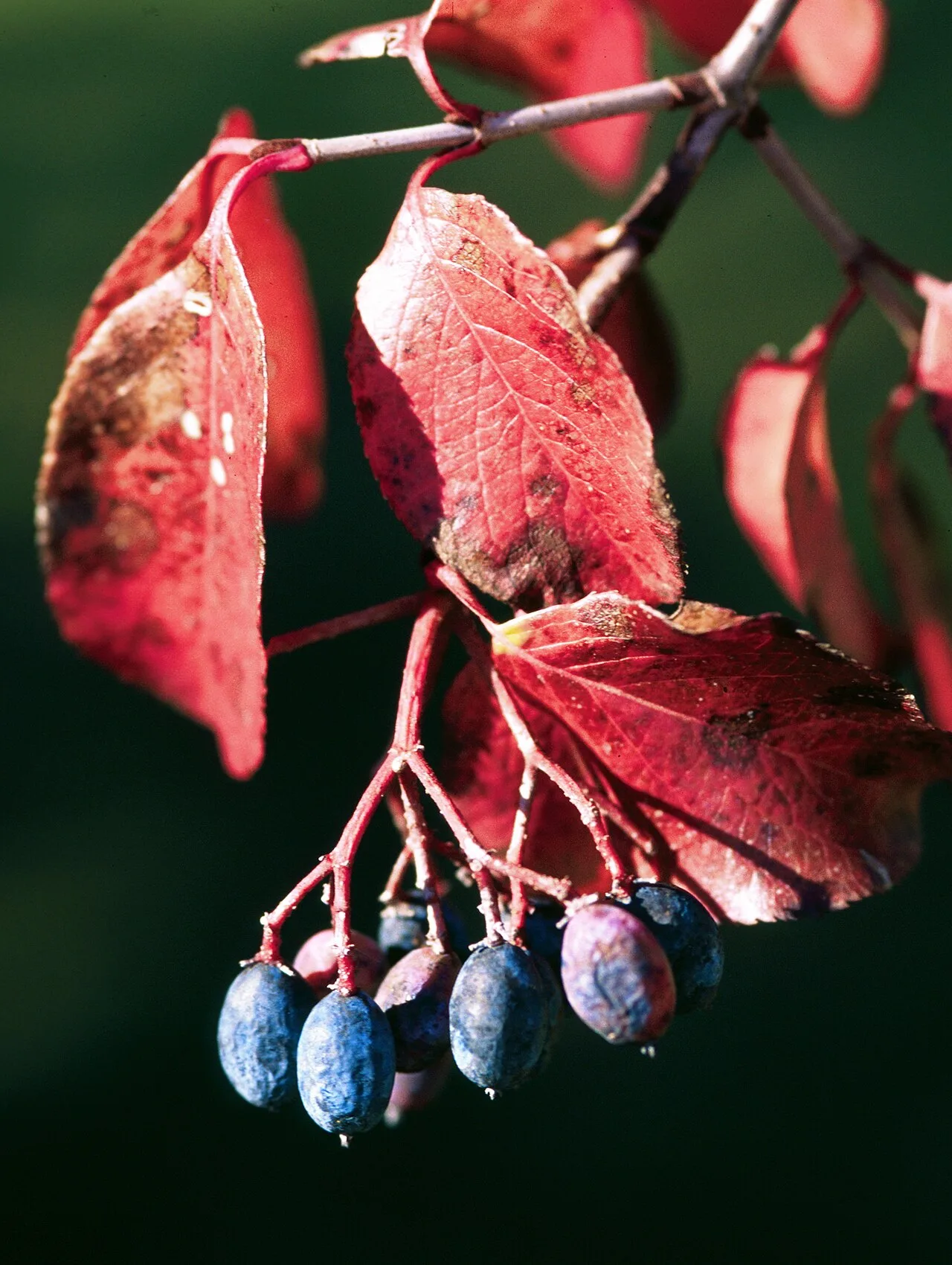
Leaves are simple, opposite, broadly elliptic to obovate, 2–4 in long and 1–2 in wide, with a finely serrated margin and a short, rust-colored, slightly winged petiole. The upper surface is dark green, glossy, and smooth; the underside is paler and covered with a dense mat of rusty-brown, stellate (star-shaped) hairs — the single best field character for identifying the species. The leaves feel noticeably thick and leathery to the touch, more so than most other viburnums. Fall color is spectacular: the leaves turn shades of deep burgundy, maroon, and reddish-purple, often persisting on the tree for several weeks in October–November in the Tulsa region. The rusty leaf undersides remain visible even in fall, creating a striking two-toned effect.

Flowers

The flowers are borne in flat-topped to slightly domed clusters (compound cymes) 3–5 in across, appearing in April to May as the leaves are unfolding. Each individual flower is small (¼ in across), creamy white, five-petaled, and has five protruding stamens with pale yellow anthers. The flowers are mildly fragrant, with a sweet, slightly musky scent. A cluster in full bloom resembles a lacecap hydrangea or a miniature elderberry bloom, but flat-topped rather than domed. The flowers are pollinated by a wide variety of insects and are especially attractive to small bees, syrphid flies, and beetles.

Fruit & Distinguishing Features

The fruit is a blue-black, egg-shaped to spherical drupe ⅓–½ in long, with a single flattened stone inside. The fruits ripen in clusters in September through October, turning from green to pink, then red, and finally dark blue-black with a bluish bloom at full ripeness. The flavor is sweet and rich, resembling a cross between raisins and prunes with a hint of date-like caramel — genuinely pleasant and unlike most wild fruits. The fruit can hang on the tree into early winter or be stripped by birds within days of ripening, depending on the local wildlife population. Key distinguishing features from the similar Viburnum prunifolium (blackhaw): rusty blackhaw has rusty-brown hairs on twigs, buds, and leaf undersides (vs. smooth in blackhaw), more leathery leaves, and prefers drier habitats.

Habitat & Range in NE Oklahoma

Viburnum rufidulum is native across the southeastern and south-central US, with eastern Oklahoma well within its core range. In NE Oklahoma, rusty blackhaw is a characteristic species of the Cross Timbers and Ozark foothill ecoregions, where it grows in dry upland woods, rocky (often limestone) slopes, glade margins, and the open understory of post oak-blackjack oak savannah. It is one of the more common understory shrubs in the hilly, wooded terrain of the Osage Hills, the sandstone ridges of western Rogers County, and the limestone-dominated Ozark front in Cherokee and Delaware counties.

Rusty blackhaw is an indicator of well-drained, often rocky soils in NE Oklahoma — you will find it growing alongside post oak, blackjack oak, black hickory, roughleaf dogwood, fragrant sumac, and coralberry on dry, rocky slopes throughout the region. It is notably drought-tolerant and performs well on the thin, gravelly soils of ridge tops and south-facing exposures that bake in the Oklahoma summer sun. You will rarely encounter it in the moist bottomlands favored by buttonbush or elderberry — rusty blackhaw belongs to the hot, dry uplands.

Ecology & Wildlife Value

[ pollinator value · Lepidoptera hosts · bird fruit · upland understory ecology ]

Pollinator Value

The creamy white spring flower clusters are highly attractive to a broad range of pollinators. Regular visitors in NE Oklahoma include small native bees (andrenids, halictids, small carpenter bees), syrphid flies, tachinid flies, soldier beetles (Chauliognathus), and various wasps. The flat-topped inflorescence serves as a landing platform that is accessible to short-tongued and small pollinators that cannot easily navigate deeper, tubular flowers. The bloom period (late April–May) fills a seasonal gap between the early-spring flush of serviceberry and Mexican plum and the peak of summer meadow flowers.

Lepidoptera Hosts & Insect Ecology

As a Viburnum species, rusty blackhaw serves as a larval host for the spring azure (Celastrina ladon) and the hummingbird clearwing moth (Hemaris thysbe), a day-flying sphinx moth that closely resembles a small hummingbird and is a delight to see hovering at flowers in a garden setting. The foliage supports a community of leaf-feeding beetles, moth larvae, and other insects that in turn feed insectivorous birds during the nesting season.

Fruit: Birds & Mammals

The blue-black drupes are consumed by a wide variety of wildlife. Key bird species include Northern cardinals, Eastern bluebirds, cedar waxwings, American robins, brown thrashers, gray catbirds, wild turkeys, bobwhite quail, and several woodpeckers. Mammals including foxes, raccoons, opossums, striped skunks, and white-tailed deer feed on the fallen fruit. The crop can be abundant in good years, and the fruit's high sugar content makes it a preferred energy source in the early fall, just as animals are preparing for winter.

Upland Understory Ecology

In the Cross Timbers woodland community, rusty blackhaw occupies the mid-level shrub/small-tree stratum beneath the oak-hickory canopy. Its deep, drought-resistant root system accesses moisture in rock fissures, and its dense, leathery leaves create a shady, cooler microclimate at ground level during the heat of July and August — a small but real thermal refuge for ground-nesting bees, amphibians, and small mammals. The species' tolerance of fire and drought makes it a resilient component of the oak savannah community, persisting through the periodic burns and dry spells that define the Cross Timbers ecology.

Horticulture & Care

[ site selection · planting · maintenance · pruning · companion planting · food forest role ]

Site selection & planting

Rusty blackhaw is one of the most problem-free and adaptable native woody plants for NE Oklahoma landscapes, particularly for dry, rocky, well-drained sites where many other shrubs struggle. It is not demanding about soil and rewards neglect with better form and flowering than heavy-handed care.

Maintenance & pruning

Companion planting & food forest integration

Rusty blackhaw fits naturally in the shrub / small-tree layer of a Cross Timbers-style food forest or native landscape planting. Pairs well with: post oak, blackjack oak, and chinkapin oak in the overstory canopy; fragrant sumac, coralberry, and roughleaf dogwood as companion shrubs; aromatic aster, purple coneflower, little bluestem, and prairie dropseed in the herbaceous understory; and sparkleberry and New Jersey tea as understory shrubs beneath widely spaced canopy trees. In the food forest specifically, rusty blackhaw functions as a pollinator-support and wildlife-fruit shrub with the bonus of edible fruit for the grower. Plant it in a sunny glade edge or along the south-facing margin of a tree planting, where it will receive full sun during bloom and fruit development.

Edible & Cultural Uses

Rusty blackhaw fruit is one of the more underappreciated wild edibles in the eastern Oklahoma landscape. The blue-black drupes, when fully ripe, are sweet, rich, and reminiscent of raisins and prunes, with a pleasant texture and a single, easily removed stone. They can be eaten fresh, processed into preserves, or dried and used like raisins. The fruit's relatively large size (for a wild viburnum), sweet flavor, and generous yield make it a genuinely useful native food plant.

The four-season native shrub. In a region where many native plants shine in one or two seasons and then recede into the background, rusty blackhaw earns its place in every month of the year: creamy white pollinator flowers in April–May; glossy dark green foliage hosting butterfly larvae all summer; raisin-sweet blue-black fruit in September–October; and deep burgundy-purple fall foliage into November, followed by rust-colored winter twigs that catch the low winter sun. It is difficult to name another native shrub in the Cross Timbers that delivers so much across the full calendar.

Propagation & nursery notes

Rusty blackhaw is propagated by seed or softwood cuttings, though seed propagation is the more common method for native stock production. The fruit contains a single flattened stone that requires warm-moist stratification followed by cold-moist stratification (typically 60–90 days warm, then 60–90 days cold) to break dormancy. Simply sowing fresh seed in fall and allowing nature to provide the temperature cycles over two winters is the simplest approach for the home grower, though germination is often low (20–40%). Seed-grown plants typically flower in 4–6 years. Container-grown rusty blackhaw is available from native plant nurseries in Oklahoma and surrounding states, though it is less common in mainstream garden centers. When purchasing, look for plants grown from locally collected seed — the species has a broad geographic range, and plants of Texas or Florida provenance may leaf out too early for the NE Oklahoma climate, risking frost damage to new growth.

Landscape design notes

Rusty blackhaw is versatile in the designed landscape. It works as a specimen small tree in a front yard or courtyard, pruned to reveal its attractive blocky bark and layered branching structure. It can be used as a deciduous screening shrub in a mixed hedge with roughleaf dogwood, American hazelnut, and fragrant sumac. In a woodland garden, it provides a mid-level structure beneath post oak or black tupelo, its glossy summer leaves catching filtered light and its fall color glowing against the darker trunks of the canopy trees. The species is not well suited to sheared hedges or formal gardens — its charm is in its natural, slightly irregular, layered form, and it should be allowed to develop that character without heavy-handed pruning.

Photo Reference

Rusty blackhaw flowers — flat-topped clusters of creamy white, April-May
// Flowers — flat-topped cymes of creamy white blooms, pollinator magnets in April–May
Wikimedia Commons
Wikimedia Commons
Rusty blackhaw fruit — blue-black drupes ripening in clusters, September-October
// Fruit — blue-black drupes, sweet and raisin-like when fully ripe
Wikimedia Commons
Rusty blackhaw fall color — deep burgundy-purple leaves on a small tree
// Fall color — spectacular deep burgundy-purple foliage, among the best native fall colors
Wikimedia Commons
Wikimedia Commons
Rusty blackhaw leaves — glossy upper surface with rusty-brown pubescent underside
// Leaves — glossy dark green above, dense rusty-brown hairs below (diagnostic character)
Wikimedia Commons
Wikimedia Commons
Rusty blackhaw bark — dark, blocky, rectangular plates on a mature trunk
// Bark — dark gray-brown, developing rectangular blocky plates with age
Wikimedia Commons
Wikimedia Commons

Sources & Further Reading

  • USDA NRCS PLANTS Database — Viburnum rufidulum: plants.usda.gov/plant-profile/VIRU
  • Lady Bird Johnson Wildflower Center — Native Plant Database: wildflower.org — VIRU
  • Oklahoma State University Extension — Native Shrub Selection for Oklahoma Landscapes (includes Viburnum rufidulum).
  • Dirr, M.A. (2007). Viburnums: Flowering Shrubs for Every Season. Timber Press — comprehensive treatment of the genus, including V. rufidulum.
  • Tallamy, D.W. (2007). Bringing Nature Home. Timber Press — native Viburnum as Lepidoptera host genus.
  • Moerman, D.E. (1998). Native American Ethnobotany. Timber Press — indigenous uses of Viburnum species.
  • Wikipedia — Viburnum rufidulum: en.wikipedia.org/wiki/Viburnum_rufidulum (CC BY-SA 4.0; portions of the description, ecology and uses sections summarize Wikipedia content).

Hero photo: Rooted Revival. Strip photos courtesy of Wikimedia Commons contributors under their respective licenses (linked under each image).