// SPECIES PROFILE · TREE · NATIVE · WHITE OAK GROUP
The White Oak is the titan of eastern North American woodlands — a massive, round-crowned tree that can live 300 to 500 years and reach heights of 80–100 ft. It is the tree that gave its name to the white oak group (section Quercus): leaves with rounded lobes without bristle tips, light gray scaly bark, and acorns that mature in a single growing season with sweeter, less tannic nutmeats than red oaks. Quercus alba is the archetype of the "good mast" tree — its acorns are the most preferred by wildlife among all oaks, and they germinate in fall rather than storing over winter. In NE Oklahoma, White Oak anchors the well-drained upland woods and north-facing slopes of the Ozark foothills, growing more slowly than red oaks but constructing a trunk that, given a century or two, becomes one of the largest-diameter trees in the eastern forest. It is the tree to plant if your ambitions stretch beyond a single human life span.

[ field key — bark · leaf · acorn · habit · distinguishing from other white oaks ]
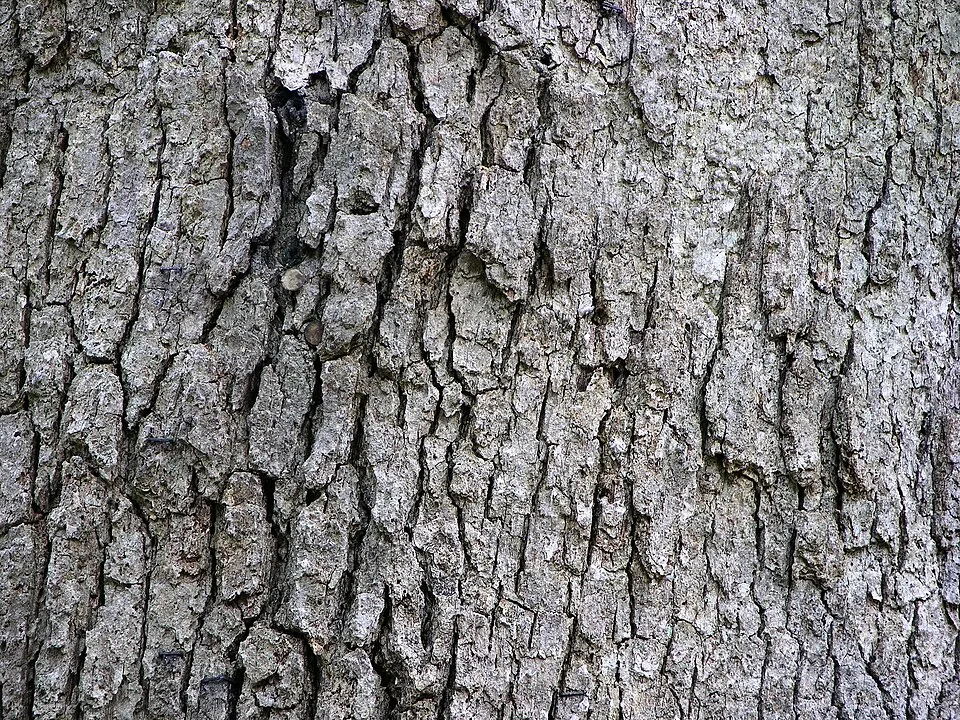
A massive deciduous tree with a broad, rounded crown when open-grown and a tall, straight trunk in forest stands. The bark is the classic "white oak" type: light ash-gray, broken into loose, scaly rectangular plates or shaggy strips. Older trees develop deeply furrowed bark on the lower trunk. Twigs are slender, reddish-brown, and hairless; winter buds are small, blunt, and clustered at branch tips. The overall silhouette in winter is open and often irregular, with stout, spreading limbs. In NE Oklahoma, mature specimens commonly reach 70–90 ft with trunk diameters of 2–4 ft.
Alternate, simple, 4–8 in long, with 5–9 rounded lobes that are entirely smooth-margined — no bristle tips anywhere. This is the single most reliable character for separating white oaks from red oaks. The sinus depth is variable: some leaves are deeply cut nearly to the midrib, others are shallowly lobed. Upper surface is smooth, dark green, and often glaucous when young; the lower surface is pale whitish-green and hairless, giving the leaf a two-toned appearance. Fall color ranges from rich burgundy to purplish-red and can be spectacular in good years. Leaves often persist (marcescent) on lower branches through winter, especially on young trees.
Monoecious. Male catkins are slender, yellowish-green, 2–3 in long, emerging with the new leaves in mid-April. Female flowers are tiny, reddish-green, in small spikes at leaf axils. Wind-pollinated. In NE Oklahoma, flowering coincides with Eastern Redbud bloom. Squirrels often nip off flowering twigs and feed on the catkins.
The acorn is ovoid, 3⁄4–1 in long, about one-quarter enclosed by a shallow, warty cap with thickened, knobby scales. Acorns mature in a single season — flowers in spring, mature and drop in September–October of the same year. The nutmeat is pale, sweet-tasting, and contains significantly fewer tannins than any red oak acorn. Critically, white oak acorns lack the internal dormancy of red oak acorns: they germinate immediately in fall, sending a radicle into the soil before winter. This means they cannot be stored long-term without special handling and are rapidly consumed by wildlife in the weeks after they fall. Heavy mast crops occur every 4–6 years.
Quercus alba reaches the western edge of its natural range in eastern Oklahoma. Within the Tulsa region, it is found on well-drained upland sites — north-facing slopes, ridgetop benches, and the deeper, loamy soils of the Ozark foothills. Unlike Northern Red Oak, which favors moist coves and bottomland terraces, White Oak tolerates drier, more exposed positions, though it still avoids the thin-soil glades and south-facing slopes where Post Oak and Blackjack Oak dominate.
Across its range, White Oak is a dominant component of the oak–hickory forest type and often forms nearly pure stands on favorable sites. In NE Oklahoma, it co-occurs with Black Hickory, Shagbark Hickory, Black Cherry, and Sassafras. In the Ozark foothills, look for it alongside Chinkapin Oak on limestone-derived soils. It grows more slowly than any of its common associates, a trait that translates directly into its legendary density and rot-resistance.
[ premier wildlife mast · Lepidoptera powerhouse · cavity habitat · soil engineer ]
Across decades of wildlife foraging studies, White Oak acorns consistently rank as the most preferred oak mast in eastern North America. The reason is chemical: white oak acorns contain roughly half the tannin concentration of red oak acorns, making them more palatable and digestible. In cafeteria trials, deer, turkey, squirrels, and blue jays select white oak acorns over red oak acorns at ratios of 3:1 or higher. This preference has a landscape-scale consequence: in a mixed oak woodland, white oak acorns are consumed within weeks of dropping, while red oak acorns persist months longer, providing a staggered food supply that carries wildlife through late winter.
Like all native oaks, Q. alba is a Lepidoptera factory. It hosts documented caterpillars of over 500 species of moths and butterflies, including the banded hairstreak (Satyrium calanus), Horace's duskywing (Erynnis horatius), the rosy maple moth (Dryocampa rubicunda), the imperial moth (Eacles imperialis), and dozens of underwing moths (Catocala spp.). The caterpillar biomass produced by a single mature white oak each spring feeds entire broods of chickadees, titmice, and warblers.
White oak acorns are documented in the diets of at least 180 vertebrate species, including white-tailed deer, wild turkey, ruffed grouse, wood duck, raccoon, opossum, black bear, gray squirrel, fox squirrel, chipmunk, and white-footed mouse. Blue jays are the primary dispersal agent: a single jay can cache 3,000– 5,000 acorns per season and recovers fewer than half, effectively planting future oak trees. Red-headed and red-bellied woodpeckers wedge acorns into bark crevices (granaries) for winter use. The sheer breadth of vertebrate dependency on white oak mast is unmatched by any other eastern tree species.
With a lifespan routinely exceeding 300 years (the Wye Oak in Maryland lived 460+ years before a storm felled it in 2002), a mature white oak shapes its local ecosystem across centuries. Old trees develop hollow trunks and large cavities that serve as critical denning and nesting sites for barred owls, wood ducks, raccoons, and bats. The deep, spreading root system stabilizes slopes, while the slow-decaying leaf litter builds a thick forest floor that moderates soil temperature, retains moisture, and hosts a diverse community of soil arthropods and mycorrhizal fungi. When a white oak finally dies, its massive trunk becomes a decades-long nutrient source and habitat island for wood-boring beetles, bracket fungi, and cavity-nesting birds.
[ site selection · planting · slow growth reality · companion planting ]
White Oak demands well-drained soil and will not tolerate heavy, poorly drained clay or compacted urban fill. It is more sensitive to soil compaction and grade changes than most other oaks — a major cause of decline in landscape specimens is construction damage to the root zone. Select a site with deep, loamy, slightly acidic soil (pH 5.5–6.8) and full sun. In NE Oklahoma, north-facing slopes and bench positions with natural woodland soil profiles are ideal. Allow at least 30–40 ft of open space around the planting site; white oaks develop massive lateral limbs and a root zone that extends 2–3 times the canopy radius.
White oak is not a fast shade tree. Expect 12–18 inches of growth per year under good conditions, less in suboptimal sites. A 5-gallon container sapling will be head-high in 4–5 years, provide meaningful shade in 15–20 years, and begin producing acorns at roughly 20–30 years of age with a full mast crop not until age 50+. If you need quick shade, pair a white oak with faster, shorter-lived pioneer trees like Eastern Cottonwood or Black Willow that will provide interim canopy and then be removed as the white oak matures.
Under a white oak, build a layered woodland community: Downy Serviceberry, Spicebush, and American Hazelnut in the mid-story; Wild Ginger, Maidenhair Fern, Mayapple, Solomon's Seal, and Woodland Phlox at ground level. Keep turf grass away from the root zone — it competes aggressively for moisture and the mowing compacts soil. A wide ring of leaf litter or wood chip mulch is the ideal ground treatment.
White oak acorns are the sweetest and least tannic of all eastern oaks and have been a staple food for Indigenous peoples across the tree's range for thousands of years. The Cherokee, Choctaw, Creek, and other Southeastern and Eastern Woodlands peoples harvested white oak acorns preferentially, distinguishing them carefully from red oak acorns. Processing typically involved shelling, grinding into meal, and cold-water leaching (running water through the meal in a sand-lined basket or cloth bag) to remove the remaining tannins. The leached meal was used for bread, mush, soup thickener, and pemmican binder. Some accounts note that white oak acorns could be roasted and eaten whole with minimal leaching — a claim that does not apply to any red oak species.
White oak wood is the gold standard of American hardwoods: dense, close-grained, watertight (pores plugged with tyloses, unlike red oak), and highly resistant to decay. It is the traditional material for whiskey and wine barrels, shipbuilding, flooring, furniture, and timber framing. The USS Constitution ("Old Ironsides") earned its nickname in part from the remarkable cannonball resistance of its white oak hull. The bark was historically a major commercial source of tannins for the leather industry. Connecticut and Maryland both claim the white oak as their state tree.
Hero photo: Rooted Revival. Strip photos courtesy of Wikimedia Commons contributors under their respective licenses (linked under each image).