home/ plants/ northern-red-oak

// SPECIES PROFILE · TREE · NATIVE · RED OAK GROUP

Northern Red Oak

Quercus rubra

The Northern Red Oak is the fastest-growing oak in eastern North America, a broad-crowned hardwood that anchors mesic woodland canopies from Nova Scotia to the Ozark foothills of NE Oklahoma. Its leaves are unmistakable among oaks: deeply lobed with bristle-tipped points, turning a deep ruby-red to russet-brown in fall. Mature bark develops distinctive vertical ridges that look like downhill ski trails running the length of the trunk — a diagnostic field mark. Quercus rubra belongs to the red oak group (section Lobatae), whose acorns take two growing seasons to mature and germinate in spring, unlike the one-season, fall-germinating acorns of the white oak group. In NE Oklahoma, this is a tree of richer bottomlands, north-facing slopes, and deep woodland soils of the Ozark foothills, where it can add 2–3 feet of height per year when young. It is one of the most important mast trees in eastern deciduous forests, and its acorns, though more tannic than white oak, are a primary winter food for deer, turkey, squirrels, and blue jays.

// QUICK FACTS
Family
Fagaceae (beech / oak family)
Life cycle
Long-lived deciduous tree; 200–400+ yr potential
Native range
Eastern N. America — Nova Scotia to Georgia, west to Minnesota and NE Oklahoma
USDA hardiness
Zones 3–8 (Tulsa = 7a/7b)
Mature size
60–75 ft tall; 40–60 ft spread in Tulsa conditions
Bloom
April–May (catkins with leaf emergence)
Fall color
Deep red to russet-brown
Sun
Full sun (6+ hrs); tolerates light shade when young
Soil
Moist, well-drained, slightly acidic; tolerates clay loam
Water
Medium; prefers consistent moisture, moderate drought tolerance
Acorn cycle
Biennial — 18 months from flower to mature acorn
Wildlife
Primary mast species · supports 500+ Lepidoptera species in eastern US
Growth rate
Fast — 2–3 ft/yr under good conditions; fastest of eastern oaks
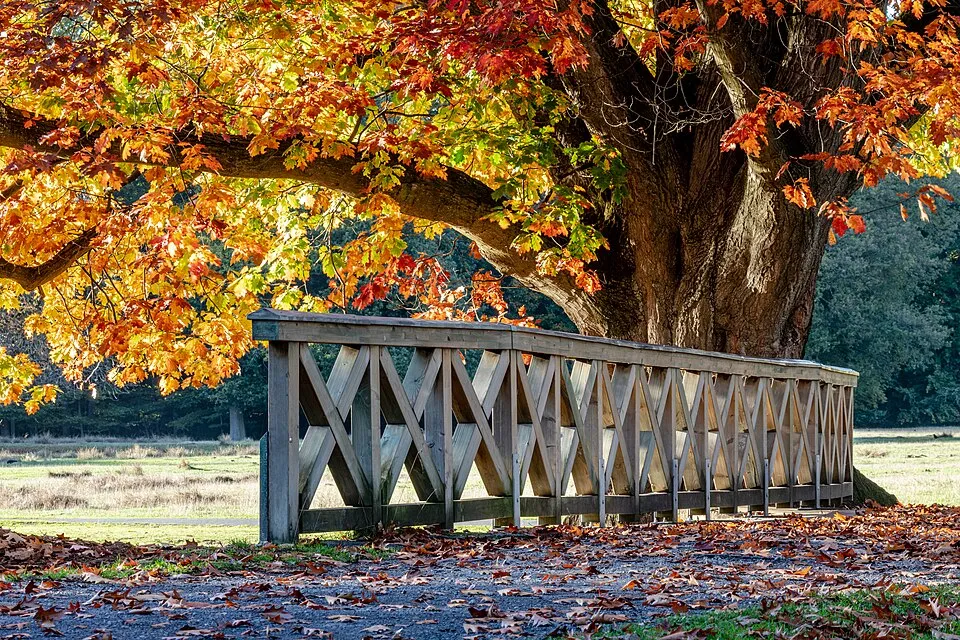
Northern Red Oak (Quercus rubra) full tree with deep red fall foliage
Quercus rubra in autumn color — the deeply lobed, bristle-tipped leaves turn a deep ruby-red typical of the red oak group. Photo: Rooted Revival.

Identification

[ field key — bark · leaf · acorn · habit · distinguishing from other red oaks ]

Habit & Bark

A large, broad-crowned deciduous tree with a straight, clean trunk in forest settings, becoming more open and spreading in full sun. The bark is the best field mark: on mature trunks it forms flat-topped, light gray ridges separated by dark fissures, producing a pattern that looks uncannily like downhill ski trails running vertically. Young bark is smooth and gray-green. The buds are clustered at twig tips, pointed, reddish-brown, and hairless — a useful winter ID feature. In NE Oklahoma, trees typically reach 60–75 ft; the national champion exceeds 140 ft.

Leaves

Alternate, simple, 5–9 in long, with 7–11 deep lobes extending more than halfway to the midrib. Each lobe is bristle-tipped (a defining trait of the red oak group) and has 1–3 smaller points along its margin. The sinuses between lobes are rounded and open, unlike the tighter sinuses of Shumard Oak. Upper surface is smooth and dull green; lower surface is paler with small tufts of hair in the vein axils. Fall color in our region ranges from deep wine-red to russet — not quite the scarlet of Q. shumardii or Q. coccinea, but richly autumnal nonetheless.

Flowers (Catkins)

Oaks are monoecious: separate male and female flowers on the same tree. Male flowers appear as slender, drooping yellow-green catkins 2–4 in long, emerging with the new leaves in April. Female flowers are tiny, reddish spikes at leaf axils on new growth — nearly invisible unless you're looking for them. Wind pollinated. Heavy pollen production can turn puddles yellow beneath the tree in peak bloom; a boon for early-season insects that collect protein-rich oak pollen.

Acorns (Fruit)

The acorn is a classic red oak type: broadly ovoid to barrel-shaped, 3⁄4–1 in long, with a flat, shallow cap (saucer-like) covering only the top quarter of the nut. The cap scales are tightly appressed and flat. Acorns take two seasons to mature — pollinated in spring of year one, developing over summer and fall of year two, dropping September–October. This biennial cycle is a key distinction from white oaks, which mature acorns in one season. The nutmeat is high in fat and carbohydrates but distinctly tannic (bitter), requiring leaching for human consumption. Heavy mast crops occur every 3–5 years.

Habitat & Range in NE Oklahoma

Quercus rubra is at the southwestern edge of its natural range in eastern Oklahoma. In the Tulsa region, it is found primarily in the mesic (moist) woodlands of the Ozark foothills and the richer bottomland terraces of the Grand, Verdigris, and Illinois River systems. It favors deep, well-drained, slightly acidic soils on north-facing slopes, coves, and lower benches — positions that hold moisture through our blistering summers. You won't find it on dry, south-facing glades or thin-soil ridge tops; those sites belong to Post Oak and Blackjack Oak. Instead, look for Northern Red Oak where the canopy is tall and the understory is rich with ferns, woodland sedges, and Maidenhair Fern — reliable indicators of the cool, consistently moist microclimates this tree requires at the western limit of its range.

Across its broader range, Northern Red Oak is remarkably adaptable, growing from sea level in the Northeast to 5,500 ft in the southern Appalachians. It is a dominant component of the oak–hickory forest type that covers much of the eastern US. In NE Oklahoma, it co-occurs with Shumard Oak in bottomlands, Sugar Maple on cooler slopes, and Shagbark Hickory in richer woodland stands.

Ecology & Wildlife Value

[ keystone mast species · Lepidoptera host · cavity nester · soil builder ]

Lepidoptera Host

Oaks are the single most important genus of host plants for native Lepidoptera in eastern North America. Quercus rubra alone supports caterpillars of over 500 species of butterflies and moths, more than any other tree species in the region. Notable visitors include the red-spotted purple (Limenitis arthemis astyanax), the banded hairstreak (Satyrium calanus), the Juvenal's duskywing (Erynnis juvenalis), the io moth (Automeris io), the polyphemus moth (Antheraea polyphemus), and the luna moth (Actias luna). This cascade of caterpillar biomass is the foundation of the eastern woodland food web.

Mast & Vertebrate Forage

Red oak acorns are a primary winter food for white-tailed deer, wild turkey, eastern gray squirrel, fox squirrel, flying squirrel, chipmunk, and at least a dozen species of birds including blue jay, red-headed woodpecker, red-bellied woodpecker, and wood duck. Because red oak acorns are higher in tannins than white oak acorns, they persist longer on the forest floor — bitter compounds slow decomposition and deter some foragers, spreading out the mast availability into late winter when sweeter white oak acorns have already been consumed or have germinated. This staggered availability is ecologically important: red oak acorns are the late-winter emergency ration of the eastern deciduous forest.

Cavity Nesting

As a large, long-lived tree, Q. rubra develops heart rot and limb cavities that provide critical nesting and denning habitat. Primary cavity excavators (pileated woodpecker, red-bellied woodpecker, northern flicker) create holes that are subsequently used by secondary cavity nesters: eastern screech-owl, barred owl, wood duck, flying squirrel, and several bat species. Dead standing trees (snags) of red oak are particularly valuable and should be retained wherever safety permits.

Leaf Litter & Soil Ecology

Oak leaf litter decomposes more slowly than most temperate hardwoods, building a thick, spongy duff layer on the forest floor. This leaf litter supports an enormous community of decomposer arthropods (springtails, mites, millipedes, isopods) and fungi, which in turn feed salamanders, ground beetles, and shrews. Red oak litter is also slightly acidic, gradually lowering soil pH in a way that benefits acid-loving understory companions like Maidenhair Fern and woodland sedges.

Keystone oaks — the numbers matter. Research by Douglas Tallamy and colleagues at the University of Delaware has documented that native oaks support more caterpillar species than any other tree genus in North America. A single mature Northern Red Oak can produce several pounds of caterpillar biomass in a season — which translates directly into chickadee nestlings, warbler migration fuel, and the entire insectivorous bird guild. If you plant one tree for wildlife in NE Oklahoma, make it an oak.

Horticulture & Care

[ site selection · planting · maintenance · companion planting ]

Site selection

Northern Red Oak needs room to grow. Do not plant this tree within 20 ft of a foundation, sidewalk, or driveway — it will become a 60-ft canopy tree with a root zone that extends well beyond the drip line. Select a site with deep, well-drained soil and at least 6 hours of direct sun. In NE Oklahoma, north-facing or east-facing slopes and lower benches provide the most reliable moisture. Avoid compacted urban fill, heavy construction zones, and locations where the soil pH has been pushed above 7.5 by limestone gravel or concrete leachate. Red oaks are less tolerant of alkaline soils than Chinkapin Oak or Bur Oak.

Planting

Maintenance

Companion planting

In a woodland or savanna planting, pair Northern Red Oak with Shagbark Hickory and Black Hickory for the classic oak–hickory canopy. The mid-story benefits from Downy Serviceberry, Red Buckeye, and Spicebush. For the ground layer, woodland perennials like Maidenhair Fern, Solomon's Seal, Wild Ginger, and Woodland Sunflower thrive in the dappled shade and acidic leaf litter beneath a red oak.

Edible & Cultural Uses

Like all oaks in the red oak group, the acorns of Quercus rubra are high in tannins and require leaching before they are palatable to humans. Indigenous peoples across eastern North America harvested red oak acorns as a staple carbohydrate, leaching them by running cold water through cracked nutmeats (often in a sand-lined basket), boiling repeatedly, or burying them in stream gravels for weeks. The resulting meal, once leached, is sweet, nutty, and was used for porridge, bread, and soup thickener. Red oak acorns were generally processed separately from white oak acorns, which are less tannic and require less leaching.

The wood of Northern Red Oak is among the most commercially important hardwoods in North America: it is used for flooring, cabinetry, furniture, veneer, and barrels. It has large, open pores (unlike white oak, whose pores are plugged with tyloses), which makes red oak barrels unsuitable for tight cooperage (whiskey, wine) but excellent for dry goods. The bark is rich in tannins historically used in leather tanning. In the landscape, this is the fastest-growing oak option for a shade tree in the Tulsa area, achieving meaningful canopy in 15–20 years rather than the 30–50 years of white oaks.

Acorn identification safety: All oak acorns are technically edible after leaching, but red oak acorns require significantly more processing than white oak acorns. Never eat acorns raw in quantity — the tannins cause gastrointestinal distress and can be toxic at high doses. Always positively identify the tree, leach thoroughly, and test a small amount first.

Photo Reference

Quercus rubra leaves showing deep lobes with bristle tips
// Leaves — deep lobes, bristle-tipped, 7–11 per leaf
Wikimedia Commons
Wikimedia Commons
Northern Red Oak bark with characteristic ski-trail ridges
// Bark — flat-topped ridges, "ski trail" pattern diagnostic
Wikimedia Commons
Wikimedia Commons
Quercus rubra acorn with shallow saucer-like cap
// Acorn — shallow flat cap, barrel-shaped, biennial maturation
Wikimedia Commons
Wikimedia Commons
Northern Red Oak in full autumn color
// Fall color — deep wine-red to russet, late October in Tulsa
Wikimedia Commons
Wikimedia Commons
Mature Northern Red Oak form in open landscape
// Habit — broad-crowned, 60–75 ft at maturity in NE Oklahoma
Wikimedia Commons
Wikimedia Commons

Sources & Further Reading

  • USDA NRCS PLANTS Database — Quercus rubra: plants.usda.gov/plant-profile/QURU
  • Lady Bird Johnson Wildflower Center — Native Plant Database: wildflower.org — QURU
  • Tallamy, D.W. (2007). Bringing Nature Home: How You Can Sustain Wildlife with Native Plants. Timber Press.
  • Tallamy, D.W. & Shropshire, K.J. (2009). Ranking lepidopteran use of native versus introduced plants. Conservation Biology 23(4):941–947.
  • Fralish, J.S. & Franklin, S.B. (2002). Taxonomy and Ecology of Woody Plants in North American Forests. Wiley.
  • USDA Forest Service — Silvics Manual, Vol. 2: Quercus rubra: srs.fs.usda.gov
  • Wikipedia — Quercus rubra: en.wikipedia.org/wiki/Quercus_rubra (CC BY-SA 4.0; portions of the description and ecology sections summarize Wikipedia content).

Hero photo: Rooted Revival. Strip photos courtesy of Wikimedia Commons contributors under their respective licenses (linked under each image).