home/ plants/ sneezeweed

// SPECIES PROFILE · PERENNIAL · NATIVE · LATE-SEASON NECTAR · AUTUMN COLOR

Sneezeweed

Helenium autumnale

Sneezeweed is one of the most unfairly maligned plants in the American flora — burdened with a name that suggests allergy-inducing properties it does not possess. In fact, sneezeweed does not cause hay fever; its pollen is heavy, sticky, and carried by insects, not wind. The name comes from the historical use of its dried leaves and flower heads as snuff — inhaled to induce sneezing as a folk remedy to expel evil spirits or clear congested sinuses. The plant itself is a gorgeous, clump-forming perennial 3–5 ft tall with masses of golden-yellow, wedge-shaped ray flowers that surround a raised, globular yellow disk, creating blooms that look like small, bright yellow gumdrops with petals. Blooming from late summer through fall, sneezeweed provides some of the season's last nectar for bees and butterflies in the wet meadows, streambanks, and moist prairies of NE Oklahoma. If you can get past the name, what you have is a stunning fall perennial that feeds pollinators when they need it most.

// QUICK FACTS
Family
Asteraceae (sunflower / daisy family)
Life cycle
Herbaceous perennial
Native range
North America — across southern Canada, all of the contiguous US except the far SW; throughout OK
USDA hardiness
Zones 3–8 (Tulsa = 7a/7b)
Mature size
3–5 ft tall, 2–3 ft wide; clump-forming
Bloom
August – October (NE OK); peak in September
Flower color
Golden-yellow wedge-shaped rays around a raised globular yellow disk
Sun
Full sun (6+ hrs); tallest and most floriferous in full sun
Soil
Moist to wet, rich; tolerates clay and seasonal flooding
Water
Medium to wet; requires consistent moisture; tolerates brief standing water
Wildlife
Late-season bee and butterfly nectar · some of season's last nectar for migrating monarchs
Conservation
Secure globally (G5); common and widespread across OK
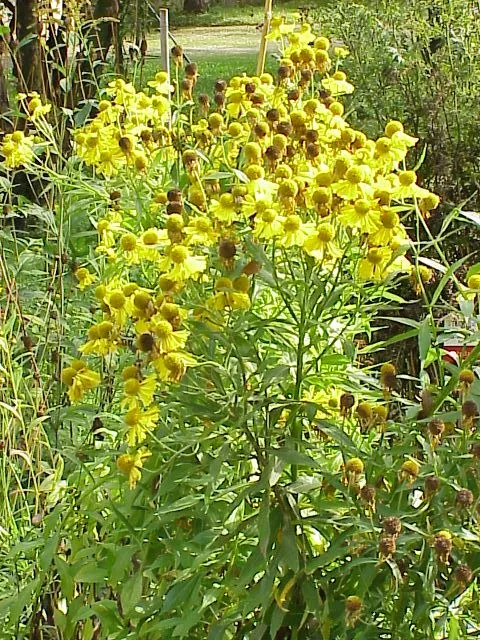
Sneezeweed (Helenium autumnale) with masses of golden-yellow flowers and raised globular disks
Helenium autumnale in peak autumn bloom — a mass of golden-yellow, insect-pollinated flowers; misnamed, not a cause of hay fever. Photo: Rooted Revival.

Identification

[ field key — stem · leaf · inflorescence · fruit · distinguishing features ]

Habit & Stem

A clump-forming perennial 3–5 ft tall with one to several erect, branched stems arising from a fibrous-rooted crown. The stems are distinctly winged — narrow, longitudinal ridges of leafy tissue run down the stem from the leaf bases, giving the stem a ribbed or flanged appearance in cross-section. These wings are narrower and less conspicuous than those of wingstem (Verbesina alternifolia), but they are a useful identification feature and the source of one of sneezeweed's lesser-known common names: "winged helenium." Stems branch in the upper portion to produce the flowering heads. The plant is clump-forming and does not spread aggressively by rhizomes.

Leaves

Leaves are alternate, lanceolate to elliptic, 2–6 in long and 1/2–1.5 in wide, with entire to finely toothed margins. The leaf base is decurrent — the leaf tissue extends down the stem as a wing below the point of attachment. The leaf surface is medium green and glabrous to sparsely hairy, with a prominent midvein and pinnate lateral veins. The leaves are sessile (no petiole) and clasp the stem at the base. Foliage is aromatic when crushed, with a somewhat bitter, resinous scent. In some conditions, the leaves develop a purplish tinge along the margins in fall.

Flower Heads

The inflorescence is a loose, branched terminal cluster producing 5–50+ individual flower heads per plant. Each head is 1–2 in across, and the structure is distinctive: 8–21 bright golden-yellow ray florets (the "petals") spread outward, each ray broadest at the tip (wedge-shaped or obovate) and three-toothed (lobed) at the end, a feature visible on close inspection. The rays surround a raised, nearly spherical central disk composed of numerous yellow disk florets that create a prominent, domed or gumdrop-shaped center. As the disk florets mature from the outside inward, the center of the dome changes color from yellow to brownish-yellow, creating a subtle two-tone effect. The overall look is like a small, warm yellow daisy with a plump, raised center. Blooms from August through October (and sometimes into November in mild autumns) in NE Oklahoma.

Fruit & Seed

Each pollinated floret produces a dry achene topped with a pappus of 5–8 thin, membranous scales (not bristles like many composites). The achenes are small, ribbed, and brown, maturing in October through November. The papery scales help with short-distance wind and water dispersal. The dried seed heads are not particularly showy but persist through winter if stems are left standing. The seeds are occasionally consumed by small ground-feeding birds, though sneezeweed is primarily valuable as a nectar plant rather than a seed source.

Distinguishing Features & Similar Species

The combination of winged stems, wedge-shaped, three-toothed yellow rays, and a raised, globular yellow disk distinguishes Helenium autumnale from other yellow-flowered composites in the Oklahoma flora. Wingstem (Verbesina alternifolia) has drooping yellow rays (not spreading), more prominent corky stem wings, and is much taller (4–8 ft vs. 3–5 ft). Black-eyed Susan (Rudbeckia hirta) has a flat or only slightly domed dark brown disk and lacks winged stems. Common sunflower has a flat brown disk and larger heads. The wedge-shaped rays with three-toothed tips are the most reliable field character for Helenium.

Seasonal Cycle in NE Oklahoma

Emerges from the crown in April. Grows steadily through May, June, and July, producing the winged stems and decurrent leaves. Flower buds form in late July to early August. The first flowers open in mid-August. Peak bloom runs from late August through September, with flowering continuing through October and sometimes into November in mild autumns — making this genuinely one of the last native perennials to bloom in the NE Oklahoma landscape. Foliage is killed by the first hard freeze in late October or November. Stems die back to the crown but often remain standing through winter if not cut back. Cut to ground in late winter or early spring.

Habitat & Range in NE Oklahoma

Helenium autumnale has the broadest geographic range of any Helenium species — it is native across almost all of North America, from southern Canada through the entire contiguous United States (except the far Southwest) and into northern Mexico. In Oklahoma it is common and widespread across the state. In NE Oklahoma it is found in moist meadows, wet prairies, streambanks, marsh edges, pond margins, roadside ditches, and low, wet openings in the tallgrass prairie and Cross Timbers.

Sneezeweed is a facultative wetland plant (FACW) — it usually occurs in wetlands but is occasionally found in non-wetland sites. In the Tulsa region, it is abundant along the Arkansas, Verdigris, Neosho, and Grand River floodplains, in wet prairie remnants, and in the numerous constructed and natural wetlands throughout the region. It is one of the most conspicuous yellow-flowered plants of the autumn landscape in moist, sunny sites, often forming large, showy drifts along stream corridors and in wet meadows. In suburban and urban areas, it appears in drainage ditches, retention pond margins, and any low, wet spot that gets full sun and is not mowed.

Ecology & Wildlife Value

[ late-season nectar · bee and butterfly resource · pollen ecology · wetland edge ]

Late-Season Nectar: The Final Feast

Sneezeweed's greatest ecological gift is its bloom timing. Flowering from August through October — and continuing into November in mild years — it provides nectar during the final weeks of the growing season when most other nectar sources have finished. This is critical for: bumblebee colonies producing new queens that must accumulate fat reserves for winter hibernation; native solitary bees provisioning their final brood cells; monarch butterflies on their southward migration; and other late-season insects building energy reserves for overwintering. A sneezeweed patch in October, when goldenrods and asters are fading and the first frosts are approaching, is often the last active nectar source in the landscape — and consequently covered in grateful insects.

Pollen Ecology: Heavy, Sticky, Insect-Carried

The most persistent myth about sneezeweed is that it causes hay fever. This is categorically false. The pollen of Helenium autumnale is heavy, sticky, and insect-carried (entomophilous) — it does not become airborne in allergenic quantities. The plant is often blamed for allergies that are actually caused by ragweed (Ambrosia spp.), which blooms at the same time and in the same habitats but produces vast quantities of lightweight, windborne pollen. The confusion is understandable but unfortunate: a plant that is an ecological hero has been cast as a villain for a crime it did not commit. If you suffer from fall allergies, look at the inconspicuous green ragweed flowers blooming nearby, not the showy yellow sneezeweed.

Bee & Butterfly Visitors

The flowers are visited by a broad range of native bees: bumblebees (Bombus pensylvanicus, B. impatiens, B. fervidus), long-horned bees (Melissodes), leafcutter bees (Megachile), sweat bees (Agapostemon, Lasioglossum, Augochlora), and mining bees (Andrena). Butterflies include monarchs, painted ladies, eastern tiger swallowtails, black swallowtails, common buckeyes, gulf fritillaries, various sulphurs, and numerous skippers. Beetles (soldier beetles, tumbling flower beetles), syrphid flies, and wasps also visit. The raised, domed disk of the flower head provides a convenient landing platform for larger insects.

Toxicity & Herbivore Defense

Helenium autumnale contains sesquiterpene lactones, including helenalin and related compounds, that are toxic to mammals and many insects if ingested in large quantities. These bitter, bioactive compounds deter most herbivores: deer and rabbits generally avoid it, livestock avoid it in pastures (one reason it persists in grazed wet meadows), and it has relatively few insect leaf-chewers. The compounds are also responsible for the plant's historical medicinal uses (as a snuff, a vermifuge, and a febrifuge). In the garden, the toxicity is a non-issue for humans unless the plant is ingested, and the bitter taste makes accidental consumption unlikely. The toxicity does mean that sneezeweed is not appropriate for planting in livestock pastures or horse paddocks where animals might graze it when other forage is scarce.

Set the record straight: If a neighbor expresses concern about your sneezeweed causing allergies, you can explain with confidence: the pollen is heavy and insect-carried, not windborne. The real culprit is ragweed (Ambrosia), which blooms at the same time. This is a teachable moment about native plant ecology disguised as a garden conversation.

Horticulture & Care

[ site · moisture · cultivars · companion plants · fall garden design ]

Site Selection & Establishment

Sneezeweed needs moisture and sun. The ideal site is a rain garden, wet meadow, pond edge, drainage swale, or consistently moist perennial border with at least 6 hours of full sun. It tolerates heavy clay and seasonal standing water — one of the few native perennials that genuinely thrives in a low, wet spot that floods after heavy rain. It will grow in average garden soil with regular irrigation but will be shorter and less lush than plants in truly moist conditions. It does not tolerate drought or dry, sandy soils.

Notable Cultivars & Hybrids

While the straight species is an excellent garden plant, many gardeners are introduced to sneezeweed through Helenium hybrids and cultivars developed in Europe for the perennial border. These tend to be more compact (2–3 ft) with a wider range of colors (orange, rust, copper, mahogany-red, bicolor). Some excellent cultivars include:

Maintenance

Companion Planting for Fall Rain Gardens

In a rain garden or moist meadow planting, combine sneezeweed with common boneset, Joe-Pye weed, wingstem, western ironweed, swamp milkweed, New England aster, tall goldenrod, Virginia mountain mint, and buttonbush. The yellow of sneezeweed and goldenrods, the purple of ironweed and asters, the white of boneset, and the pink of Joe-Pye weed and swamp milkweed together create a complete late-season color palette. For a streambank stabilization planting, combine with inland sea oats, eastern gamagrass, and river birch.

Livestock warning: The sesquiterpene lactones in sneezeweed (particularly helenalin) are toxic to livestock if consumed in large quantities. Do not plant sneezeweed in or adjacent to livestock pastures, horse paddocks, or areas where confined animals might graze it. In open range and wildlife contexts, deer and cattle generally avoid it due to its bitter taste, and poisoning is rare except when animals are forced to eat it due to lack of other forage.

Photo Reference

Close-up of Helenium autumnale flower showing wedge-shaped three-toothed yellow rays and raised globular disk
// Flower head — wedge-shaped, three-toothed rays around a raised globular yellow disk
Wikimedia Commons
Wikimedia Commons
Winged stem of Helenium autumnale showing decurrent leaf tissue
// Winged stem — decurrent leaf tissue forms narrow wings along the stem
Wikimedia Commons
Wikimedia Commons
Bumblebee foraging on a sneezeweed flower head
// Bombus sp. on sneezeweed — one of many late-season bee visitors
Wikimedia Commons
Wikimedia Commons
Drift of sneezeweed in bloom in a wet meadow
// Drift — massed planting in a wet meadow, peak autumn display
Wikimedia Commons
Wikimedia Commons
Dried seed heads of Helenium autumnale in late fall
// Seed heads — dried heads in late fall, achenes with membranous pappus scales
Wikimedia Commons
Wikimedia Commons

Sources & Further Reading

  • USDA NRCS PLANTS Database — Helenium autumnale: plants.usda.gov/plant-profile/HEAU
  • Lady Bird Johnson Wildflower Center — Native Plant Database: wildflower.org — HEAU
  • Missouri Botanical Garden — Helenium autumnale Plant Finder: missouribotanicalgarden.org
  • Oklahoma Biological Survey — Helenium autumnale county-level distribution: biosurvey.ou.edu
  • Gleason, H.A. & Cronquist, A. (1991). Manual of Vascular Plants, 2nd ed. New York Botanical Garden.
  • Burrows, G.E. & Tyrl, R.J. (2013). Toxic Plants of North America, 2nd ed. Wiley-Blackwell — monograph on sesquiterpene lactone toxicity in Helenium.
  • Wikipedia — Helenium autumnale: en.wikipedia.org/wiki/Helenium_autumnale (CC BY-SA 4.0; portions of the description and ecology sections summarize Wikipedia content).

Hero photo: Rooted Revival. Strip photos courtesy of Wikimedia Commons contributors under their respective licenses (linked under each image).