home/ plants/ common-boneset

// SPECIES PROFILE · PERENNIAL · NATIVE · PREMIER POLLINATOR · TRADITIONAL MEDICINE

Common Boneset

Eupatorium perfoliatum

Common Boneset is one of the great medicinal and ecological plants of the American landscape — a clump-forming perennial 3–5 ft tall with a remarkable perfoliate leaf arrangement in which the stem appears to pierce through the center of a single, fused pair of opposite leaves. From mid-summer through fall, the plant produces broad, flat-topped clusters of fragrant, fuzzy white flowers that are bone-shatteringly attractive to pollinators: wasps, bees, butterflies, beetles, flies, moths — the full spectrum of flower-visiting insects converges on boneset blooms in numbers that rival the mountain mints. The common name comes from its use in treating breakbone fever (dengue), a viral disease characterized by severe joint and muscle pain, which European settlers and Indigenous healers treated with boneset tea. Eupatorium perfoliatum is one of the most historically significant plants in the American materia medica and, simultaneously, one of the most ecologically valuable mid-summer nectar sources for NE Oklahoma's wetland-edge plantings.

// QUICK FACTS
Family
Asteraceae (sunflower / daisy family)
Life cycle
Herbaceous perennial
Native range
Eastern and central North America — Nova Scotia to Florida, west to Manitoba and Texas; eastern OK
USDA hardiness
Zones 3–8 (Tulsa = 7a/7b)
Mature size
3–5 ft tall, 2–3 ft wide; clump-forming
Bloom
July – October (NE OK); long bloom period
Flower color
Fuzzy white; disc florets only, no ray flowers
Sun
Full sun to part shade
Soil
Moist to wet, rich; tolerates clay and seasonal flooding
Water
Medium to wet; requires consistent moisture
Wildlife
Exceptional pollinator diversity · wasp, bee, butterfly, beetle, fly, moth magnet
Conservation
Secure globally (G5); common in eastern OK
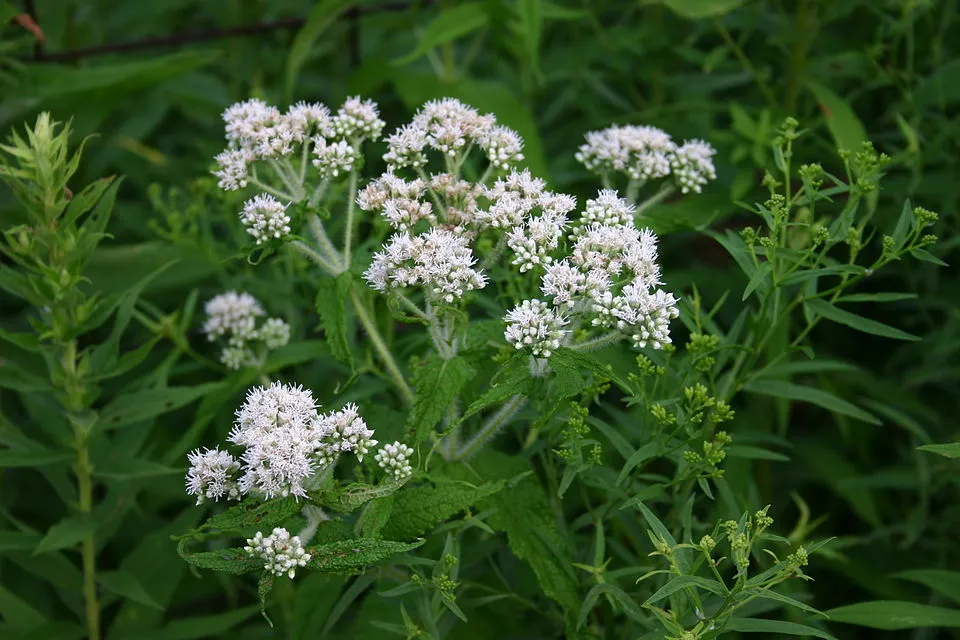
Common Boneset (Eupatorium perfoliatum) with broad clusters of fuzzy white flowers and perfoliate leaves
Eupatorium perfoliatum in mid-summer bloom — broad, flat-topped clusters of fuzzy white flowers draw the full spectrum of insect visitors. Photo: Rooted Revival.

Identification

[ field key — perfoliate leaf · stem · inflorescence · distinguishing from other Eupatorium ]

Habit & Stem

An erect, clump-forming perennial 3–5 ft tall with one to several stout, hairy stems arising from a fibrous-rooted crown. The stems are round, densely covered in long, spreading hairs, and are typically unbranched below the inflorescence. The plant has a coarse, somewhat weedy appearance until it blooms, at which point the striking perfoliate leaves and broad white flower clusters make it immediately identifiable and rather handsome. Clumps expand slowly over time but do not spread aggressively by rhizomes.

Leaves: The Perfoliate Phenomenon

The leaves of Eupatorium perfoliatum are among the most distinctive of any eastern North American plant. They are opposite, united at the base (connate-perfoliate), meaning that each pair of opposite leaves fuses together at their bases around the stem, creating the illusion that a single leaf has been pierced through by the stem. The resulting structure is a wrinkled, lanceolate blade 4–8 in long and 1–2 in wide, with finely serrated margins, a pointed tip, and a rough, conspicuously reticulate (netted-veined) surface. The perfoliate leaf arrangement is the source of the species epithet perfoliatum and is the most reliable field identification character. The leaves are aromatic when crushed, with a somewhat bitter, resinous scent.

Inflorescence & Flowers

The inflorescence is a broad, dense, flat-topped to slightly rounded terminal corymb 3–8 in across, composed of numerous small flower heads. Each head is tiny — about 1/4 in across — and composed entirely of disc florets only; there are no ray flowers. The disc florets are fuzzy white, with the "fuzziness" created by the long, protruding styles that extend well beyond the corolla tube. The overall effect of the corymb is a broad, soft-textured, slightly domed cluster of off-white that looks almost like cauliflower from a distance. Individual heads are faintly fragrant and are among the most heavily visited flowers in the mid-summer landscape. Blooms from July through October in NE Oklahoma, one of the longest bloom periods of any native perennial.

Fruit & Seed

Each pollinated floret produces a small achene with a pappus of fine, white capillary bristles that catch the wind for dispersal. The seed heads mature from September through November and are fluffy and windborne, similar to those of goldenrods and asters. The dried flower heads are an attractive silvery-tan in fall and winter, and small birds occasionally pick at them for the tiny seeds. The stems and seed heads persist through winter and provide structure in the dormant garden.

Distinguishing from Related Species

The genus Eupatorium has been taxonomically reorganized in recent decades, and many former members are now placed in other genera (Ageratina, Conoclinium, Eutrochium). True Eupatorium in the narrow sense includes bonesets and thoroughworts. Eupatorium perfoliatum is distinguished from all other Oklahoma Eupatorium species by its perfoliate leaves — no other species in the genus in our region has leaves fused around the stem. Eupatorium serotinum (late boneset) has petioled, non-perfoliate leaves. The Joe-Pye weeds (Eutrochium spp.) have whorled leaves in groups of 3–7 and pink to purple flowers. Mistflower (Conoclinium coelestinum) has blue flowers and opposite, petioled leaves.

Seasonal Cycle in NE Oklahoma

Emerges from the ground in April with the first warm weather. Grows steadily through May and June, producing the characteristic perfoliate leaves. Flower buds become visible in late June to early July. The first flowers open in mid-July, and peak bloom runs from late July through September, with flowering continuing into October until frost. Foliage turns yellow and brown with frost in late October or November. Stems die back to the crown but remain standing through winter as architectural structure. Cut back in late winter or early spring before new growth.

Habitat & Range in NE Oklahoma

Eupatorium perfoliatum is native to eastern and central North America, from Nova Scotia and Quebec south to Florida, and west to Manitoba, the Dakotas, Nebraska, and eastern Texas. In Oklahoma it is common in the eastern third of the state, becoming less frequent westward and largely absent from the Panhandle and far western counties. In NE Oklahoma it occupies moist meadows, streambanks, marsh edges, bottomland openings, roadside ditches with reliable moisture, and the margins of ponds and lakes.

Boneset is a wetland indicator species (Facultative Wetland+ in the Atlantic and Gulf Coastal Plain regions, meaning it usually occurs in wetlands). It is found along the Arkansas, Verdigris, Neosho, and Grand River systems and their tributaries, in wet prairie remnants, seeps, fens, and the margins of natural and constructed wetlands throughout the region. In the Tulsa area, look for it in bottomland natural areas like Oxley Nature Center, in wet ditches along country roads, and in the marshy edges of farm ponds and small lakes. It is a reliable component of any consistently moist, sunny site in eastern Oklahoma.

Ecology & Wildlife Value

[ extraordinary pollinator diversity · wasps · bees · butterflies · wetland edge ecology ]

Pollinator Diversity: The Full Spectrum

Boneset flowers are visited by an astonishingly broad range of insects. The shallow, accessible florets provide nectar that is reachable even by short-tongued insects, and the broad, flat corymbs serve as a landing platform for multiple simultaneous visitors. A 15-minute observation of a mature boneset clump in August in NE Oklahoma will typically record: native bees (bumblebees, sweat bees, leafcutter bees, long-horned bees, carpenter bees, cuckoo bees, mining bees), wasps (thread-waisted wasps, potter wasps, paper wasps, spider wasps, ichneumonid and braconid parasitoids, chrysidid cuckoo wasps), butterflies (swallowtails, monarchs, painted ladies, red admirals, buckeyes, crescents, sulphurs, skippers), beetles (soldier beetles, tumbling flower beetles, longhorn beetles, blister beetles), flies (syrphid flies, tachinid flies [important parasitoids], bee flies, thick-headed flies), and moths (day-flying sphinx moths and various noctuid and geometrid moths at dusk). Boneset and its close relatives constitute a pollinator hub on par with goldenrods and mountain mints.

Parasitoid Wasps & Biocontrol

Boneset is particularly attractive to parasitoid wasps in the families Ichneumonidae and Braconidae, whose larvae develop inside the bodies of pest caterpillars, beetle larvae, and other insects. By feeding these beneficial wasps with nectar, boneset directly supports biological pest control in the surrounding garden or landscape. Tachinid flies, which are also abundant boneset visitors, are similarly parasitoids of caterpillars and other soft-bodied insects. Planting boneset near vegetable gardens or orchards effectively establishes a nectar fueling station for your resident pest-control army.

Specialist Bees & Eupatorium Associates

Several native bee species are specialists on Eupatorium and related Asteraceae, provisioning their nests with pollen from bonesets, Joe-Pye weeds, and related plants. These include species of Andrena (mining bees) and Melissodes (long-horned bees) that are documented Eupatorium specialists. The plant is also visited by bumblebees of multiple species and is an important mid to late-summer resource when bumblebee colonies are at peak size and nectar demand is highest.

Wetland Edge Ecology

In its natural habitat, boneset plays a role in wetland and riparian ecology. Its dense root systems help stabilize streambank and marsh-edge soils. The tall summer foliage provides cover and shade for amphibians and wetland-edge arthropods. The flowers support an exceptionally diverse insect community that forms the base of the wetland food web, feeding birds, bats, dragonflies, spiders, and predatory insects. In a constructed rain garden or water feature, boneset is a foundation species — plant it and the insect community builds around it.

Medicinal & Cultural History

[ Indigenous medicine · settler materia medica · breakbone fever · modern research ]

Eupatorium perfoliatum holds a central place in the history of American herbal medicine. Indigenous peoples across eastern North America, including the Cherokee, Chippewa, Menominee, Mohegan, and Iroquois Confederacy, used boneset preparations to treat fevers, colds, influenza, body aches, and rheumatism. When European settlers arrived, they rapidly adopted boneset into their own pharmacopoeia, and the plant became one of the most widely used remedies in colonial and early American medicine. It was listed in the United States Pharmacopeia from 1820 to 1916 and was a standard household remedy well into the early 20th century.

The name "boneset" arises from its use in treating breakbone fever (dengue), a mosquito-borne viral disease that causes intense muscle and joint pain. The plant's traditional indications also include influenza, common cold, intermittent fevers (ague/malaria), and general debility. Boneset tea, made by steeping the dried leaves and flowering tops, is intensely bitter and induces diaphoresis (sweating), which was believed to "break" the fever. Modern pharmacological research has identified sesquiterpene lactones, flavonoids, and polysaccharides in E. perfoliatum with demonstrated immunostimulatory, anti-inflammatory, and antiviral activity. A 2012 study (Hensel et al.) found that boneset extracts stimulated macrophage activity and showed activity against influenza A virus in vitro.

Important caveat: Boneset contains pyrrolizidine alkaloids (PAs) that are hepatotoxic (liver-damaging) with chronic use or in high doses. Traditional use was limited to short-term treatment of acute febrile illness — a few days at most — not long-term or daily consumption. Do not use boneset internally without consulting a qualified clinical herbalist or healthcare provider. It is not recommended for pregnant or nursing people, people with liver disease, or children. If you grow it, appreciate it primarily as an ecological plant and a piece of living botanical history.

Horticulture & Care

[ site · moisture · companion rain garden plants · maintenance ]

Site Selection & Establishment

Boneset is a plant for moist ground — it will not thrive in dry soil without irrigation. The ideal site is a rain garden, wet meadow, pond edge, drainage swale, or consistently moist perennial border with full sun to light shade. It tolerates heavy clay and seasonal inundation and is an excellent choice for the low, wet spot in the yard where other plants drown. In the Tulsa area, a north- or east-facing slope that retains moisture after rain is ideal.

Maintenance

Companion Planting for Rain Gardens & Wet Meadows

In a rain garden or moist pollinator planting, combine boneset with buttonbush, swamp milkweed, Joe-Pye weed, wingstem, western ironweed, tall goldenrod, New England aster, and Virginia mountain mint for a wet-meadow pollinator powerhouse that blooms from July through October. Underplant with moisture-tolerant grasses like inland sea oats and eastern gamagrass. For a riparian buffer planting, combine with black willow, river birch, American sycamore, and buttonbush. The white flowers of boneset provide a unifying, neutral backdrop that ties together the purples, yellows, and pinks of its blooming companions.

Photo Reference

Broad flat-topped corymb of Eupatorium perfoliatum with fuzzy white flowers
// Inflorescence — broad, flat corymb of fuzzy white disc florets
Wikimedia Commons
Wikimedia Commons
Perfoliate leaves of Eupatorium perfoliatum showing stem piercing through fused leaf bases
// Perfoliate leaves — the stem appears to pierce through a single fused leaf pair
Wikimedia Commons
Wikimedia Commons
Multiple wasps, bees, and butterflies on boneset flowers
// Pollinator activity — wasps, bees, and butterflies foraging simultaneously
Wikimedia Commons
Wikimedia Commons
Mature Eupatorium perfoliatum plant in a wet meadow setting
// Habit — 3–5 ft, clump-forming in a moist meadow
Wikimedia Commons
Wikimedia Commons
Seed heads of common boneset showing fluffy white pappus bristles
// Seed heads — fluffy white pappus for wind dispersal in fall
Wikimedia Commons
Wikimedia Commons

Sources & Further Reading

  • USDA NRCS PLANTS Database — Eupatorium perfoliatum: plants.usda.gov/plant-profile/EUPE3
  • Lady Bird Johnson Wildflower Center — Native Plant Database: wildflower.org — EUPE3
  • Missouri Botanical Garden — Eupatorium perfoliatum Plant Finder: missouribotanicalgarden.org
  • Hensel, A. et al. (2012). Eupatorium perfoliatum L.: phytochemistry, traditional use and current applications. Journal of Ethnopharmacology 138(3):641–651.
  • Oklahoma Biological Survey — Eupatorium perfoliatum county-level distribution: biosurvey.ou.edu
  • Moerman, D.E. (1998). Native American Ethnobotany. Timber Press — comprehensive database of Indigenous plant uses, including boneset.
  • Gleason, H.A. & Cronquist, A. (1991). Manual of Vascular Plants, 2nd ed. New York Botanical Garden.
  • Wikipedia — Eupatorium perfoliatum: en.wikipedia.org/wiki/Eupatorium_perfoliatum (CC BY-SA 4.0; portions of the description, ecology, and medicinal history sections summarize Wikipedia content).

Hero photo: Rooted Revival. Strip photos courtesy of Wikimedia Commons contributors under their respective licenses (linked under each image).