home/ plants/ joe-pye-weed

// SPECIES PROFILE · PERENNIAL · NATIVE · POLLINATOR

Joe-Pye Weed

Eutrochium purpureum

Joe-Pye Weed is the architectural late-summer giant of NE Oklahoma's moist woodland edges and stream sides — a 4–7 ft sturdy perennial topped in August with broad, soft-pink to dusty-mauve domes of tiny flowers that vibrate with pollinators. Eutrochium purpureum is the “sweet” or “forest” Joe-Pye, distinguished from its taller swamp-loving cousins by its mostly green stems with purple only at the leaf nodes, and a faint vanilla-like scent when the leaves are bruised. Reclassified into Eutrochium in 2004 from the old name Eupatorium purpureum; many sources still use the older name.

// QUICK FACTS
Family
Asteraceae (composite family)
Group
Herbaceous perennial; clumping
Native range
E US: ME → MN → KS → OK → FL
USDA hardiness
Zones 4–9 (Tulsa = 7a/7b)
Mature size
4–7 ft tall × 2–4 ft wide
Habit
Stout, upright, single-stemmed clumps
Sun
Part shade preferred; tolerates morning sun
Soil
Rich, moist loam; tolerates clay; pH 5.5–7.5
Water
Medium to medium-wet — do not let dry out
Bloom
July–September; soft pink-mauve domes
Wildlife value
Premier butterfly & native-bee plant
Larval host
Clymene moth, Eupatorium borer moth
Ecological role
Riparian forb · late-summer nectar bridge · pollinator magnet
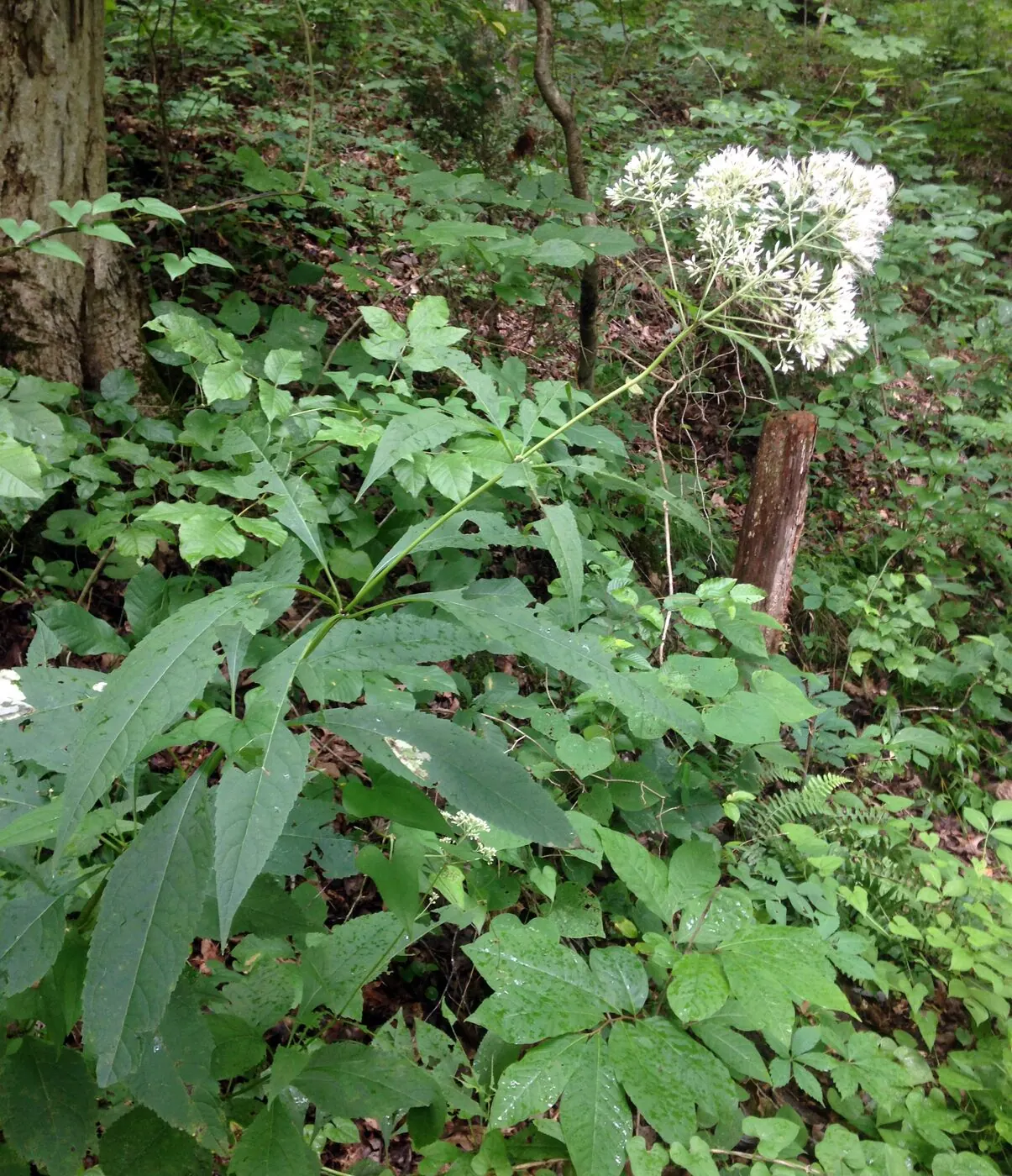
Joe-Pye Weed (Eutrochium purpureum) — tall pink-mauve flower dome covered in butterflies
Eutrochium purpureum in late-summer bloom. Photo via Wikipedia / Wikimedia Commons.

Identification

[ field key — stem · leaves · flower dome · lookalikes ]

Habit & stem

A robust, upright herbaceous perennial 4–7 ft tall, growing as a clump of 2–6 stout single-leader stems from a short rhizomatous crown. The diagnostic stem feature: the stem is mostly green with conspicuous deep-purple bands only at the leaf nodes — not solid purple all the way up like E. fistulosum or E. maculatum. The stem is solid (not hollow) and finely grooved.

Leaves

Whorled in groups of 3–4 (most often 4) per node — an unmistakable Joe-Pye signature. Each leaf is lance-shaped to narrowly ovate, 4–10 in long, with a serrated margin and a pointed tip. When crushed, foliage of E. purpureum emits a faint vanilla-like sweet scent — the source of the common name “sweet Joe-Pye” and a clean field separation from look-alike species.

Flower dome

The terminal inflorescence is a broad, slightly rounded compound corymb 8–12 in across, composed of dozens of small heads each bearing 4–7 small disk florets (no rays). Colour is a soft pale-pink to dusty mauve — subtler than the deep magenta of swamp Joe-Pye. Bloom is long: July through early September in NE Oklahoma. Seedheads turn dusky-grey by October and persist into winter.

Lookalikes

Three Joe-Pye species occur in or near OK and are routinely confused: E. purpureum (sweet Joe-Pye, this species — green stem with purple nodes, 3–4 leaves per whorl, pale pink, woodland edges); E. fistulosum (hollow Joe-Pye — hollow stem, solid purple, 4–7 leaves per whorl, deep mauve, wet meadows); E. maculatum (spotted Joe-Pye — solid purple-spotted stem, 4–5 leaves per whorl, flat-topped corymb, north-central range). Choose the species that matches your moisture conditions.

Habitat & Range in NE Oklahoma

Eutrochium purpureum reaches the western edge of its native range in eastern Oklahoma and is genuinely native in the moist hardwood forests of the Ozark and Ouachita uplifts — Cherokee, Adair, McCurtain, Pushmataha, and Le Flore counties — with scattered NE Oklahoma populations on the wetter slope-bottom and stream-edge sites of the eastern Cross Timbers. It is found on rich, moist, well-drained loam in partial shade: seep heads, woodland glades, north-facing hollows, the upper terraces of permanent streams, and the dappled-shade edges of the Illinois River, Spavinaw Creek, and the upper Caney drainage.

Tulsa-region landscape use is feasible but requires attention to its single non-negotiable need: consistent moisture. In a typical August of 100°F days and four weeks without rain, an unirrigated joe-pye on a sun-baked west-facing bed will collapse and not bloom. Site it in dappled shade, a north-facing bed, the bottom of a shallow swale, the edge of a downspout disconnect, an irrigated rain garden, or near pond edges. With the right siting it is one of the most reliable late-summer pollinator perennials in the Tulsa palette.

Ecology & Wildlife Value

[ butterflies · native bees · larval hosts · winter cover ]

Butterflies

Joe-Pye is one of the premier butterfly nectar plants of late summer in eastern North America. Tiger swallowtails (eastern, spicebush, pipevine), monarchs staging for fall migration, great spangled fritillaries, common buckeyes, painted ladies, red admirals, and silver-spotted skippers all work the pink domes heavily. A well-grown clump in early September can hold a dozen species simultaneously.

Native bees & flies

Bumblebees (Bombus impatiens, B. pensylvanicus), long-horned bees (Melissodes, Eucera), small carpenter bees (Ceratina), green sweat bees (Agapostemon, Augochlora), thread-waisted wasps, soldier beetles, and syrphid flower flies are constant. Joe-Pye is documented as a specialist pollen host for the rare native bee Andrena platyparia.

Larval hosts

Larval host plant for the showy clymene moth (Haploa clymene) — the white moth with the bold black cross pattern — and the Eupatorium borer moth (Carmenta bassiformis). Several other moth species feed on joe-pye foliage as a minor host.

Winter cover & songbirds

The dried winter stems hold standing structure that is used as overwintering habitat by small native bees nesting in pithy stems and as foraging perches for goldfinches and sparrows working the seedheads. Stand structure also catches snow and creates important micro-shelter for ground-dwelling beneficials — one more reason to defer the fall cutback.

Late-summer nectar bridge: The 8 weeks from mid-July to mid-September is a notoriously thin nectar window in NE Oklahoma — spring forbs are done, fall asters not yet open. Joe-Pye is one of the most reliable bridge plants available, alongside ironweed (Vernonia), mountain-mint (Pycnanthemum), and native rosinweeds (Silphium). Its presence in a garden measurably extends the local pollinator season.
Drought collapse: Joe-Pye in unirrigated full sun in a Tulsa August will wilt severely, drop lower leaves, and abort the bloom. Site it where it gets either dappled shade or a reliable summer water source. This is the most common joe-pye-grower mistake in the region.

Horticulture & Care

[ siting · planting · cutback · cultivars · pests ]

When to plant intentionally

Joe-Pye Weed is the back-of-border architectural perennial for rain gardens, downspout disconnect beds, pond and stream edges, irrigated cottage borders, dappled-shade native gardens, butterfly gardens, and woodland-edge restorations. Excellent at the back of a 6 ft mixed perennial border or massed in groups of 3–5 in larger landscapes. Striking against a dark wall or hedge, where the soft pink reads dramatically.

Planting & establishment

Pinching for height control

For a shorter (3–4 ft instead of 6 ft), bushier plant with more but smaller flower domes, pinch the growing tips by half in mid-May (the “Chelsea chop”). The plant will branch and bloom slightly later (early September) but will not flop, which is useful in small front borders.

Cutback & division

Cut stems back to 4 in in late winter (Feb–early Mar) before new growth resumes. Leaving stems standing through winter feeds finches, shelters stem-nesting bees, and adds structure to the dormant garden. Divide established clumps every 4–6 years in early spring if vigour declines.

Notable cultivars / forms

Cultivar Habit Distinguishing feature Notes for Tulsa
Straight species (E. purpureum) 5–7 ft tall Soft pink dome; subtle vanilla scent Best for restoration and naturalistic plantings.
'Little Joe' (technically E. dubium hybrid) 3–4 ft compact Smaller, denser, mauve-pink domes Best small-garden choice; the most-grown joe-pye in Tulsa retail.
'Gateway' (E. maculatum) 5–6 ft Deeper mauve domes; sturdy stems Reliable mid-size cultivar; needs more moisture than E. purpureum.
'Baby Joe' (E. dubium) 2–3 ft very compact Dwarf habit, dark stems Front-of-border choice for small spaces; container-friendly.

Pests & diseases

Cultural & Material Uses

Joe-Pye Weed has a rich folk and Indigenous medicinal record across the eastern US, plus an increasingly central role in modern pollinator-conservation horticulture.

Sources & Further Reading

  • USDA NRCS PLANTS Database — Eutrochium purpureum: plants.usda.gov/plant-profile/EUPU21
  • Lady Bird Johnson Wildflower Center — Eutrochium purpureum: wildflower.org — EUPU21
  • Missouri Botanical Garden Plant Finder — Eutrochium purpureum horticultural profile and cultivar notes.
  • Oklahoma State University Extension — native perennials for Oklahoma rain gardens.
  • Oklahoma Biological Survey — Atlas of the Flora of Oklahoma, Eutrochium distribution records.
  • Lamont, E.E. (2004), “Reorganization of Eupatorium and related genera into Eutrochium and others”, Sida — the foundational reclassification paper.
  • Moerman, D.E. — Native American Ethnobotany, Eupatorium / Eutrochium entries.
  • Xerces Society — Pollinator Plants of the Central United States, joe-pye entry.
  • Pollinator Partnership — Eastern Broadleaf Forest planting guide, joe-pye recommendation.
  • Wikipedia — Eutrochium purpureum: en.wikipedia.org/wiki/Eutrochium_purpureum (CC BY-SA 4.0).

Companion Planting

[ guild · polyculture · cross-layer pairings ]

Along a stream or seasonal floodplain, joe-pye weed pairs naturally with: american hornbeam (Carpinus caroliniana), american elderberry (Sambucus canadensis), eastern gamagrass (Tripsacum dactyloides), cowpea / black-eyed pea (Vigna unguiculata), swamp milkweed (Asclepias incarnata), and american sycamore (Platanus occidentalis).

Combine joe-pye weed with the warm-season grasses listed above for a self-sustaining matrix.