// SPECIES PROFILE · PERENNIAL · NATIVE · PREMIER POLLINATOR PLANT
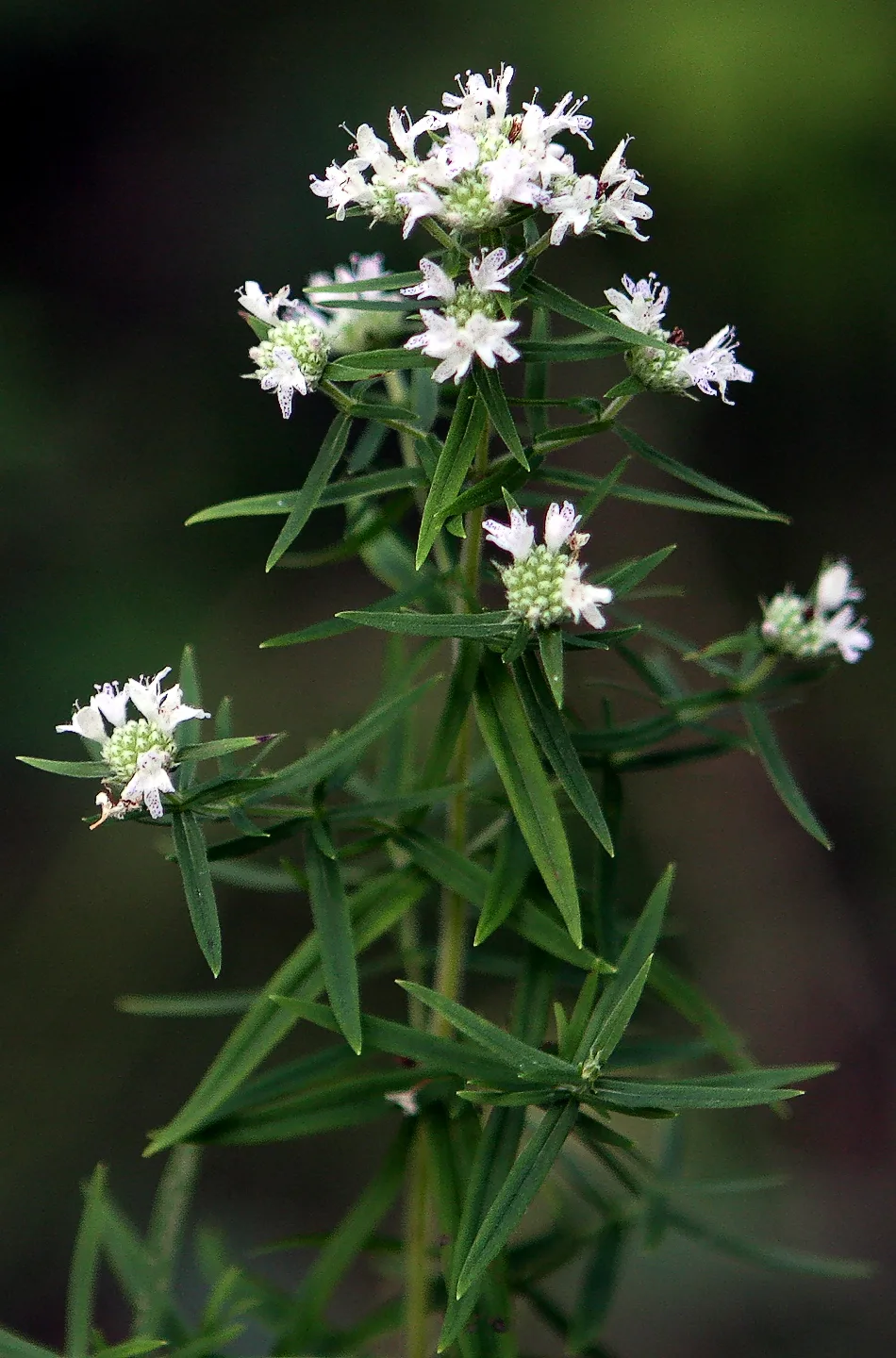
Virginia Mountain Mint belongs to a genus that, by weight of empirical evidence, supports the highest diversity and abundance of flower-visiting insects of any herbaceous plant group in eastern North America. Among the mountain mints, Pycnanthemum virginianum is the moisture-tolerant specialist — a clump-forming, intensely aromatic perennial 2–3 ft tall with narrow leaves and dense, flat-topped clusters of small white flowers dotted with purple spots, blooming through the mid to late summer when the pollinator crush is at its peak. On a warm July morning in NE Oklahoma, a single mature clump of this plant can host literally hundreds of insects at once: native bees, wasps, beneficial predatory wasps, butterflies, beetles, flies, and the occasional hummingbird moth. This is not backyard gardening — this is hosting a pollinator research station in the form of a plant. More moisture-tolerant than its narrowleaf cousin Pycnanthemum tenuifolium, it is the mountain mint for rain gardens, moist meadows, and seepage slopes across NE Oklahoma.

[ field key — stem · leaf · inflorescence · mint family traits · distinguishing from other Pycnanthemum ]
An erect, clump-forming perennial 2–3 ft tall with multiple stiff, square (4-angled) stems — a hallmark of the Lamiaceae (mint family). Stems are finely pubescent with short, white hairs, especially on the angles, and branch freely in the upper portion to produce a dense, bushy inflorescence. The plant forms tight, expanding clumps via short rhizomes but is not as aggressively spreading as true mints (Mentha). The entire plant is strongly aromatic — crush a leaf and the sharp, minty, almost medicinal scent fills the air, a blend of pulegone and other volatile oils characteristic of the genus.
Leaves are opposite (another mint-family trait), linear to narrowly lanceolate, 1–2.5 in long and 1/8–1/4 in wide, with entire (smooth) margins and a sessile or nearly sessile attachment to the stem. The leaf surface is green and glabrous to sparsely hairy above, paler and more densely hairy below, with a prominent midvein. Unlike P. tenuifolium, the leaves of P. virginianum are broader and less needle-like, and they lack the conspicuous fascicles of smaller leaves in the axils that characterize some other species. The foliage has a slightly grayish-green cast in dry conditions and a richer green when well-watered.
The flowers are borne in dense, flat-topped to slightly rounded terminal corymbs 1–2 in across, each composed of many small individual flowers. The individual flowers are tiny — barely 1/4 in long — but collectively create a frothy white display. Each flower is two-lipped (bilabiate), with the upper lip entire or slightly notched and the lower lip three-lobed. The corolla is white with small, distinct purple spots on the lower lip, a detail visible only on close inspection. The calyx is tubular, with five sharp teeth. Bracts beneath the flower clusters are white-woolly on the upper surface, creating a silvery cast around the flower clusters that makes the blooms visible from a distance. Blooms from July through September in NE Oklahoma, with the display intensifying through the season.
Each pollinated flower produces a cluster of four small nutlets (mericarps), the typical fruit type of the Lamiaceae. The nutlets are tiny, brown, and smooth, released in late fall as the seed heads dry and shatter. The plant self-seeds moderately and reliably in suitable conditions, and volunteer seedlings often appear in moist, open soil near the parent clump. The dried seed heads are not particularly ornamental but provide some winter texture in the garden. Goldfinches and other small finches occasionally pick at the dried heads for the tiny seeds.
Two mountain mints are native to NE Oklahoma, and they differ primarily in leaf width and moisture preference. Pycnanthemum tenuifolium (narrowleaf mountain mint) has very narrow, almost needle-like leaves 1/16–1/8 in wide, and prefers drier, upland sites — prairies, open woods, dry roadsides. P. virginianum has broader leaves (1/8–1/4 in) and prefers moister sites. Both species are pollinator powerhouses; the choice between them is primarily a matter of site moisture. In the garden, P. virginianum is the better choice for rain gardens, moist borders, and irrigated beds, while P. tenuifolium is the choice for dry prairie plantings and unirrigated hell strips.
New stems emerge from the perennial crown in April, forming a tight clump of square-stemmed shoots. Growth accelerates through May and June, with the plant reaching full height by late June. Flower buds appear in late June to early July, and the first flowers open in mid-July. Peak bloom runs from late July through August, with flowering tapering through September and often continuing until the first hard frost in October or November. Foliage turns brown with frost and stems die back to the crown. Cut back in late winter. In mild winters with sustained moisture, a small basal rosette of leaves may persist.
Pycnanthemum virginianum ranges across eastern and central North America, from Quebec and Maine west through the Great Lakes region to the Dakotas, and south to Georgia, Alabama, and eastern Oklahoma. In Oklahoma it is largely restricted to the eastern half of the state, reaching roughly as far west as the Cross Timbers, with scattered occurrences further west in moist microsites. In NE Oklahoma it is found in moist meadows, prairie edges, open wetland margins, seepage slopes, and the edges of bottomland woods along the Arkansas, Verdigris, Neosho, and Grand River systems.
This species is less common in the landscape than P. tenuifolium in Oklahoma, owing to its preference for consistent moisture in a region where such sites are limited. Look for it in wet prairie remnants, fen-like seeps, and the transition zone between tallgrass prairie and riparian woodland. It occurs in the Grand Lake watershed, along spring-fed creeks in the Ozark foothills of far eastern Oklahoma, and in the botanical rich spots where the Osage Hills meet the Arkansas River floodplain. It is a plant of the moist prairie-woodland ecotone — that narrow, species-rich band where two communities meet.
[ extraordinary pollinator visitation · predatory wasps · syrphid flies · keystone mid-summer resource ]
Research by Penn State's Center for Pollinator Research and other institutions has repeatedly found Pycnanthemum species to be the most heavily visited plants by pollinating insects in comparative trials of eastern North American native perennials. The small, shallow flowers offer easily accessible nectar to insects with a wide range of tongue lengths, and the dense, flat-topped corymbs provide a landing platform that allows many insects to forage simultaneously. In a five-minute observation of a mature P. virginianum clump in late July in the Tulsa area, you might count: 20+ bumblebees, 30+ sweat bees of multiple genera, 15+ wasps (including thread-waisted, potter, paper, and spider wasps), 10+ syrphid flies, several butterflies, a few beetles, and an ant or two. The plant is not just supporting pollinators — it is operating as a miniature ecosystem hub.
One of the most ecologically significant aspects of mountain mint is its attraction of predatory and parasitoid wasps that also serve as natural pest control in the garden. Thread-waisted wasps (Ammophila, Sphex) hunt caterpillars and grasshoppers to provision their nests. Potter wasps (Eumeninae) hunt beetle larvae and caterpillars. Parasitoid wasps (Ichneumonidae, Braconidae) lay eggs in or on pest insects, and their larvae consume the host from the inside. By planting mountain mint, you are not just feeding pollinators — you are recruiting a standing army of biological control agents that patrol your garden for pests. This is the ecological approach to pest management: support the predators, and the pests stop being a problem.
The blooms of P. virginianum attract many species of butterflies including eastern tiger swallowtails, black swallowtails, painted ladies, red admirals, common buckeyes, pearl crescents, silver-spotted skippers, and various sulphurs. While the mountain mints are not primary larval hosts for most butterflies (caterpillars do not typically feed on mint-family plants), the adult nectar resource is profound. Syrphid flies (hover flies, flower flies) are among the most numerous visitors, and their larvae are voracious aphid predators — another layer of built-in pest control.
The strong, pungent aromatic oils that make mountain mint leaves so fragrant to humans serve an ecological function: they contain pulegone and related monoterpenes that deter most mammalian herbivores (deer and rabbits generally avoid it) and many insect herbivores. The plant has relatively few leaf-chewing pests compared to less aromatic species. The oils also likely function in antimicrobial defense against foliar pathogens. In the garden, this chemical armor means mountain mint is exceptionally low-maintenance — no pest problems, no deer damage, no fuss.
[ site · moisture · spreading · companion planting · aromatic maintenance ]
Pycnanthemum virginianum prefers full sun to light shade and moist, well-drained soil. This is the mountain mint for rain gardens, the bottom of slopes, areas that receive roof runoff, and the edges of ponds and streams. It tolerates heavy clay as long as water does not stand for more than a day or two after heavy rain. It will grow in drier conditions than its optimum, but it will be shorter (closer to 1.5–2 ft) and bloom less profusely.
Unlike true mints (Mentha), which are notorious garden thugs, Pycnanthemum species spread slowly and manageably by short rhizomes. A clump will expand from 12 in to perhaps 24 in across over five years. The plant also self-seeds moderately, and volunteer seedlings can be found within a few feet of the parent. If you want to control spread, cut off spent flower heads before seed maturity in October, or simply pull the occasional volunteer seedling in spring.
Virginia Mountain Mint's moisture preference makes it an ideal companion for rain garden and wet-meadow plants. In a rain garden, combine with buttonbush, swamp milkweed, common boneset, Joe-Pye weed, cardinal flower, and inland sea oats. For a moist pollinator garden, pair with western ironweed, tall goldenrod, common milkweed, and purple coneflower. In a food forest or perennial garden, mountain mint functions as an insectary plant — place it near vegetables and fruit trees to attract pollinators and predatory wasps that will patrol your crops. Underplant with buffalograss or sideoats grama as a living mulch.
Hero photo: Rooted Revival. Strip photos courtesy of Wikimedia Commons contributors under their respective licenses (linked under each image).