home/ plants/ wingstem

// SPECIES PROFILE · PERENNIAL · NATIVE · LATE-SEASON BEE BANQUET · MONARCH MIGRATION FUEL

Wingstem

Verbesina alternifolia

Wingstem is a tall, attention-grabbing perennial of moist woods and bottomlands, named for the conspicuous corky "wings" that run down the length of its stems between nodes — a trait so unusual and pronounced that it makes identification immediate at any distance. In late summer and fall, when many nectar sources are fading or finished, this plant erupts into dozens of drooping yellow ray flowers arranged around a raised, greenish-yellow disk, creating an effect like small, wind-blown suns scattered across a 4–8 ft plant. The bloom coincides with the most urgent period of the ecological year: monarchs are migrating south, native bees are provisioning their final brood cells before winter, and bumblebee colonies are producing next year's queens. Wingstem is one of the plants that fuels all of this. It spreads vigorously in moist conditions and is best suited for large naturalized areas, riparian plantings, and situations where its exuberant growth is an asset rather than a problem.

// QUICK FACTS
Family
Asteraceae (sunflower / daisy family)
Life cycle
Herbaceous perennial
Native range
Eastern and central North America — New York to Florida, west to Nebraska and Texas; throughout eastern OK
USDA hardiness
Zones 4–9 (Tulsa = 7a/7b)
Mature size
4–8 ft tall, 2–4 ft wide; spreads aggressively by rhizomes in moist soil
Bloom
August – October (NE OK); one of the latest fall-blooming perennials
Flower color
Yellow ray flowers drooping around a raised greenish-yellow disk
Sun
Full sun to part shade; best flowering in sun
Soil
Moist, rich, well-drained; tolerates clay and seasonal flooding
Water
Medium to wet; requires consistent moisture for best performance
Wildlife
Late-season bee banquet · monarch migration fuel · native bee nest provisioning
Conservation
Secure globally (G5); common and increasing in eastern OK
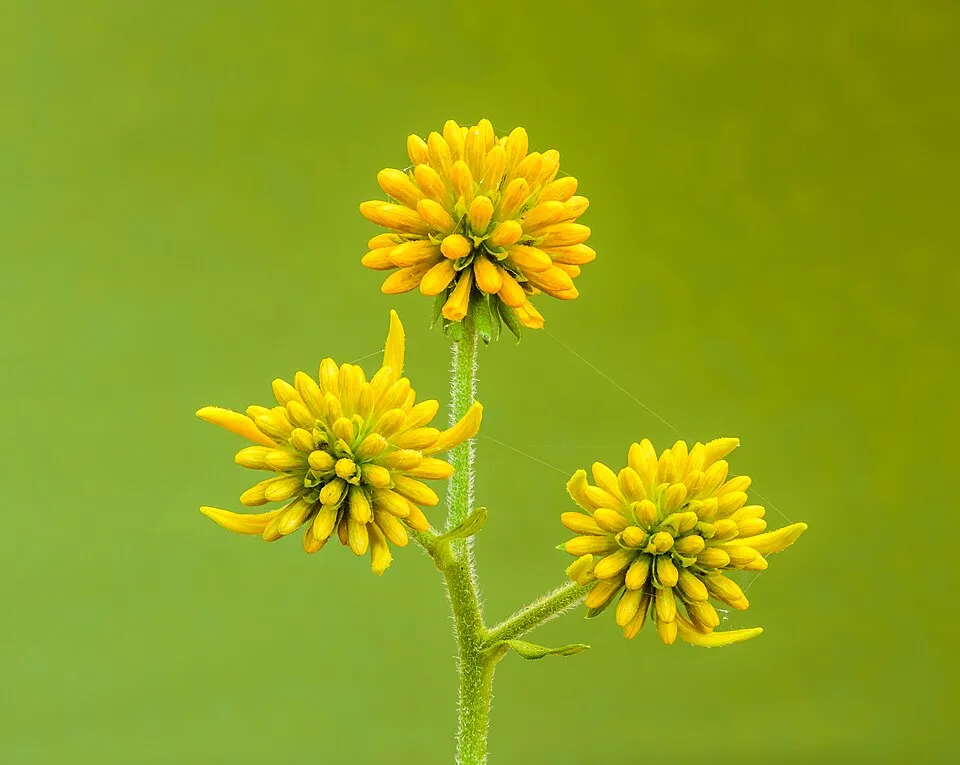
Wingstem (Verbesina alternifolia) with drooping yellow ray flowers and distinctive winged stems
Verbesina alternifolia in late-summer bloom — drooping yellow rays and the unmistakable corky wings on the stems. Photo: Rooted Revival.

Identification

[ field key — winged stem · leaf · inflorescence · distinguishing feature · seasonal cycle ]

Habit & Stem

A tall, upright perennial 4–8 ft tall in NE Oklahoma, with a single or few stout stems arising from a fibrous-rooted crown. The defining feature of this species is the conspicuous corky "wing" or flange of tissue that runs down each side of the stem between the leaf nodes, extending from one leaf base to the next. These wings are green to brownish, 1/8–1/4 in wide, and give the stem a ribbed or winged appearance unlike any other common Oklahoma plant. The stem itself is stout, somewhat hairy, and hollow or pithy in cross-section. The plant forms large, expanding colonies via vigorous rhizomatous spread in moist, favorable conditions.

Leaves

Leaves are alternate (the species epithet alternifolia refers to this), lanceolate to elliptic, 4–12 in long and 1–3 in wide, with sharply serrated margins and a tapered base that extends downward along the stem as the wing. The upper leaf surface is rough and sandpapery (scabrous) to the touch, while the lower surface is paler and finely hairy. Leaves are sessile or have a very short petiole. The foliage has a somewhat coarse, weedy appearance up close, but the overall effect of a large wingstem in flower is quite striking. Leaves remain green through summer and turn yellow in fall.

Inflorescence & Flower Heads

The inflorescence is a loose, branched terminal cluster (corymb-panicle) 4–12 in across, bearing 15–100+ individual flower heads. Each head is 1–2 in across with 2–10 drooping or reflexed yellow ray florets (the "petals") that hang downward like a skirt around a raised, rounded central disk composed of greenish-yellow to brownish disk florets. The drooping rays give the flower a slightly disheveled, windswept look that is distinctive and rather charming. The disk is noticeably domed or hemispherical, not flat like a sunflower. Flowers open from August through October in NE Oklahoma, continuing until the first hard freeze. Individual heads last several days, and the panicle produces new heads for weeks.

Fruit & Seed

Each pollinated floret produces a dry achene with two short awns or scales at the tip rather than a fluffy pappus. The achenes are flattened and winged, a trait that gives the genus part of its common name (wingstem refers to the stems, but the seeds are also winged). The achenes mature in October and November and are dispersed primarily by water and gravity, dropping near the parent plant or floating downstream in the riparian habitats where wingstem often grows. The winged achenes are a minor fall and winter food source for small seed-eating birds.

Variation & Related Species

Verbesina alternifolia varies considerably in leaf width and pubescence across its range, and some botanists recognize varieties, though these distinctions are rarely important in the garden. The related Verbesina encelioides (crownbeard / golden crownbeard) is an annual with similar yellow flowers but lacks the winged stems. Verbesina virginica (frostweed) is a white-flowered perennial found further south and east that also has winged stems. The combination of winged stems + drooping yellow rays + tall stature in moist woods makes V. alternifolia nearly unmistakable in NE Oklahoma.

Seasonal Cycle in NE Oklahoma

Emerges from the ground in April with the first warm weather. Grows rapidly through May and June, reaching much of its height by early July. Flower buds form in late July to early August, and the first flowers open in mid-August. Peak bloom runs from late August through September, with flowering continuing through October and often right up until a killing frost in late October or November. Foliage is frost-killed and turns blackish-brown. The tall stems often remain standing through winter as architectural structure. Cut back in late winter or early spring.

Habitat & Range in NE Oklahoma

Verbesina alternifolia is native to eastern and central North America, from New York and southern Ontario south to the Florida Panhandle, and west to Nebraska, Kansas, Oklahoma, and Texas. In Oklahoma it is common in the eastern third of the state, becoming less frequent westward. In NE Oklahoma it occupies moist, rich woods, bottomland forests, streambanks, woodland edges, roadside ditches with reliable moisture, and the transition zone between riparian woodland and open floodplain meadow. It is a plant of the Arkansas, Verdigris, Neosho, and Grand River watersheds and their tributary creeks and bottomlands.

Wingstem is particularly abundant along wooded stream corridors throughout the region, where it forms dense colonies in the partial shade of sycamore, cottonwood, and willow. It also appears in moist openings within the Cross Timbers where drainage concentrates water, and along the margins of floodplain forests bordering the Arkansas River. In the Tulsa area, look for it in bottomland natural areas like Oxley Nature Center, Turkey Mountain's lower draws, and any unmowed ditch or creek bank with partial shade and consistent soil moisture. It can form near-monocultural stands in ideal conditions, and these stands are a spectacular sight in late September when the entire colony is in bloom.

Ecology & Wildlife Value

[ late-season bee resource · monarch migration · specialist bees · colony ecology ]

Late-Season Nectar: Critical Timing

Wingstem's greatest ecological value is its bloom timing. Flowering from August through October, it provides nectar during a period when many earlier-blooming prairie and woodland plants are finished and before most fall asters and goldenrods reach their peak. This bridges a critical nectar gap in late summer, precisely when: monarch butterflies are migrating south and need fuel; native solitary bees are provisioning their final brood cells for the year; bumblebee colonies are rearing new queens that must accumulate enough fat reserves to survive winter hibernation; and other fall migratory insects (painted ladies, cloudless sulphurs, various skippers) are passing through NE Oklahoma in substantial numbers.

Native Bee Associations

Wingstem flowers are visited by an impressively broad spectrum of native bees: bumblebees (Bombus pensylvanicus, B. impatiens, B. fervidus), long-horned bees (Melissodes, Svastra), leafcutter bees (Megachile), sweat bees (Agapostemon, Lasioglossum, Augochlora), cuckoo bees (Triepeolus), and several species of Andrena mining bees. Verbesina-specialist bees include several species in the genera Melissodes and Andrena that rely heavily on wingstem and related composites for pollen. The raised disk of the flower head provides a convenient landing platform for larger bees, who work the disk florets methodically.

Butterflies & Other Insect Visitors

Beyond monarchs, wingstem is visited by a wide range of butterflies: eastern tiger swallowtails, black swallowtails, spicebush swallowtails, painted ladies, red admirals, common buckeyes, gulf fritillaries, pearl crescents, various sulphurs, and many grass skippers. The flowers also attract beetles (soldier beetles, tumbling flower beetles), syrphid flies, tachinid flies (whose larvae are parasitoids of pest caterpillars), and numerous wasps. The pithy, hollow stems of wingstem provide nesting cavities for overwintering solitary bees if left standing through winter.

Riparian Ecology

In its natural habitat, wingstem plays an important role in riparian and bottomland ecology. Its dense root systems help stabilize streambank soils against erosion. The tall stems and broad leaves shade the soil, reducing evaporation and moderating soil temperature. The abundant leaf litter produced each fall contributes to organic matter buildup in floodplain soils. In managed riparian corridors, wingstem can be a useful component of a multi-layered buffer planting alongside trees like black willow, river birch, and American sycamore, and shrubs like buttonbush.

Vigorous spreader in moist conditions: Wingstem is not a plant for a small, contained garden bed. In moist, rich soil it spreads vigorously by rhizomes and can form large, dense colonies that crowd out less competitive species. This is an asset in a naturalized area, riparian planting, or large pollinator meadow — but a problem in a 4×8 ft perennial border. Plant it where its exuberance is welcome, and pair it with equally robust companions that can hold their own.

Horticulture & Care

[ site · moisture · management · large-scale plantings ]

Site Selection

Wingstem needs consistent moisture to thrive. The ideal site is a low spot, drainage swale, rain garden, streambank, pond edge, or bottomland opening with full sun to light shade. It tolerates heavy clay and seasonal inundation but does not grow in permanently standing water. In full sun with ample moisture, it reaches its maximum height and flower production. In drier sites it will be shorter and may fail to thrive — if you have a dry site, plant Maximilian sunflower or common sunflower instead.

Managing Spread

In moist, rich soil, wingstem spreads aggressively by rhizomes and can double or triple its footprint in a single season. To control spread:

Companion Planting for Riparian & Large Naturalized Areas

Wingstem belongs in large-scale naturalized plantings where its vigor is an asset. In a riparian buffer or bottomland planting, combine with buttonbush, common boneset, Joe-Pye weed, swamp milkweed, western ironweed, tall goldenrod, and New England aster for a late-season pollinator spectacle that runs from August through October. Underplant with moisture-tolerant grasses like inland sea oats and eastern gamagrass. The towering stems of wingstem, Joe-Pye weed, and ironweed together create a layered, architectural composition that feels like standing inside a prairie-bottomland ecotone.

Winter architecture: The tall, stout stems of wingstem stand through winter and catch frost, snow, and low-angle light beautifully. The winged stems are particularly striking when coated in ice or rimed with frost. Leave them standing until late winter, when you cut everything back before new growth emerges.

Photo Reference

Close-up of Verbesina alternifolia flower head with drooping yellow rays and domed central disk
// Flower head — drooping yellow rays around raised greenish-yellow disk
Wikimedia Commons
Wikimedia Commons
Close-up of winged stem of Verbesina alternifolia showing corky flanges
// Winged stem — corky flanges running down between nodes — the defining ID feature
Wikimedia Commons
Wikimedia Commons
Alternate, canceolate leaves of Verbesina alternifolia showing serrated margins
// Leaves — alternate, lanceolate, sharply serrated, rough above
Wikimedia Commons
Wikimedia Commons
Dense colony of wingstem in bloom in a bottomland opening
// Colony — dense stand in a moist bottomland, the plant's natural habitat
Wikimedia Commons
Wikimedia Commons
Bumblebee foraging on wingstem flower head
// Bombus sp. on wingstem — one of scores of late-season bee visitors
Wikimedia Commons
Wikimedia Commons

Sources & Further Reading

  • USDA NRCS PLANTS Database — Verbesina alternifolia: plants.usda.gov/plant-profile/VEAL
  • Lady Bird Johnson Wildflower Center — Native Plant Database: wildflower.org — VEAL
  • Missouri Botanical Garden — Verbesina alternifolia Plant Finder: missouribotanicalgarden.org
  • Oklahoma Biological Survey — Verbesina alternifolia county-level distribution: biosurvey.ou.edu
  • Gleason, H.A. & Cronquist, A. (1991). Manual of Vascular Plants, 2nd ed. New York Botanical Garden.
  • Jarrod Fowler & Sam Droege — Pollen Specialist Bees of the Eastern United States (includes Verbesina-associated species).
  • Wikipedia — Verbesina alternifolia: en.wikipedia.org/wiki/Verbesina_alternifolia (CC BY-SA 4.0; portions of the description and ecology sections summarize Wikipedia content).

Hero photo: Rooted Revival. Strip photos courtesy of Wikimedia Commons contributors under their respective licenses (linked under each image).