// SPECIES PROFILE · PERENNIAL · NATIVE · MONARCH FUEL · PRAIRIE RESTORATION
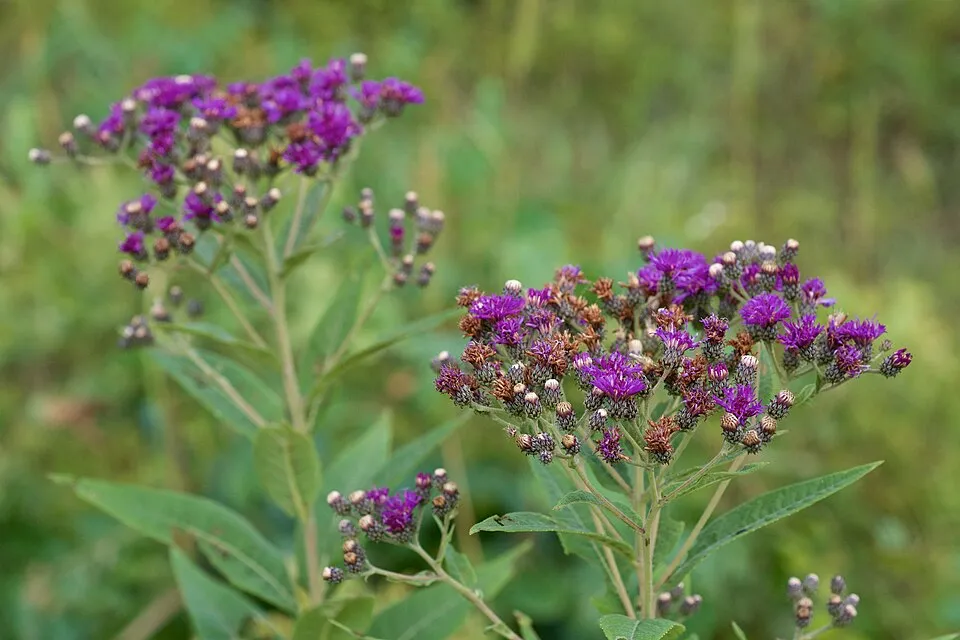
Western Ironweed is the tall, uncompromising purple beacon of the late-season prairie — a tough, iron-stemmed perennial that rises 3–5 ft above the fading grasses of August and unfurls dense, flat-topped clusters of the most intense royal-purple flowers in the Oklahoma flora. Its bloom coincides precisely with peak monarch migration through NE Oklahoma, and a single large ironweed plant in September can host dozens of monarchs, painted ladies, red admirals, and native bees simultaneously, all fueling up for the long flight south. Vernonia baldwinii is not delicate or subtle — it is coarse, abundant, iron-strong, and covered in insects from dawn to dusk for six to eight weeks. Named for its tough, rigid stems that stand upright through winter, it is one of the three or four most important late-season nectar plants in the Cross Timbers and Tallgrass Prairie of NE Oklahoma, and every pollinator garden or prairie restoration without it is incomplete.

[ field key — habit · stem · leaf · inflorescence · distinguishing from other ironweeds ]
An upright, clump-forming perennial 3–5 ft tall (occasionally to 6 ft in rich, moist soil) with one to several stout, rigid stems arising from a woody crown. The stems are tough and fibrous — the "iron" in ironweed — covered in fine, grayish or silvery tomentose hairs that give the stem a slightly fuzzy, pale appearance. The stems are unbranched below the inflorescence and persist upright through winter without collapsing, a valuable trait for winter garden structure. The plant forms expanding clumps over time via short rhizomes but is not aggressively colonial; individual clumps live for many years.
Leaves are alternate, simple, lanceolate to narrowly elliptic, 3–7 in long and 1–2 in wide, with sharply serrated margins that are a distinctive, saw-like feature of the species. The leaf surface is rough-hairy above and densely pubescent (grayish-white tomentose) beneath, giving the underside a noticeably pale, silvery cast. Leaves are sessile or nearly so (almost no petiole), tapering to the stem at the base. The foliage is coarse-textured and has a faint, somewhat resinous aroma when crushed. Leaves remain green through summer even during moderate drought and turn a muted yellow-brown in fall.
The flowers are borne in broad, dense, flat-topped to slightly rounded terminal corymbs 3–8 in across, each containing 20–50+ individual flower heads. Each head is small (1/4–1/3 in across) and composed entirely of disc florets only — no ray flowers — which is a defining characteristic of the genus Vernonia. The disc florets are tubular, deeply five-lobed, and an intense royal-purple to magenta-purple that is nearly fluorescent in late-day sun. The phyllaries (bracts) beneath each head are ovate, green with purple tips, and tightly overlapping in several series, with awl-shaped, spreading tips that are a diagnostic feature for distinguishing V. baldwinii from other ironweed species. Blooms open progressively over several weeks, with individual heads lasting a few days each.
Each pollinated floret produces a small, dry, one-seeded achene (cypsela) topped with a pappus of tawny to purplish bristles that catches the wind. The achenes mature in late September through November, and the fluffy seed heads disperse on autumn winds like miniature dandelions. The persistent seed heads are an attractive fall and winter feature, turning a soft brownish-gray and catching low-angle autumn light. Goldfinches and other small seed-eating birds occasionally pick at the achenes, though ironweed is more important as a nectar plant than a seed source.
Oklahoma hosts several Vernonia species, and they can be challenging to separate. V. baldwinii has phyllary tips that are awl-shaped and spreading (not appressed) and leaf undersides that are densely white- or gray-tomentose. Vernonia missurica (Missouri ironweed) is taller (to 6+ ft) with broader leaves and phyllaries that are appressed with blunt tips and dilated at the base. Vernonia gigantea (tall ironweed) can reach 8–10 ft in moist soils and has leaves that are glabrous beneath. Vernonia fasciculata (prairie ironweed) has smooth, glabrous leaves and is found in wetter prairies further north and east. In NE Oklahoma, V. baldwinii is the most common ironweed of dry to mesic prairies and pastures.
Emerges from the ground in April and grows steadily but not dramatically through May and June. The plant puts on its major growth spurt in July as summer heat intensifies. Flower buds become visible in late July to early August, and the first flowers open in mid-August. Peak bloom runs from late August through September, with sporadic flowering continuing into October until the first hard freeze. Foliage is killed by frost in late October or November, but the stems and seed heads stand through winter. Cut back in late winter or early spring before new growth begins.
Vernonia baldwinii is a central and south-central US species, ranging from Nebraska and Iowa south through Missouri, Kansas, Oklahoma, Arkansas, and Texas. It is abundant throughout all of Oklahoma and is one of the most conspicuous flowering plants of late summer and fall in the state's prairies, pastures, and open woodlands. In NE Oklahoma, it is found in tallgrass prairie remnants, restored prairies, overgrazed pastures (where it increases under grazing pressure because cattle avoid its bitter foliage), roadsides, fencerows, open post-oak and blackjack-oak woodlands, and the edges of Cross Timbers savannah.
This species is a characteristic member of the Tallgrass Prairie Preserve flora in Osage County, where its purple corymbs dot the landscape from late August through September. It also occurs extensively in the wider Flint Hills, Osage Hills, and Cherokee Prairie regions that surround the Tulsa metropolitan area. In the Cross Timbers, it occupies sunny openings and woodland edges, often alongside big bluestem, indiangrass, and switchgrass. It is common enough that you will see it from the highway — those brilliant purple patches in September pastures between Tulsa and Pawhuska are ironweed.
[ monarch migration · 30+ pollinator species · late-season ecological niche · grazing ecology ]
The bloom of Vernonia baldwinii coincides precisely with the peak of the monarch butterfly fall migration through NE Oklahoma (late August through early October). Monarchs require abundant, high-quality nectar to fuel their 2,000+ mile journey to the oyamel fir forests of central Mexico, and ironweed is one of the most heavily visited plants along the Oklahoma segment of the central flyway. A mature ironweed plant in bloom in September regularly hosts 3–10 monarchs at once, along with other migratory and resident butterflies: painted ladies (Vanessa cardui), red admirals (V. atalanta), common buckeyes (Junonia coenia), gulf fritillaries, and various sulphurs and skippers. If you want to provide meaningful, ecologically critical fuel for the monarch migration corridor, plant ironweed.
The rich, accessible nectar of ironweed flowers attracts an extraordinary diversity of native bees. In a single hour of observation on a sunny September afternoon in Osage County, you can count 30+ species of flower-visiting insects on one large plant: bumblebees (Bombus pensylvanicus, B. impatiens, B. fervidus), long-horned bees (Melissodes, Svastra), sweat bees (Agapostemon, Lasioglossum, Augochlora), leafcutter bees (Megachile), mining bees (Andrena), cuckoo bees (Triepeolus, Epeolus), and numerous thread-waisted wasps (Ammophila, Sphex), potter wasps (Eumeninae), and syrphid flies. Few native plants in Oklahoma match ironweed for late-season pollinator diversity per square foot.
Ironweed is one of the increaser species in overgrazed tallgrass prairie — cattle avoid its bitter, fibrous foliage while selectively grazing the more palatable grasses and forbs around it. This gives ironweed a competitive advantage under heavy grazing pressure, and dense stands of ironweed in a pasture are often an indicator of past or current overstocking. In a conservation context, this tolerance of herbivory means ironweed persists in fragments of prairie where more sensitive species have been eliminated, making it a resilient foundation plant for prairie restoration on degraded sites. It does not spread aggressively in ungrazed or well-managed prairie plantings.
Ironweed occupies the late-summer to fall flowering niche in prairie ecosystems — a critical gap when many early and mid-season forbs have finished blooming and the last nectar sources before winter are essential for insects building fat reserves for hibernation or migration. Alongside stiff goldenrod, tall goldenrod, showy goldenrod, New England aster, and Maximilian sunflower, ironweed forms the fall nectar guild that sustains the entire late-season pollinator community. The stems, left standing through winter, provide overwintering cavities for native bees that nest in pithy stems, including small carpenter bees (Ceratina) and mason bees (Osmia).
[ site · spacing · maintenance · companion prairie plants · cutting back ]
Ironweed is adaptable to nearly any sunny site with decent drainage. It thrives in full sun on clay, loam, sandy, or rocky soils and tolerates both the heavy red clay common around Tulsa and the thin, dry soils of limestone and sandstone uplands. It is an excellent choice for hell strips, parking lot islands, and other hot, dry, neglected spaces where many plants fail. Plant it where you can see it in September from a window or patio — you will want to watch the monarchs.
Ironweed is the anchor of the fall prairie garden. Plant it with stiff goldenrod, showy goldenrod, and tall goldenrod for the classic purple-and-gold combination that defines September on the southern Plains. Combine with New England aster, prairie blazing star, compass plant, and Maximilian sunflower for a multi-layered, multi-colored fall pollinator corridor. The tall grasses big bluestem, indiangrass, and switchgrass provide a structural backdrop and help support the ironweed stems against late-summer windstorms. For a lower layer, underplant with little bluestem and prairie dropseed.
Hero photo: Rooted Revival. Strip photos courtesy of Wikimedia Commons contributors under their respective licenses (linked under each image).