home/ plants/ riverbank-grape

// SPECIES PROFILE · VINE · NATIVE · ROOTSTOCK PARENT · WILDLIFE FRUIT

Riverbank Grape

Vitis riparia

Riverbank grape is a vigorous, climbing native grape vine with tendrils, large three-lobed leaves, and clusters of small, sour, dark purple grapes with a heavy bluish bloom. It is the phylloxera-resistant rootstock parent upon which nearly all European wine grapes worldwide are now grafted — a native North American plant that quite literally saved the global wine industry from collapse in the late 19th century. Vitis riparia is common throughout NE Oklahoma, especially along the Arkansas River system, where it clambers high into cottonwoods, willows, and sycamores in the floodplain forest. Its fruit is valuable for juice, jelly, and wine, and the vine itself is one of the most cold-hardy and disease-resistant grapes in existence.

// QUICK FACTS
Family
Vitaceae (grape family)
Life cycle
Deciduous perennial woody vine; long-lived (50–100+ years) in favorable sites
Native range
Eastern and central North America — Saskatchewan to Quebec, south to Texas and Florida; common throughout OK
USDA hardiness
Zones 3–8 (Tulsa = 7a/7b — well within ideal range)
Mature size
Vines 30–60 ft long; trunk can reach 8–12 in diameter on very old specimens
Bloom
May – June (NE OK); small greenish-yellow, fragrant flowers in panicles
Fruit
Clusters of small, dark purple to blue-black grapes ¼–½ in, with a heavy bloom; ripens August–September
Sun
Full sun to partial shade; climbs into full sun in the canopy; most productive in full sun
Soil
Adaptable — tolerates sand, loam, clay, and gravel; prefers moist, well-drained alluvial soils. pH 5.0–7.5
Water
Medium to moist; floodplain-adapted but tolerates drier upland sites once established
Wildlife
Grapes for birds and mammals · nectar and pollen for bees · larval host for numerous sphinx moths
Economic significance
Foremost rootstock for the global wine industry; phylloxera-resistant
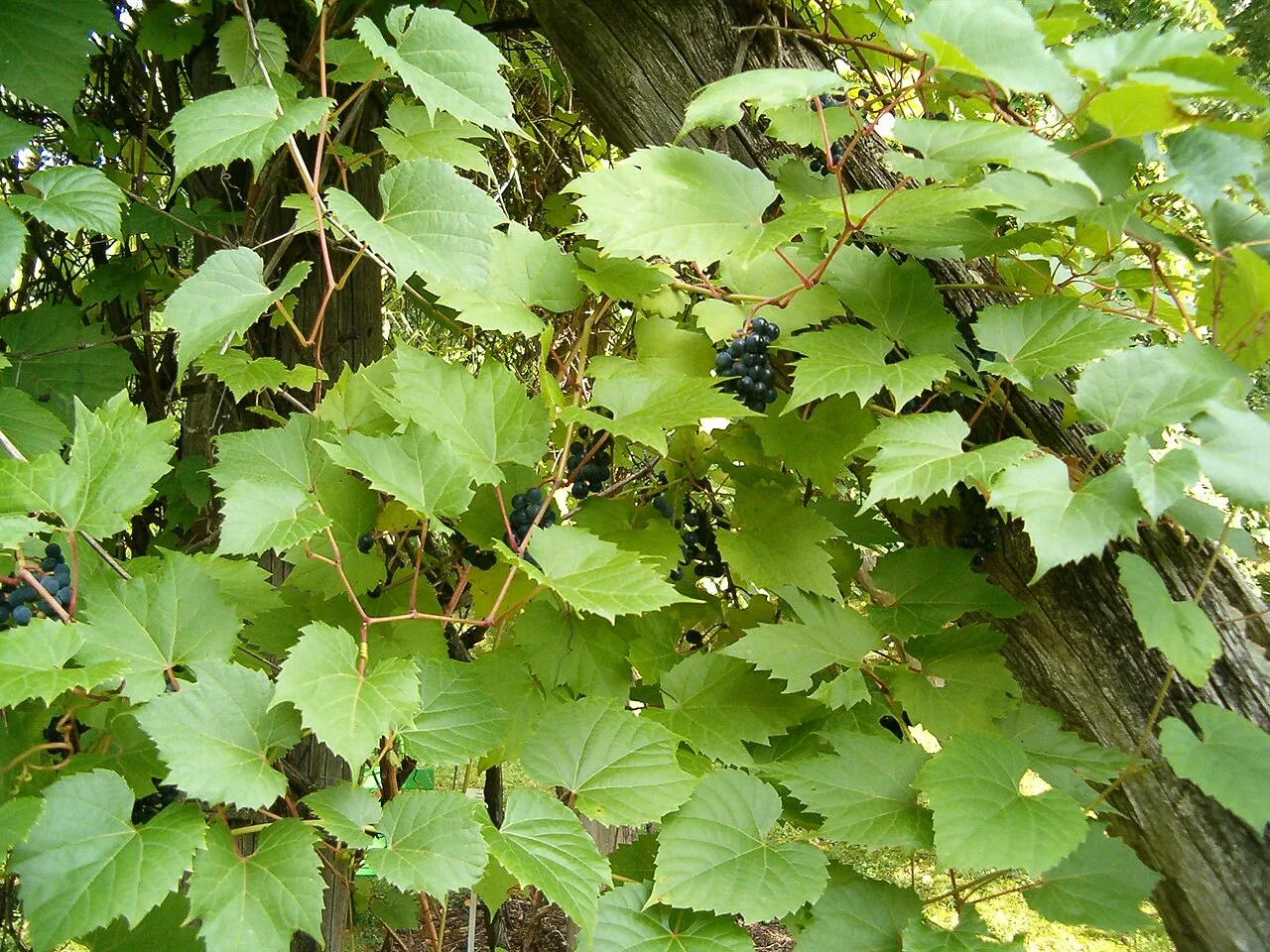
Riverbank Grape (Vitis riparia) — three-lobed leaves, tendrils, and clusters of dark purple grapes with heavy bloom
Vitis riparia — the phylloxera-resistant native grape: three-lobed leaves, tendrils, and clusters of dark purple fruit. Photo: Rooted Revival.

Identification

[ field key — vine · leaf · flower · fruit · distinguishing features ]

Growth Habit & Tendrils

A vigorous, high-climbing deciduous woody vine reaching 30–60 ft into the crowns of tall streamside trees. Old trunks become dark brown, shaggy, and shredding in long strips, resembling the bark of a river birch when mature. Young stems are green to reddish-brown, smooth to faintly hairy, and bear opposite tendrils (actually modified inflorescences) at many of the nodes. The tendrils are forked (bifid) and wrap tightly around branches, twigs, and fences, anchoring the vine as it grows. Unlike the related summer grape (Vitis aestivalis), which has a slightly more restrained, woodland-edge habit, riverbank grape is an aggressive climber that will ascend to the very top of a sycamore or cottonwood canopy.

Leaves

Leaves are alternate, simple, and broadly three-lobed with sharp, jagged teeth along the margins — the overall outline is somewhat maple-like but coarser. The blade is 3–8 in long and about as wide, with a heart-shaped (cordate) base. The upper surface is medium green and smooth to slightly rough; the underside is paler and may have tufts of hair in the vein axils or be nearly smooth. The sinus (notch) at the base of the leaf is broad and U-shaped — a useful character for distinguishing riverbank grape from the fox grape (Vitis labrusca), which has a narrower, more closed basal sinus. The petiole is 2–4 in long. Fall color is a clear, bright yellow, often quite showy when the vine is draped across a dark-barked host tree.

Flowers

Riverbank grape is dioecious or sometimes functionally dioecious — most individuals are either male (staminate) or female (pistillate), though some can have both flower types. The flowers are small, greenish-yellow, fragrant, and borne in loose, branched panicles 2–6 in long that emerge opposite the leaves in May–June. The fragrance is distinctively sweet and musky, noticeable from quite a distance on warm, still days during bloom. Pollination is by bees and other insects, as well as by wind. Male vines produce abundant pollen and no fruit; female vines produce the grape clusters but require a male nearby for pollination.

Fruit & Distinguishing Features

The fruit is a loose to moderately compact cluster of small, spherical grapes ¼–½ in in diameter, dark purple to blue-black when ripe with a conspicuous bluish-white waxy bloom that rubs off easily. Each grape contains 2–4 small, hard seeds. The flavor is tart and astringent when raw — riverbank grape is not a dessert grape — but the berries sweeten after a hard frost and are excellent for processing. Key distinguishing features from other Oklahoma native grapes: the leaves have sharply jagged teeth and a broad, U-shaped basal sinus; the grapes are small and heavily bloomed with a bluish cast; and the vine is typically found in floodplains and moist sites rather than the drier upland forest edges preferred by summer grape.

Habitat & Range in NE Oklahoma

Vitis riparia has one of the widest natural distributions of any North American grape species, ranging from the Canadian Prairie Provinces to Texas. It is common throughout Oklahoma, and in the northeast part of the state it is concentrated in the floodplains, streambanks, and moist thickets of the major river systems — especially the Arkansas, Grand (Neosho), Verdigris, and Illinois rivers and their larger tributary creeks. Look for it draped over black willow, eastern cottonwood, and American sycamore in the bottomland gallery forest, or forming impenetrable, head-high tangles on sunny sandbars and gravel bars.

The species is a classic riparian corridor specialist — it follows watercourses, and its seeds are dispersed by the very rivers that flood and recede through its habitat each spring. You will see riverbank grape draping the trees along the Arkansas River between Tulsa and Muskogee, in the bottomland woods of the Grand Lake region, and along every sizable creek in the Cherokee Prairie. It occasionally ventures into uplands along fencerows and in moist draws, but it is at its most abundant and vigorous within sight of moving water.

Ecology & Wildlife Value

[ wildlife fruit · pollinator value · floodplain ecology · phylloxera context ]

Wildlife Fruit Value

Riverbank grapes are an important fall wildlife food throughout NE Oklahoma. The fruit is eaten by at least 100 bird species, with heavy use by American robins, cedar waxwings, Northern mockingbirds, brown thrashers, gray catbirds, Eastern bluebirds, Baltimore orioles, red-bellied woodpeckers, Northern flickers, wild turkeys, and bobwhite quail. Mammals including raccoons, opossums, foxes, striped skunks, deer, squirrels, and black bears (in the Ozark foothills) consume the grapes eagerly. The vines also provide nesting sites and cover for songbirds within their dense tangle of foliage and branches. Even the dense, shaggy bark of old vines provides roosting habitat for bats and overwintering insects.

Pollinators & Insects

The fragrant spring flowers attract a diverse array of pollinators, including honey bees, bumblebees, mining bees, sweat bees, syrphid flies, beetles, and wasps. As a larval host, riverbank grape supports several sphinx moth species, including the achemon sphinx (Eumorpha achemon), the Nessus sphinx (Amphion floridensis), and the pandora sphinx (Eumorpha pandorus). The grape foliage also hosts a variety of smaller moths, beetles, and leafhoppers that in turn feed insectivorous birds.

Riparian & Floodplain Ecology

In the bottomland forests of NE Oklahoma, riverbank grape functions as the primary vining layer, weaving the canopy together and creating structural complexity that benefits a wide array of wildlife. The vine's deep, extensive root system stabilizes streambanks and gravel bars, and the heavy leaf litter it produces each autumn contributes to the rich alluvial soil of the floodplain. During flood events, the flexible vines survive inundation better than many tree species, bending with the current rather than breaking. The species is an integral part of a healthy riparian plant community, and its decline (from channelization, gravel mining, and clearing of bottomland forest) is one of the less visible ecological losses in the modern Arkansas River corridor.

The Phylloxera Story

The global significance of Vitis riparia cannot be overstated. In the 1860s, an aphid-like insect called grape phylloxera (Daktulosphaira vitifoliae) was accidentally introduced from North America to Europe, where it devastated vineyards by feeding on the roots of European grapevines (Vitis vinifera). European grapes had no resistance; American grapes, which co-evolved with phylloxera, did. The solution was to graft European wine grape scions onto American rootstocks — and Vitis riparia became the most important of them all. Nearly every Cabernet Sauvignon, Chardonnay, and Pinot Noir vine planted on Earth today grows on a rootstock that is at least partially derived from V. riparia. This unassuming floodplain grape of the Arkansas and Grand River bottoms is, in a very literal sense, holding up the world's wine.

Horticulture & Care

[ site selection · planting · trellising · pruning · companion planting · food forest role ]

Site selection & planting

Riverbank grape is exceptionally easy to grow in NE Oklahoma — it is native, cold-hardy, and adapted to local soils and climate. The main considerations are providing something tall and sturdy to climb and acknowledging that once established, the vine will be vigorous to the point of aggressive and will require annual pruning to keep it in bounds.

Pruning & management

Pruning is not optional with riverbank grape — an unpruned vine will produce a massive tangle of foliage and relatively little fruit. Prune in late winter (February) while the vine is fully dormant. Riverbank grape flowers and fruits on current-season growth that arises from buds on the previous year's wood. The standard grape pruning system for this species is spur pruning or cane pruning on a high-renewal system: remove 80–90% of the previous year's growth, leaving short spurs with 2–3 buds each, spaced every 6–10 in along a permanent framework of trunks and cordons. If this sounds involved — it is. Growing grapes for fruit is a commitment. If the vine is planted primarily for wildlife, aesthetic, or ecological reasons, a simpler approach (cut back hard to the main framework each winter, ignoring refined spur detail) is sufficient.

Pests & diseases

Companion planting & food forest integration

Riverbank grape fills the vining layer of a multi-story food forest, climbing into the canopy and producing fruit in the sun while its roots occupy the shaded, moist soil below. Pairs well with: pecan, American sycamore, eastern cottonwood, or river birch as canopy support trees; groundnut as a companion nitrogen-fixing vine; sunchoke, Joe-Pye weed, and cardinal flower along the moist-to-wet edge beneath; and buttonbush and elderberry in the shrub layer. In a designed food forest, riverbank grape is best placed along a swale, pond edge, or rain garden overflow channel where its moisture preference is met and its sprawling vigor can be directed along a trellis or into a large, sturdy host tree.

Edible & Cultural Uses

Riverbank grape fruit is small, tart, and seedy when eaten raw off the vine in late summer — it is not a table grape. But it is a superb processing grape for juice, jelly, preserves, and wine, and it has been used for these purposes by Indigenous peoples across eastern North America for thousands of years and by rural families in Oklahoma and the Ozarks through the present day.

A native plant with global reach. The story of riverbank grape is one of the more remarkable chapters in the history of human-plant relationships. A floodplain vine from the rivers of the American interior, co-evolved with a root-sucking insect, became the foundation upon which the entire European wine tradition was rebuilt. Every glass of French Bordeaux, Italian Barolo, or Napa Cabernet you have ever tasted came from a vine on American grape roots. That is worth remembering when you see Vitis riparia draped over a willow along the Arkansas River.

Photo Reference

Riverbank grape clusters — small dark purple grapes with heavy bluish bloom
// Fruit clusters — small, dark purple grapes with heavy bluish bloom, ripening in fall
Wikimedia Commons
Wikimedia Commons
Riverbank grape leaf — broadly three-lobed with jagged teeth and U-shaped basal sinus
// Leaf — three-lobed with sharply jagged teeth and broad U-shaped basal sinus
Wikimedia Commons
Wikimedia Commons
Riverbank grape vine climbing a host tree — thick, shaggy bark vines ascending the trunk
// Vine — mature trunk with shaggy bark, climbing a floodplain host tree
Wikimedia Commons
Wikimedia Commons
Riverbank grape flowers — small, greenish-yellow, fragrant, in loose panicles
// Flowers — small, fragrant, greenish-yellow in loose panicles, May–June
Wikimedia Commons
Wikimedia Commons
Riverbank grape in floodplain habitat — vine draping trees along a river corridor
// Habitat — floodplain forest along the Arkansas River, draped in riverbank grape
Wikimedia Commons
Wikimedia Commons

Sources & Further Reading

  • USDA NRCS PLANTS Database — Vitis riparia: plants.usda.gov/plant-profile/VIRI
  • Lady Bird Johnson Wildflower Center — Native Plant Database: wildflower.org — VIRI
  • Reisch, B.I. et al. (2012). Grape Breeding. In: Fruit Breeding. Springer — the role of Vitis riparia in rootstock development.
  • Granett, J. et al. (2001). Biology and management of grape phylloxera. Annual Review of Entomology 46:387–412 — definitive treatment of the phylloxera crisis and rootstock solution.
  • Pohl, J.M. (2013). Wild Grapes of the Ozarks: Identification and Use. Ozark Society Press.
  • Moerman, D.E. (1998). Native American Ethnobotany. Timber Press — indigenous uses of Vitis species.
  • Wikipedia — Vitis riparia: en.wikipedia.org/wiki/Vitis_riparia (CC BY-SA 4.0; portions of the description, ecology and uses sections summarize Wikipedia content).

Hero photo: Rooted Revival. Strip photos courtesy of Wikimedia Commons contributors under their respective licenses (linked under each image).