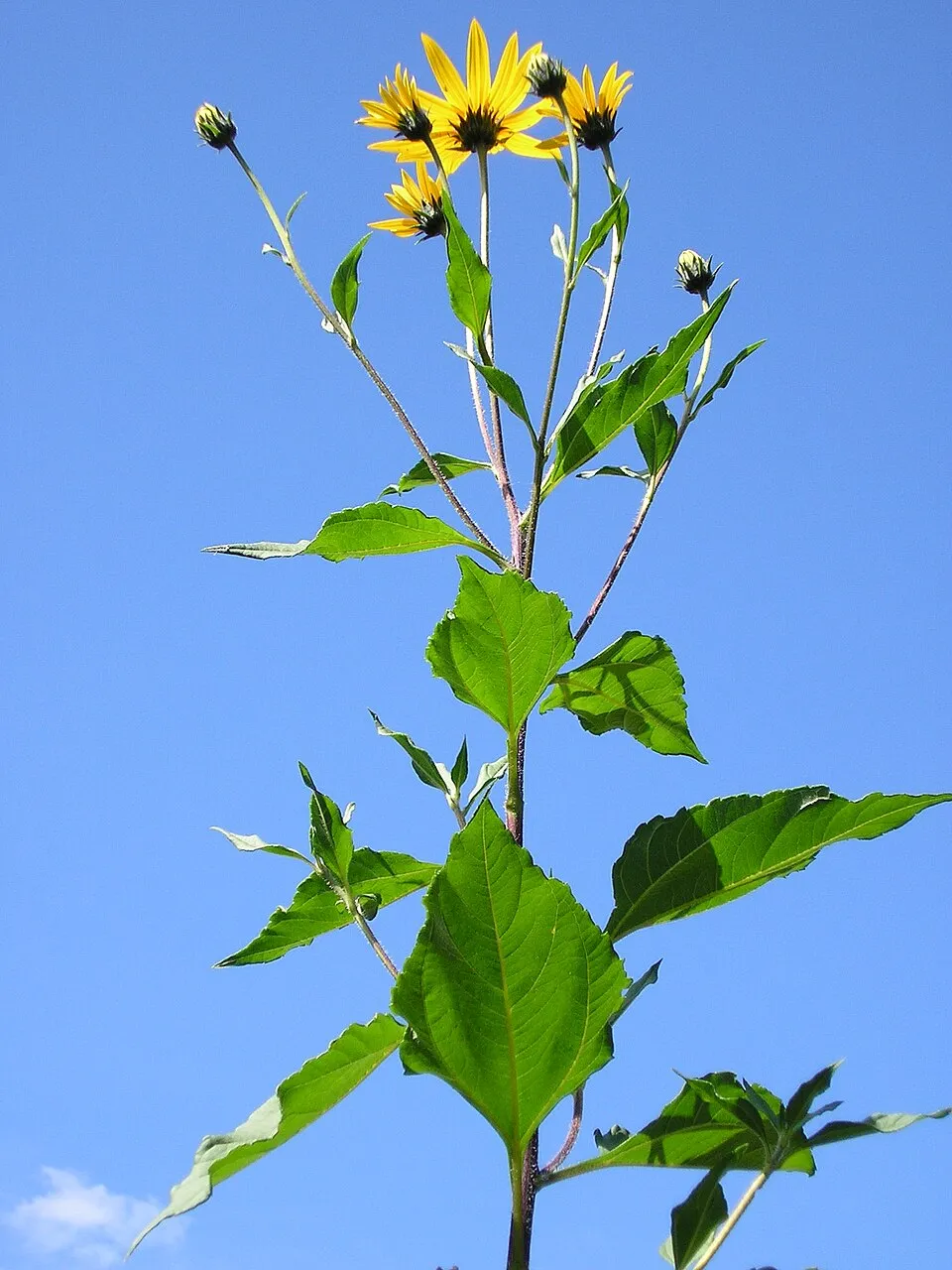
// SPECIES PROFILE · PERENNIAL · NATIVE · EDIBLE TUBER
The sunchoke is a vigorous perennial sunflower that towers 6–10 ft tall and spreads underground by knobby, edible tubers with a crisp texture and a nutty, artichoke-like flavor. Native to central North America, it was cultivated by Indigenous peoples long before European contact and has naturalized in moist, sunny edges throughout NE Oklahoma — you can find it in roadside ditches, stream margins, and old homestead sites across Tulsa, Rogers, and Cherokee counties. Helianthus tuberosus produces masses of golden composite flowers from August through October, supporting a guild of specialist bees unique to the genus. The tubers store energy as inulin rather than starch, making them a prebiotic superfood that supports gut health without spiking blood sugar — a genuinely unique carbohydrate source among North American native vegetables.

[ field key — stem · leaf · flower · tuber · distinguishing features ]
Stout, erect perennial herb from a system of spreading underground rhizomes tipped with edible tubers. Stems are 6–10 ft tall, typically branched in the upper third, and covered with coarse, stiff hairs that feel like sandpaper to the touch. Unlike the annual common sunflower, sunchoke stems arise from perennial tubers rather than seed each year, and a single plant can produce dozens of new shoots in a dense colony. In heavy clay or nutrient-poor Oklahoma soils, plants tend toward the shorter end of the height range but still bloom prolifically.
Leaves are mostly opposite on the lower stem and alternate toward the top — a mixed arrangement that helps distinguish H. tuberosus from the fully alternate-leaved annual sunflower. Blades are simple, broadly ovate to lance-ovate, 4–10 in long and 1.5–4 in wide, with a tapered (attenuate) tip, serrated margin, and a short, winged petiole. Both leaf surfaces are rough-hairy (scabrous), though less so than H. annuus. The undersides are noticeably paler green and have a soft, almost velvety texture from fine pubescence. Lower leaves drop by flowering time, leaving the upper stem well-leafed.
Golden composite heads, 2–4 in across, borne in loose terminal panicles of 3–15+ heads per stalk. Each head has 10–20 yellow ray florets surrounding a central disk of darker yellow fertile florets. The heads are noticeably smaller than the massive 8–12 in heads of cultivated annual sunflowers but are produced in far greater numbers over a longer period — a single mature clump in a Tulsa garden can carry 50–100+ blooms simultaneously from late August through October. Bracts (phyllaries) are dark green, lanceolate, and loosely spreading to recurved, often with fine cilia along the margins.
The underground tubers are the definitive identification feature and the reason to grow sunchokes. They are knobby, irregular, somewhat ginger-root-shaped structures 2–5 in long and 1–2 in thick, with thin, light-tan to reddish-brown skin and crisp white flesh. Tubers form at the tips of long rhizomes that radiate outward from the parent plant, often several feet. The flavor is nutty, slightly sweet, and reminiscent of artichoke hearts or water chestnuts. The easiest way to distinguish sunchoke from Maximilian sunflower is by digging — H. maximiliani has a woody, non-tuberous crown, while H. tuberosus produces abundant edible tubers.
Helianthus tuberosus is native to a broad swath of central and eastern North America, from Saskatchewan and Manitoba south to Georgia and Texas, with Oklahoma sitting squarely within its core range. In NE Oklahoma, sunchokes are frequently found along moist woodland edges, stream terraces, floodplain margins, and low-lying disturbed ground — think the Arkansas River and Grand River bottoms, fencerows in Rogers and Mayes counties, and old farmstead sites throughout the Cherokee Prairie region. The species thrives where consistent subsoil moisture meets full-to-partial sun: ditch banks along county roads, creek-side thickets, and the transition zone between bottomland forest and open field.
Unlike the strictly upland Maximilian sunflower of the tallgrass prairie, sunchoke leans toward mesic (moist) sites with rich, deep soil — the same kind of bottomland that would historically have grown pecan, sycamore, and black willow. It tolerates heavier clay than most Helianthus species, which is why it persists happily in Tulsa's red clay subsoil as long as drainage is adequate. Once established, colonies can live for decades in the same location, spreading slowly by tuber in the absence of mechanical disturbance and rapidly when the soil is tilled, trenched, or washed out by flood events — each tuber fragment capable of producing a new plant.
[ specialist bees · late-season nectar · Lepidoptera hosts · seed and browse ]
Like all Helianthus species, sunchoke hosts a dedicated guild of sunflower-specialist solitary bees. In NE Oklahoma, the regulars include Andrena helianthi (sunflower miner bee), Diadasia enavata (sunflower chimney bee), Melissodes agilis, M. trinodis, and Svastra obliqua — all ground-nesting native bees that provision their brood cells almost exclusively with Helianthus pollen. The late bloom period (August–October) makes sunchoke especially valuable: it's one of the last major nectar and pollen sources available before frost, bridging the gap for bees that need to provision fall nests and for migrating butterflies.
Larval host plant for the silvery checkerspot (Chlosyne nycteis) and the gorgone checkerspot (C. gorgone), both of which use Helianthus foliage. The painted lady (Vanessa cardui) also uses sunchoke as a host, and adult butterflies of many species nectar extensively on the late-season flowers. The sunflower moth (Homoeosoma electellum) larvae feed within developing seed heads; damage is typically cosmetic and can be left for birds to clean up.
Sunchoke seed is smaller and less oil-rich than that of the annual common sunflower, but it is still eagerly taken by American goldfinches, house finches, several sparrow species, mourning doves, and dark-eyed juncos from late fall through winter. White-tailed deer browse the foliage and will graze a sunchoke patch to the ground if it's within reach in late summer; the tubers themselves are dug and eaten by voles, groundhogs, feral hogs, and occasionally raccoons — a consideration if you're growing for harvest in a rural setting. Dense sunchoke colonies provide excellent summer cover for rabbits and small mammals, their tall stalks creating a miniature forest at ground level.
Sunchoke occupies an important ecological niche as a tall, late-blooming, large-biomass perennial in moist woodland edges and bottomlands. Its massive above-ground growth sequesters significant carbon each season, and the underground tuber network stabilizes stream-bank soils against erosion and scouring during flood events. The dense canopy of foliage shades out cool-season pasture grasses and provides a thermal refuge for insects and ground-nesting birds in late summer. In a food forest context, a sunchoke stand functions as a multifunctional hedgerow: windbreak, pollinator buffet, erosion anchor, and carbohydrate crop all in one plant.
[ planting tubers · soil · water · containment · harvest · companion planting ]
Plant sunchoke tubers in early spring (mid-March through early April in Tulsa) as soon as the soil can be worked. They are as easy to establish as any vegetable you can bury in the ground. Choose a location carefully — once sunchokes are in, they are remarkably difficult to eradicate completely because even a ½-inch tuber fragment left in the soil will regenerate. For this reason, dedicate a permanent bed or plant them in a contained area bordered by mowed grass, a buried rhizome barrier, or a location where spreading is acceptable (a fencerow, an out-of-the-way utility strip, or the back edge of a food forest).
Let's be direct: sunchokes are aggressive spreaders in rich, moist soil. A single tuber planted in prime bottomland can produce 20–75+ new tubers in one season. If you cannot accept a large stand, employ one of these strategies:
Sunchokes fill the tall herbaceous perennial layer of a multi-story food forest. Pairs well with: elderberry and buttonbush in wet-edge plantings, Joe-Pye weed for a dramatic native pollinator screen, ironweed and tall goldenrod for a late-season pollinator powerhouse hedge, common sunflower for staggered bloom from July through October, and winter squash or sweet potato as a groundcover underneath (the squash rambles while sunchokes tower above, and the sweet potatoes enjoy the partial shade from the sunflower stalks). Keep sunchokes at least 15–20 ft away from vegetable beds you intend to till or turn annually, lest the tubers invade.
Sunchokes have been cultivated as a food plant by Indigenous peoples of eastern North America for thousands of years — long before European contact and long before the "Jerusalem artichoke" moniker appeared (which itself is a linguistic mash-up of the Italian girasole, "sunflower," corrupted into "Jerusalem"). French explorers encountered sunchokes being grown by Indigenous communities along the St. Lawrence and Atlantic coast in the early 1600s and brought tubers back to Europe, where they became a popular garden vegetable for two centuries before being displaced by the potato. Here is what you need to know about eating them today:
Hero photo: Rooted Revival. Strip photos courtesy of Wikimedia Commons contributors under their respective licenses (linked under each image).