// SPECIES PROFILE · PERENNIAL VINE · NATIVE · NITROGEN-FIXING · INDIGENOUS STAPLE
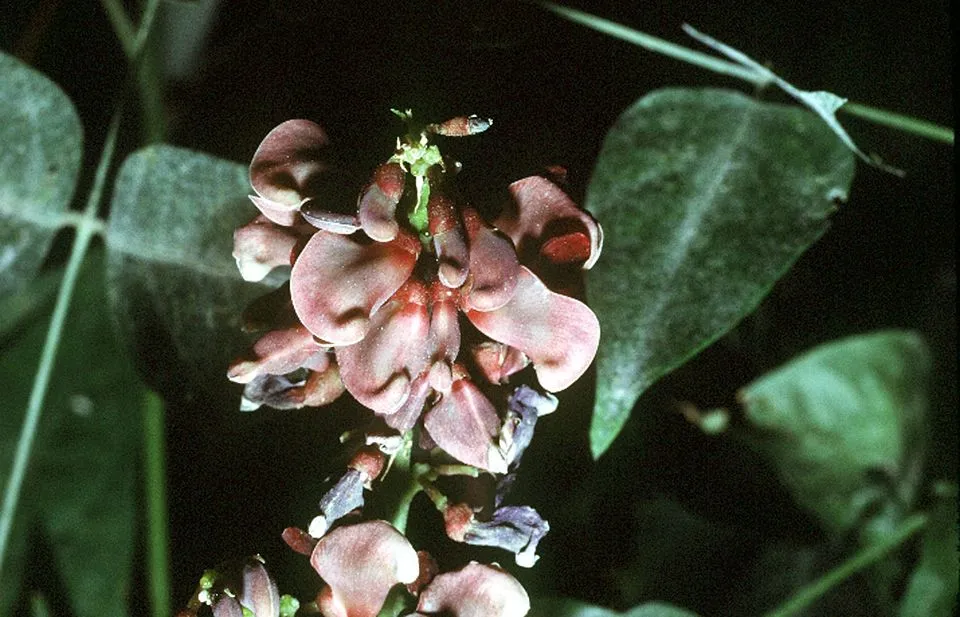
Groundnut is a twining, nitrogen-fixing perennial vine with compound leaves and clusters of fragrant maroon-chocolate pea flowers that smell unmistakably like violets. It produces chains of starchy, potato-like edible tubers along its roots — a staple food of Eastern Woodlands Indigenous peoples for millennia, with a protein content roughly three times that of potatoes. Apios americana is native across eastern North America and thrives in the moist thickets, streambanks, and bottomland edges throughout the Arkansas and Grand River systems of NE Oklahoma. Every part of a food forest benefits from groundnut: it fixes nitrogen into the soil, climbs trellises and small trees without strangling them, feeds pollinators with its unusual velvety blooms, and delivers a substantial edible yield from the ground beneath.

[ field key — vine · leaf · flower · tuber · distinguishing features ]
Slender, herbaceous, twining perennial vine 8–15 ft long in a single growing season. Stems are 1–3 mm in diameter, smooth to slightly hairy, green to reddish-brown, and twine clockwise around supports. Unlike woody vines such as summer grape, groundnut dies completely to the ground each winter, leaving only its underground tuber system alive. New shoots emerge in April in the Tulsa region, growing rapidly once soil temperatures exceed 55°F. Underground, the plant produces slender rhizomes tipped with chains of swollen, edible tubers.
Pinnately compound with 5–7 (occasionally 9) ovate to lance-ovate leaflets, each 1–3 in long. Leaflets are smooth (glabrous) to sparsely hairy, with entire margins and pointed tips. The overall leaf is 4–8 in long and borne on a slender petiole. Leaves are alternate along the stem. The compound leaf arrangement and hairless leaflets distinguish groundnut from the superficially similar but trifoliate-leaved pole bean and the coarser-textured wisteria (which is woody and has 9–15 leaflets).
The flowers are the most distinctive feature and one of the most beautiful among North American legumes. They are borne in dense, axillary racemes 2–6 in long, each carrying 6–40 individual flowers. Each bloom is a typical pea-flower shape: a broad, rounded standard petal maroon to deep reddish-brown on the exterior and paler pinkish within, flanked by two brownish winged petals and a curved keel. The fragrance is remarkable — sweet, powdery, and distinctly violet-like — and the blooms are pollinated primarily by bumblebees, which are strong enough to trip the keel and access the nectar.
The edible portion of groundnut is a chain of spherical to oblong tubers connected by thin, wiry rhizomes that radiate outward and downward from the main root crown. Individual tubers are 1–3 in in diameter, with thin, brown skin and white, starchy, crisp flesh. Tubers form at depths of 1–3 ft and can spread several feet outward from the parent plant. When cut, the flesh exudes a milky latex — an unusual trait among edible roots. The flavor is described as a cross between a potato and a peanut, with a slightly sweet finish. A single mature plant can produce 2–5 lb of tubers annually under good growing conditions.
Apios americana is native across the eastern half of North America, from the Canadian Maritimes west to the Great Plains and south to the Gulf Coast. Oklahoma sits near the western edge of its native range, and in NE Oklahoma the plant is found in moist, low-lying habitats: riparian thickets, floodplain forests, stream and river banks, swamp edges, and wet-to-mesic bottomland woods. Look for it along the Arkansas River corridor between Tulsa and Muskogee, the Grand (Neosho) River system in Mayes and Delaware counties, and the smaller creeks and drainage ditches that lace the Cherokee Prairie and Ozark foothill region. It needs consistent subsoil moisture and does not tolerate fully dry upland sites.
The typical NE Oklahoma groundnut site is a partially shaded stream terrace where the vine clambers over black willow, roughleaf dogwood, or buttonbush near the water's edge. It also colonizes wet ditches along county roads in the flatter portions of Rogers and Wagoner counties. Groundnut is less common here than in the humid Southeast, but it persists in the region's high-quality bottomland remnants and is well suited to intentional planting in moist food forest sites — particularly along swales, rain gardens, and pond margins where the soil stays damp through August.
[ bumblebee pollination · Lepidoptera hosts · nitrogen fixation · wetland edge ecology ]
Groundnut flowers are adapted for bumblebee pollination — the keel petal encloses the stamens and pistil, and only bees heavy enough to depress the keel (primarily Bombus species) can access the nectar and effect pollination. In NE Oklahoma, common visitors include the common eastern bumble bee (Bombus impatiens), the American bumble bee (B. pensylvanicus), and the brown-belted bumble bee (B. griseocollis). Honey bees will also work the flowers, though less efficiently. The sweet violet-like fragrance persists in the garden, noticeable from several feet away on still summer days. The species also produces small extrafloral nectaries on the leaf petioles, attracting ants that may provide incidental defense against herbivores.
Larval host for the silver-spotted skipper (Epargyreus clarus), one of the largest and most common skippers in eastern North America — you will see its distinctive leaf-rolling larvae on groundnut foliage in July and August. Deer browse the foliage eagerly and will graze a patch heavily if it's accessible; in a natural setting, the tubers are dug and eaten by bears, feral hogs, and small mammals including voles and chipmunks. The plant's vigorous regrowth from tubers makes it resilient to moderate browsing pressure.
As a legume in the Fabaceae, groundnut forms root nodules housing nitrogen-fixing rhizobia bacteria that convert atmospheric N₂ into plant-available ammonium. This is a genuinely valuable ecological function: a mature groundnut planting fixes an estimated 50–100 lb of nitrogen per acre per year, enriching soil for neighboring plants. In a food forest, groundnut functions as a living nitrogen source for fruit trees, pecan, and other heavy feeders. The nitrogen-rich leaf litter decomposes rapidly, further building topsoil. Unlike annual legumes (e.g., pole beans or cowpeas), groundnut fixes nitrogen year after year without replanting.
In its natural streambank and bottomland habitat, groundnut contributes to the dense, multi-layered vining tangle that stabilizes soil, slows floodwater, and provides cover for amphibians, reptiles, and ground-nesting birds. The thick tuber and rhizome network binds soil in the upper 1–3 ft, reducing erosion during flood pulses. In a designed landscape, groundnut planted along a swale, rain garden, or pond edge performs the same functions while also feeding people. The vine's annual dieback adds organic matter to the soil surface each winter, contributing to the slow accumulation of a rich, dark A-horizon characteristic of healthy riparian zones.
[ planting tubers · trellising · water · harvest · companion planting · food forest integration ]
Groundnut needs consistent moisture and something to climb — it will not thrive in dry upland sites or as a groundcover sprawl. Choose a location in the moist zone of your food forest: a swale bottom, a pond edge, a rain garden depression, or a bed with irrigation and good organic matter. It tolerates partial shade well, making it an excellent vine for the understory-to-shrub-layer transition — plant it to climb young black willow, coppiced pawpaw or red buckeye, or a sturdy trellis between fruit trees.
This is the single most important horticultural factor. Groundnut growing in consistently moist soil will produce 3–5 times the tuber yield of a water-stressed plant. In the Tulsa summer, plan for 1–1.5 inches of water per week during June through September. Drip irrigation beneath mulch is ideal. Signs of water stress appear as wilting at midday and premature leaf drop — a stressed groundnut will survive but will produce few tubers that year. Beyond watering, maintenance is minimal: a spring compost top-dressing, occasional weeding in the first season, and cutting back dead vines to ground level after frost.
Tubers are best harvested after the first hard frost (typically November in Tulsa), when starch content peaks and the vines have died back, making the location of the root crown easier to find. In practice, groundnut is a "hunt and dig" crop: follow the rhizomes outward from the crown, carefully lifting tubers with a garden fork. The rhizome chains can extend 6–10 ft from the crown at depths of 1–3 ft. Always leave a portion of the tuber chain in the ground to resprout the following year — the plant is a perennial, not an annual, and harvesting the entire system will kill it. A simple strategy: dig one side of the plant each year, rotating sides annually for a sustained yield. Tubers store 4–6 months in damp sand or sawdust in a root cellar or cool basement (35–45°F).
Groundnut is a textbook example of the vining layer in a multi-story food forest. Pairs exceptionally well with: pawpaw and spicebush in the understory (groundnut climbs the pawpaw's slender trunks without harming them), elderberry in wet-edge shrub plantings, Joe-Pye weed and tall goldenrod for a native pollinator support cast, and common sunflower or sunchoke as tall annual/perennial companions that absorb the vine's nitrogen contributions. Groundnut also works as an understory vine beneath open-canopy trees like Kentucky coffeetree or honey locust, where dappled light and nitrogen-rich leaf litter create an ideal growing environment.
Few North American native plants have a deeper cultural food history than groundnut. Archaeological evidence dates Indigenous use of Apios americana to at least 9,000 years before present, and the tubers were a dietary staple for Algonquian, Iroquoian, Siouan, and Muskogean-speaking peoples across the Eastern Woodlands and into the Plains. The Wampanoag taught the Pilgrims to harvest and prepare groundnut during the winter of 1620–21, likely saving lives. In NE Oklahoma, the Osage and Quapaw nations utilized groundnut wherever it occurred along the region's river systems, and it remains an underappreciated native food of the lower Midwest. Here is what matters for the modern grower and cook:

Hero photo: Rooted Revival. Strip photos courtesy of Wikimedia Commons contributors under their respective licenses (linked under each image).