// SPECIES PROFILE · PERENNIAL · SHALLOW-WATER POLLINATOR PLANT · DRAGONFLY PERCH
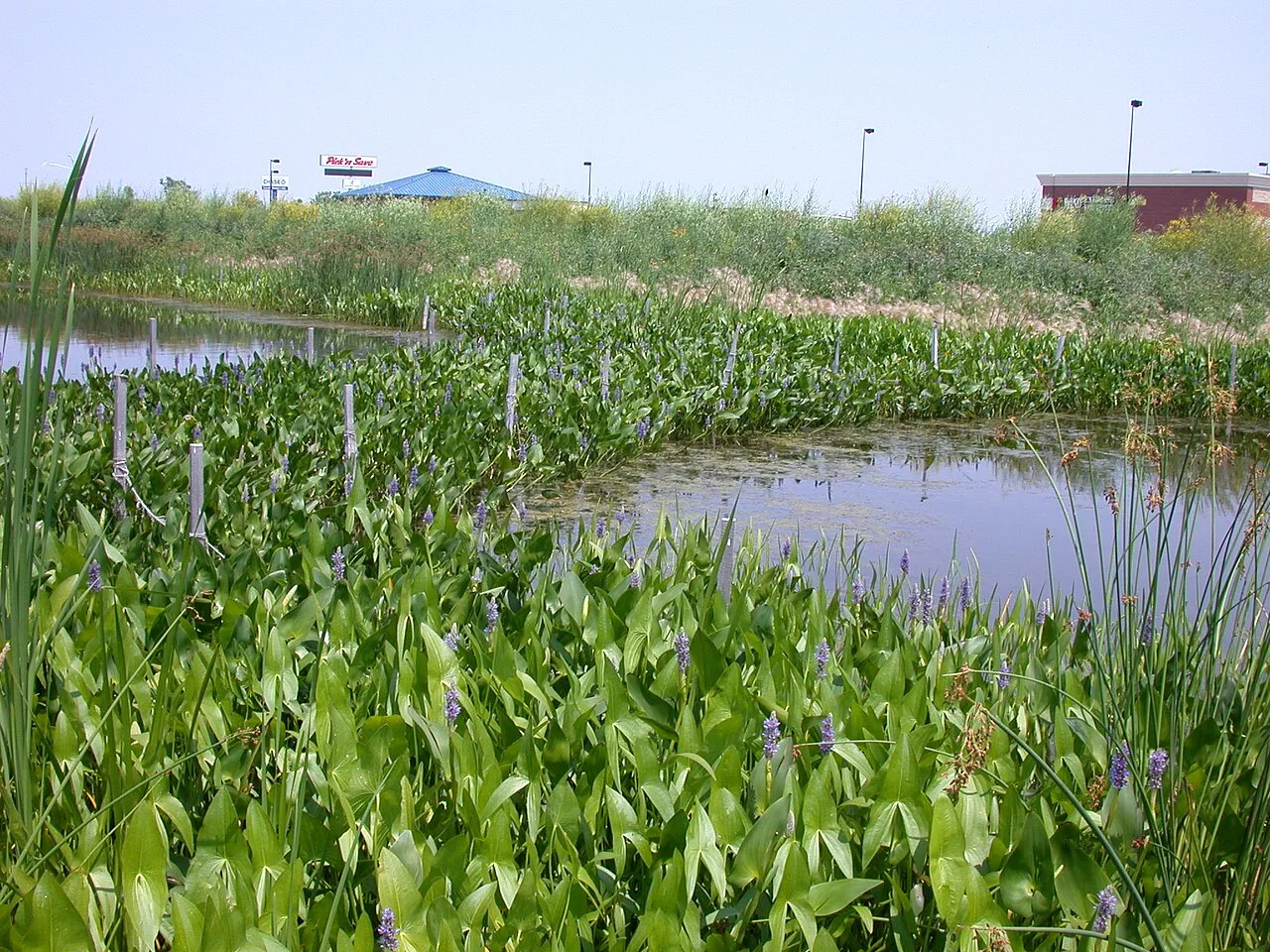
Pickerelweed is the elegant workhorse of the shallow water margin — an upright aquatic perennial 2–3 feet tall with glossy, heart-shaped (cordate) leaves with long petioles and, from June through October, dense, bottlebrush-like spikes of violet-blue flowers that are among the most reliable pollinator resources in the wetland garden. The flower spikes rise just above the foliage on thick, fleshy stalks, each spike composed of dozens of small, two-lipped flowers that open from the bottom upward over several weeks. In NE Oklahoma, Pontederia cordata is found in shallow water of ponds, marshes, and slow streams throughout the region, where its flowers provide rich nectar and pollen for bumblebees, native bees, and butterflies, while the sturdy stalks serve as essential emergence perches for dragonflies and damselflies leaving their aquatic larval stage.

[ field key — leaf · inflorescence · flower · fruit · rhizome ]
Upright, clump-forming emergent perennial with a thick, creeping rhizome anchored in the bottom mud. The above-water portion consists of a rosette of long-petioled leaves and leafless flowering stalks emerging directly from the rhizome. Stems (actually petioles and peduncles) are stout, fleshy, and smooth, with spongy internal tissue (aerenchyma) adapted for oxygen transport in waterlogged sediments. Plants form discrete, gradually expanding clumps in shallow water, not aggressive runners. The overall architecture is clean, architectural, and reliable — it looks manicured without any maintenance.
The leaves are the definitive identification feature when the plant is not in flower: glossy, rich green, heart-shaped to lanceolate (variable), 4–10 in long on long, thick, spongy petioles that can reach 2–3 ft in length and hold the blade above the water surface. The cordate (heart-shaped) leaf base gives the species its epithet cordata. The blade has entire margins, prominent parallel veins, and a glossy, almost waxy surface. In deeper water or moving water, leaves may be more narrowly lanceolate and lack the heart-shaped base. Submerged leaves, if present, are linear and ribbon-like.
The flowering stalk rises bare from the rhizome (no leaves) and bears a single, dense, cylindrical spike (technically a spadix) 3–6 in long of bright violet-blue to purple-blue flowers. The spike is surrounded at its base by a conspicuous green spathe (a leaf-like bract). Individual flowers are small (about 1/2 in), two-lipped, and tubular, with 6 fused perianth lobes. The upper lip has two distinct yellow nectar guide spots that direct pollinating insects into the throat. Flowers are proterandrous (male phase first, then female), with 3 long, curved, purple stamens and a single curving style. Blooms open sequentially from the bottom to the top of the spike over about 2–3 weeks per spike.
After pollination, each flower develops into a small, single-seeded, one-chambered fruit (a nutlet or utricle). The seed is large relative to the flower, with a strongly ridged and toothed floating structure (the perianth persists as a buoyant crown) that keeps it at the water surface for dispersal. Seeds are dispersed by water currents and adhesion to waterfowl. In the Tulsa region, seeds mature from August through October. The dried seed heads remain attractive through fall and winter and provide textural interest in the dormant pond landscape.
Pontederia cordata ranges from Nova Scotia southward through the entire eastern and central United States into Florida and Texas, west to the Great Plains. In Oklahoma, it is common throughout the eastern half of the state, with populations extending westward along the major river corridors. In NE Oklahoma, it is a characteristic species of the shallow margins of natural ponds, oxbow lakes, and the quiet backwaters of the Arkansas, Verdigris, Grand, and Illinois River systems. It is especially abundant in the broad, shallow, vegetated coves of the region's large reservoirs (Eufaula, Hudson, Fort Gibson, Oologah), where it forms dense, linear stands in water 6–18 inches deep.
The species is also common in farm ponds and constructed stormwater basins throughout the Tulsa metropolitan area and surrounding counties. It frequently co-occurs with broadleaf arrowhead and common rush, forming the classic shallow-water plant community of the region. In the Ozark-influenced spring runs of Delaware and Adair counties, pickerelweed is a common emergent in the slower, sunnier reaches where water willow gives way to more herbaceous vegetation.
[ bumblebee pollination · odonate perch · waterfowl · amphibian habitat ]
Pickerelweed flowers are primarily pollinated by bumblebees (Bombus spp.) and a variety of native solitary bees, particularly long-tongued species that can access the nectar at the base of the corolla tube. Common visitors in NE Oklahoma gardens include common eastern bumblebee (Bombus impatiens), American bumblebee (B. pensylvanicus), and two-spotted bumblebee (B. bimaculatus). Carpenter bees (Xylocopa virginica) and various halictid bees also visit. The yellow nectar guides on the upper lip are visible to bees' UV-sensitive vision. Each spike produces flowers in sequence over weeks, providing sustained, reliable nectar flow through the hottest part of the summer when many other nectar sources are in decline.
The emergent stalks and flower spikes of pickerelweed serve as critical emergence sites and perches for dragonflies and damselflies (Odonata). Aquatic larvae (nymphs) climb the stems to emerge from the water, split their nymphal skin, and expand and dry their wings on the sturdy vegetation before their first flight. The emergent stalks also provide hunting perches for adult dragonflies such as green darners (Anax junius), blue dashers (Pachydiplax longipennis), eastern pondhawks (Erythemis simplicicollis), and widow skimmers (Libellula luctuosa), all common in NE Oklahoma. Pickerelweed planted near the water's edge will significantly increase odonate presence in a pond or water garden.
The seeds (nutlets) of Pontederia cordata are consumed by several duck species, including wood ducks, mallards, and teal, as well as rails and other marsh birds. Muskrats eat the leaves, petioles, and seeds. The dense leaf canopy provides cover for frogs, tadpoles, and small fish. The submerged portions of the stems and leaves support epiphytic algae and invertebrates that form the base of the aquatic food web. The plant's fibrous, stabilizing root system reduces bank erosion and improves water clarity by trapping suspended sediment.
Pickerelweed is notable among aquatic plants for its efficient uptake and sequestration of dissolved nutrients, particularly phosphorus and nitrogen, from the water column and sediment. The plant's rapid summer growth (biomass accumulation) effectively removes excess nutrients that would otherwise fuel algal blooms. In constructed wetlands and stormwater treatment systems, Pontederia cordata is consistently among the highest-performing species for nutrient removal, rivalling rushes and cattails. The nutrient-rich foliage exported from the wetland at the end of the growing season (if cut and removed) completes the nutrient cycling.
[ siting · planting · water depth · container culture · companion planting ]
Pickerelweed is one of the easiest and most reliable native aquatic plants for pond margins and water gardens. It requires full sun (6+ hours) for maximum bloom but tolerates dappled shade for a portion of the day. Plant in shallow water 0–12 inches deep with 2–8 inches being optimal. In NE Oklahoma, plant container-grown specimens or divisions in spring (April–May) after the water has warmed. For contained water features, use an aquatic planting basket (at least 12 in diameter) filled with heavy garden soil, topped with pea gravel, and set at the desired depth.
Pickerelweed is virtually maintenance-free. Cut back dead foliage and spent flower stalks to the base in late winter (February). No fertilizer is necessary in natural ponds — the plant draws what it needs from the water and sediment. In container-grown specimens in small water features, an occasional aquatic plant fertilizer tablet inserted into the soil in early summer supports optimal flowering.
Pickerelweed anchors the middle zone of a layered pond or wetland planting. Combine with: arrowhead for contrasting leaf texture and white flowers at the same water depth; common rush for vertical green stems and water filtration; sweet flag for aromatic foliage on the shallow shelf; cardinal flower and great blue lobelia for red and blue flowers at the moist bank margin; rose mallow for towering pink blossoms at the water's edge; and American lotus for the deep-water zone.
The seeds (nutlets) of Pontederia cordata are edible and were collected by Indigenous peoples throughout the plant's range, including the Seminole, Miccosukee, and other Southeastern tribes. The seeds can be harvested from the dried spikes in fall, cleaned, and eaten raw, roasted, or ground into flour. The flavor is mild and nutty, and the seeds are high in starch. Young leaves and petioles were occasionally eaten as a cooked green, though they are less palatable than the seeds.
The genus Pontederia is named for Giulio Pontedera (1688–1757), an Italian botanist and professor at the University of Padua. The common name "pickerelweed" derives from the plant's frequent association with pickerel (a predatory freshwater fish, Esox spp.), which are often found hunting among the dense, submerged foliage in shallow water. The name thus speaks to both the plant's habitat and its role in structuring the aquatic food web.
Hero photo: Rooted Revival. Strip photos courtesy of Wikimedia Commons contributors under their respective licenses (linked under each image).