// SPECIES PROFILE · PERENNIAL · LATE-SEASON BUMBLEBEE PLANT · RAIN GARDEN ACCENT
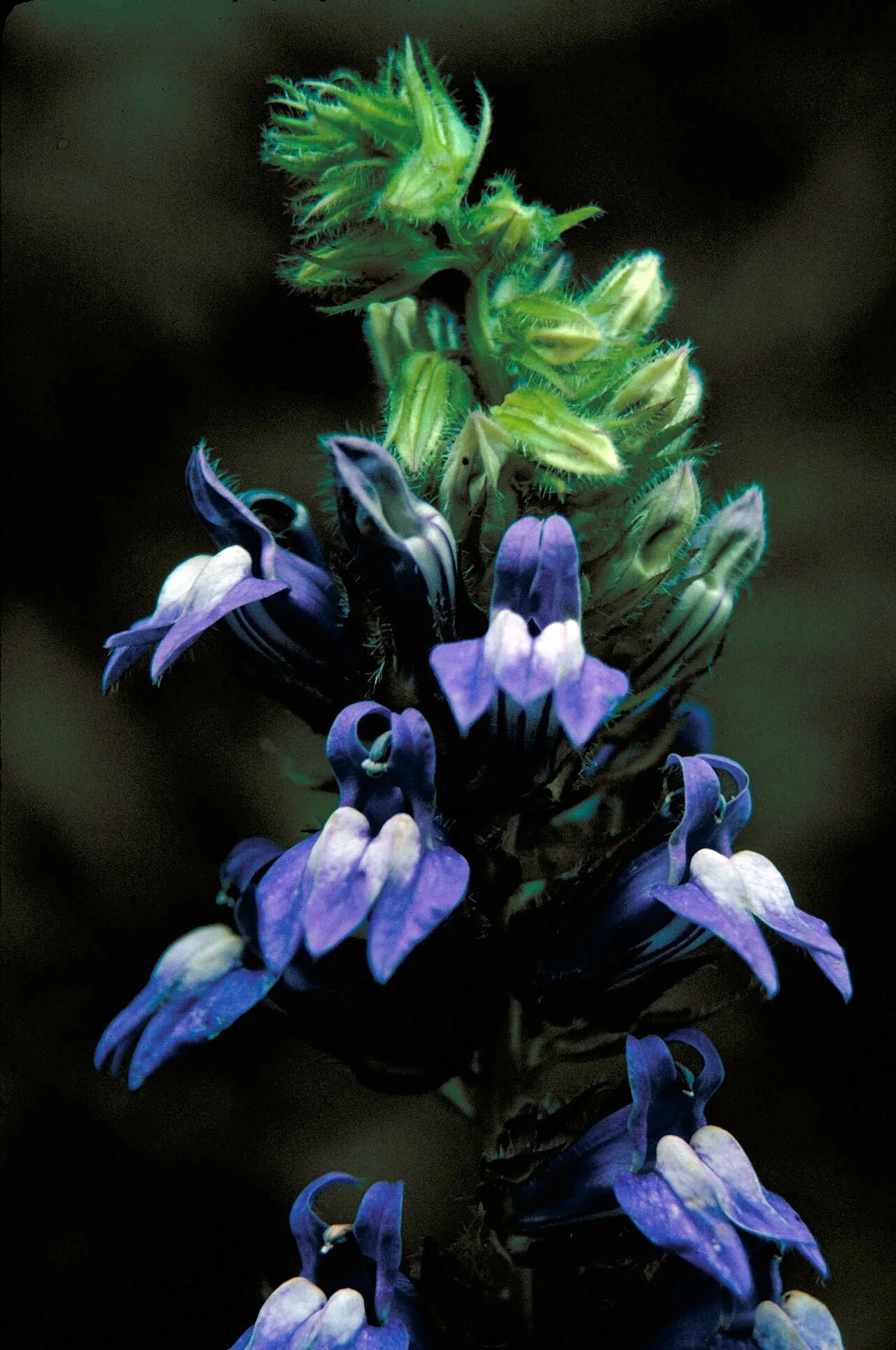
Great Blue Lobelia is the cool-blue counterpoint to the fiery red of its celebrated cousin cardinal flower (Lobelia cardinalis) — a clump-forming perennial of moist woods and streambanks that sends up dense, terminal spikes of vivid blue, two-lipped, tubular flowers from late August through October, precisely when most other native perennials are fading. The flowers are engineered for bumblebee pollination with remarkable precision: the reproductive structures (stamens and style) are positioned in an arch over the flower opening so that a visiting bumblebee, wedging its body into the tube for nectar, receives a dab of pollen on its back. Found in moist woods, wet meadows, streambanks, and seepage areas throughout eastern Oklahoma, this species is an essential rain garden component for extending the bloom season into autumn.

[ field key — stem · leaf · flower · fruit · vs. look-alikes ]
Erect, clump-forming perennial with one or several unbranched, angular stems arising from a basal rosette of overwintering leaves. Stems are 2–3 ft tall, stout but not woody, with prominent ridges (angled) and typically smooth or sparsely hairy. Unlike the red-flowered L. cardinalis, the stems of L. siphilitica are not reddish but a plain medium green. The basal rosette of broadly oval leaves persists through winter in Tulsa conditions (zone 7), providing semi-evergreen ground cover. Plants are relatively short-lived (3–5 years in heavy clay) but reliably self-sow into moist, bare soil.
Leaves are alternate, simple, oblong to lanceolate or elliptical, 2–5 in long with irregularly toothed margins and a pointed tip. The leaf surface is medium green with sparse, short hairs above and more densely hairy on the veins beneath. Leaves reduce in size progressing up the stem, with the uppermost leaves becoming small bracts subtending the flowers. The basal rosette leaves are larger and more rounded than the stem leaves, with longer petioles. Crushed foliage has a mild, somewhat acrid scent characteristic of the Lobeliaceae.
The inflorescence is a dense, terminal raceme (spike-like cluster) of 20–80 individual flowers, each about 1 in long. The corolla is bright blue to violet-blue (rarely white), strongly two-lipped (zygomorphic), and tubular. The upper lip is split into two narrow, erect lobes; the lower lip is three-lobed, broader, and marked with white nectar guides at the base. The five stamens are fused into a tube that arches over the flower entrance, and the style protrudes through the tube. When a bumblebee forces its head and thorax into the corolla to reach nectar, the anthers and stigma contact the bee's back, effecting pollination with a "pump-action" mechanism — the style pushes pollen out of the anther tube in a measured dose. Blooms open from the bottom of the spike upward over several weeks.
The fruit is a small, dry, two-chambered capsule enclosed by the persistent calyx, containing numerous tiny, dust-like, brown seeds. When mature, the capsule splits open at the top, and the seeds are dispersed by wind and rain splash onto surrounding soil. A single inflorescence can produce several thousand seeds. Seeds require light for germination and should be surface-sown without covering. Seed viability in the soil bank is moderate (2–3 years).
Lobelia siphilitica is widespread across eastern North America from the Great Lakes to the Gulf Coastal Plain, ranging west through Kansas and Oklahoma into eastern Nebraska and the Dakotas. In NE Oklahoma it is a plant of moist, shady to semi-open ground: the banks of creeks and small rivers, seepage areas at the base of wooded slopes, wet meadows in the bottoms of narrow valleys, and the moist woodland edges of the Ozark-influenced northeastern corner of the region. It is frequently encountered in the shady margins of spring-fed streams in Delaware and Adair counties where the Ozark Plateau gives way to the Cherokee Prairie.
Closer to Tulsa proper, Great Blue Lobelia is found in moist bottomland woods along Bird Creek, the Caney River, and the lower Verdigris, as well as in the heavy, moisture-retentive clay soils of the lowland forests of Rogers and Mayes counties. It thrives in the transition zone between forest and open wetland, where it receives dappled morning light but protection from harsh afternoon sun — conditions that can be replicated in the garden by siting it on the east side of a building or tree line. In garden settings with supplemental water, it tolerates full sun in Oklahoma better than L. cardinalis.
[ bumblebee pollination · specialist bees · hummingbirds · Lepidoptera ]
Bumblebees are the primary and most effective pollinators of Lobelia siphilitica. The flower's long, narrow corolla tube and the specialized "pump" mechanism for pollen presentation are precisely adapted to the size and behavior of large-bodied Bombus species. Common eastern bumblebees (Bombus impatiens), American bumblebees (B. pensylvanicus), and brown-belted bumblebees (B. griseocollis) are consistently the most frequent visitors in NE Oklahoma gardens. Smaller bees cannot effectively trip the pollination mechanism, though they occasionally visit for residual nectar. The flowers produce copious nectar with a sugar concentration of approximately 25–35%, providing high-quality fuel for bumblebee colonies that are reaching their seasonal peak in late summer.
Ruby-throated hummingbirds occasionally visit Great Blue Lobelia, particularly during fall migration (August–September) when the flowers coincide with the southward movement of hummingbirds through Oklahoma. While hummingbirds show a strong preference for the red-flowered L. cardinalis, they will use L. siphilitica as a fall nectar source, especially where both species are planted near each other. The combination of red cardinal flower (July–August) and blue great lobelia (August–October) creates a continuous hummingbird nectar supply spanning the entire late summer and fall period.
A small guild of oligolectic (specialist) bees collect pollen primarily from Lobelia species, including Megachile lobeliae (a leafcutter bee that provisions nests exclusively with Lobelia pollen). Various halictid bees (sweat bees) and syrphid flies visit the flowers for pollen. The plant's foliage is occasionally browsed by caterpillars of the lobelia sawfly and various noctuid moth larvae, but significant herbivory is uncommon in garden settings.
Like all Lobelia species, Great Blue Lobelia contains piperidine alkaloids, primarily lobeline, which are toxic to mammals if ingested in significant quantities — hence the plant is generally avoided by deer and rabbits. The specific epithet siphilitica references an erroneous historical belief that the plant could cure syphilis (based on the Doctrine of Signatures), though lobeline has been used as a respiratory stimulant and smoking-cessation aid. Handle with care: the alkaloids can be absorbed through skin; wear gloves when dividing plants or collecting seed.
[ siting · soil · water · propagation · companion planting ]
Great Blue Lobelia thrives in moist, rich soil with morning sun and afternoon shade in the Tulsa region. Full sun is tolerated only with consistently wet soil (rain garden bottom or pond edge); in average garden moisture, partial shade is essential to prevent leaf scorch during July and August. Ideal sites include the east side of a structure, the dappled shade of an open-canopy tree like eastern redbud or black tupelo, or a spot in the rain garden that receives morning light but is shaded by taller perennials by mid-afternoon.
Consistent soil moisture is non-negotiable. Plants in dry soil will wilt, drop lower leaves, and produce stunted flower spikes. Provide 1–2 inches of supplemental water per week during dry periods. A 2–3 in layer of shredded leaf mulch retains moisture and keeps roots cool. Deadhead spent flower spikes to prolong bloom into October, but leave the last spikes to set seed for self-sowing. Cut stems to the ground after the first hard frost. The basal rosette of leaves remains green through most Tulsa winters and should be left in place; do not cut it back.
Great Blue Lobelia pairs beautifully with a range of late-season natives and woodland-edge plants: cardinal flower (Lobelia cardinalis) for the classic red-blue wetland duo; tall goldenrod or showy goldenrod for bright yellow-purple contrast in September; New England aster for purple-blue harmony at the same season; Christmas fern and maidenhair fern for textural ground cover; and Joe Pye weed and buttonbush for taller structural backdrop in rain garden settings.
The species name siphilitica derives from a historical misapplication in European and colonial American medicine: the plant was used as a treatment for syphilis based on the Doctrine of Signatures (the belief that plants resembling body parts could treat ailments of those parts). While ineffective for syphilis, Lobelia species contain lobeline, a piperidine alkaloid that acts as a respiratory stimulant and has been used in traditional medicine by several Indigenous cultures, including the Cherokee, as an emetic, expectorant, and treatment for asthma and respiratory ailments.
The Cherokee name for the plant, so-qui-li, refers to its use as a ceremonial purification agent and as a remedy for bronchial complaints. Dried leaves were smoked as a tobacco substitute (hence another common name, "Indian tobacco," more often applied to L. inflata). Modern pharmacology has investigated lobeline as a smoking-cessation aid, though results have been mixed. The plant should never be used for self-medication — the therapeutic window is narrow and overdose causes nausea, vomiting, convulsions, and potentially fatal respiratory depression.
Hero photo: Rooted Revival. Strip photos courtesy of Wikimedia Commons contributors under their respective licenses (linked under each image).