home/ plants/ sweet-flag

// SPECIES PROFILE · PERENNIAL · AROMATIC WETLAND PLANT · TRADITIONAL MEDICINE · WATER FILTRATION

Sweet Flag

Acorus calamus

Sweet Flag is a wetland perennial of ancient pedigree — an iris-like plant with erect, sword-shaped leaves that emit a distinctively sweet, spicy-sweet fragrance when crushed, unlike anything else in the North American wetland flora. The scent, which some describe as a mix of cinnamon, clove, and citrus, arises from volatile aromatic oils that have made this plant one of the most widely used medicinal, ceremonial, and aromatic plants in the Northern Hemisphere for at least 4,000 years. In NE Oklahoma, Acorus calamus is found in shallow water and saturated soils of marshes, pond margins, and quiet streams — a plant deeply valued by the Cherokee and other Indigenous cultures of the region as a stomachic, ceremonial purifier, and insect repellent. It also serves a modern technical purpose: its dense root mass is highly effective at removing dissolved pollutants from water in constructed wetlands.

// QUICK FACTS
Family
Acoraceae (sweet flag family) — the sole genus in this ancient, basal monocot family
Life cycle
Perennial; clump-forming from thick, aromatic, creeping rhizomes
Native range
Circumboreal; Asia, Europe, and N. America; introduced in much of its current range but prehistoric in others
USDA hardiness
Zones 3–9 (Tulsa = 7a/7b, fully hardy)
Mature size
2–4 ft tall (occasionally 5 ft); clumps spreading by rhizome 2–3 ft wide
Bloom
May – July (NE OK); flowers are small, greenish-yellow, borne on a lateral spadix
Flower
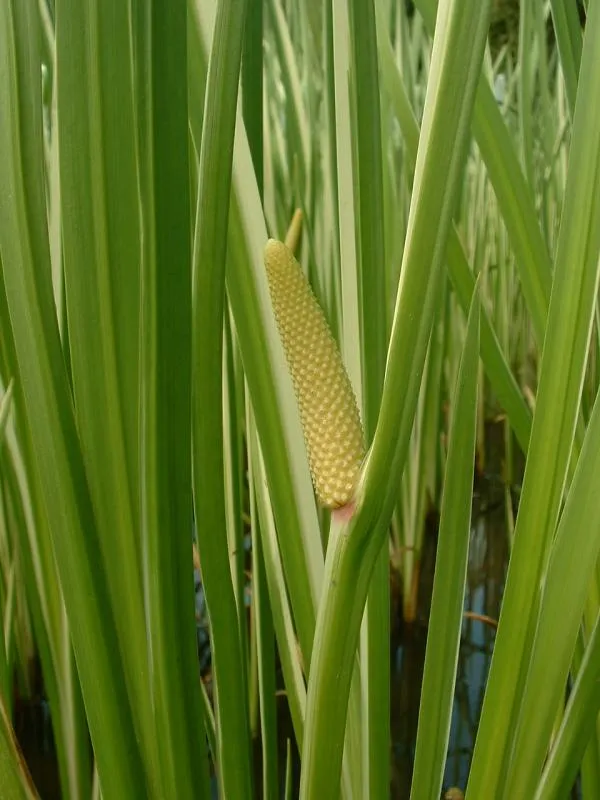
Inconspicuous; a dense, cylindrical spadix 2–4 in long, greenish-yellow, emerging from the side of a leaf-like stalk
Sun
Full sun to partial shade (4+ hrs for best growth)
Soil
Saturated muck, heavy clay, silt; tolerates standing water 0–6 in deep
Water
Wet to consistently moist; intolerant of drought
Wildlife
Waterfowl seed & rhizome forage · muskrat food · frog & invertebrate cover
Ethnobotany
Major medicinal & ceremonial plant; Cherokee, Dakota, and many others; 4,000+ year use record
Sweet Flag (Acorus calamus) with erect sword-shaped leaves emerging from shallow water
Acorus calamus — the iris-like foliage is distinguished by its sweet, spicy fragrance when crushed and its unique leaf margin that is wavy (crisped) in some forms. Photo: Rooted Revival.

Identification

[ field key — leaf · scent · inflorescence · rhizome · vs. irises ]

Habit & Growth Form

Upright, clump-forming perennial that strongly resembles an iris at first glance, with erect, flat, sword-shaped leaves emerging in a fan from a thick, horizontal, surface-creeping rhizome. The plant is 2–4 ft tall (occasionally taller in rich, saturated soil) and forms dense, gradually expanding stands in shallow water and saturated mud. The rhizome is thick (up to 1 in diameter), pale to pinkish-tan on the outside, white and spongy within, and intensely aromatic — the scent is unmistakable and diagnostic. Unlike irises, Sweet Flag has no showy flowers and is easily identified by crushing any leaf or rhizome piece between the fingers and smelling the sweet-spicy fragrance.

Leaves

Leaves are erect, linear, sword-shaped (ensiform), bright green, 2–4 ft long and 1/2–1 in wide with parallel veins and a prominent, raised midrib. A key identification feature distinguishing Sweet Flag from similar-leaved irises and cattails is the distinct, crisped (wavy) margin on one or both edges of the leaf, especially in the var. americanus form found in North America. Another definitive character: when held up to the light, the leaf blade reveals numerous fine, transverse veins connecting the parallel longitudinal veins (visible with a hand lens). Most critically: crush a leaf and inhale — the spicy-sweet fragrance is unique and immediate.

Inflorescence & Flowers

The flowers are small, inconspicuous, and often overlooked. The inflorescence is a dense, cylindrical, greenish-yellow spadix 2–4 in long that emerges from the side of a three-angled, leaf-like stalk (scape) — not from the tip. This lateral spadix is covered with numerous tiny, perfect (bisexual) flowers with 6 tepals and 6 stamens. The flowering stalk is easily mistaken for a vegetative leaf unless examined closely. Flowers open May through July in NE Oklahoma. The plant is not reproductively significant by seed in most of North America (the species in North America is a sterile triploid that spreads vegetatively), so the flowers fade without producing a showy fruit.

Rhizome (The "Sweet Flag Root")

The rhizome is the most economically and culturally significant part of the plant. It is thick, elongate, creeping horizontally at or just below the soil surface, branching occasionally, with distinct ring-like nodes. The exterior is pale tan to pinkish-brown; the interior is white, spongy, and succulent when fresh. The entire rhizome is saturated with volatile aromatic oils dominated by β-asarone (in the Eurasian diploid form) or lacking it (in the North American triploid form). When cut or crushed, the rhizome releases the characteristic sweet-spicy odor that has been valued in perfumery, medicine, and ceremony for millennia. The rhizome was historically candied and eaten as a confection in Europe and colonial America.

Habitat & Range in NE Oklahoma

The natural history of Acorus calamus in North America is complex and contested. The species is circumboreal — native to Asia, Europe, and North America — with different cytotypes (diploid, triploid, tetraploid) in different regions. The North American form is predominantly a sterile triploid (var. americanus) that is native to the continent and was present here prior to European contact, while the fertile diploid and tetraploid forms are Eurasian and were introduced historically. The North American triploid is believed to have been dispersed across the continent by Indigenous peoples who valued it as a medicinal and ceremonial plant.

In Oklahoma, Sweet Flag is widely but patchily distributed in the eastern half of the state. In NE Oklahoma, it occurs in marshes, quiet pond margins, the shallow edges of slow streams, and spring-fed seeps — particularly in the Ozark-influenced spring runs of Delaware, Adair, and Cherokee counties and in the alluvial wetlands of the Grand River and Illinois River watersheds. It is often found in association with lizard's tail (Saururus cernuus), buttonbush, and sedges, forming the herbaceous layer of shrub swamps and wet thickets.

Ecology & Wildlife Value

[ muskrat forage · waterfowl · amphibian habitat · phytoremediation ]

Mammal & Bird Forage

Muskrats are the primary mammalian consumer of Sweet Flag rhizomes and leaves, and their common name "muskrat root" reflects this close ecological relationship. Muskrats excavate and consume sections of the thick rhizomes, especially in fall and winter when other aquatic vegetation is dormant. Beavers occasionally consume the foliage and stems. Waterfowl, including wood ducks and mallards, consume the small seeds when available (in fertile Eurasian forms). The dense foliage provides cover for wood ducks with ducklings, rails, and marsh wrens.

Amphibian & Invertebrate Habitat

The dense, clumping growth and the network of shallow, creeping rhizomes create excellent microhabitat for frogs, toads, and salamanders along pond and stream margins. Green frogs, Southern leopard frogs, and Blanchard's cricket frogs use Sweet Flag stands for daytime cover and foraging substrate. Aquatic invertebrates, including snails, aquatic insects, and crustaceans, inhabit the submerged leaf bases and rhizome surfaces. The aromatic oils in the rhizome appear to deter some herbivorous insects but do not significantly affect the aquatic invertebrate community.

Phytoremediation

Acorus calamus is a highly effective plant for constructed wetlands and wastewater treatment systems. Its extensive, thick rhizome mass supports a dense biofilm of bacteria and fungi that metabolize dissolved organic pollutants. Research on floating treatment wetlands and horizontal subsurface flow systems shows that Acorus consistently outperforms many other wetland plants in removing biochemical oxygen demand (BOD), nitrogen (via denitrification), phosphorus, and heavy metals from domestic and agricultural wastewater. It is particularly valuable in the shallow shelf zone of constructed wetlands and in floating island systems.

Allelopathy & Competition

The aromatic rhizome releases allelopathic compounds (primarily asarone and related phenylpropanoids) into the surrounding soil and water that can suppress the germination and growth of competing plants, including some algae. This chemical competition, combined with the plant's dense, shading foliage, allows Sweet Flag to form near-monocultural stands in favorable conditions. In small water gardens, this allelopathic effect is generally beneficial, reducing weed pressure, but it may suppress less vigorous neighboring plants placed too close.

Horticulture & Care

[ siting · planting · water depth · maintenance · companion planting ]

Site selection & planting

Sweet Flag is exceptionally easy to grow in any sunny to partly shaded site with consistently saturated soil or shallow standing water. In NE Oklahoma, plant rhizome divisions or container-grown plants in spring (April–May). Ideal sites include the shallow shelf of ornamental ponds (0–6 in water depth), the saturated edge of rain gardens, constructed wetland filter strips, and bog gardens. For contained settings, use an aquatic planting basket or wide container filled with heavy garden soil, topped with pea gravel, with the rhizome set horizontally just beneath the soil surface.

Maintenance & propagation

Sweet Flag is virtually disease- and pest-free and requires minimal maintenance. Cut back dead foliage in late winter (February) before new growth emerges. In small water features, contain the rhizome within a pot or basket to prevent it from colonizing the entire planting area. In larger naturalized ponds, the gradual spread is generally welcome.

Companion planting

Sweet Flag occupies the shallowest water zone and saturated soil margin of the pond or wetland and pairs well with virtually all the native emergent plants of NE Oklahoma: pickerelweed and arrowhead in slightly deeper water; common rush for contrasting cylindrical stem texture; buttonbush as a taller shrub backdrop; cardinal flower and great blue lobelia at the moist bank margin for late-season color; and rose mallow for towering pink blossoms. The aromatic foliage adds an olfactory dimension to the garden that distinguishes Sweet Flag from all other wetland plants.

Edible & Cultural Uses

Few native wetland plants of North America carry the depth and breadth of cultural significance that Sweet Flag holds. The plant has been used medicinally and ceremonially across Eurasia and North America for at least 4,000 years:

IMPORTANT SAFETY NOTE: The Eurasian diploid form of Acorus calamus contains high levels of β-asarone, a compound shown to be carcinogenic in laboratory animals and banned as a food additive by the FDA. The North American triploid form (var. americanus) contains negligible β-asarone and is considered safe for traditional use at moderate levels. However, without chemical analysis, it is impossible to distinguish the forms visually. We do not recommend internal use of Acorus calamus without expert identification and consultation with a qualified herbal practitioner.

Photo Reference

Acorus calamus foliage showing erect sword-shaped leaves with wavy margins
// Foliage — erect, iris-like leaves with characteristic crisped margins
Wikimedia Commons
Wikimedia Commons
Inconspicuous greenish-yellow spadix of Acorus calamus emerging from leaf-like stalk
// Inflorescence — the lateral spadix with tiny greenish-yellow flowers
Wikimedia Commons
Wikimedia Commons
Freshly harvested Acorus calamus rhizome showing pinkish-tan exterior and white interior
// Rhizome — the aromatic "sweet flag root" with white, spongy interior
Wikimedia Commons
Wikimedia Commons
Dense stand of Acorus calamus along a pond margin
// Pond margin stand — dense colony in saturated soil at water's edge
Wikimedia Commons
Wikimedia Commons
Variegated cultivar of Acorus calamus with cream-striped leaves
// Cultivar 'Variegatus' — a popular ornamental with cream-striped foliage
Wikimedia Commons
Wikimedia Commons

Sources & Further Reading

  • USDA NRCS PLANTS Database — Acorus calamus: plants.usda.gov/plant-profile/ACCA4
  • USDA NRCS Plant Guide — Sweet Flag (ACCA4), National Plant Data Center.
  • Lady Bird Johnson Wildflower Center — Native Plant Database: wildflower.org — ACCA4
  • Motley, T.J. (1994). The ethnobotany of sweet flag, Acorus calamus (Acoraceae). Economic Botany 48:397–412 — the definitive ethnobotanical review.
  • Hocking, G.M. (1947). Cherokee medicinal plants used for ailments of the digestive system. — Sweet Flag in Cherokee medicine.
  • FDA (1974). Code of Federal Regulations, Title 21, Vol. 3, 21CFR189.110 — ban on calamus and its derivatives as food additives.
  • Vymazal, J. (2011). Plants used in constructed wetlands: a review. Hydrobiologia 674:133–156 — Acorus phytoremediation performance.
  • Flora of North America, Vol. 22 — Acoraceae treatment, incl. cytotype and distribution discussion.
  • Wikipedia — Acorus calamus: en.wikipedia.org/wiki/Acorus_calamus (CC BY-SA 4.0; portions of description summarize Wikipedia content).
  • Moerman, D.E. (1998). Native American Ethnobotany. Timber Press — Acorus entries across 40+ Indigenous nations.

Hero photo: Rooted Revival. Strip photos courtesy of Wikimedia Commons contributors under their respective licenses (linked under each image).