// SPECIES PROFILE · PERENNIAL · ICONIC AQUATIC PLANT · EDIBLE SEEDS & TUBERS
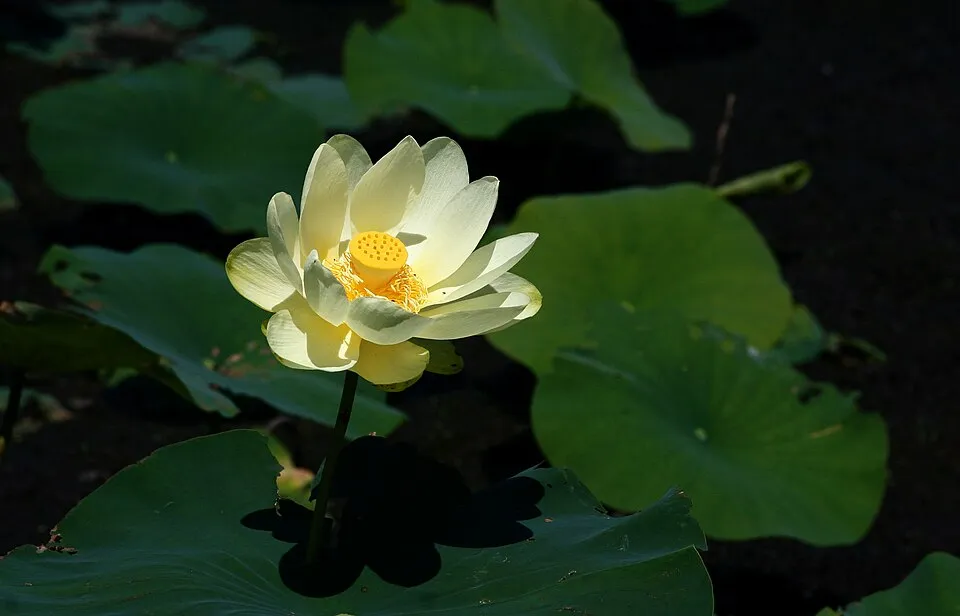
The American Lotus is the largest, most charismatic aquatic wildflower native to North America — a plant of almost mythological proportions, with enormous, round, blue-green leaves (up to 2 ft across) held well above the water on long petioles, and in summer, pale yellow, sweet-scented blossoms 6–10 inches in diameter rising above the foliage on stout stalks. Each flower opens in the morning and closes by mid-afternoon for several consecutive days, the petals slowly dropping to reveal an iconic, inverted-cone-shaped seed pod resembling a shower head. In NE Oklahoma, the American Lotus is found in the still backwaters, oxbow lakes, and quiet sloughs of the Arkansas, Verdigris, and Grand River systems. And it holds a distinction unmatched in the botanical world: the oldest viable seed ever documented (over 1,300 years) came from a related Asian species, and American Lotus seeds are similarly long-lived, germinating after decades or even centuries of dormancy in lake sediments.

[ field key — leaf · flower · seed pod · rhizome · vs. water lilies ]
The leaves are peltate (the petiole attaches to the center of the blade), perfectly circular, and enormous — 1–2 ft in diameter — held above the water surface on long, robust petioles (unlike water lilies, whose leaves float on the surface). The upper leaf surface is blue-green and distinctly water-repellent (hydrophobic) — water beads up into perfect spheres that roll across the surface collecting dirt particles, the famous "lotus effect" created by microscopic wax papillae on the cuticle that inspired self-cleaning surface technologies. Young, unopened leaves emerge as tight spirals on the water surface. The petioles are armed with scattered, sharp prickles.
The flowers are massive (6–10 in across), pale yellow (sometimes cream), and intensely fragrant with a sweet, almost anise-like scent. They rise above the leaves on stout, prickly peduncles. The flower consists of numerous overlapping petals surrounding a central, flat-topped, yellow receptacle that resembles a shallow bowl. At the center, embedded in the flat surface, are the individual pistils. Numerous golden-yellow stamens ring the receptacle. Flowers exhibit thermogenesis — they generate metabolic heat, raising their internal temperature up to 20°F above ambient air, which volatilizes the scent and attracts beetle pollinators. Each flower opens and closes for 3–4 consecutive days.
After the petals drop, the receptacle matures into the iconic lotus "seedpod": a woody, inverted-cone-shaped or flat-topped structure 3–5 in across, with 10–30 circular cavities each containing a single, hard, dark-brown, acorn-like seed (nutlet) about 1–1.5 cm long. The pod dries to a woody texture and persists on the dried stalk through fall and winter. As the stalk bends toward the water, seeds are released and scattered. This shower-head-like pod is one of the most recognizable structures in botany and is highly prized in dried flower arrangements.
The plant spreads by thick, creeping, starchy rhizomes that run horizontally through the bottom mud, sending up leaves and flowers at intervals. The rhizomes are banana-sized, segmented, and full of air canals that give them buoyancy and facilitate gas exchange in anoxic sediments. In late fall, the rhizomes develop swollen, starchy terminal storage tubers. These tubers are the edible portion — harvested by Indigenous peoples throughout the plant's range as a staple carbohydrate. The rhizome system can colonize large areas of shallow water rapidly; in small ponds, lotus may require containment.
Nelumbo lutea is widespread across the eastern and central United States, ranging from the Great Lakes south to Florida and Texas, west through the Great Plains into eastern Colorado and New Mexico, and north into southern Ontario. In Oklahoma, it is common in the eastern half of the state, where its preferred habitat — still or slow-moving backwaters with mucky sediment — is abundant in the river systems draining the Ozark Plateau and the Cherokee Prairie.
In NE Oklahoma, the American Lotus reaches its greatest local abundance in the oxbow lakes, cutoff meanders, and quiet backwaters of the Arkansas River navigation system — particularly the extensive slackwater areas created by the McClellan-Kerr Navigation locks and dams. It is also common in the natural oxbow lakes of the Grand (Neosho) River in Mayes and Delaware counties, in Lake Eufaula backwaters, Fort Gibson Lake shallows, and the quiet upper reaches of Oologah and Hudson Lakes. Farm ponds throughout eastern Oklahoma that receive minimal wave disturbance frequently host established lotus colonies, often introduced inadvertently by waterfowl carrying seeds on their feet or in their digestive tracts.
[ waterfowl food · fish habitat · beetle pollination · water quality ]
The large, nut-like seeds are a premier waterfowl food — mallards, wood ducks, gadwall, and teal consume them heavily in fall and winter. The seeds are rich in carbohydrates and protein, providing high-energy forage for migrating waterfowl. The common names "duck acorn" and "water chinquapin" reflect this importance. Beavers and muskrats consume the rhizomes. White-tailed deer wade into shallow water to browse the emergent foliage. Frogs, including bullfrogs (Lithobates catesbeianus) and green frogs, rest on the large floating leaves.
The dense underwater network of lotus petioles and rhizomes creates structurally complex fish habitat in what would otherwise be featureless pond and lake bottoms. Juvenile largemouth bass, bluegill, crappie, and various sunfish species use lotus beds for cover from predators and as ambush sites for invertebrate prey. The shade cast by the large floating and emergent leaves reduces water temperature in the immediate vicinity, providing thermal refuge for cool-water species during NE Oklahoma's hot summers.
The primary pollinators of Nelumbo lutea are beetles (primarily scarab beetles and pollen beetles in the family Nitidulidae), which are attracted to the strong, sweet fragrance. The flower's thermogenic capacity — generating temperatures 10–20°F above ambient — enhances scent dispersal and provides a warm microclimate that encourages beetles to remain in the flower overnight, increasing pollen transfer. This is a primitive and ancient pollination system dating to the Cretaceous, shared with magnolias and water lilies. Bees and flies also visit but are secondary pollinators.
The seeds of Nelumbo are among the longest-lived of any flowering plant. The Asian sacred lotus (N. nucifera) holds the scientifically verified record: a seed recovered from a dry lakebed in northeastern China was radiocarbon-dated to approximately 1,300 years old and germinated successfully in 1995. American Lotus seeds have been documented germinating after at least 400 years of dormancy in lake sediments. This extraordinary longevity is enabled by the impermeable, stone-hard seed coat and the seed's ability to repair cellular damage upon imbibition. The mechanism (the enzyme L-isoaspartyl methyltransferase) represents one of the most effective known biological preservation systems.
[ siting · water depth · container culture · propagation · management ]
American Lotus demands full sun (at least 6 hours of direct sun) and still or very slow-moving water 1–6 ft deep over rich, mucky sediment. It will not bloom in shade and does not tolerate strong currents or wave action. In NE Oklahoma, the species is fully winter-hardy; the rhizomes survive in bottom mud under ice-covered ponds without issue. For pond plantings, choose a site with minimal wave disturbance — the back of a cove, a protected inlet, or behind a windbreak. For water gardens, plant in a large, wide container (minimum 24 in diameter, 12 in deep) to restrict spread and allow the container to be lifted for division.
For pond-less water features, half-barrels, and large ceramic containers, American Lotus can be grown successfully with these adaptations: use the widest possible container (30+ in diameter), fill bottom 8–10 in with heavy garden soil, plant a single rhizome section horizontally just below the soil surface, add 2–3 in of pea gravel cap, and maintain 6–12 in of water above the soil surface. Position the container in full sun. Fertilize monthly during growth with aquatic tabs. In winter, either sink the container to the bottom of a deep pond or move to a frost-free location.
In a naturalized pond setting, American Lotus pairs beautifully with: pickerelweed at the shallower margins for violet-blue flower spikes; arrowhead for emergent leaf texture and white flowers; sweet flag for the pond's shallow shelf; and buttonbush on the bank edge for shrub structure. For deeper water, allow the lotus to be the sole emergent centerpiece — its architectural presence needs no competition.
The American Lotus is one of the most comprehensively useful wild food plants of North America, and it was a staple food plant for numerous Indigenous nations across its range, including the Osage, Quapaw, Caddo, Cherokee, and Choctaw within what is now Oklahoma. Nearly every part of the plant was used:
The closely related Asian sacred lotus (Nelumbo nucifera) holds profound spiritual significance in Hinduism, Buddhism, and several other Asian traditions as a symbol of purity, rebirth, and enlightenment, arising immaculate from the mud. While the American Lotus lacks the same degree of religious iconography, it was spiritually significant to many Indigenous peoples of the Eastern Woodlands and Plains as a symbol of abundance and the fecundity of water.
Hero photo: Rooted Revival. Strip photos courtesy of Wikimedia Commons contributors under their respective licenses (linked under each image).