// SPECIES PROFILE · GRASS · WETLAND EMERGENT · RAIN GARDEN STAPLE
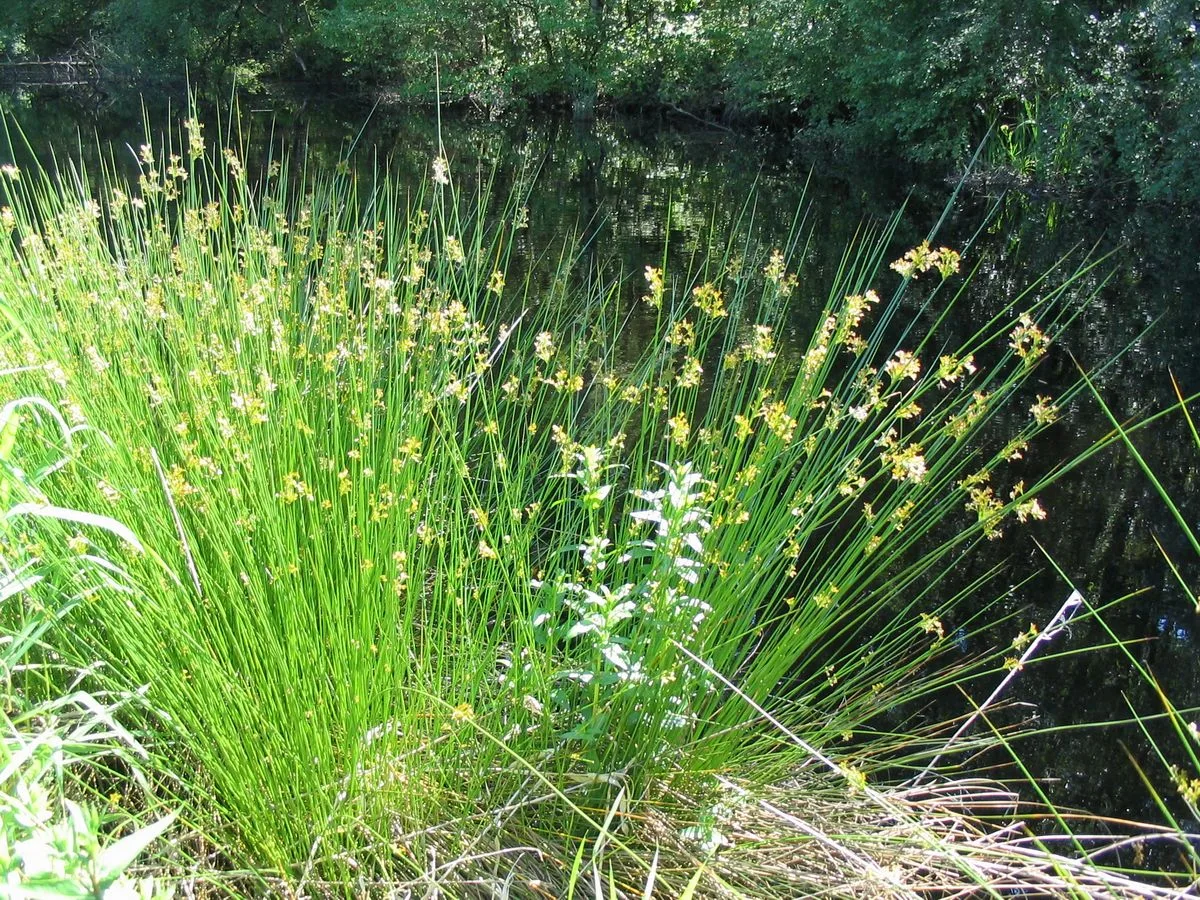
Common Rush is a dense, clump-forming, grass-like wetland perennial whose smooth, cylindrical, deep-green stems stand upright year-round through standing water, saturated clay, and the capricious hydrology of NE Oklahoma stormwater basins. It belongs to the rush family (Juncaceae), not the true grasses (Poaceae), but serves the same architectural role in marshy ground, wet meadows, pond margins, and roadside ditches throughout Green Country. Juncus effusus is among the most important plants for phytoremediation and water filtration — its dense, fibrous root system traps sediment, absorbs dissolved nutrients, and denatures pathogens and heavy metals in stormwater runoff, making it an essential functional component of rain gardens and bioswales throughout the region. It also provides critical cover for frogs, dragonflies, and wetland songbirds.

[ field key — stem · inflorescence · capsule · rhizome · look-alikes ]
Dense, tightly clumped perennial forming distinct tussocks 2–4 ft tall from a stout, woody rhizome. Stems are erect, unbranched, cylindrical (terete), smooth, and leafless — the classic "round-stemmed rush" distinction. Each stem is a deep, glossy green throughout the growing season, often turning straw-colored and persisting into winter. The stems are filled with a continuous white pith (not hollow or septate), which is a critical identification character separating J. effusus from hollow-stemmed look-alikes. Stems are smooth to the touch, never rough or ridged.
True leaves are reduced to basal sheaths at the base of the stems only. The sheaths are brown to reddish-brown at the base, often with a short, stiff point (mucro) at the tip but lacking a true blade. There are no leaves along the stem — all photosynthesis occurs in the green, cylindrical stem itself. The basal sheaths may be darker red-brown in winter, helping distinguish persistent dormant clumps from other rushes.
The flowering structure appears as a loose, diffuse cluster emerging laterally from the side of the stem — not from the tip, which continues upward as a stiff, pointed bract. This "appears-lateral" arrangement (actually a continuation of the stem beyond the inflorescence) is a distinctive Juncus trait. Individual flowers are small (2–4 mm), brown to greenish-brown, with 6 tepals (3 sepals + 3 petals, similar in appearance), 3 stamens, and a 3-branched style. Flowers open June through August in NE Oklahoma.
The fruit is a small, three-chambered capsule (2–3 mm) that is broadly obovoid and slightly sunken at the tip. Each capsule contains numerous tiny, dust-like seeds (typical of Juncaceae). When mature, the capsule turns reddish-brown and splits open at the top, releasing seeds that are dispersed by wind, water, and adhesion to waterfowl. A single robust clump can produce tens of thousands of seeds annually.
Juncus effusus is essentially cosmopolitan — found on every continent except Antarctica — but its core North American range encompasses virtually all of the continental US and southern Canada. In NE Oklahoma it is ubiquitous in any persistently wet or seasonally saturated ground: pond and lake margins, wet meadows, roadside ditches that hold water, bottomland seeps, and floodplain depressions along the Arkansas, Verdigris, Grand (Neosho), and Illinois River corridors. It is especially conspicuous in the sloughs and oxbow bottomlands of the McClellan-Kerr Arkansas River Navigation System, where it forms extensive stands in shallow backwaters.
The species thrives in the heavy, impermeable clay soils typical of the Cherokee Prairie and Osage Plains physiographic regions where surface water ponds after rain. It is equally at home in the sandy-loam alluvial soils of the eastern river valleys. In urban and suburban Tulsa, it is one of the most common volunteers in stormwater detention basins, retention ponds, and poorly drained construction sites — often arriving on its own via wind-dispersed seed within one to two growing seasons.
[ amphibian cover · lepidoptera host · seed for birds · water filtration ]
Dense rush clumps provide essential microhabitat for amphibians, particularly green frogs (Lithobates clamitans), Southern leopard frogs (L. sphenocephalus), Blanchard's cricket frogs (Acris blanchardi), and American toads. The thick basal thatch and rhizome mass offers overwintering shelter and daytime refuge. Odonates (dragonflies and damselflies) use emergent stems as perches for hunting and as emergence sites for tenerals leaving their aquatic larval stage. Crayfish excavate burrows at the base of rush clumps in saturated soils.
Juncus effusus is the larval host for the two-spotted skipper (Euphyes bimacula) and several other sedge-skipper butterflies (Hesperiinae). The common roadside skipper (Amblyscirtes vialis) will also use rushes as host plants. Rush stems and seed heads support a community of plant-sucking Hemiptera including rush aphids, leafhoppers, and plant bugs which in turn feed spiders and insectivorous birds. While wind-pollinated and lacking showy flowers, the inflorescence is visited by small flies and beetles seeking pollen.
The tiny but abundant seeds of J. effusus are consumed by several sparrow species (song sparrow, swamp sparrow in winter), red-winged blackbirds, and various waterfowl including mallards, wood ducks, and teal that dabble in shallow marsh edges. The persistent winter stems provide cover and foraging substrate for Carolina wrens, common yellowthroats, and marsh wrens. Northern harriers hunt over rush-dominated wetlands in winter.
This is where Juncus effusus truly earns its place. The dense root mass functions as a biological filter: rhizosphere microbes associated with rush roots break down organic pollutants, denitrify nitrates, and immobilize phosphorus and heavy metals (copper, zinc, lead, cadmium) in stormwater. Research at constructed wetland sites shows that stands of Juncus spp. can reduce total suspended solids by 70–90% and reduce dissolved nitrogen and phosphorus loads significantly. This is the biochemical engine of a properly functioning rain garden or bioswale.
[ planting · soil · division · cultivars · landscape uses ]
Juncus effusus is nearly indestructible once established in moist to wet soil. It performs best in full sun (6+ hours) but tolerates light, dappled shade, especially in afternoon. Soil type is largely irrelevant as long as moisture is adequate: the heavy, poorly drained red and gray clays common around Tulsa are ideal. Plant nursery-grown plugs or divisions in spring or early fall, setting the crown at or slightly below the soil surface. Space 18–24 inches apart; clumps will fill in within two growing seasons.
Clumps can be left untouched for many years. If centers begin to die out (typically after 4–5 years), divide in early spring before new growth emerges: lift the entire clump, cut into quarters or smaller divisions with a sharp spade or saw, and replant the vigorous outer portions. Cut back dead foliage in late winter (February in Tulsa) before new growth pushes up. Burning is an option on larger plantings in early spring, which rushes tolerate well and which mimics natural fire cycles in wet prairies.
| Cultivar | Form | Distinguishing feature | Notes for Tulsa |
|---|---|---|---|
| Straight species | Upright clump | Dark green, cylindrical stems to 3–4 ft | Best for rain gardens and ecological function; tolerates our clay. |
| 'Spiralis' (Corkscrew Rush) | Curled/spiraled | Stems spiral and curl; shorter, 12–18 in | Striking container plant; less cold-hardy; needs wet feet. |
| 'Unicorn' (a.k.a. 'Spiralis') | Curled/spiraled | Tightly curled, dark green stems | Pond edge novelty; protect from Oklahoma summer scorch with afternoon shade. |
| 'Gold Strike' | Variegated upright | Green stems with bright golden-yellow vertical stripes | Adds bright accent in wet areas; slightly more tender than straight species. |
| 'Quartz Creek' | Variegated upright | Vertical white striping on green stems | Similar to 'Gold Strike' with cooler tones. |
For a functional rain garden planting in NE Oklahoma, pair with: buttonbush as a shrub anchor in the deepest zone, cardinal flower and great blue lobelia for late-season color at the toe of the slope, swamp milkweed for pollinator support, and inland sea oats on the drier upper rim. For larger constructed wetlands and pond edges, combine with pickerelweed, arrowhead, and sweet flag for a layered emergent community.
While Juncus effusus is not a significant food plant, its durable, flexible stems have been used for basketry, matting, and cordage by numerous Indigenous cultures across its range, including Cherokee and Muscogee (Creek) peoples within Oklahoma. Stems are harvested in late summer, dried, and woven into baskets, mats, chair seats, and even sandals. The pith was historically used as a lamp wick when soaked in oil or grease — a traditional use that persists in some regional folk crafts.
In Japan, J. effusus pith is the primary material of tatami mat cores (tatami-doko), where it is prized for its resilience, moisture regulation, and cushioning properties. The Cherokee and other Southeastern tribes also recognized the medicinal value of rush root preparations for treating diarrhea and as a diuretic.
Hero photo: Rooted Revival. Strip photos courtesy of Wikimedia Commons contributors under their respective licenses (linked under each image).