// SPECIES PROFILE · TREE · NATIVE · BOTTOMLAND CANOPY
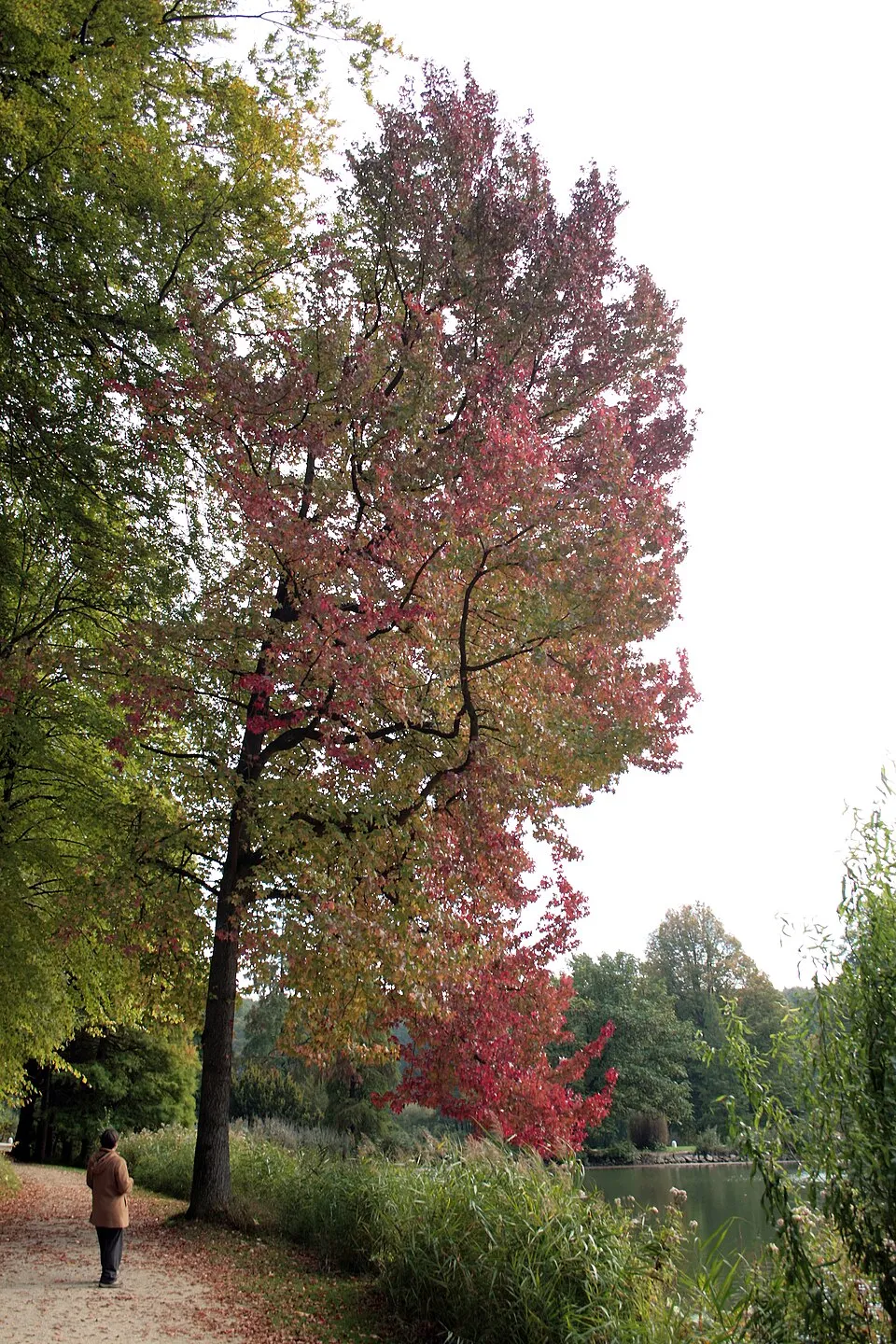
Sweetgum is one of the great fall-color trees of the southern lowlands — its star-shaped leaves turning a kaleidoscope of deep purple, crimson, orange, and gold, often all on the same branch. It is a fast- growing bottomland hardwood, tolerating heavy clay and seasonal flooding with a stoicism that few other shade trees can match, which is precisely why it has become a staple of NE Oklahoma landscapes. Liquidambar styraciflua is named for its fragrant resin (liquidus = liquid, ambar = amber): the aromatic gum that oozes from wounded bark was historically chewed, used medicinally, and exported as "American storax." The tree is known by everyone who has walked barefoot across a lawn beneath one by its spiny, spherical seed balls that persist into winter — a feature that divides gardeners between those who curse the prickly litter and those who appreciate the craft potential. In winter, the corky-winged twigs are distinctive, with prominent corky ridges running along the stems — an unmistakable field mark even when the tree is bare. In NE Oklahoma, Sweetgum grows in bottomlands, floodplains, and disturbed moist woods from the Cross Timbers into the southeastern part of the state, where it takes its place among the tall canopy hardwoods of the richer river bottoms.

[ field key — leaf · twig · fruit · bark · habit ]
A tall, straight-trunked deciduous tree with a pyramidal to oblong crown when young, becoming more oval and spreading with age. The bark is gray-brown and develops deep, narrow furrows and irregular scaly ridges on mature trunks. The twigs are the best winter field mark: they develop prominent corky, wing-like ridges along their length, a character shared with some elms but far more pronounced in Sweetgum. The terminal buds are large, glossy, reddish-brown, and pointed — useful for winter identification. In NE Oklahoma, mature trees typically reach 60–80 ft with a straight, clean bole.
Alternate, simple, deciduous, 4–7 in across, deeply star-shaped (palmately lobed) with 5–7 pointed lobes. This is the leaf that no one mistakes for anything else. The margin is finely toothed. The upper surface is glossy, dark green and smooth; the underside is paler with small tufts of hair in the vein axils. The petiole is long and slender. Crushed leaves emit a pleasant, resinous, aromatic scent — the origin of the name "Sweetgum." Fall color is the species' crowning glory: leaves turn deep purple, brilliant crimson, bright orange, and golden yellow, often with multiple colors on a single leaf or tree. In the Tulsa area, peak color comes in late October to early November.
Monoecious, with separate male and female flowers on the same tree. Male flowers are in upright, greenish-yellow, bottlebrush-like clusters at branch tips; female flowers are in drooping, globular heads on a separate stalk. Flowers appear in April–May with the emerging leaves and are wind-pollinated. They are inconspicuous and not ornamental, but the male catkins can drop and litter sidewalks and windshields in spring.
The notorious spiny, spherical, woody seed balls are 1–1½ in in diameter, hanging on a slender stalk and persisting on the tree through winter. Each ball is a cluster of dozens of individual capsules, each containing 1–2 winged seeds. The spines are stiff and sharp enough to make barefoot lawn walking an unpleasant experience — the primary complaint against this otherwise outstanding tree. On the plus side, the seeds are eaten by finches, sparrows, and squirrels, and the balls are popular for crafts, wreaths, and potpourri. Seed production begins at 20–30 years of age, and a single mature tree can produce thousands of balls annually.
Liquidambar styraciflua reaches the western edge of its natural range in southeastern Oklahoma, with the main body of its distribution lying in the southeastern US coastal plain and piedmont. In NE Oklahoma, it is a bottomland and floodplain tree, found along the Verdigris River, Grand River, and their tributaries, and in seasonally wet depressions within the Cross Timbers woodlands. It is one of the most flood-tolerant of all native hardwoods, able to survive weeks of inundation during spring floods — a trait that makes it invaluable for riparian restoration and rain garden plantings.
Sweetgum is remarkably tolerant of heavy clay soils — more so than almost any other large native hardwood. This clay tolerance, combined with its fast growth rate and spectacular fall color, has made it one of the most widely planted shade trees in Tulsa-area subdivisions, parks, and commercial landscapes. It thrives on disturbed urban soils where oaks and maples struggle, and it has naturalized beyond its native range in many parts of the region.
[ Lepidoptera host · seed forage · cavity habitat · floodplain ecology ]
Sweetgum is the larval host for the luna moth (Actias luna) and the promethea silkmoth (Callosamia promethea), two of the most spectacular Saturniidae in eastern North America. It also hosts the sweetgum defoliator (Halisidota tessellaris), the imperial moth (Eacles imperialis), and several underwing moths (Catocala spp.). While it supports fewer Lepidoptera species than oaks, the large, showy moths that it hosts are disproportionately important for nocturnal insectivores including bats and whip-poor-wills.
The winged seeds within the spiny balls are eaten by American goldfinch, purple finch, Carolina chickadee, tufted titmouse, white-throated sparrow, and dark-eyed junco. Eastern gray squirrels and fox squirrels pry the balls apart on winter days to extract the seeds. While not a premier wildlife mast species on the level of oaks, Sweetgum seed balls provide a winter food source that persists into late season when many other seeds have been consumed or buried under snow.
Sweetgum is prone to developing heart rot in old age, which creates cavities used by wood ducks, screech-owls, flying squirrels, and bats. Its tall, straight trunks produce grade-A sawlogs, but from a wildlife perspective, the "defect" trees with rot pockets are the most valuable individuals. In floodplain forests, the dense shade of mature Sweetgum helps suppress invasive understory species and maintain the open, park-like ground plane characteristic of healthy bottomland woods.
The aromatic resin (storax / liquidambar) that exudes from wounded bark and twigs is a complex mixture of cinnamic acid derivatives and triterpenoids that acts as an antimicrobial wound sealant and insect deterrent. This chemical defense is one reason Sweetgum suffers relatively little insect damage compared to many hardwoods. The resin has been harvested commercially for perfumery (as a fixative), incense, and traditional medicine since the colonial era.
[ site selection · planting · pruning · companion design ]
Sweetgum is remarkably adaptable but does best in moist, deep soils with full sun. It tolerates heavy clay, seasonal flooding, and compacted urban soils better than almost any other large native tree. Avoid shallow soils over bedrock, where surface roots will be a persistent problem. This is a large tree — do not plant within 15 ft of foundations, sidewalks, or driveways. The aggressive, shallow root system can lift pavement and infiltrate sewer lines if sited too close.
In a bottomland or rain garden setting, pair Sweetgum with River Birch, Bald Cypress, Black Willow, and Buttonbush. In the mid-story, Possumhaw Holly, American Beautyberry, and Roughleaf Dogwood thrive in moist partial shade. For the ground plane, wet-tolerant grasses and sedges including Creek Sedge, Inland Sea Oats, and Common Rush form a functional understory.
The aromatic resin of Sweetgum, known commercially as American storax or liquidambar, has been harvested for centuries. The resin was historically collected by wounding the bark and scraping the exuded gum, which was then used as a chewing gum (sweet and aromatic), a medicinal expectorant and antiseptic, an ingredient in perfumes and incense, and a fixative in soap and cosmetics. Indigenous peoples across the Southeast used the gum medicinally for wounds, coughs, skin ailments, and as a chewing gum. The Choctaw and Creek used the inner bark as a sedative tea.
Sweetgum wood is commercially important under the trade names red gum (heartwood) and sap gum (sapwood). It is used for veneer, plywood, cabinetry, furniture, and pulp. The heartwood has a rich reddish-brown color with a distinctive interlocked grain (marketed as "satin walnut") that is highly prized for fine furniture and interior trim. It is one of the most important commercial hardwood timbers of the southeastern US.
Hero photo: Rooted Revival. Strip photos courtesy of Wikimedia Commons contributors under their respective licenses (linked under each image).