// SPECIES PROFILE · GRASS · NATIVE · RAIN GARDEN STAPLE
Creek Sedge occupies the floodplains and alluvial terraces of NE Oklahoma's river systems — the Arkansas, the Verdigris, the Grand — where periodic inundation and heavy, saturated clay soils define the growing conditions. This is a sedge built for water and clay, two things NE Oklahoma has in abundance. Its broad, slightly bluish-green leaves form dense arching clumps 1–2 feet tall that hold their form through temporary flooding and emerge undamaged when the water recedes, making Carex amphibola the single best native sedge for the vegetated component of a rain garden, bioswale, or stormwater retention planting. The specific epithet amphibola (from Greek amphibolos, "ambiguous") hints at the plant's dual nature — equally at home on well-drained stream terraces and in the periodically submerged margins of backwater sloughs — a physiological flexibility that has made it essential in green stormwater infrastructure design across the eastern United States.

[ field key — habit · leaf · inflorescence · distinguishing features ]
Densely caespitose (clump-forming) perennial with short, stout rhizomes. Crowns produce 20–50+ individual leaves, creating a rounded, fountain-like tuft. Foliage arches outward and downward from the center. In rich alluvial soil, clumps can reach 30 inches in diameter within 3–4 years. Flowering culms are erect to slightly arching, typically rising a few inches above the foliage mass. The fibrous root system anchors the plant securely in the soft, saturated soils of floodplain habitats.
Leaves are broad for a sedge — blades 5–12 mm wide, flat, and distinctly slightly bluish-green (glaucous), especially on the underside. The upper leaf surface is medium green and smooth; the lower surface is paler with a waxy bloom. Margins are smooth or only minutely roughened. Basal sheaths are brown and somewhat fibrous. Foliage is semi-evergreen in mild winters (common in Tulsa) and remains attractive through November; in colder winters, leaves die back by late December.
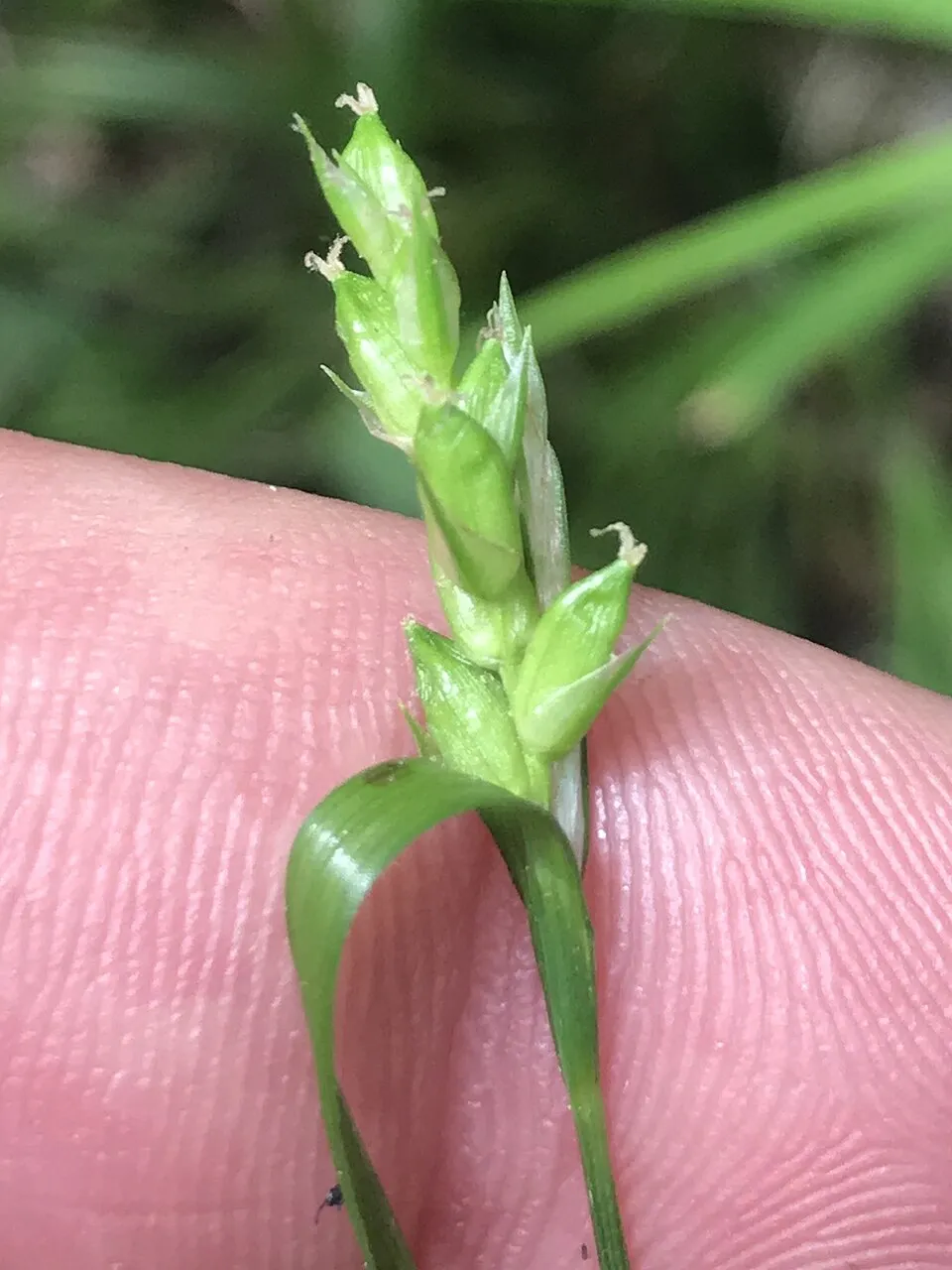
The inflorescence bears a single terminal staminate (male) spike, slender and club-shaped, 10–25 mm long. Below are 2–4 pistillate (female) spikes, loosely flowered, 10–30 mm long, on short peduncles that may be partly enclosed in the leaf sheath. The lowermost pistillate spike is often on a longer, exserted stalk. Perigynia are ovoid, 4–6 mm long, strongly many-nerved (9–15 prominent veins), and taper abruptly to a short, slightly curved beak. Pistillate scales are hyaline with a green midrib, shorter than the perigynia.
Carex amphibola belongs to section Griseae, a notoriously difficult group of bottomland sedges. In NE Oklahoma, it is distinguished from C. cherokeensis by having perigynia with fewer veins and a more abrupt beak, more northerly range extending into the Great Lakes, and slightly narrower leaves. The combination of broad, glaucous leaves, strongly nerved perigynia, and floodplain habitat is the best practical identification for this species in our region. It is less strictly southern than C. cherokeensis and generally occupies wetter, more heavily clay-dominated floodplain sites.
Carex amphibola ranges throughout the eastern and central United States. In Oklahoma, it follows the major river systems: the Arkansas, Verdigris, Grand (Neosho), and their tributaries. It is a characteristic component of the herbaceous layer in floodplain forests beneath American sycamore, pecan, black willow, and river birch.
Within the Tulsa area, look for it in the alluvial bottomlands along Bird Creek, Haikey Creek, Mingo Creek, and the Arkansas River floodplain. It is particularly abundant on partially shaded terraces flooded for a few days at a time during spring rains but that drain freely thereafter — the precise hydrologic regime that rain gardens are engineered to replicate. It is less common in the upland Cross Timbers, where drier, sandier soils favor Eastern Woodland Sedge and White-tinged Sedge.
[ stream-bank stabilization · amphibian cover · floodplain food web · satyrid host ]
The dense, fibrous root system of Creek Sedge makes it one of the most effective native plants for stabilizing eroding stream banks. Sedges produce a dense mat of fine roots in the upper 6–12 inches of soil that binds soil particles and resists scouring. Established colonies of C. amphibola survive short-term inundation with foliage fully submerged, resuming function within days of water recession — invaluable for riparian buffer plantings along urban and agricultural streams in Green Country.
Seeds are consumed by waterfowl (mallards, wood ducks), rails and snipe, and songbirds including swamp sparrows (Melospiza georgiana) and red-winged blackbirds. The dense clumps provide cover for amphibians and reptiles — southern leopard frogs, Blanchard's cricket frogs, and numerous skinks and small snakes inhabiting the aquatic-terrestrial interface along Oklahoma rivers.
Like other broad-leaved woodland sedges, C. amphibola is a larval host for satyr butterflies. The northern pearly-eye (Lethe anthedon), Appalachian brown (Satyrodes appalachia), and eyed brown (Satyrodes eurydice) all use woodland sedges as larval hosts. The dion skipper (Euphyes dion), a wetland specialist, is documented on sedges in similar floodplain habitats and likely uses C. amphibola within its Oklahoma range.
In active floodplains, C. amphibola functions as a pioneer stabilizer that colonizes freshly deposited alluvium after floods recede. Its seeds are water-dispersed, and seedlings establish rapidly on bare, moist silt. The species contributes to structural complexity of the floodplain herbaceous layer, providing microhabitats for invertebrates. As floodplain forests in NE Oklahoma face pressure from channelization, development, and invasive species (particularly Japanese hops, Humulus japonicus), maintaining healthy populations of native sedges in remnant bottomland forests is an important conservation priority.
[ rain garden · bioswale · floodplain planting · stormwater management ]
Creek Sedge is adapted to the wettest, heaviest soils of any woodland sedge commonly available in the nursery trade. This makes it the go-to species for rain gardens, bioswales, and stormwater retention basins — features increasingly common in Tulsa's green infrastructure program. Select a site that collects water after rainfall. The soil must retain moisture; this species will not perform on dry, elevated sites.
Plant container-grown specimens in spring (March–April) or fall (September–October). In a rain garden, position plants in the middle to upper zone of the depression — the area periodically inundated but draining within 24–48 hours. The deepest, most frequently flooded center is better suited to obligate wetland species like buttonbush and cardinal flower, with C. amphibola on slopes and margins.
Like most Carex species, Creek Sedge has no documented edible or medicinal use. The broad, tough leaves would have been suitable for basketry and weaving — Southeastern Indigenous cultures including the Creek, Cherokee, and Choctaw utilized sedge leaves for mats, baskets, and cordage. In the modern era, C. amphibola is increasingly important in ecological engineering — the design of landscapes that perform ecological functions (water filtration, flood mitigation, habitat provision) while serving aesthetic purposes. Its use in rain gardens and bioswales across the eastern US represents recognition that native floodplain species are often the best-adapted plants for engineered stormwater systems.
Hero photo: Rooted Revival. Strip photos via Wikimedia Commons under respective licenses.