home/ plants/ red-mulberry

// SPECIES PROFILE · TREE · NATIVE · EDIBLE FRUIT · WILDLIFE KEYSTONE

Red Mulberry

Morus rubra

Red mulberry is a medium-sized native tree 35–50 ft tall with large, variably shaped leaves — some lobed, some unlobed on the same branch — and a dense, rounded crown that provides excellent shade. It produces sweet, dark purple-red aggregate fruits in late spring that rival blackberries in flavor and are one of the most important wildlife food sources in eastern North America. Morus rubra is native from Massachusetts to Florida and west to the Great Plains, including all of Oklahoma, where it is found in moist, well-drained woods, fencerows, and bottomland forests. Over 50 bird species consume red mulberry fruit, and the tree's generous, reliable crop and early ripening (late May through June) make it a cornerstone of the seasonal food calendar for everything from cedar waxwings to box turtles.

// QUICK FACTS
Family
Moraceae (mulberry / fig family)
Life cycle
Deciduous perennial tree; long-lived (75–125+ years)
Native range
Eastern and central North America — Massachusetts to Florida, west to the Great Plains, including all of OK
USDA hardiness
Zones 4–9 (Tulsa = 7a/7b — well within range)
Mature size
35–50 ft tall, 30–45 ft spread; can reach 70 ft on exceptional bottomland sites
Bloom
April – May (NE OK), with male and female flowers on separate trees (dioecious)
Fruit ripening
Late May – June; one of the earliest tree fruits of the year in NE Oklahoma
Fruit
Compound aggregate (syncarp), 1–2 in long; dark purple-red to nearly black when ripe; sweet
Sun
Full sun to partial shade; tolerates understory conditions but fruits most heavily in sun
Soil
Rich, moist, well-drained loam preferred; tolerates clay and sandy loam. pH 5.5–7.5
Water
Medium to moist; intolerant of prolonged drought on thin upland soils
Wildlife
Fruit eaten by 50+ bird species · mammals · box turtles; larval host for Hyalophora cecropia moth
Conservation
Not listed federally; declining in parts of range due to competition and hybridization with invasive white mulberry (Morus alba)
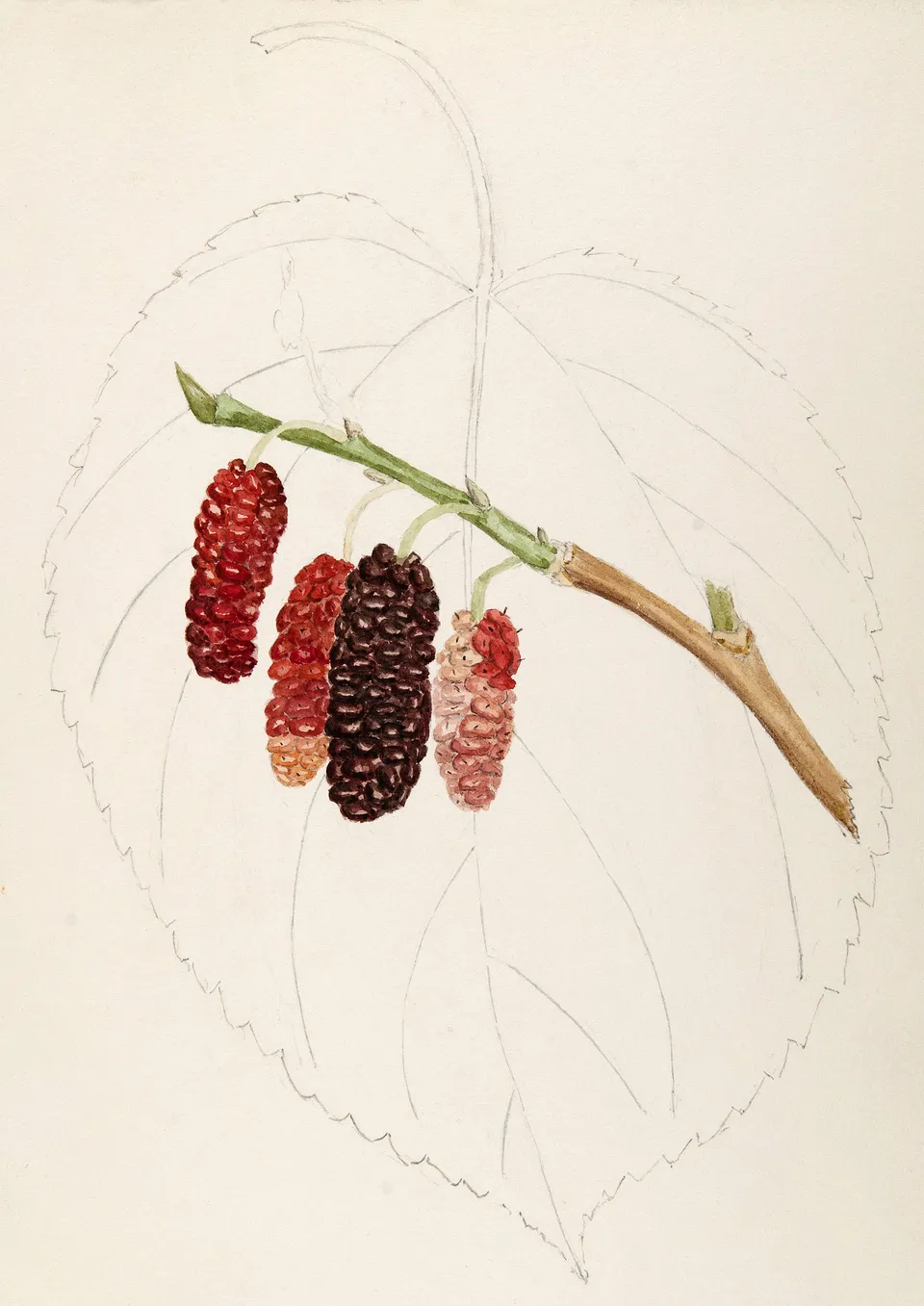
Red Mulberry (Morus rubra) branch laden with ripe dark purple aggregate fruits among large ovate leaves
Morus rubra in fruit — dark purple-red aggregate fruits among variably lobed and unlobed leaves. Photo: Rooted Revival.

Identification

[ field key — habit · leaf · flower · fruit · distinguishing features ]

Habit, Bark & Sap

A medium-sized deciduous tree 35–50 ft tall with a short trunk, broad rounded crown, and spreading branches. Bark on young trees is smooth and orange-brown with prominent lenticels; on mature trunks, it becomes gray-brown and develops narrow, scaly ridges with an orange undertone visible in the furrows. The tree exudes a milky white latex when leaves, twigs, or fruit stems are broken — a diagnostic family trait shared with fig and Osage orange, both fellow Moraceae. Unlike the weedy Morus alba (white mulberry), red mulberry tends to form a single straight trunk rather than a multi-stemmed shrubby cluster.

Leaves

The leaves of red mulberry are famously variable, and both lobed and unlobed leaves occur on the same tree, often on the same branch. Unlobed leaves are broadly ovate, 3–8 in long and 2–6 in wide, with a long-acuminate (drawn-out) tip, a heart-shaped to rounded base, and coarsely serrated margins. Lobed leaves typically have 1–3 lobes (occasionally more on vigorous young shoots) and resemble a mitten or a three-fingered glove. The upper surface is dark green and rough-sandpapery (scabrous) to the touch; the underside is paler, softly hairy, and uniformly pubescent across the entire surface — this uniform underside hairiness is the single best field character for separating red mulberry from the introduced white mulberry, which has only tufts of hair in the vein axils or is entirely hairless underneath.

Flowers & Pollination

Red mulberry is dioecious (male and female flowers on separate trees), though occasionally a tree will carry a few flowers of the opposite sex. Flowers appear in April to early May as the leaves are unfolding. Male flowers are held in pendant, yellowish-green catkins 1–2 in long that release copious wind-borne pollen. Female flowers are in shorter, denser, upright catkin-like spikes, also greenish, each tiny flower containing a single ovary. Pollination is by wind — no showy petals are needed. For fruit production, you need at least one male tree nearby (within about 300 ft) to pollinate female trees; isolated female trees will produce small, seedless, or aborted fruit.

Fruit & Distinguishing Features

The fruit is an aggregate syncarp 1–2 in long, resembling an elongated blackberry, composed of many tiny drupelets fused together around a central core. Ripe fruit is dark purple-red to nearly black, juicy, and intensely sweet with a mild tartness. The ripening season in the Tulsa area runs roughly mid-May through late June — earlier than most other native fruits and overlapping with serviceberry and the tail end of strawberry season. The fruits stain vigorously — purple-black juice will color sidewalks, patio furniture, and clothing, which is why red mulberry was traditionally planted away from the house in the barnyard or fencerow. The fruiting stalk (pedicel) stays attached to the tree, not the fruit, when ripe — unlike the white mulberry, where the stalk often pulls free with the berry.

Habitat & Range in NE Oklahoma

Morus rubra is native across all of Oklahoma and is common throughout the eastern half of the state, including the Cross Timbers, Ozark foothills, Cherokee Prairie, and Arkansas River bottomland forests of the northeast region. Its preferred habitat is moist, well-drained, fertile woods — you will find red mulberry in bottomland hardwood stands alongside pecan, sycamore, black walnut, and black cherry; on shaded stream terraces and limestone ledges; and along old fencerows where birds have deposited seeds for generations.

In NE Oklahoma specifically, red mulberry is a reliable component of the mid-story to lower canopy layer in mature bottomland forests along the Arkansas, Grand, and Illinois rivers and their tributary creeks. It also appears in upland mixed woods in the Ozark foothills of Cherokee, Delaware, and Adair counties, where it grows in the partial shade of post oak, blackjack oak, and shagbark hickory on north-facing slopes and in moist draws. Red mulberry is somewhat drought-sensitive and will struggle on exposed, thin-soil, south-facing ridge tops — if you see a mulberry on a blazing dry hilltop in Oklahoma, it is almost certainly the invasive white mulberry, which tolerates those conditions far better than the native.

Ecology & Wildlife Value

[ keystone wildlife fruit · Lepidoptera hosts · bird species · mammal forage · riparian ecology ]

Bird Species

Red mulberry is one of the most heavily bird-visited fruiting trees in eastern North America. Over 50 documented bird species consume the fruit, including cedar waxwings, American robins, Northern mockingbirds, brown thrashers, Eastern bluebirds, Baltimore orioles, orchard orioles, summer tanagers, scarlet tanagers, great crested flycatchers, Eastern kingbirds, red-bellied woodpeckers, Northern flickers, blue jays, gray catbirds, several thrush species, and wild turkeys. The early ripening window (late May–June) places mulberry fruit at a critical time when many birds are feeding nestlings and protein-demanding young — a mulberry in a food forest is a bird nursery support system.

Lepidoptera Hosts & Insect Ecology

Red mulberry is the larval host plant for the spectacular cecropia moth (Hyalophora cecropia), North America's largest native moth, with a wingspan up to 6 in. It also hosts the mourning cloak butterfly (Nymphalis antiopa) and the red-spotted purple (Limenitis arthemis astyanax). The tree's dense foliage supports a diverse insect community that in turn feeds insectivorous birds nesting in the canopy. The sap-producing wounds and overripe fruit on the ground attract butterflies and moths that feed on fermenting juices.

Mammals & Other Wildlife

The fruit crop is consumed by a long list of mammals: gray and fox squirrels, raccoons, opossums, striped skunks, white-tailed deer (which also browse foliage), and Eastern box turtles, for which mulberry fruit is a significant seasonal food in Oklahoma bottomlands. Black bears, where they occur in the Ozark foothills, climb mulberry trees to feed on the fruit. The dense summer canopy provides nesting and roosting cover for birds and tree squirrels alike.

Threat: Hybridization with White Mulberry

The most significant ecological threat to Morus rubra is competition and hybridization with the invasive white mulberry (Morus alba), introduced from Asia in the 17th century for the silk industry. White mulberry is more drought-tolerant, more urban-adapted, and produces abundant viable pollen that can pollinate red mulberry flowers, producing hybrids that backcross and dilute the native gene pool. In much of the eastern US, pure M. rubra is becoming uncommon. If you are planting mulberry for ecological value, source your tree from a reputable native plant nursery that verifies the species — retail nursery "mulberry" stock is frequently mislabeled M. alba or hybrid seedlings.

Horticulture & Care

[ site selection · planting · pollination · pruning · companion planting · food forest role ]

Site selection & planting

Plant red mulberry in moist, rich, well-drained soil with at least a half-day of sun for fruit production. It tolerates partial shade and will grow as an understory tree, but fruiting declines noticeably with less than 4–6 hours of direct sun. In the Tulsa landscape, the ideal site is a moist draw, the edge of a swale, or a location receiving runoff from a roof or driveway — red mulberry appreciates extra moisture in our hot summers. Avoid thin, dry ridge-top soils and compacted urban fill.

Maintenance & pruning

Pests & diseases

Companion planting & food forest integration

Red mulberry fits naturally in the small-tree to canopy layer of a NE Oklahoma food forest. Pairs well with: pawpaw and American persimmon in the understory/tree layer, spicebush and American hazelnut in the shrub layer, woodland phlox and wild ginger as herbaceous groundcover, and groundnut as a nitrogen-fixing vine that can climb the mulberry's lower branches without causing damage. In a riparian buffer planting, red mulberry works well with black willow, river birch, and buttonbush. Unlike black walnut, red mulberry has no allelopathic effect on neighboring plants and can be interplanted closely with a wide variety of species.

Edible & Cultural Uses

Red mulberry fruit is a genuinely delicious native food that has been consumed by Indigenous peoples across eastern North America for thousands of years and remains one of the easiest-to-grow and most productive fruit trees available to the NE Oklahoma homeowner. The fruits have a complex sweetness with a subtle tart undertone that some compare to a blend of blackberry and Concord grape, with a hint of vanilla in the best individuals. Here is what you need to know:

A tree that feeds everyone. In the hierarchy of wildlife food plants in eastern North America, red mulberry sits near the top — right alongside black cherry and the oaks. A single mature female red mulberry can produce 30–50+ gallons of fruit in a good year, enough to feed a barnyard's worth of birds, a family's jam-making operation, and still leave plenty to fall, ferment, and cycle nutrients back into the soil. It is one of the most generous plants you can put in the ground.

Photo Reference

Ripe dark purple-red red mulberry fruits among leaves
// Ripe fruit — dark purple aggregate syncarps, late May–June
Wikimedia Commons
Wikimedia Commons
Red mulberry variably shaped leaves — some lobed, some unlobed, on the same branch
// Leaves — variable shape: lobed and unlobed on the same branch; uniformly hairy underside
Wikimedia Commons
Wikimedia Commons
Mature red mulberry tree — full rounded crown, broad spreading branches
// Mature tree — broad rounded crown, typically 35–50 ft tall
Wikimedia Commons
Wikimedia Commons
Red mulberry bark — gray-brown with scaly ridges and orange undertone
// Bark — gray-brown with narrow scaly ridges; orange undertone visible in furrows
Wikimedia Commons
Wikimedia Commons
Cedar waxwing eating red mulberry fruit
// Cedar waxwing feeding on red mulberry — one of 50+ bird species that rely on the fruit
Wikimedia Commons
Wikimedia Commons

Sources & Further Reading

  • USDA NRCS PLANTS Database — Morus rubra: plants.usda.gov/plant-profile/MORU2
  • USDA NRCS Plant Guide — Red Mulberry (MORU2), National Plant Data Center, 2000.
  • Lady Bird Johnson Wildflower Center — Native Plant Database: wildflower.org — MORU2
  • Oklahoma State University Extension — Native Tree Selection for Oklahoma Landscapes (includes Morus rubra).
  • Burgess, K.S. et al. (2005). Asymmetrical introgression between two Morus species (M. alba, M. rubra) that differ in abundance. Molecular Ecology 14(11):3471–3483 — on hybridization threat.
  • Tallamy, D.W. (2007). Bringing Nature Home: How You Can Sustain Wildlife with Native Plants. Timber Press — mulberry ranked among the highest wildlife-value trees.
  • Moerman, D.E. (1998). Native American Ethnobotany. Timber Press — comprehensive reference to indigenous uses of Morus rubra.
  • Wikipedia — Morus rubra: en.wikipedia.org/wiki/Morus_rubra (CC BY-SA 4.0; portions of the description, ecology and uses sections summarize Wikipedia content).

Hero photo: Rooted Revival. Strip photos courtesy of Wikimedia Commons contributors under their respective licenses (linked under each image).