// SPECIES PROFILE · SHRUB · NATIVE · NITROGEN-FIXER
False Indigo Bush is the workhorse native shrub of NE Oklahoma's streambanks, pond margins, and bottomland thickets — a large, suckering legume that thrives where most ornamental shrubs drown. From late April through June, its tall wand-like spikes of deep purple flowers studded with brilliant gold anthers rise above compound, feathery foliage, forming a haze of color that draws native bees, butterflies, and hummingbirds. As a member of Fabaceae, Amorpha fruticosa fixes atmospheric nitrogen through a symbiosis with rhizobial bacteria, enriching the soil in exactly the kinds of wet, compacted, heavy-clay sites where fertility is most needed. It also suckers freely from the base, forming dense, bird-harboring thickets that stabilize eroding banks along creeks, rivers, and detention ponds across the Tulsa region.

[ field key — habit · leaf · flower · fruit · special features ]
A large, multi-stemmed deciduous shrub with an open, arching silhouette. Mature plants typically reach 6–12 ft tall with a spread that matches or exceeds the height due to vigorous root-suckering. Stems are gray-brown with scattered lenticels; young twigs are greenish and finely hairy. In the Tulsa region, plants in moist bottomland sites naturally form dense, rounded colonies 12–15 ft across within five to seven years. The root system is fibrous, wide-spreading, and deep enough to anchor eroding streambanks.
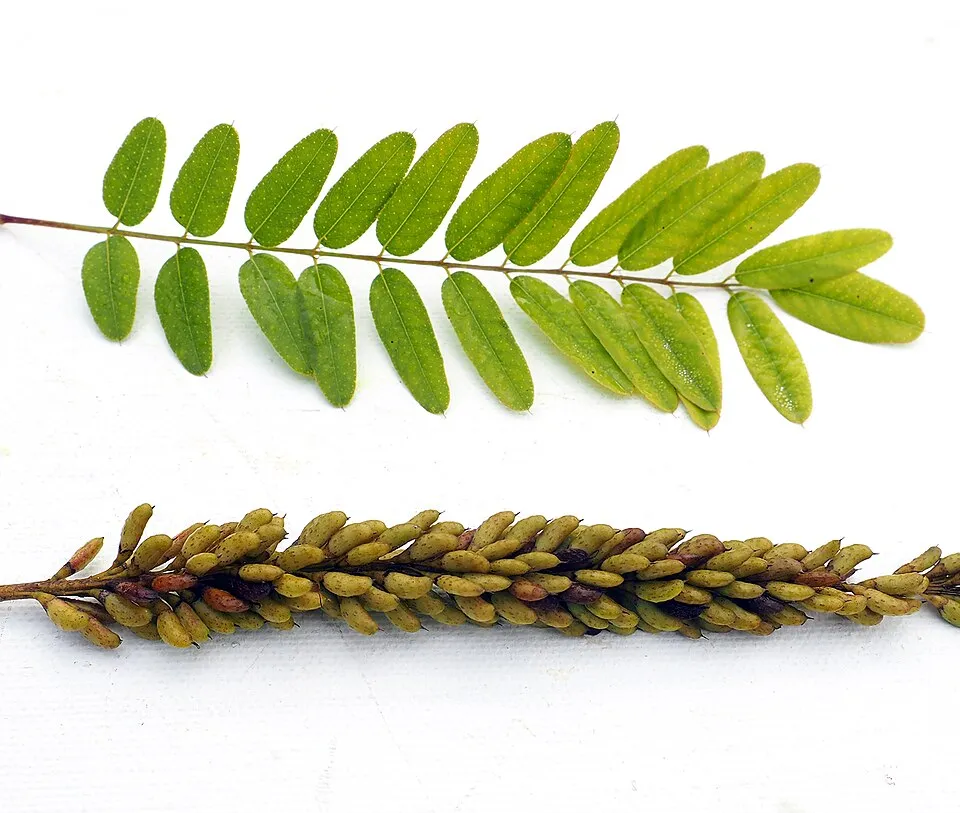
Alternate, pinnately compound, 6–12 in long with 13–25 small oblong to elliptical leaflets each about 1–2 in long. Leaflets are entire-margined, dark green above and paler below, with tiny glandular dots visible with a hand lens. The overall texture is feathery and fine, reminiscent of black locust but softer and less coarse. Leaves turn a brief, unremarkable yellow in fall before dropping. Crushed foliage has little odor, unlike true indigo (Indigofera).
The inflorescence is a dense terminal raceme 4–8 in tall, packed with dozens of small, deep purple flowers. Each individual flower is about ¼ in long with a single erect petal (the banner or standard) — the wing and keel petals found in most typical pea flowers are absent, a distinctive feature of the genus Amorpha. Ten bright orange-gold stamens protrude far beyond the petal, giving the spike a brilliant, fuzzy appearance. Flowers open from the bottom of the spike upward over several weeks.
Fruits are small, curved, one-seeded indehiscent pods (legumes) about ¼ in long, covered with prominent raised resin glands that are visible as translucent golden dots. Pods ripen from green to brown in late summer and persist on the shrub into winter, providing visual interest and food for seed-eating birds. The genus name Amorpha (Greek for "deformed") refers to the single-petaled flower. The specific epithet fruticosa means "shrubby." Not to be confused with the related leadplant (Amorpha canescens), a shorter, silvery-leaved prairie species.
Amorpha fruticosa is one of the most widespread Amorpha species in North America, occurring from southern Canada through almost the entire contiguous United States and into northern Mexico. In NE Oklahoma, it is a faithful indicator of alluvial soils and moist ground — you will find it wherever water meets land: along the banks of the Arkansas, Verdigris, and Neosho rivers, around farm ponds and stock tanks, in low wet spots of hay meadows, in floodplain forest openings, and lining the drainage ditches that crisscross agricultural land in Tulsa, Rogers, Wagoner, and Osage counties.
The plant is equally at home in the Cross Timbers ecoregion's bottomlands as it is along the broader floodplains of the Arkansas River system. It tolerates the heavy, poorly-drained clay soils common in NE Oklahoma subdivisions — the same soils that kill rhododendrons and azaleas outright. In fact, False Indigo Bush is one of the few native shrubs that genuinely prefers having wet feet for part of the year, making it invaluable for rain gardens, bioswales, detention-basin plantings, and the perpetually-soggy back corner of the yard where nothing else will grow.
[ nitrogen fixation · specialist bees · lepidoptera host · birds & mammals ]
Like all members of the Fabaceae, A. fruticosa forms a symbiosis with nitrogen-fixing rhizobial bacteria housed in root nodules. These bacteria convert atmospheric N2 into plant-available ammonium in exchange for carbohydrates from the host. In wet, compacted soils where decomposition is slow and nitrogen often limiting, this biological input is ecologically significant — the shrub essentially fertilizes its own neighborhood, improving growing conditions for nearby plants over time. Regular pruning of stems for mulch (chop-and-drop) accelerates nitrogen cycling into the soil.
The purple flower spikes with their exposed golden stamens are a magnet for a wide range of native bees. Bumblebees (Bombus spp.) are the most effective pollinators, sonicating the flowers as they work the racemes bottom to top. Leafcutter bees (Megachile), sweat bees (Lasioglossum, Agapostemon), and carpenter bees (Xylocopa) also visit in numbers. Honeybees forage heavily when colonies are nearby. Several species of solitary bees in the genus Anthophora are known Amorpha specialists in the central US.
Amorpha fruticosa is a larval host for the silver-spotted skipper (Epargyreus clarus), one of the largest and most recognizable skippers in NE Oklahoma, whose caterpillars tie leaflets together with silk to form shelters. It also hosts the southern dogface sulphur (Zerene cesonia) and is recorded as a host for several geometer moths including the Amorpha-feeding Pero and Euchlaena species found in the Cross Timbers region.
The dense, thicket-forming habit makes False Indigo Bush prime nesting cover for northern cardinals, brown thrashers, gray catbirds, and indigo buntings along NE Oklahoma waterways. Bobwhite quail and wild turkey consume the resin-dotted seeds from the shrub and from the ground beneath. White-tailed deer browse the foliage and twigs heavily — in areas with high deer density, plants may take on a hedged appearance. Beaver include Amorpha stems in their winter cache along the Arkansas and Verdigris rivers.
[ site selection · planting · management · companion planting ]
This is not a shrub for the formal foundation planting. A. fruticosa is large, informal, and suckering — it belongs in the wet back corner, along a drainage swale, at the pond edge, or on the outer bank of a creek where mowers cannot reach. Full sun produces the heaviest bloom and densest growth, but it will tolerate partial shade from overstory trees, blooming more sparsely but still functioning as a nitrogen-fixer and wildlife shrub. Container-grown plants establish most reliably; plant in spring or fall with the root ball set at grade. Space 8–12 ft apart for individual specimens or 6–8 ft on center for a continuous hedging thicket.
Prune in late winter before bud break to control size and shape. The shrub responds well to rejuvenation pruning — cutting the oldest third of stems to the ground each year keeps the colony vigorous and prevents the interior from becoming a tangle of dead wood. For a denser, more compact form, cut all stems back to 12–18 in every 3–4 years. This also generates a pulse of nitrogen-rich mulch for adjacent plantings. Remove root suckers that emerge where they are not wanted by cutting them at ground level; repeated mowing is effective.
In a riparian restoration or wet garden, combine False Indigo Bush with buttonbush for overlapping bloom and contrasting flower form, black willow for the overstory, river birch for peeling bark contrast, cardinal flower and Joe-Pye weed at the shrub's feet, and inland sea oats or switchgrass as the herbaceous matrix. For a food forest wet zone, underplant with comfrey as a living mulch and nutrient accumulator. Avoid planting where the suckering habit will compete with vegetable beds or small ornamental perennials.
Unlike true indigo (Indigofera spp.), Amorpha fruticosa does not produce a usable blue dye, despite the common name. The shrub has a limited record of ethnobotanical use. Indigenous peoples of the Great Plains and Eastern Woodlands used the resinous, aromatic leaves as a component of smoking mixtures (kinnikinnick) in some regions, and the stems were occasionally used for basketry or light construction. Some accounts record the use of the gland-dotted pods as a insect repellent when crushed and rubbed on skin, though this was likely a minor use. The seeds are not considered edible for humans; the plant's primary value in a modern context is ecological rather than culinary.
Hero photo: Rooted Revival. Strip photos courtesy of Wikimedia Commons contributors under their respective licenses (linked under each image).