// SPECIES PROFILE · GRASS · NATIVE · CROSS TIMBERS UNDERSTORY
White-tinged Sedge is the Cross Timbers understory specialist — a low, finely textured sedge that has adapted to one of the harshest horticultural environments in North America: the dry, acidic, root-competitive soil found on the ridges and slopes beneath post oak and blackjack oak. In this world of thin sandy loam over sandstone, summer drought, and deep seasonal shade, Carex albicans forms dense, delicate tufts 6–12 inches tall, its very narrow leaves giving a soft, fine-textured appearance that belies the plant's toughness. The common name comes from the whitish, translucent tips of the perigynia that appear in spring — a subtle field mark that gives the species its identity. If you garden under native oaks in the Cross Timbers and have given up on anything surviving there, this sedge is one of the few plants genuinely adapted to that ecological niche.

[ field key — habit · leaf · inflorescence · distinguishing features ]
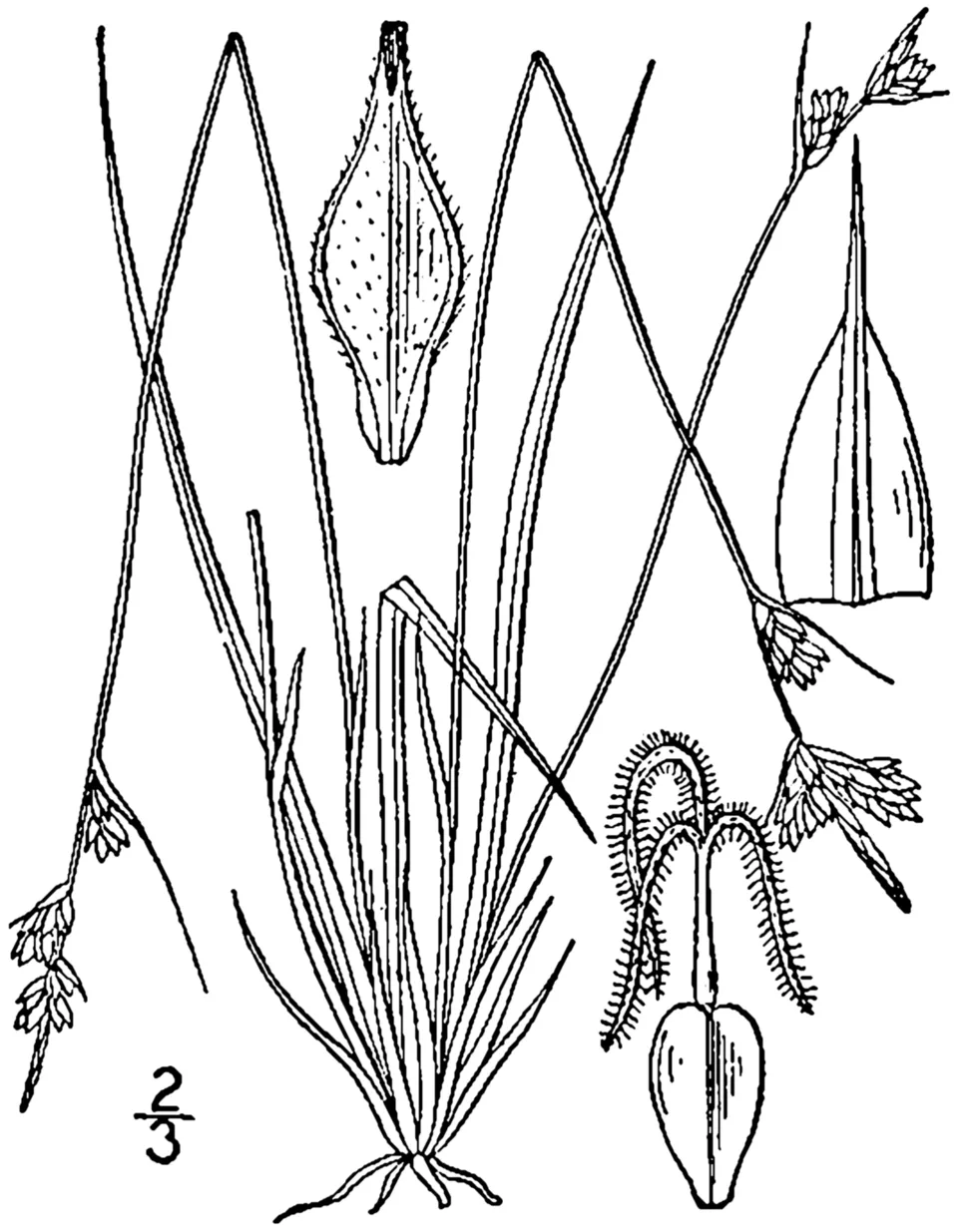
Densely caespitose (clump-forming) with fibrous roots and very short rhizomes that give the crown a compact, tight appearance. Individual clumps are small, 8–12 inches in diameter, but multiple plants often grow in close proximity, creating a fine-textured patchwork in the understory. Unlike colonial sedges, C. albicans does not spread laterally to form continuous carpets — each tuft remains discrete. The foliage arches gently, often lying nearly prostrate or lax by late summer, especially in the deepest shade.
Leaves are narrow, 1–3 mm wide, flat to slightly channeled, and bright medium green in spring, deepening to a somewhat duller green by midsummer. Blades are soft and pliable, not stiff or rough. The foliage is among the finest-textured of any Carex in Oklahoma, second only to C. pensylvanica. Basal sheaths are brown and may persist. Foliage is semi-evergreen in mild Tulsa winters, with significant green tissue persisting through February, though tips will brown in prolonged cold. This makes it useful for winter groundcover structure in the woodland garden.
The inflorescence is short, compact, and held among or slightly above the leaves on slender, nodding culms. The terminal spike is staminate (male), slender and club-shaped. Below are 1–3 pistillate (female) spikes, sessile or nearly so, clustered near the male spike. The perigynia are small (2–3 mm), obovoid, with a distinct whitish, translucent beak that is noticeably paler than the body of the perigynium — the feature that gives the species both its scientific and common names (albicans = "becoming white"). This whitish beak, visible with a hand lens, is the most reliable field character for distinguishing C. albicans from similar fine-leaved woodland sedges.
In NE Oklahoma, Carex albicans is most easily confused with C. pensylvanica (Pennsylvania Sedge), which shares fine texture and dry woodland habitat. Key differences: C. albicans is caespitose (clumped) rather than colonial via creeping rhizomes; its perigynia have a whitish translucent beak rather than being entirely pubescent; and it is more common in the drier, sandier Cross Timbers habitats than the somewhat moister Ozark foothills. It also resembles C. communis (Fibrous-rooted Sedge), which has a similarly fine texture but lacks the whitish perigynium beak and has fibrous, non-rhizomatous root systems.
Carex albicans is widespread in the eastern and central United States, from New England and the Great Lakes south to the Gulf Coast and west into eastern Nebraska, Kansas, Oklahoma, and Texas. In NE Oklahoma, it is strongly associated with the Cross Timbers ecoregion, particularly the dry, acidic, well-drained uplands dominated by post oak (Quercus stellata) and blackjack oak (Quercus marilandica) over sandstone substrates. It is a characteristic component of the Cross Timbers understory in Osage, Tulsa, Creek, and western Rogers counties, where it grows on upper slopes, ridge crests, and flatwoods with thin, sandy loam soils of low to moderate fertility.
The Cross Timbers is one of the least-recognized and most threatened ecoregions in North America. The post oak-blackjack oak woodlands that define it evolved under a regime of frequent low-intensity fire, and the herbaceous understory was once rich with grasses, sedges, and forbs. C. albicans is a survivor of this historic understory community, persisting in remnants where development, fire suppression, and invasive species (particularly Ligustrum sinense and Lonicera japonica) have eliminated much of the native ground flora. It is also found in the Ozark foothills on dry, cherry slopes and in open, rocky woodlands on limestone and sandstone substrates.
[ satyrid host · seed foragers · Cross Timbers ecology · fire-adapted ]
The small achenes of C. albicans are consumed by ground-feeding songbirds including eastern towhees (Pipilo erythrophthalmus), dark-eyed juncos (Junco hyemalis), and various sparrows. In the Cross Timbers, where the herbaceous layer is often sparse, sedge clumps serve as important islands of cover and foraging substrate for birds that scratch through leaf litter for seeds and invertebrates. Northern bobwhite quail consume sedge seeds opportunistically in dry upland woods.
Carex albicans is a documented larval host for the northern pearly-eye (Lethe anthedon) and little wood-satyr (Megisto cymela), both of which are common in Oklahoma's deciduous woodlands. The adult northern pearly-eye is a medium-sized brown butterfly with prominent eyespots on the hindwing undersides, frequently seen in dappled woodland light from June through August in the Cross Timbers. Dusted skippers (Atrytonopsis hianna) and other grass-skippers likely use this sedge as a host in Oklahoma.
In the fire-maintained woodlands of the historic Cross Timbers, C. albicans was part of a diverse graminoid understory that also included little bluestem, Indiangrass, and a variety of native forbs. It is fire-adapted: the compact crown and fibrous root system allow it to resprout after low-intensity surface fires. In contemporary fire-suppressed Cross Timbers woodlands, it persists in the sparse understory beneath dense woody thickets of eastern redcedar and roughleaf dogwood, but its abundance and vigor decline as canopy closure increases and leaf litter accumulates without periodic fire.
Like most woodland sedges, C. albicans forms associations with arbuscular mycorrhizal fungi, which connect it to the extensive mycorrhizal network of the oak-dominated Cross Timbers forest. These fungal associations are critical for nutrient and water acquisition in the nutrient-poor, drought-prone soils of the Cross Timbers uplands. The preservation of native sedge populations is thus linked to the preservation of intact soil fungal communities, which are disrupted by soil disturbance, compaction, and the application of fungicides and high-phosphorus fertilizers.
[ dry shade under oaks · Cross Timbers garden · minimal care · oak understory ]
White-tinged Sedge is a specialist for dry shade under mature native oaks on well-drained, acid soils. In the Tulsa landscape, this means the area beneath post oaks and blackjack oaks, where the thin, sandy soil dries out quickly after rain and root competition from the oaks makes supplemental watering only marginally effective. This is precisely the condition where C. albicans outperforms nearly every other groundcover. It also performs well under black hickory and on dry, rocky slopes with partial shade.
Plant in early spring (March–April) or fall (September–October). Space 12–15 inches apart for a patchwork effect; clumps will not merge into a continuous carpet but will fill in as individual tufts over 2–3 years. Water weekly during the first growing season to establish the root system. Once established (year 2+), this is one of the most drought-tolerant sedges available and requires no supplemental irrigation except during exceptional drought. Do not overwater established plants — wet feet in heavy soil will kill C. albicans faster than drought.
Cut back old foliage in late winter (February) before new growth emerges. Otherwise, maintenance is essentially zero. The species does not require fertilizer (and excess fertility will produce weak, floppy growth prone to lodging). It does not require division unless clumps become overly dense and begin to die out in the center after many years, in which case dig and divide in early spring. It is generally pest- and disease-free in the landscape.
In a Cross Timbers garden, pair C. albicans with other species adapted to dry, acidic, shaded conditions: Christmas fern for evergreen structure, coralberry for low shrub mass, American alumroot for foliage texture, and wild columbine for spring blooms. Under post oaks, combine with black-eyed Susan and little bluestem at the woodlands edge where more light penetrates. Purple poppy mallow makes an excellent sprawling companion in the sunnier gaps.
No significant ethnobotanical uses are recorded for Carex albicans specifically. The fine-textured leaves are less suitable for basketry than broader-leaved sedges, and no edible or medicinal applications are documented. The species' value to humans is primarily ecological — as a component of the Cross Timbers understory that supports wildlife and contributes to the ecological integrity of one of North America's most distinctive and threatened woodland ecosystems.
Hero photo: Rooted Revival. Strip photos via Wikimedia Commons under respective licenses.