home/ plants/ eastern-woodland-sedge

// SPECIES PROFILE · GRASS · NATIVE · VERSATILE GROUNDCOVER

Eastern Woodland Sedge

Carex blanda

Eastern Woodland Sedge is the workhorse of the eastern North American forest floor — the most frequently encountered Carex species from Vermont to Texas, found in virtually every mesic to dry woodland in NE Oklahoma. It is not a showy plant. No one will stop on a garden tour and ask what that glowing sedge is. But Carex blanda is ecologically indispensable: a clump-forming, semi-evergreen groundcover that holds soil on shaded slopes, feeds satyrid butterfly caterpillars, and produces seed for sparrows and finches while asking almost nothing of the gardener. It tolerates dry shade — that horticultural zone of despair under mature oaks and walnuts where nothing else seems to survive — better than almost any other sedge in the genus, making it the single most reliable native for stabilizing the shaded, neglected corners of a Tulsa landscape.

// QUICK FACTS
Family
Cyperaceae (sedge family)
Life cycle
Perennial, cool-season
Native range
Eastern and central North America — widespread from New England and Ontario south to Texas and Florida; present in every county of eastern Oklahoma
USDA hardiness
Zones 3–9 (Tulsa = 7a/7b; fully hardy, occasionally semi-evergreen)
Mature size
6–18 in tall × 8–16 in wide, clump-forming
Bloom
April – early June (NE OK)
Flower / fruit
Inconspicuous greenish spikelets; terminal spike staminate, lower spikes pistillate; perigynia obovoid, finely nerved, with a short bent beak
Sun
Part shade to full shade; tolerates dappled sun and even brief periods of morning sun if soil moisture is adequate
Soil
Extremely adaptable — loam, silt, clay, sandy loam; acid to neutral pH; tolerates the heavy red clay common in the Tulsa region better than many sedges
Water
Medium to dry; one of the most drought-tolerant woodland sedges once established
Wildlife
Larval host for satyr butterflies · songbird seed · ground-dwelling insect cover · small mammal forage
Conservation status
G5 — Secure globally; abundant throughout NE Oklahoma
Eastern Woodland Sedge (Carex blanda) — dense tuft of bright green foliage in woodland understory
Carex blanda in dry-mesic woodland — bright green, semi-evergreen clumps are the most common Carex in eastern North America. Photo: Rooted Revival.

Identification

[ field key — habit · leaf · inflorescence · distinguishing features ]

Habit & Growth Form

Densely caespitose (clump-forming), producing tight, multi- stemmed crowns 6–18 inches tall. Unlike rhizomatous sedges that spread laterally, C. blanda stays in discrete tufts, each crown gradually expanding in diameter over years. The overall form is a low, rounded mound of arching foliage with flowering culms that rise slightly above or remain within the leaf mass. In deep shade, plants are more open and graceful; in brighter conditions with adequate moisture, they form denser, more compact tufts.

Foliage

Leaves are bright green, flat, and 3–8 mm wide — intermediate in width among woodland sedges, broader than C. pensylvanica but narrower than C. cherokeensis. Blades are soft and pliable, not stiff or leathery, with a prominent midrib visible on both surfaces. The lower leaf sheaths are brownish to reddish at the base but not strongly pigmented. Foliage holds its color well into fall and retains a significant proportion of green tissue through winter in Tulsa's climate, effectively functioning as semi-evergreen in all but the coldest winters. This characteristic makes it particularly valuable for year-round groundcover structure.

Inflorescence & Fruit

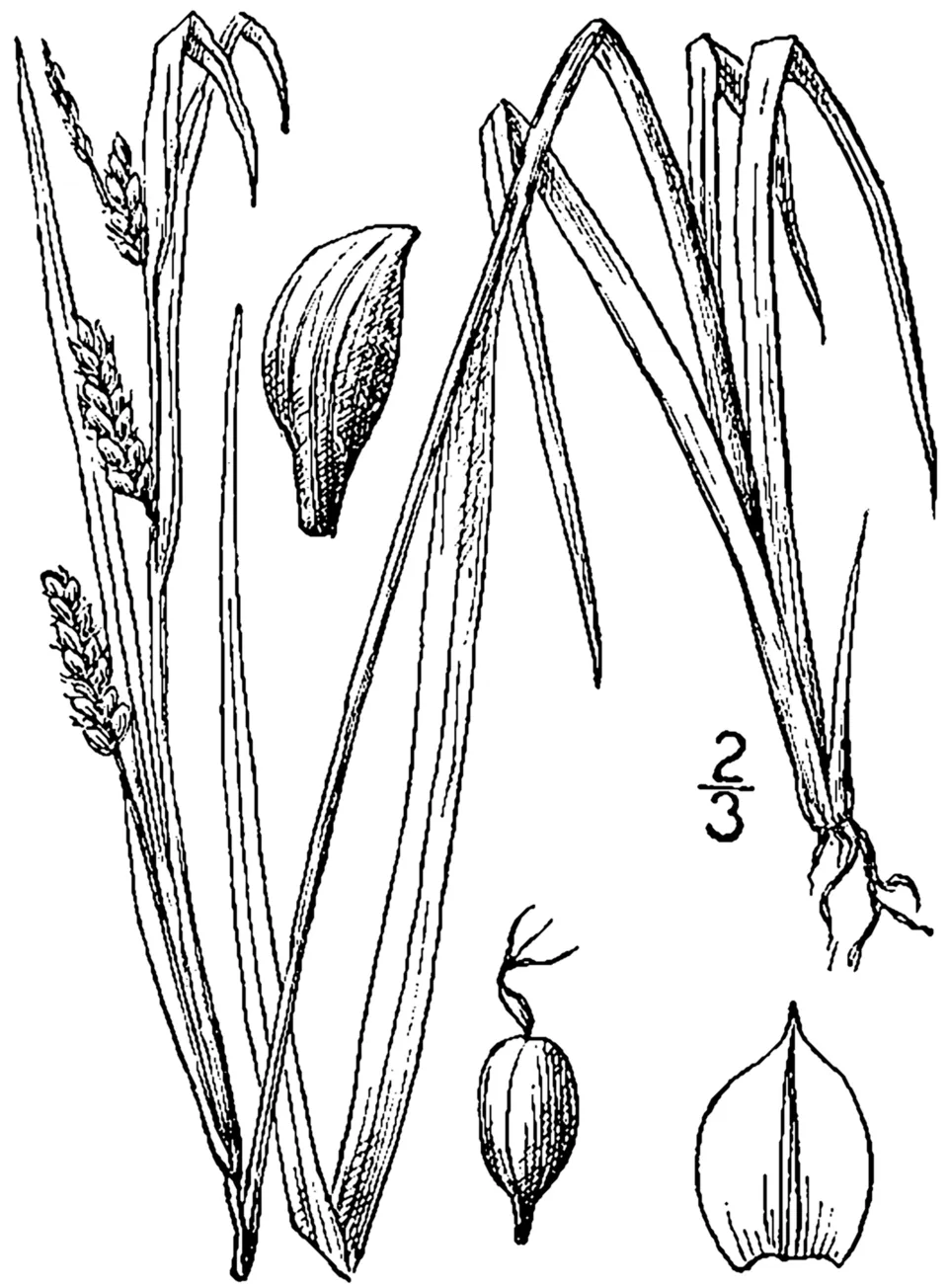
The flowering culms bear a terminal staminate (male) spike that is slender, club-shaped, and 5–15 mm long, subtended by 2–4 pistillate (female) spikes on short peduncles. The pistillate spikes are loosely flowered, 5–15 mm long, with the lowermost spike often somewhat remote from the upper ones on a longer stalk. Perigynia (the diagnostic papery sacs of Carex) are obovoid, 2.5–3.5 mm long, finely nerved (8–12 obscure veins), and taper to a short, slightly bent beak. The specific epithet blanda means "smooth" or "charming" in Latin — a reference to the relatively smooth, unribbed perigynia compared to related species. The pistillate scales are hyaline (translucent) with a green midrib, shorter than the perigynia.

Distinguishing Features

Carex blanda belongs to section Laxiflorae, a notoriously difficult group of broad-leaved woodland sedges that requires attention to perigynium details for reliable identification. In NE Oklahoma, it is most likely to be confused with C. albicans (White-tinged Sedge), which has narrower, more erect leaves and perigynia with a distinctly whitish, translucent beak; and C. leavenworthii (Leavenworth's Sedge), which forms denser, darker green tufts with perigynia that are more prominently nerved and have a longer beak. The combination of wide, bright green, soft-textured leaves; loosely flowered pistillate spikes; and obovoid, obscurely nerved perigynia with a short, slightly bent beak reliably distinguishes C. blanda from its woodland congeners in the region.

Habitat & Range in NE Oklahoma

Carex blanda is among the most broadly distributed native sedge species in North America, ranging from southern Quebec and Ontario through virtually the entire eastern half of the continent and extending as far west as eastern Nebraska, Kansas, Oklahoma, and Texas. In NE Oklahoma, it is ubiquitous in mesic to dry-mesic deciduous woodlands across all ecoregions: the Cross Timbers post oak-blackjack oak savannas and forests of Osage, Tulsa, and Creek Counties; the richer mixed oak-hickory forests of the Ozark foothills; the riparian corridors of the Arkansas, Verdigris, and Grand River systems; and even the shaded margins of tallgrass prairie remnants where woody encroachment is beginning.

It is the sedge you find in the shade of a backyard post oak in midtown Tulsa, in the un-managed fence row behind a Rogers County pasture, and carpeting the floor of mature bottomland forest at Oxley Nature Center. The species' extraordinary adaptability to soil type, moisture regime, and canopy density is the reason it is so common — C. blanda occupies everything from floodplain silt to upland sandstone-derived clay loam, from deep-shaded north slopes to the partly sunny edges of woodland openings. If you walk a wooded acre anywhere in Green Country between March and June, the odds are high that the low green sedge clump near your feet is Carex blanda.

Ecology & Wildlife Value

[ satyrid host · songbird seed · ground-cover refuge · forest-floor ecology ]

Wildlife Forage & Cover

The achenes of Eastern Woodland Sedge are a reliable food source for ground-feeding songbirds, including song sparrows (Melospiza melodia), dark-eyed juncos (Junco hyemalis), white-throated sparrows (Zonotrichia albicollis), eastern towhees (Pipilo erythrophthalmus), and northern cardinals (Cardinalis cardinalis). Northern bobwhite quail and wild turkey poults scratch through sedge tufts for seeds and insects. The dense basal clumps serve as thermal refuge and escape cover for ground-dwelling arthropods, small snakes, and the invertebrates that form the base of the woodland food web. Ruffed grouse (in the eastern portion of the species' range) are known to consume sedge achenes.

Lepidoptera Host

Carex blanda is a confirmed larval host for several sedge-feeding butterflies and moths. The northern pearly-eye (Lethe anthedon) uses broad-leaved woodland sedges as its primary host in Oklahoma; adults are medium-sized brown butterflies with conspicuous eyespots on the hindwings, commonly seen in dappled woodland light from June through August. The little wood-satyr (Megisto cymela) and Carolina satyr (Hermeuptychia sosybius) also feed on sedges as larvae. The dusted skipper (Atrytonopsis hianna) and other grass-skippers in the subfamily Hesperiinae are documented sedge feeders in the eastern US.

Small Mammals

Eastern chipmunks (Tamias striatus), white-footed mice (Peromyscus leucopus), and eastern gray squirrels (Sciurus carolinensis) consume sedge achenes opportunistically. Cottontail rabbits (Sylvilagus floridanus) browse young foliage in spring, though sedge leaves are tough and siliceous — they are not a preferred forage species. Woodland voles (Microtus pinetorum) tunnel beneath and around sedge clumps, using the dense root mass for tunnel stability.

Soil Ecology & Forest-Floor Function

As a cool-season perennial, C. blanda plays an underappreciated role in nutrient cycling on the forest floor. It photosynthesizes actively during the early spring before canopy closure, producing biomass that decomposes throughout the growing season and contributes to the litter layer. The root systems of established clumps bind soil particles and reduce erosion on sloped woodland sites, particularly important in the Cross Timbers where thin, sandy soils over sandstone are prone to sheet erosion after leaf litter is removed. Sedges are also important in mycorrhizal networks — they form associations with arbuscular mycorrhizal fungi that connect them to trees and other understory plants in the forest community.

Horticulture & Care

[ dry-shade specialist · low maintenance · mass planting · native groundcover ]

Site selection

The singular virtue of Eastern Woodland Sedge as a landscape plant is its tolerance for dry shade — the combination of dense canopy and root-competitive, moisture-poor soil that defeats most horticultural plants. Under mature post oaks, blackjack oaks, or black walnuts, where turfgrass thins to bare dirt and hostas struggle, C. blanda persists and slowly expands. It also performs well in mesic woodland gardens with richer, moister soil — this is a sedge that accommodates a wider range of conditions than almost any other native Carex.

Planting & establishment

Plant container-grown stock in early spring (March–April) or early fall (September–October). Dig a hole twice the width of the root ball and no deeper than the soil line of the container. Backfill with the native soil — this sedge does not require soil amendment, though a handful of compost worked into the planting hole accelerates establishment in very poor soils. Water thoroughly at planting and provide supplemental irrigation once weekly during the first growing season. Once established (typically by the second spring), C. blanda is remarkably drought-tolerant and requires no supplemental water except during severe, prolonged drought.

Maintenance

The maintenance requirement is minimal. Cut back old foliage in late winter (February) before new growth emerges. If you prefer a wilder aesthetic, simply leave the plants alone — the old foliage will decompose under the new growth by midsummer. Clumps can be divided every 4–5 years to rejuvenate vigor and increase stock; divide in early spring by digging the crown, separating into sections with 3–5 growing points each, and replanting immediately. C. blanda is notably free of serious pests and diseases in the landscape.

Companion plants

In the dry-shade conditions where C. blanda excels, compatible companions include Christmas fern for evergreen contrast, coralberry as a low shrub layer, and American alumroot for foliage texture. Under deeper shade with more moisture, combine with wild ginger as a low foreground groundcover, Solomon's seal for vertical accent, and maidenhair fern for delicate texture. In the semi-shaded woodland edge, pair with Ohio spiderwort and wild columbine for spring floral interest rising above the sedge carpet.

Landscape uses

Propagation tip: Carex blanda is easily grown from seed collected in late May to June. Perigynia should be stripped from the culm when they turn tan-brown. Sow immediately (they have little to no dormancy) in a prepared seedbed in dappled shade, or cold-moist stratify for 30 days and sow in spring. Seed-grown plants reach garden size in two growing seasons. This is the most economical way to produce large numbers of plants for woodland restoration or mass landscape plantings.

Cultural Uses & Ethnobotany

Carex blanda has no documented edible or medicinal uses — like most sedges, its primary ethnobotanical value lies in weaving and basketry. Sedges were widely used by Eastern Woodlands Indigenous peoples for mats, baskets, and cordage. The tough, fibrous leaves were split into narrow strips, dried, and woven into burden baskets and sitting mats. While specific records for C. blanda are absent from the ethnographic literature (the species was not taxonomically distinguished until the 19th century), broader cultural patterns of sedge use among Cherokee, Creek, and other Southeastern Indigenous nations suggest it would have been recognized and utilized alongside other broad-leaved woodland sedges in its range.

In the modern landscape, C. blanda has been used increasingly in ecological restoration of degraded woodlands throughout the eastern US, serving as a low-cost, self-sustaining groundcover component of forest understory rehabilitation projects. Its ubiquity in native woodlands makes it a natural choice for restoration plantings where the goal is to re-establish the characteristic herbaceous layer of a healthy deciduous forest.

Photo Reference

Carex blanda — flowering habit
// Carex blanda — flowering habit

Sources & Further Reading

  • USDA NRCS PLANTS Database — Carex blanda: plants.usda.gov/plant-profile/CABL
  • Lady Bird Johnson Wildflower Center — Native Plant Database: wildflower.org/plants/result.php?id_plant=CABL
  • Weakley, A.S. (2022). Flora of the Southeastern United States. University of North Carolina Herbarium.
  • Ball, P.W. & Reznicek, A.A. (2002). Carex sect. Laxiflorae. In: Flora of North America Editorial Committee, Flora of North America North of Mexico, Vol. 23: Cyperaceae. Oxford University Press.
  • Yatskievych, G. (1999). Steyermark's Flora of Missouri, Vol. 1. Missouri Department of Conservation.
  • Oklahoma Biological Survey — Carex of Oklahoma. University of Oklahoma.
  • Mt. Cuba Center (2020). Carex for the Mid-Atlantic Region. Research Report.
  • Tallamy, D.W. (2007). Bringing Nature Home: How You Can Sustain Wildlife with Native Plants. Timber Press.
  • Wikipedia — Carex blanda: en.wikipedia.org/wiki/Carex_blanda

Hero photo: Rooted Revival. Strip photos courtesy of Wikimedia Commons contributors under their respective licenses (linked under each image).