Horticulture & Care
[ siting · soil · pruning · pests ]
When to plant
Container-grown American holly establishes best when planted
October through April. The fall window is preferred because
cool, moist winter weather minimizes transplant stress on a species that
resents root disturbance. Avoid planting after May once daytime highs
exceed 85°F.
Planting & establishment
- Sun: 4–6 hours direct for steady growth; tolerates full shade but fruit production drops sharply.
- Soil: the critical variable — must be well-drained
and acidic (pH 4.5–6.5). Heavy alkaline Tulsa clay is the
primary cause of failure. Amend planting beds heavily with pine bark,
peat moss, and elemental sulfur (1–2 lb per 100 sq ft, split across
two applications, 6 months apart). Mulch with pine straw or shredded
hardwood leaves.
- Hole: twice the width of the root ball, slightly shallower than the
ball depth — plant 1–2 in proud in clay to improve drainage
at the root crown.
- Spacing: 10–15 ft between trees for grove
planting; 15–20 ft for specimen trees to develop their full
pyramidal form.
- Water: consistent moisture through the
first two full growing seasons. Do not let root balls dry out in
August. This species is not drought-tolerant in NE
Oklahoma's 100°F summers and will need supplemental watering during
extended dry spells even when mature.
- Mulch: 2–3 in of pine straw or pine bark,
keeping the root flare exposed and the mulch ring extending to the
drip line.
Acidifying alkaline Tulsa soils
American holly's adaptation to acidic forest soils means that gardeners in
the Tulsa basin — where native pH commonly runs 7.0–8.2 —
face an ongoing maintenance task. Symptoms of high-pH (chlorotic) stress
include yellow leaves with green veins (iron chlorosis), stunted
growth, twig dieback, and eventually death. Strategies:
- Pre-plant amendment: incorporate 30–50% pine bark
or peat moss by volume into the backfill. Add granular sulfur at the
rate recommended by a soil test.
- Ongoing pH management: top-dress with granular sulfur
each fall (1–2 lb/100 sq ft) and monitor pH yearly. Maintain a
pine-straw or pine-bark mulch layer — do not use hardwood mulch,
which is typically alkaline in decomposition.
- Acid-forming fertilizer: use ammonium sulfate or an
acid-formula evergreen fertilizer (e.g., Holly-Tone) in March and
September.
- Iron supplementation: for acute chlorosis, use
chelated iron as a foliar spray or soil drench. This is a temporary fix;
the underlying pH must be corrected for the tree to thrive long-term.
- White vinegar flush (temporary): 1 tbsp per gallon of
water, applied as a soil drench, can rapidly lower pH in a small root
zone. Use sparingly.
Sexing & pollination
American holly is dioecious: only female plants bear the
signature red berries, and they require pollen from a male of the same
species. Most named cultivars sold at nurseries are female; a male is sold
separately (see cultivar table below). If purchasing unlabeled seedlings, buy
at least 5–7 plants to ensure one or more males are present. Ratio in a
designed planting: 1 male : 5–10 females. The male should be sited
within 50–100 ft of the females — bee-range, not wind-range.
Pruning & shaping
- Prune in late winter (February–March) while the tree is
still dormant but berries have been eaten.
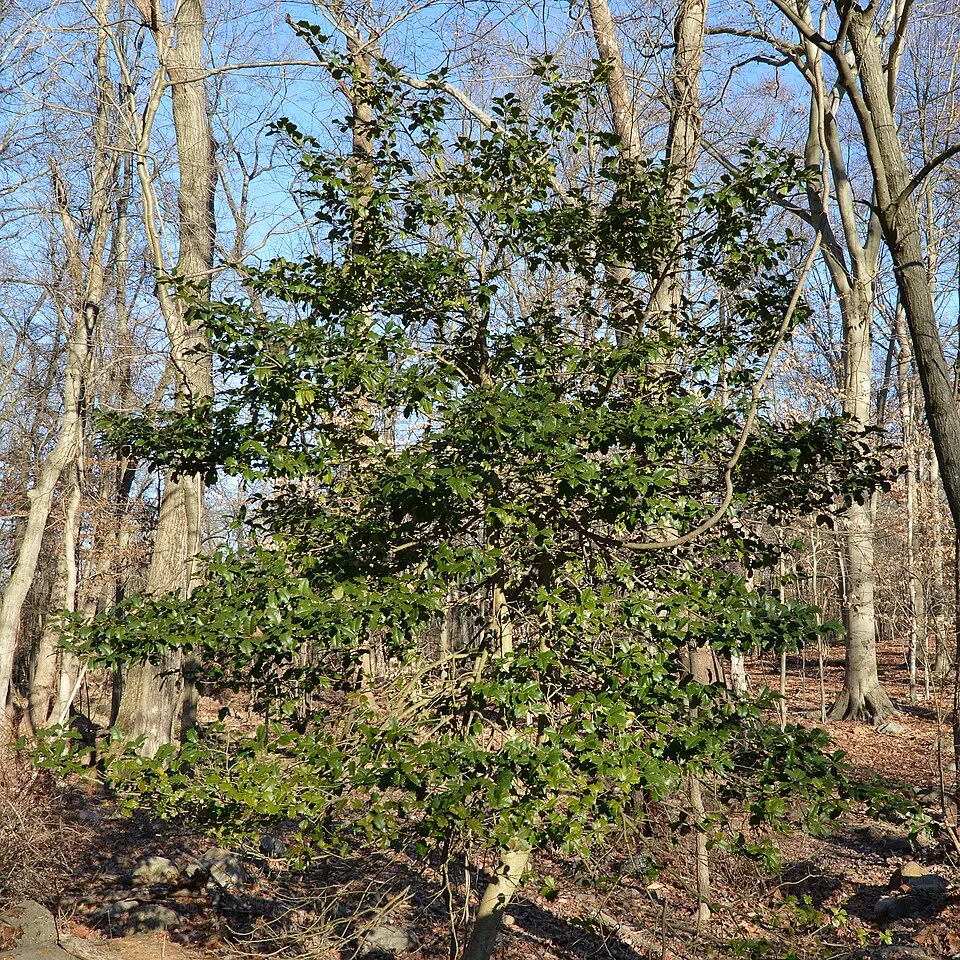
- American holly naturally develops a strong central leader; do not
"round-over" the top as you would a boxwood — let it keep its
pyramidal form and thin selectively from the interior to improve air
circulation.
- Remove crossing, damaged, or rubbing branches; lower
limbs can be removed to expose the attractive smooth gray trunk as the
tree ages.
- To encourage denser hedging, pinch back new growth by 1/3 in early
summer before the terminal bud hardens.
- Rejuvenation pruning by cutting back hard to main scaffold branches is
tolerated but slow to recover (2–3 years to re-fill).
Pests & diseases
- Holly leaf miner (Phytomyza ilicicola) — cosmetic
serpentine mines; tolerable. Systemic insecticide only if severe.
- Scale insects — holly pit scale, tea scale,
cottony cushion scale. Horticultural oil in dormant season; systemic
imidacloprid for persistent infestations.
- Spider mites — can build up on stressed trees in
hot, dry summers. Mitigate with horticultural oil or insecticidal soap;
maintaining good soil moisture and mulching reduces outbreaks.
- Tar spot, leaf spot, powdery mildew — occasional
fungal foliar diseases in humid summers. Fungicidal maintenance rarely
warranted.
- Canker diseases (Botryosphaeria, Nectria)
— the most serious threat, causing twig and branch dieback.
Prune infected wood back to healthy tissue; disinfect tools between
cuts. Avoid drought-stress and mechanical wounding.
- Phytophthora root rot — lethal in wet, poorly
drained soils. Prevention through correct siting is the only
management.
Selected cultivars
| Cultivar | Sex | Distinguishing feature | Notes for Tulsa |
|---|
| 'Jersey Princess' | female | Heavy, uniform fruit set; dark green foliage | One of the most reliable fruiters in the mid-South; OSU-recommended |
| 'Jersey Knight' | male | Vigorous pollinator; blooms in sync with 'Jersey Princess' | The default pollinator partner for many female cultivars |
| 'Greenleaf' | female | Large, lustrous dark-green leaves; abundant red berries | One of the most cold-hardy; excellent for zone 6b Oklahoma |
| 'Dan Fenton' | female | Compact, dense habit; heavy fruiting | Good for smaller Tulsa lots; maxes around 15–20 ft |
| 'Satyr Hill' | female | Large olive-green leaves; abundant large red berries | National champion-quality foliage; widely available |
| 'Miss Helen' | female | Abundant scarlet berries; compact columnar form | Excellent vertical accent for narrow spaces |
| 'Canary' | female | Yellow fruit instead of red | Striking contrast; fruit color unique among hollies in the trade |
| 'Stewards Silver Crown' | female | Variegated cream edges on leaves | Ornamental foliage; less fruit than green-leaf cultivars |
| 'Southern Gentlemen' | male | Reliable pollinator; blooms synchronously with many females | Good counterpart to 'Satyr Hill' and 'Greenleaf' flowering windows |
| Wild seedling (mixed) | varies | Variable habit & fruit; unpredictable | Cheapest option; buy 5+ for a mixed group including a male pollinator |
Propagation
Seed requires warm stratification (60–80°F for
60–90 days), then cold stratification (36–40°F for
60–90 days) and may take 16–36 months to germinate.
Cultivars are propagated by semi-hardwood cuttings taken in
August–September, treated with 8,000–10,000 ppm IBA, and
rooted under mist. Grafting onto seedling rootstock can accelerate production
but also transmits root-disease vulnerabilities.