// SPECIES PROFILE · GRASS · RHIZOMATOUS WETLAND RUSH · EROSION CONTROL
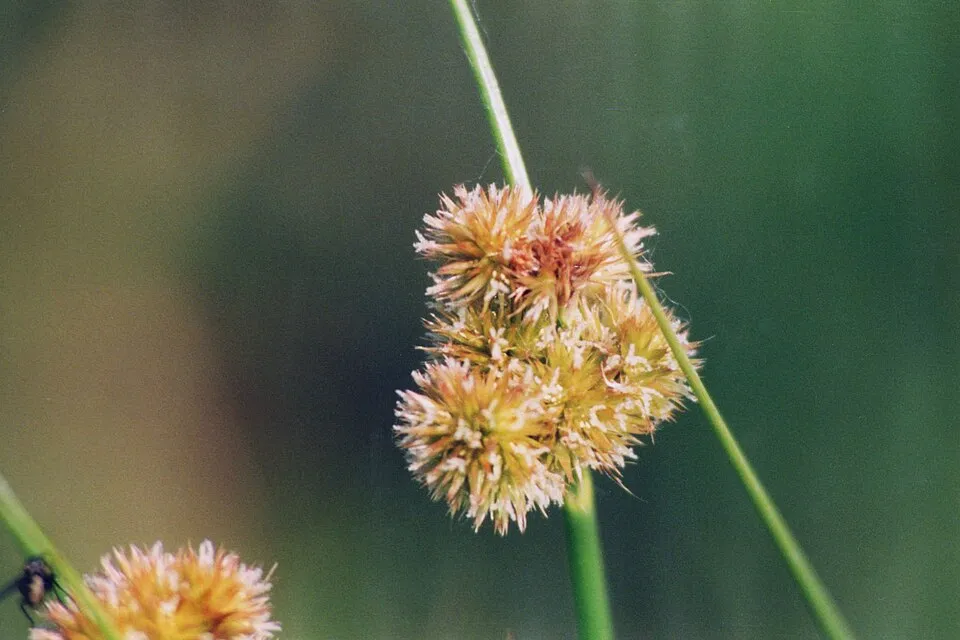
Torrey's Rush is a colony-forming, rhizomatous wetland rush that spreads aggressively by underground stems to knit wet soils into an erosion-resistant mat. Standing 1–2 feet tall, it is shorter and more colonial than its clumping cousin Common Rush (Juncus effusus), and its most recognizable feature is a dense cluster of round, spiky, brownish-tan seed heads — bristly globes roughly the size of a marble, held above the narrow foliage like miniature pom-poms. In NE Oklahoma, Juncus torreyi is a signature plant of wet prairies, pond margins, and intermittently flooded basins across the tallgrass prairie region and the alluvial lowlands of Green Country. It is named for John Torrey (1796–1873), the preeminent 19th-century American botanist who described over 1,700 plant species.

[ field key — rhizome · stem · leaf · glomerule · capsule · look-alikes ]
Colony-forming perennial spreading aggressively via thick, elongate, white-fleshed rhizomes that run horizontally just below the soil surface, sending up erect shoots at intervals. A single plant can produce a patch several feet across in two growing seasons and cover tens of square feet in three to four years. Unlike the tight, discrete tussocks of Common Rush, Torrey's Rush forms a diffuse, interconnected network of stems — each shoot arises individually from the rhizome rather than from a central clump. This rhizomatous architecture is what makes it superb for soil stabilization.
Stems are slender, erect, cylindrical, 1–2 ft tall, smooth, green, and hollow with transverse internal septae (cross-partitions) — a key difference from the continuously pith-filled stems of J. effusus. Each stem bears 1–3 true leaf blades (not just basal sheaths), which are narrow, cylindrical (terete), and similar in appearance to the stem but shorter. The leaf sheaths at the base are loose and membranous with small, rounded auricles at the top.
The inflorescence is a dense, terminal cluster of 1–15 spherical heads (glomerules), each 10–15 mm in diameter. Each glomerule is composed of many individual flowers packed tightly together into a bristly, spiky-looking ball — the effect comes from the long, stiff, pointed tepals (perianth parts) that extend well beyond the capsule. The overall cluster at the top of the stem resembles a cluster of small brown pom-poms or the spiky head of a teasel in miniature. Flowers are greenish-brown, opening June through September. The glomerules persist on the plant well into winter.
The fruit is a narrowly lance-shaped, three-sided capsule 4–5 mm long, with a long, slender beak at the tip. Each capsule contains numerous tiny, dust-like seeds typical of the genus. When capsules split, seeds are dispersed by wind, surface water flow, and attachment to the feathers and feet of waterfowl. The empty glomerules remain attached to the dried stems through winter, adding textural interest to the dormant landscape.
Juncus torreyi is a plant of the Great Plains and interior lowlands, ranging from southern Manitoba and Ontario south through the Dakotas, Nebraska, and Kansas, through all of Oklahoma into Texas, with disjunct populations eastward into the Ohio Valley and Appalachians. In Oklahoma it is most abundant in the central and eastern portions of the state, where remnant tallgrass prairie meets the oak woodlands of the Cross Timbers.
In NE Oklahoma, Torrey's Rush occupies a specific hydrologic niche: wet prairies, low spots in hay meadows, the drawdown zones of farm ponds, and the seasonally flooded margins of creeks and rivers. It is a characteristic species of the intermittently flooded basins and swales of the Cherokee Prairie, where soils alternate between saturated in spring and bone-dry in late summer. The species is notably common along the Caney and Bird Creek watersheds and in the alluvial flats of the Verdigris River bottomlands. In the Tallgrass Prairie Preserve (Osage County), it forms extensive colonies in bison wallows and wet depressions that hold rainwater into June.
[ soil stabilization · waterfowl food · amphibian habitat · skipper host ]
The primary ecological value of Juncus torreyi in the landscape is soil stabilization. The dense network of rhizomes running through the upper soil profile binds saturated, erosion-prone soils at pond edges, streambanks, and drainage channels. When planted on eroding shorelines, the rhizomes form a living geotextile that resists undercutting by wave action and flowing water. Research on riparian buffer strips shows that dense rush colonies can reduce bank erosion rates by 40–70% compared to unvegetated soil. After flood events, rush colonies trap and hold sediment, slowly rebuilding lost soil.
The seeds of J. torreyi are consumed by dabbling ducks (mallard, blue-winged teal, northern shoveler) that forage in shallow water along pond and marsh edges. Swamp sparrows, song sparrows, and red-winged blackbirds eat seeds from standing stems. Dense, spreading colonies provide nesting cover for marsh wrens, common yellowthroats, and sedge wrens. Amphibians including the plains leopard frog (Lithobates blairi) and the small-mouthed salamander (Ambystoma texanum) use rush colonies as daytime refuge and overwintering habitat.
Like other Juncus species, Torrey's Rush serves as a larval host for sedge skippers (Hesperiinae), including the two-spotted skipper (Euphyes bimacula) and the dun skipper (Euphyes vestris), both of which occur in eastern Oklahoma. The rush-feeding common roadside skipper (Amblyscirtes vialis) may also use this species. The dense, low foliage shelters ground beetles, wolf spiders, and other predatory arthropods that control pest insect populations in adjacent garden and agricultural areas.
In wet prairie and pond-edge settings, Juncus torreyi contributes to evapotranspiration-driven water level regulation — dense stands pump significant volumes of soil water into the atmosphere through their leaves and stems, drying saturated soils during wet periods. This moderates the extreme wet-dry cycles of temporarily flooded basins and helps maintain the characteristic hydrology of wet-mesic prairie plant communities. The stands also slow overland flow during rain events, increasing infiltration and reducing downstream flooding.
[ siting · rhizome management · division · landscape uses · limitations ]
Torrey's Rush requires full sun and consistently moist to wet soil to thrive and spread. In the Tulsa region, plant in the drawdown zone of ponds, the saturated margins of drainage swales, and in the bottom of rain gardens where water pools after storms. This species is well-adapted to intermittently flooded basins — it tolerates standing water for weeks followed by gradual drying, a common pattern in NE Oklahoma's clay-bottomed wet spots. Plant plugs or rhizome divisions 18–24 inches apart in spring or early fall.
This is an aggressive spreader. In small garden settings, Torrey's Rush will colonize every available square inch of moist soil unless constrained. Manage spread by edging with a deep root barrier (12–18 inches minimum depth, protruding 2–3 inches above soil to block rhizomes), planting in a contained basin where dry ground naturally limits expansion, or physically removing rhizomes at the perimeter once annually in spring. For large properties, ponds, and restoration sites, the spreading tendency is an asset rather than a problem.
Best deployed in ecological restoration and functional landscapes where its spreading habit is an advantage:
Named for John Torrey, the prolific 19th-century American botanist who mentored Asa Gray and co-authored Flora of North America, this rush carries the legacy of the first systematic botanical exploration of the Great Plains. Torrey described this species from specimens collected during the U.S. Exploring Expedition and early surveys of the American interior. While Juncus torreyi lacks the extensive basketry and craft applications of its larger cousin J. effusus, the tough, cylindrical stems have been used for makeshift cordage and binding material by rural communities across the Plains.
The species' most significant human value lies in restoration ecology: it is among the most reliable native plants for repairing eroded pond banks, stabilizing drainage channels, and restoring wet prairie vegetation after agricultural abandonment. The rapid rhizomatous spread that makes it a nuisance in gardens is precisely the trait that makes it invaluable on degraded sites where speed of soil cover is the priority.
Hero photo: Rooted Revival. Strip photos courtesy of Wikimedia Commons contributors under their respective licenses (linked under each image).