home/ plants/ spotted-beebalm

// SPECIES PROFILE · PERENNIAL · NATIVE · BEE MAGNET · DROUGHT-HARDY

Spotted Beebalm

Monarda punctata

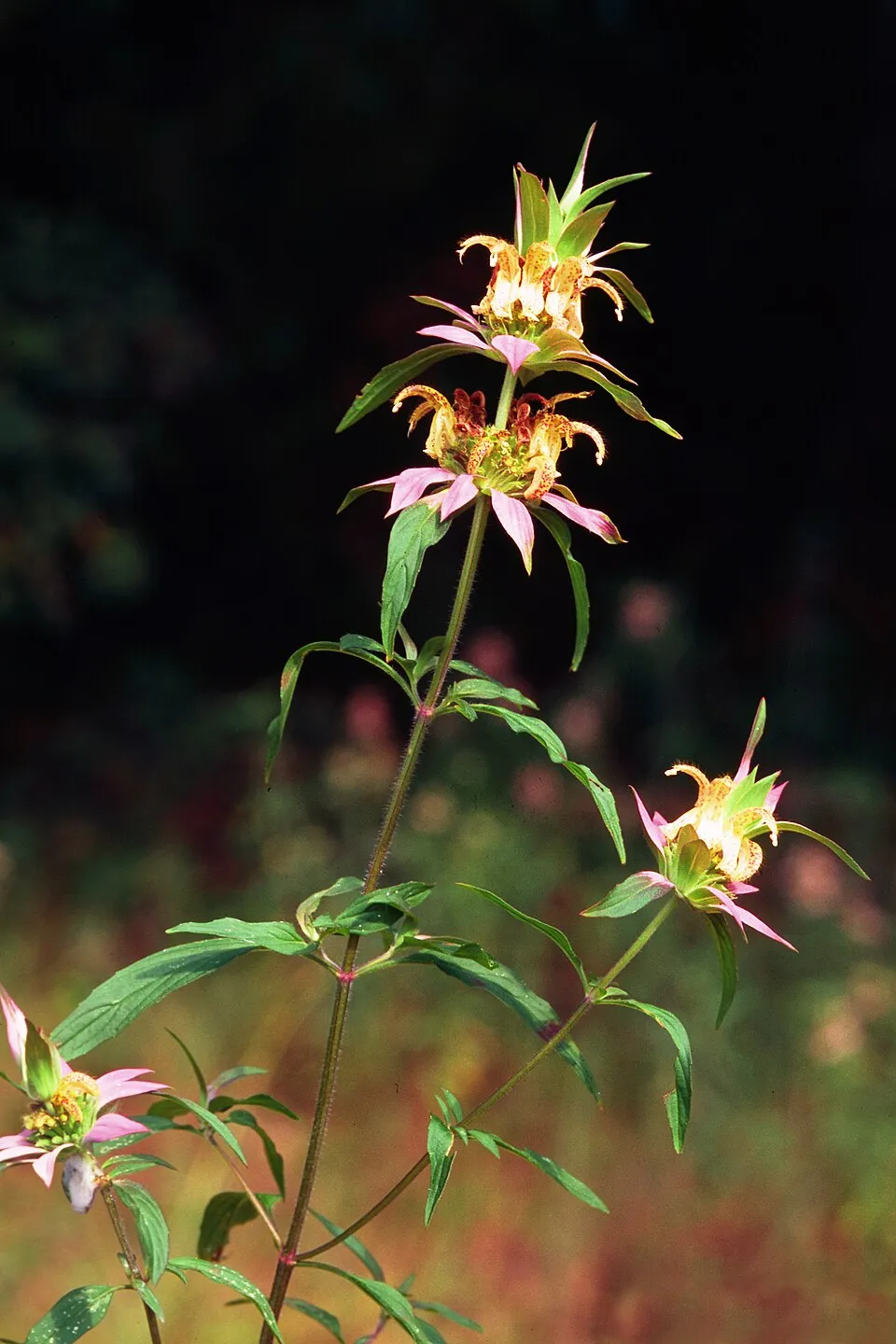
Spotted Beebalm is the most architecturally distinctive of the eastern North American mints — a perennial 1–3 ft tall with whorled tiers of tubular yellow flowers spotted with purple, each whorl subtended by a collar of showy pink to lavender-rose bracts that persist long after the flowers fade, giving the plant the appearance of a multi-tiered pagoda. The effect is so unusual and striking that even non-gardeners stop to ask what it is. This is not the familiar, shade-grown garden beebalm (Monarda fistulosa, wild bergamot) — this is a plant of dry, sandy, harsh soils and full sun, perfectly adapted to the sandstone and sandy-loam soils of the Cross Timbers and the sandy Tallgrass Prairie remnants of NE Oklahoma. Extremely attractive to bumblebees, native bees, and beneficial wasps, and more compact, more drought-tolerant, and more mildew-resistant than other Monarda species, it is the beebalm for tough, unirrigated sites.

// QUICK FACTS
Family
Lamiaceae (mint family)
Life cycle
Herbaceous perennial (sometimes short-lived; behaves as a biennial in some conditions)
Native range
Eastern and central North America — Vermont to Florida, west to New Mexico and Wisconsin; throughout OK
USDA hardiness
Zones 3–9 (Tulsa = 7a/7b)
Mature size
1–3 ft tall, 1–1.5 ft wide
Bloom
June – September (NE OK); staggered bloom over extended period
Flower color
Tubular yellow flowers with purple spots; pink to lavender-rose bracts
Sun
Full sun (6+ hrs); will not flower well in shade
Soil
Dry, sandy, well-drained; tolerates poor, thin soils; does not tolerate heavy wet clay
Water
Dry to very dry; extremely drought-tolerant; overwatering causes rot
Wildlife
Exceptional bumblebee and native bee magnet · beneficial wasps · occasional butterfly nectar
Conservation
Secure globally (G5); common and locally abundant in Cross Timbers and sandy prairies
Spotted Beebalm (Monarda punctata) with tiered whorls of yellow purple-spotted flowers and pink bracts
Monarda punctata in mid-summer bloom — the pagoda-like whorls of yellow spotted flowers and showy pink bracts make this the most architecturally distinctive mint in eastern North America. Photo: Rooted Revival.

Identification

[ field key — habit · leaf · inflorescence structure · bracts · distinguishing from other Monarda ]

Habit & Stem

An erect, somewhat shrubby perennial 1–3 ft tall, often with multiple branching stems from a woody base. Stems are square (4-angled) — the mint family hallmark — and covered in fine, short hairs. The plant has a stiff, upright, somewhat candelabra-like form with branches, each terminating in the characteristic whorled inflorescence. In sandy, dry soils in NE Oklahoma, plants tend toward the shorter end of the range (1–2 ft); in richer garden soils, they may reach 3 ft and become somewhat lax. The plant is strongly aromatic — crush a leaf and the scent is a complex blend of mint, oregano, and thyme.

Leaves

Leaves are opposite, lanceolate to narrowly oblong, 1–3 in long and 1/4–3/4 in wide, with shallowly toothed to nearly entire margins and a short petiole (or sessile near the top of the stem). The leaf surface is grayish-green and softly pubescent on both surfaces, giving the foliage a slightly silvery or velvety cast. The leaves are aromatic, releasing volatile oils that contain thymol, carvacrol, and other phenolic monoterpenes — the same compounds found in oregano and thyme, to which Monarda is chemically related. The foliage is somewhat sparse, giving the plant an open, airy architecture that allows it to thrive in high-light, low-humidity conditions without developing powdery mildew.

Inflorescence: Tiered Whorls & Bracts

The inflorescence is what makes Monarda punctata unlike any other mint. The flowers are arranged in dense, spherical verticillasters (whorls) stacked in 2–5 tiers along the upper stem, each tier separated by a length of bare stem, creating the plant's distinctive pagoda or candelabra structure. Each whorl is subtended by a collar of large, showy bracts that are pink, lavender-pink, or rose-purple, often tinged with green at the base, and slightly reflexed (bent downward) at the tips. The bracts are the primary ornamental feature — they develop color before the flowers open and persist for weeks after the flowers fade, extending the plant's display period to two months or more. The effect is like a series of small, pink, leafy explosions suspended at intervals along the stem.

Flowers

The individual flowers emerge from within the bract collar and are tubular, two-lipped (bilabiate), 1/2–3/4 in long. The corolla is pale yellow to cream-yellow with conspicuous purple-brown spots on the lower lip — the "punctata" (spotted) of the scientific name. The upper lip is narrow and arched over the stamens; the lower lip is broader and three-lobed. The flowers open progressively from the bottom whorl upward over a period of several weeks. Individual flowers last only a few days, but each whorl produces new flowers continuously. The stamens and style extend beyond the upper lip, contacting the back of visiting bees as they probe for nectar. The flowers have a faint, sweet fragrance distinct from the foliage.

Fruit & Seed

Each pollinated flower produces four small nutlets (typical of the Lamiaceae). The nutlets are tiny, brown, and smooth, released as the calyx dries and splits in late fall. The plant self-seeds freely and reliably in sandy, disturbed soils — a trait that makes it useful for colonizing difficult sites. In a garden setting, seedlings are easily removed or transplanted in spring. The dried calyx whorls with their bracts persist on the stem through winter and are attractive in dried arrangements and as winter garden structure.

Distinguishing from Other Monarda Species

Monarda punctata is unmistakable in the Oklahoma flora due to its tiered whorls of yellow spotted flowers with pink bracts. No other Monarda species in the region has this structure. Monarda fistulosa (wild bergamot) has a single terminal head of lavender-pink flowers with a whorl of lavender bracts beneath — no stacked tiers. Monarda citriodora (lemon beebalm) is an annual with stacked pink-to-lavender flower whorls but the flowers are pink-purple (not yellow with spots) and the plant has a strong lemon scent. Monarda didyma (scarlet beebalm) is a red-flowered species native to the Appalachian Mountains but widely cultivated; it requires moist, rich soil and is prone to powdery mildew in Oklahoma's humidity.

Habitat & Range in NE Oklahoma

Monarda punctata has one of the widest ranges of any eastern North American mint, occurring from Vermont and New York south to Florida, and west to New Mexico, Wisconsin, and the Great Plains. It is common throughout Oklahoma, including the western part of the state, and is one of the characteristic wildflowers of the Cross Timbers and Tallgrass Prairie. In NE Oklahoma it is found in sandy prairies, dry open woods, prairie edges, roadsides in sandy soil, old fields, and the openings and margins of the Cross Timbers post-oak and blackjack-oak woodlands.

This species is a specialist of dry, sandy, and well-drained soils. In the Tulsa region, look for it in sandy prairie remnants (particularly those with a history of fire), along sandstone outcrops and rocky glades in the Cross Timbers, and in the sandy-loam soils of the Arkansas River terraces. It often grows alongside little bluestem, sideoats grama, butterfly milkweed, purple prairie clover, and Indian blanket. It is rare or absent on heavy clay soils and in bottomlands — if you see spotted beebalm, you are almost certainly standing on sandy or rocky, well-drained ground.

Ecology & Wildlife Value

[ bumblebee and native bee specialist · beneficial wasps · mint chemistry · sand prairie ecology ]

Bumblebee & Native Bee Magnet

The flowers of Monarda punctata are exceptionally attractive to bees, particularly bumblebees which are the primary and most effective pollinators. The tubular corolla holds nectar at its base, accessible only to long-tongued bees that can reach deep into the tube. The visiting fauna includes: bumblebees (Bombus pensylvanicus, B. impatiens, B. griseocollis, B. fervidus), large carpenter bees (Xylocopa virginica), Anthophora bees, long-horned bees (Melissodes), leafcutter bees (Megachile), and numerous sweat bees (Agapostemon, Lasioglossum). Monarda-specialist bees include several Anthophora and Melissodes species that rely heavily on Monarda pollen. The plant's extended bloom period (June–September) means it provides a consistent nectar resource through the entire summer.

Beneficial Wasps

Like other Monarda species, M. punctata attracts beneficial predatory and parasitoid wasps that consume nectar as adults while hunting pest insects for their larvae. Regular visitors include thread-waisted wasps (Ammophila, Eremnophila), potter wasps (Eumeninae), paper wasps (Polistes), and parasitoid wasps (Ichneumonidae, Braconidae). Planting spotted beebalm near vegetable gardens and fruit trees effectively recruits a biological control workforce that patrols for caterpillars, beetle larvae, and other crop pests.

Butterfly & Moth Visitors

The deep, narrow corolla tube limits nectar access for many short-tongued insects, but large butterflies with long proboscises can reach the nectar. Visitors include eastern tiger swallowtails, black swallowtails, spicebush swallowtails, and monarchs. The plant is a larval host for several moth species, including the hermit sphinx moth (Lintneria eremitus) and the orange mint moth (Pyrausta orphisalis), whose caterpillars feed on Monarda foliage.

Chemical Ecology & Herbivore Defense

The aromatic oils in Monarda punctata — primarily thymol, carvacrol, p-cymene, and limonene — function as a broad-spectrum chemical defense against herbivores, pathogens, and competing plants. These phenolic compounds are antimicrobial, antifungal, and insect-deterrent, which explains why M. punctata is one of the most pest- and disease-resistant native plants in the garden. It almost never develops powdery mildew (the bane of M. didyma and many M. fistulosa cultivars), is rarely browsed by deer or rabbits, and has few insect pests. The thymol in its tissues is the same compound that gives thyme its preservative and antimicrobial properties — effectively, the plant is self-sterilizing.

The beebalm for dry ground: Where wild bergamot (M. fistulosa) needs decent soil and moderate moisture, and scarlet beebalm (M. didyma) demands rich, moist conditions and still gets mildew, spotted beebalm thrives on neglect. If you have a dry, sandy, sun-blasted hell strip that kills everything else, this is your plant.

Horticulture & Care

[ site · soil · drought tolerance · short-lived perennial management · companion xeric plants ]

Site Selection & Soil

Monarda punctata demands full sun and excellent drainage. It is the perfect plant for sandy, gravelly, or rocky soils — the same conditions that kill most garden perennials. It will grow in poorer soil than almost any other native mint, including thin soils over sandstone, decomposed granite, or limestone gravel. Do not plant it in heavy clay or anywhere that stays wet after rain — root rot is the one thing that reliably kills it. A south-facing slope, a raised bed filled with sandy loam, a rock garden, or a neglected strip between a sidewalk and the street are all ideal.

Managing as a Short-Lived Perennial

Monarda punctata is often short-lived in the garden, behaving as a biennial or short-lived perennial that may persist 2–4 years from an individual plant. It compensates for this by self-seeding prolifically in suitable conditions. To maintain a permanent planting:

Companion Planting for Dry, Sandy Gardens

In a dry prairie or sand garden, combine spotted beebalm with butterfly milkweed, purple prairie clover, little bluestem, prairie dropseed, sideoats grama, pale purple coneflower, leadplant, wild indigo, Indian blanket, lance-leaf coreopsis, and Mexican hat. The pink bracts and yellow flowers of spotted beebalm work with the oranges, purples, and yellows of the dry prairie palette. In a Cross Timbers woodland edge, plant beneath post oak and blackjack oak with fragrant sumac and coralberry.

Dried flower use: The tiered whorls of spotted beebalm are excellent for dried flower arrangements. Cut stems when the bracts are fully colored and the flowers are at peak bloom, hang upside-down in a dark, dry place, and the bracts will retain their pink color for months.

Photo Reference

Tiered whorls of Monarda punctata with yellow spotted flowers and pink bracts
// Inflorescence — stacked whorls of yellow flowers with purple spots, pink bracts
Wikimedia Commons
Wikimedia Commons
Close-up of individual Monarda punctata flower showing yellow corolla with purple spots
// Individual flower — yellow tubular corolla with purple-brown spots on lower lip
Wikimedia Commons
Wikimedia Commons
Bumblebee foraging on Monarda punctata flower whorl
// Bombus sp. on spotted beebalm — bumblebees are the primary pollinators
Wikimedia Commons
Wikimedia Commons
Mature Monarda punctata plant in a sandy prairie setting
// Habit — 1–3 ft, candelabra-like branching in a Cross Timbers sandy opening
Wikimedia Commons
Wikimedia Commons
Dried seed heads of Monarda punctata persisting on stems in winter
// Seed heads — persistent dried whorls for winter garden structure
Wikimedia Commons
Wikimedia Commons

Sources & Further Reading

  • USDA NRCS PLANTS Database — Monarda punctata: plants.usda.gov/plant-profile/MOPU
  • Lady Bird Johnson Wildflower Center — Native Plant Database: wildflower.org — MOPU
  • Missouri Botanical Garden — Monarda punctata Plant Finder: missouribotanicalgarden.org
  • Oklahoma Biological Survey — Monarda punctata county-level distribution: biosurvey.ou.edu
  • Gleason, H.A. & Cronquist, A. (1991). Manual of Vascular Plants, 2nd ed. New York Botanical Garden.
  • Burdock, G.A. (2010). Fenaroli's Handbook of Flavor Ingredients, 6th ed. CRC Press — monograph on thymol and related Monarda essential oil constituents.
  • Wikipedia — Monarda punctata: en.wikipedia.org/wiki/Monarda_punctata (CC BY-SA 4.0; portions of the description and ecology sections summarize Wikipedia content).
  • Robinson, G.S. et al. (2010). HOSTS — A Database of the World's Lepidopteran Hostplants. Natural History Museum, London (records for Monarda as host).

Hero photo: Rooted Revival. Strip photos courtesy of Wikimedia Commons contributors under their respective licenses (linked under each image).