// SPECIES PROFILE · PERENNIAL · NATIVE · NITROGEN-FIXER
Roundhead Lespedeza is the late-summer legume that quail hunters know by name. It is an upright, stiff-stemmed perennial with silvery-green, three-parted leaves and dense, button-like clusters of small cream-to-greenish flowers that appear when most of the prairie has already passed its bloom peak — August into September in the Tulsa region. Lespedeza capitata is a nitrogen-fixing member of the Fabaceae and one of the most ecologically valuable native legumes in the Cross Timbers and tallgrass prairie: its seeds are highly prized by northern bobwhite quail, wild turkey, and a suite of grassland songbirds, and it is frequently cited as an indicator species for quality quail habitat. It is also fire-adapted and responds vigorously to periodic burning, making it an essential component of managed prairie restorations where prescribed fire is part of the long-term maintenance plan.

[ field key — habit · leaf · flower · fruit · special features ]
Upright, stiff-stemmed perennial with one to several unbranched or sparsely branched stems arising from a woody crown. Stems are stout, ridged, and densely covered with appressed silvery hairs that give the plant a distinctive frosted or silvery-gray appearance even from a distance. The overall silhouette is robust and vertical — a single stem topped with dense, rounded flower clusters at the upper leaf axils and terminal tip. Plants die back to the crown each winter and re-sprout in late spring, typically reaching full height by mid to late summer.
Alternate, trifoliate (three-parted), the classic clover-like leaf arrangement shared by many legumes. Leaflets are oblong to elliptical, 1–2.5 in long, with entire margins and a small bristle at the tip. Both surfaces are covered with dense, silky, silvery-white hairs (sericeous), which reflect light and give the plant its characteristic pale, silvery-green cast. The leaflets are proportionally narrower and longer than those of most other prairie Lespedeza species, which helps distinguish it in the field. The stipules at the leaf base are small, brown, and papery.
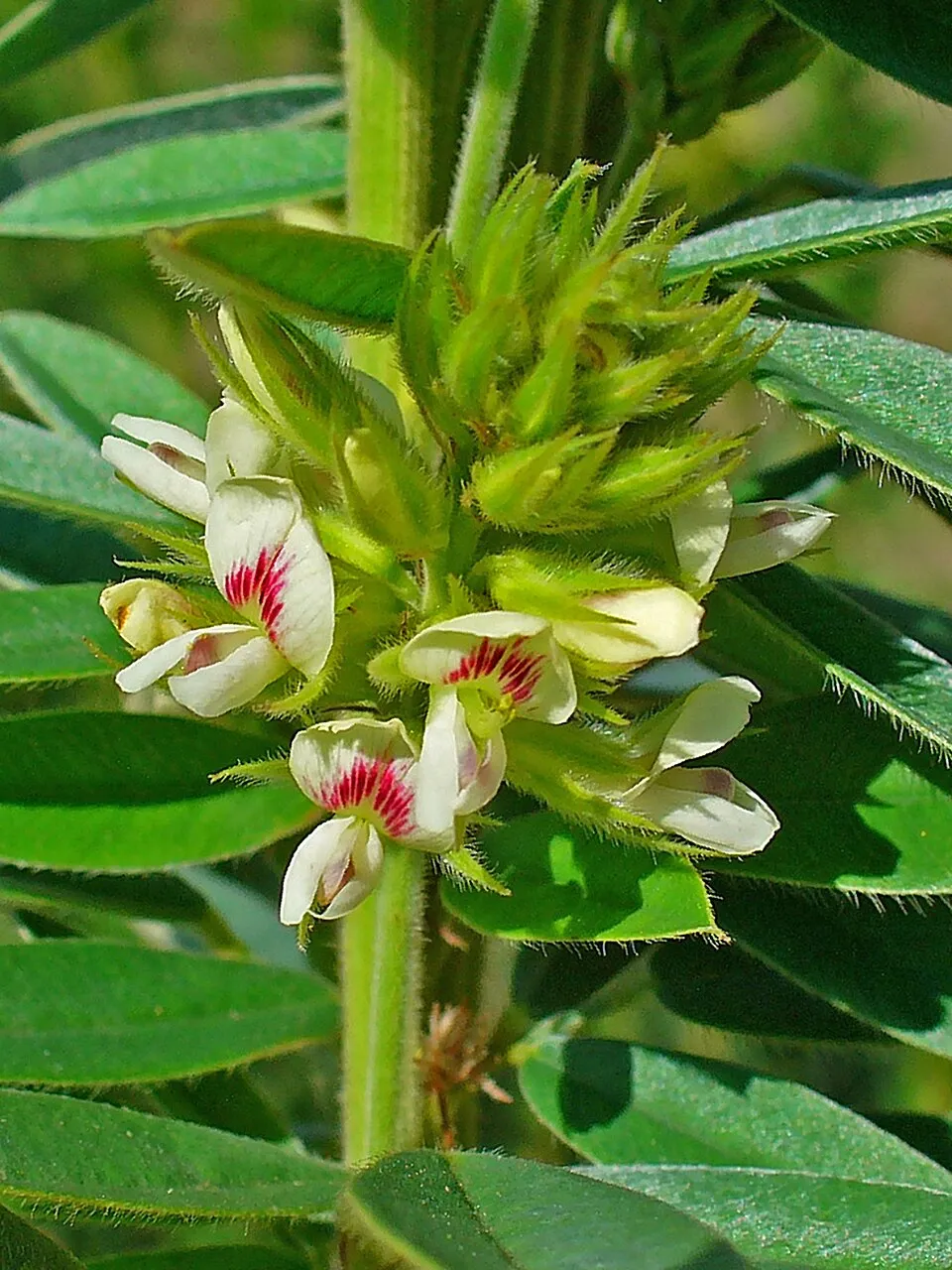
Flowers are borne in dense, globose to short-cylindrical clusters (heads) about ½–1 in in diameter at the upper leaf axils and stem tips. Each individual flower is small (¼–⅓ in), creamy-white to greenish-white, occasionally with a faint purple spot at the tip of the keel petal. The typical pea-flower shape is subtle — the flowers are far less showy than those of Baptisia or Dalea — and from a distance, the clusters read as fuzzy, pale spheres rather than floral displays. Lespedeza species produce two types of flowers: the visible chasmogamous flowers (opening for cross-pollination) and small, hidden cleistogamous flowers that self-pollinate without opening, ensuring seed production even when pollinator visits are scarce.
Fruits are small, flat, one-seeded, indehiscent pods (legumes) about ¼ in long, enclosed within the persistent dried calyx. The pod surface is finely hairy and net-veined. The seeds are olive-brown to dark brown, hard-coated, and highly nutritious, containing 16–20% crude protein. The species epithet capitata ("having a head") refers to the dense, rounded flower clusters. The plant's silvery-hairy stems and leaves are the most reliable field character — no other common prairie Lespedeza in NE Oklahoma is as conspicuously silver-haired as L. capitata.
Lespedeza capitata ranges across the eastern and central United States, from the Atlantic seaboard west to the Great Plains, south to Florida and Texas, and north into the Great Lakes states. In Oklahoma, it is found throughout the state but is concentrated in the eastern tallgrass prairie, Cross Timbers, and Ozark border regions. In NE Oklahoma, it is a plant of dry prairies, open post-oak-blackjack oak savannahs, sandy old fields, and the grassy openings within oak-hickory woodlands. It is notably common on the well-drained, sandy loam soils derived from sandstone in the Cross Timbers and on the deep sandy alluvium of the Arkansas River's ancestral terraces.
In the Tulsa region, Roundhead Lespedeza can be found in prairie hay meadows of Osage and Rogers counties, in the sandstone barrens and grassy openings of the Cross Timbers northwest of town, on dry roadsides and railroad rights-of-way, and in the managed prairie plantings of the Tallgrass Prairie Preserve and Oologah Wildlife Management Area. It is frequently associated with warm-season grasses including little bluestem, big bluestem, indiangrass, and sideoats grama, and with a diverse community of mid-to-late-season prairie forbs. It is less common on the heavy, poorly-drained clay soils of the immediate Tulsa metropolitan area.
[ nitrogen fixation · fire ecology · pollinators · wildlife food web ]
L. capitata is a nitrogen-fixing legume, forming root nodules with compatible rhizobia and contributing fixed nitrogen to the typically nitrogen-limited prairie soil. The plant's deep, fibrous root system also provides a modest amount of erosion control on sandy, drought-prone sites. In the tallgrass prairie nitrogen economy, Lespedeza operates at a smaller scale than the larger legumes (Baptisia, Amorpha) but makes a meaningful contribution to the patchy mosaic of soil fertility across the prairie landscape.
Roundhead Lespedeza is strongly fire-adapted. Periodic prescribed burns (every 2–4 years) or natural wildfires top-kill the above-ground stems but stimulate vigorous re-sprouting from the perennial crown. Fire also scarifies seeds in the soil seed bank, improving germination rates. Populations in regularly-burned native prairie remnants consistently show higher stem density and greater seed production than those in unburned sites where woody encroachment and thatch buildup suppress the species. This fire-dependence is one reason L. capitata is considered an indicator of well-managed, high-quality prairie.
Though the flowers are modest, they are a valuable late-season nectar and pollen source when many prairie plants have finished blooming. The primary visitors are bumblebees (Bombus pensylvanicus, B. impatiens, B. griseocollis) and leafcutter bees (Megachile spp.), which are strong enough to manipulate the small pea flowers. Sweat bees (Lasioglossum, Agapostemon) and small carpenter bees (Ceratina) also visit. The combination of chasmogamous and cleistogamous flowers ensures seed set regardless of pollinator availability — a bet-hedging reproductive strategy common in the genus.
The seeds of Roundhead Lespedeza are one of the most important fall and winter foods for northern bobwhite quail across the central and eastern US, including NE Oklahoma. The seeds are high in protein and energy, persist on the plant into winter, and are accessible to ground-feeding birds even in snowy conditions. Wild turkey, mourning doves, and several sparrow species (field, song, and white-throated sparrows) also consume the seeds. White-tailed deer and cottontail rabbits browse the protein-rich foliage, particularly in late summer when other herbaceous browse quality declines. The seeds and foliage are also consumed by small mammals including deer mice and hispid cotton rats.
[ site selection · establishment · care · companion planting ]
Roundhead Lespedeza is a sun-loving plant of dry, lean, well-drained soils. It does not want rich garden loam, supplemental irrigation, or fertilizer — give it a sunny spot with sandy or gravelly soil and it will thrive with essentially no input. Heavy clay soils are acceptable only if the site is well-drained (on a slope or mound); winter-saturated heavy clay will rot the crown. Full sun produces the most robust, upright growth; light shade from scattered oaks is tolerated but plants will be more open and may lean.
Prescribed fire (every 2–4 years in late winter or early spring) is the ideal management tool for maintaining vigorous Roundhead Lespedeza populations in larger prairie plantings. Fire removes thatch, releases nutrients, and scarifies soil-stored seed while stimulating re-sprouting from the perennial crown. Where fire is not practical, an annual late-winter mowing (leaving clippings in place) provides a reasonable substitute. Do not fertilize — added nitrogen suppresses nodulation and encourages competition from aggressive non-legume forbs and grasses. The plant has no significant pests or diseases in NE Oklahoma gardens, and its stiff, hairy stems are relatively resistant to deer browse compared to other prairie forbs.
In a dry prairie or Cross Timbers savannah planting, Roundhead Lespedeza pairs with warm-season grasses including little bluestem, sideoats grama, and prairie dropseed. For a forb-rich community, combine with late-season bloomers including stiff goldenrod, showy goldenrod, aromatic aster, Maximilian sunflower, and the related rough blazing star. For quail habitat plantings, include partridge pea, Illinois bundleflower, and purple prairie clover for a diverse, multi-species protein resource. The silvery foliage of L. capitata provides excellent textural contrast against the greens of warm-season grasses and the purples and yellows of late-summer prairie wildflowers.
There is a limited ethnobotanical record for Lespedeza capitata. While the seeds are protein-rich and consumed by wildlife, they are too small and require too much processing to have been a significant human food source historically. Some Indigenous peoples of the Eastern Woodlands and Plains are recorded as having used various Lespedeza species for medicinal purposes, including as a tea for treating fevers and stomach ailments, and the tough, fibrous stems were occasionally used in small-scale basketry. The plant's primary contemporary value is its ecological role as a nitrogen-fixing, fire-adapted, and wildlife-supporting component of the prairie ecosystem.
A note on the broader genus: Lespedeza species, particularly L. cuneata (sericea lespedeza), are widely planted as forage and erosion control in the southern US. However, L. cuneata is a highly invasive Asian species that has become a major problem in Oklahoma prairies and should never be planted. Always ensure you are sourcing L. capitata (native Roundhead Lespedeza) and not the invasive sericea lespedeza, which can be distinguished by its wedge-shaped leaflets with a notch at the tip and a prominent silvery midrib.
Hero photo: Rooted Revival. Strip photos courtesy of Wikimedia Commons contributors under their respective licenses (linked under each image).