home/ plants/ rough-blazing-star

// SPECIES PROFILE · PERENNIAL · NATIVE · GLADE + PRAIRIE SPECIALIST

Rough Blazing Star

Liatris aspera

Rough Blazing Star is the drought-proof Liatris that thrives where its showier cousin prairie blazing star (L. pycnostachya) struggles — on the thin, rocky, sun-blasted soils of glades, barrens, and dry prairie ridges. Its rough-hairy stems rise 2–4 ft, bearing dense, button-like heads of vibrant purple flowers arranged along an interrupted spike that is distinctively loose and widely spaced, unlike the dense, bottlebrush spikes of other Liatris species. The flowers open from the top of the spike downward — the reverse of most Liatris, and a reliable field character. Blooming from August through October, Liatris aspera is an essential late-season nectar source for migrating monarch butterflies as they move south through Oklahoma on their journey to Mexico. It also supports an extraordinary diversity of native bees, including several Liatris-specialist species found nowhere else.

// QUICK FACTS
Family
Asteraceae (sunflower / daisy family)
Life cycle
Herbaceous perennial from a corm
Native range
Central and eastern US; Great Plains to the Appalachians, Texas to the Great Lakes; throughout Oklahoma
USDA hardiness
Zones 3–8 (Tulsa = 7a/7b)
Mature size
2–4 ft tall, 1–1.5 ft wide
Bloom
August – October (NE OK); late-season nectar critical for monarch migration
Flower color
Vibrant purple to lavender-pink, in button-like heads
Sun
Full sun
Soil
Dry to mesic, well-drained; sandy, rocky, or gravelly; tolerates poor soil
Water
Low; highly drought-tolerant
Wildlife value
Monarch migration fuel · Liatris-specialist bees · goldfinch seed · butterfly nectar
Conservation
G5 — secure globally; common in dry prairies, glades, and rocky openings of Cross Timbers and Ozark ridges in NE Oklahoma
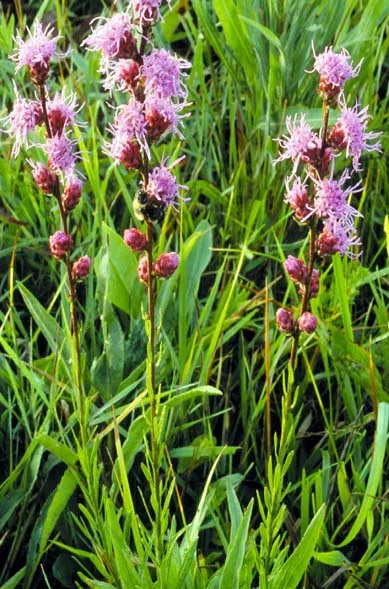
Rough Blazing Star (Liatris aspera) with button-like purple flower heads on an interrupted spike
Liatris aspera in late summer bloom — the widely spaced purple heads and rough-hairy stems distinguish it from all other Liatris. Photo: Rooted Revival.

Identification

[ field key — habit · leaf · flower · fruit · special features ]

Habit & Stem

Upright perennial from a globose, woody corm that sits just below the soil surface. One to several flowering stems arise from each corm. Stems are stout, unbranched, and densely covered with short, stiff hairs (scabrous to hispid) — the roughness is noticeable to the touch and is the source of both the common name ("rough") and the species epithet aspera. The stems are more rigid and less prone to flopping than those of L. pycnostachya, and the overall silhouette is more open and architectural due to the widely spaced flower heads.

Leaves

Alternate, simple, linear to narrowly lance-shaped, with the largest leaves concentrated near the base of the plant and becoming progressively smaller up the stem. Basal leaves are 6–12 in long and ½–1 in wide, rough-hairy on both surfaces, with a prominent midrib. Stem leaves are smaller, reduced to bracts near the inflorescence. The rough texture is a consistent field character — prairie blazing star has smoother, hairier stems and leaves. Foliage turns an attractive golden-brown in fall.

Flowers

The inflorescence is a loose, interrupted spike (not a dense, continuous cylinder) of rounded, button-like heads each about ¾–1 in across, spaced ½–2 in apart along the upper stem. Each head contains 25–40 individual tubular disk florets (no ray florets) of vibrant purple to lavender-pink. The heads are borne on short, stiff stalks and open from the top of the spike downward — the opposite of L. pycnostachya and L. spicata, which bloom bottom-to-top. This top-down blooming pattern is a nearly foolproof field character for L. aspera in the tallgrass region.

Fruit & Special Features

Fruits are small, ribbed achenes (cypselae) topped with a tuft of barbed bristles (pappus) that catch the wind for dispersal. The bristles give the fruiting heads a fuzzy, silver-gray appearance in fall and winter. The corm is edible (roasted) and was used as a food source by Indigenous peoples of the Plains and Eastern Woodlands, though the small size of individual corms limits their practical food value. The dried flower stalks with their architectural button heads are excellent in dried flower arrangements and persist attractively through winter.

Habitat & Range in NE Oklahoma

Liatris aspera has a broad range across the central and eastern US, from the eastern Great Plains through the Midwest to the Appalachians, south to Texas and the Gulf Coast. In NE Oklahoma, it is a plant of dry, open, well-drained sites: sandstone and limestone glades, dry tallgrass prairie remnants, rocky slopes, post-oak savannah openings, and the sunny margins of blackjack-oak woodlands. It is consistently found on thinner, poorer, rockier soils than its relatives — this is the Liatris for the dry end of the moisture gradient.

In the Tulsa region, Rough Blazing Star is common on the sandstone barrens and glades of the Cross Timbers in Osage County, on the limestone glades scattered along the Arkansas River bluffs, and on the dry, south-facing slopes of the Ozark-influenced ridges in far eastern Rogers and Mayes counties. It frequently grows in association with little bluestem, sideoats grama, prairie dropseed, aromatic aster, and a distinctive community of glade-endemic forbs including pale purple coneflower and narrow-leaved coneflower.

Ecology & Wildlife Value

[ monarchs · specialist bees · lepidoptera · birds ]

Monarch Migration Fuel

The late bloom period of L. aspera (August–October) coincides directly with the peak of monarch butterfly migration through Oklahoma. As monarchs move south from their northern breeding grounds toward their overwintering sites in central Mexico, they require abundant, high-quality nectar to fuel the journey. The numerous, purple, nectar-rich flower heads of Rough Blazing Star are consistently ranked among the most heavily visited monarch nectar plants in tallgrass prairie restorations and are a critical component of the late-summer nectar corridor that sustains the migration.

Specialist Bees

Liatris flowers support an unusually large guild of specialist solitary bees that feed almost exclusively on Liatris pollen. In NE Oklahoma, these include Melissodes desponsus, M. boltoniae, and other long-horned bees (tribe Eucerini) that are frequently observed on L. aspera in late summer. Generalist visitors include bumblebees (Bombus spp.), leafcutter bees (Megachile), sweat bees (Lasioglossum, Agapostemon), and honeybees. The top-down bloom sequence ensures a prolonged daily nectar availability over 4–6 weeks.

Lepidoptera Hosts & Nectar

Beyond monarchs, the flowers are heavily visited by painted ladies, red admirals, gulf fritillaries, eastern-tailed blues, silver-spotted skippers, and numerous other butterflies. The foliage is a larval host for the glorious flower moth (Schinia gloriosa), a small, pink-and-yellow day-flying moth whose caterpillars feed specifically on Liatris flowers and seeds. Several other Schinia species (flower moths) also use Liatris as a host.

Birds

American goldfinches feed heavily on the ripening achenes in fall, clinging acrobatically to the flower stalks. Field sparrows, chipping sparrows, and other granivorous songbirds also consume the seeds. The stiff, persistent stalks provide perching sites for insectivorous birds hunting in the prairie and shelter for overwintering beneficial insects.

Horticulture & Care

[ site selection · establishment · care · companion planting ]

Site selection & establishment

Rough Blazing Star is the Liatris for the dry, tough spots. It demands full sun and well-drained soil — heavy, water-retentive clay will rot the corm in winter. Plant on a slope, a mound, or in naturally thin, rocky soil. This is an outstanding choice for a glade garden, rock garden, dry prairie planting, or south-facing embankment where other Liatris species might struggle.

Care & maintenance

Once established, Rough Blazing Star is extremely low-maintenance. It needs no supplemental water, no fertilizer, and no staking. Cut dead stems to the ground in late winter, or leave them standing for winter interest and wildlife. The corms are long-lived (decades on intact prairie remnants) and slowly produce offsets that can be divided every 4–5 years in spring. Do not over-mulch — a light gravel or crushed limestone mulch mimics the plant's natural glade habitat and discourages crown rot far better than organic mulches. There are no significant pests or diseases in NE Oklahoma.

Companion planting

In a dry prairie or glade garden, pair Rough Blazing Star with little bluestem, prairie dropseed, and sideoats grama as the grass matrix. For a forb-rich fall display, combine with aromatic aster, stiff goldenrod, showy goldenrod, and Missouri coneflower. The architectural, widely spaced flower heads create a striking silhouette and provide textural contrast to the finer grasses and the broader goldenrod and aster blooms. For a full-season Liatris sequence, plant L. aspera alongside prairie blazing star (L. pycnostachya) to extend the blazing star bloom window from July through October.

Edible & Cultural Uses

The corms (underground storage structures) of Liatris species were used as a food source by several Indigenous peoples of the Great Plains and Eastern Woodlands, including the Lakota, Omaha, and Pawnee. The corms were typically roasted in coals or boiled and have a nutty, starchy flavor. They can be collected in late fall or early spring, though the small size of individual L. aspera corms limits their practical food value compared to larger-rooted prairie plants like prairie turnip. The flowers can be used as a cut flower (fresh or dried), and the stiff, persistent stalks with their fuzzy seed heads are attractive in dried arrangements and winter bouquets.

The genus name Liatris has an obscure etymology (likely a coined name or derived from a lost Indigenous word), and the specific epithet aspera means "rough" in Latin, referring to the stems and leaves. The plant has no known toxicity and is generally considered safe, though the corms should be positively identified and cooked before consumption.

Photo Reference

Close-up of Liatris aspera button-like purple flower heads
// Flower heads — rounded, purple, in an interrupted spike, blooming top-down
Wikimedia Commons
Wikimedia Commons
Monarch butterfly nectaring on Liatris aspera
// Monarch (Danaus plexippus) — critical late-summer migration fuel
Wikimedia Commons
Wikimedia Commons
Liatris aspera plant showing rough-hairy stem and widely spaced heads
// Plant habit — stiff, rough-hairy stems 2–4 ft tall
Wikimedia Commons
Wikimedia Commons
Liatris aspera growing on a dry sandstone glade in the Cross Timbers
// Glade habitat — on dry sandstone barrens with little bluestem
Wikimedia Commons
Wikimedia Commons
Liatris aspera fruiting heads with fuzzy gray bristles
// Fruiting heads — fuzzy gray pappus bristles for wind dispersal
Wikimedia Commons
Wikimedia Commons

Sources & Further Reading

  • USDA NRCS PLANTS Database — Liatris aspera: plants.usda.gov/plant-profile/LIAS
  • Lady Bird Johnson Wildflower Center — Native Plant Database: wildflower.org — LIAS
  • Kindscher, K. (1987). Edible Wild Plants of the Prairie. University Press of Kansas (contains Liatris corm ethnobotany).
  • Fowler, J. & Droege, S. — Pollen Specialist Bees of the Eastern United States (Asteraceae; Liatris specialists).
  • Oklahoma Biological Survey — distribution of Liatris species in Oklahoma glades and prairies.
  • Oberhauser, K.S. & Solensky, M.J., eds. (2004). The Monarch Butterfly: Biology and Conservation. Cornell University Press.
  • Wikipedia — Liatris aspera: en.wikipedia.org/wiki/Liatris_aspera (CC BY-SA 4.0).

Hero photo: Rooted Revival. Strip photos courtesy of Wikimedia Commons contributors under their respective licenses (linked under each image).