home/ plants/ partridge-pea

// SPECIES PROFILE · ANNUAL/SHORT-LIVED PERENNIAL · NATIVE · NITROGEN-FIXER

Partridge Pea

Chamaechrista fasciculata

Partridge Pea is the bushy, sun-loving legume that shows up reliably on sandy barrens, old fields, and disturbed prairie edges across NE Oklahoma from July through October. Its bright yellow, asymmetrical flowers with reddish centers are an unmistakable feature of late-summer roadsides, and its finely divided, touch-sensitive leaves — folding together when brushed — make it a favorite of curious kids and a reliable field identification character. Chamaechrista fasciculata is a nitrogen-fixing annual (or short-lived perennial in mild winters) that pulls double ecological duty: the seeds are a critical food source for northern bobwhite quail, and the foliage is a larval host for sulphur butterflies, including the cloudless sulphur, sleepy orange, and little yellow. If you are managing land for quail in Oklahoma, this plant is not optional — it is essential.

// QUICK FACTS
Family
Fabaceae (pea / legume family)
Life cycle
Annual (sometimes a short-lived perennial in mild winters)
Native range
Eastern and central US; New York to Florida, west to Texas and the Dakotas; all of Oklahoma
USDA hardiness
Grown as an annual zones 2–11 (Tulsa = 7a/7b)
Mature size
1–2 ft tall, 1–2 ft wide
Bloom
July – October (NE OK)
Flower color
Bright yellow with reddish-purple center; asymmetrical
Sun
Full sun; will not bloom in shade
Soil
Well-drained sandy, loamy, or gravelly soil; prefers poor, disturbed soils
Water
Low; very drought-tolerant
Wildlife value
Critical quail food · sulphur butterfly host · nitrogen-fixer · bee forage
Conservation
G5 — secure globally; common in sandy open ground and old fields throughout NE Oklahoma
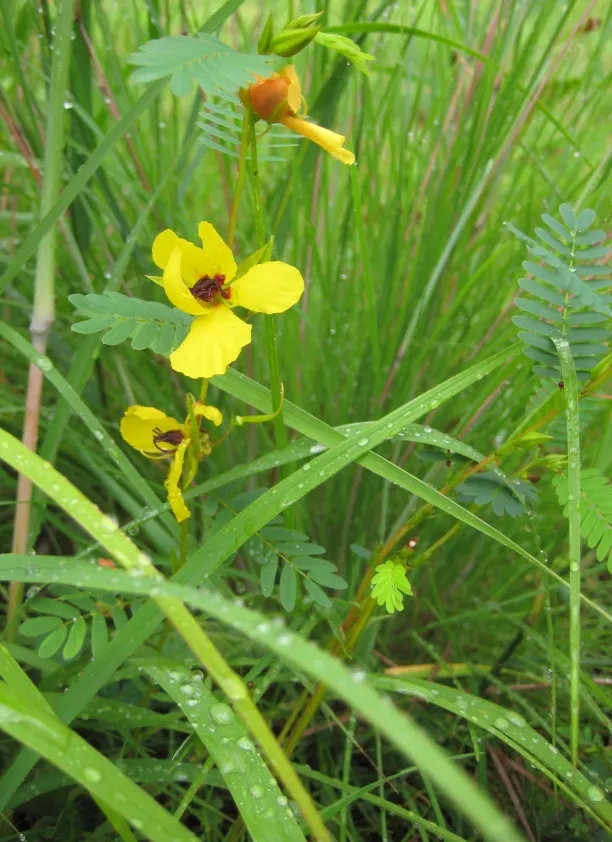
Partridge Pea (Chamaechrista fasciculata) with bright yellow asymmetrical flowers and finely divided leaves
Chamaechrista fasciculata — the bright yellow flower with reddish center and asymmetrical petals is diagnostic. Photo: Rooted Revival.

Identification

[ field key — habit · leaf · flower · fruit · special features ]

Habit & Stem

Low, bushy annual (occasionally surviving a second year in Tulsa's milder winters) with a branched, somewhat sprawling form. Stems are slender, green to reddish-brown, and smooth or sparsely hairy. Multiple stems arise from a single base and spread outward, creating a rounded bushy plant 1–2 ft tall and wide. The plant dies completely with the first hard freeze and relies entirely on its abundant seed bank for persistence, though individual stems may survive mild winters in Zone 7b and produce a small second-year flush. Plants grow quickly from seed — from germination to full bloom in approximately 60–75 days.

Leaves

Alternate, pinnately compound with 8–15 pairs of small, narrow, oblong leaflets arranged along a central stalk (rachis). Each leaflet is about ½–¾ in long, bright green, and hairless. The leaves are thigmonastic (touch-sensitive): when brushed, the leaflets fold together along the rachis within 1–2 seconds, an adaptation thought to deter herbivores or reduce water loss. They also close at night (nyctinasty). The overall texture is delicate and fern-like, much finer than the typical prairie legume.

Flowers

Flowers are bright yellow, asymmetrical, and showy, about 1–1.5 in across, borne singly or in small clusters from the upper leaf axils. Each flower has five unequal yellow petals, with the lower petal often largest, and a cluster of prominent reddish-purple stamens (typically 10) in the center. The asymmetry is a key diagnostic: unlike the radially symmetrical flowers of most prairie legumes, the partridge pea's bloom has an irregular, somewhat lopsided appearance. Flowers open in the morning and last only one day, but new blooms open daily for weeks. The pollen is produced in poricidal anthers that release pollen only when vibrated at the right frequency (buzz pollination) — bumblebees are the primary pollinators.

Fruit & Special Features

The fruit is a flat, narrow, linear legume pod 1.5–2.5 in long that matures from green to dark brown. When fully dry, the two halves of the pod twist apart explosively (elastically dehiscent), flinging the small, flat, rectangular seeds several yards from the parent plant. The seeds are dark brown to black, hard-coated, and highly nutritious. A key ecological feature: each leaf stalk bears a small, cup-shaped nectary (extrafloral nectary) near its base that exudes a sweet secretion attracting ants, parasitic wasps, and other beneficial insects. These visitors patrol the plant and prey on herbivorous caterpillars, giving the plant a built-in bodyguard service — a classic example of indirect plant defense.

Habitat & Range in NE Oklahoma

Chamaechrista fasciculata is widespread across the eastern and central United States, from New England south to Florida and west through the Great Plains to Texas and the Dakotas. In NE Oklahoma, it is a characteristic plant of sandy, open, disturbed ground: old fields, abandoned lots, sandy roadsides, railroad rights-of-way, overgrazed pastures, and the naturally disturbed openings in post-oak woodlands and Cross Timbers savannah. It thrives where soil has been scraped, graded, or burned, and it is one of the first native legumes to colonize freshly exposed mineral soil.

In the Tulsa region, Partridge Pea is abundant on the sandy terraces of the Arkansas River, in the sandstone barrens of the Cross Timbers, on the sandy soils along Highway 412 and the Creek Turnpike corridors, and in any farm field that has been left fallow for a season. It often grows in association with other disturbance-adapted natives like black-eyed Susan, plains coreopsis, and Indian blanket. The plant's preference for acidic, sandy soils means it is more common on the sandstone-derived soils of the Cross Timbers than on the limestone clays of the western tallgrass prairie.

Ecology & Wildlife Value

[ nitrogen fixation · lepidoptera hosts · quail food · extrafloral nectaries ]

Nitrogen Fixation

As a legume, C. fasciculata forms root nodules with nitrogen-fixing rhizobial bacteria. Because it is an annual (or short-lived perennial), fixed nitrogen is released into the soil relatively quickly upon plant death and decomposition, making it an effective green manure for poor, sandy soils. In a prairie restoration context, it acts as a pioneer nitrogen source during the early years of a planting, helping to build soil fertility while the slower perennial legumes (Baptisia, Dalea) are still establishing their long-term root systems.

Lepidoptera Hosts

Partridge Pea is a critical larval host for sulphur butterflies (subfamily Coliadinae). The caterpillars of the cloudless sulphur (Phoebis sennae), sleepy orange (Abaeis nicippe), and little yellow (Pyrisitia lisa) all feed on the foliage. The orange sulphur (Colias eurytheme) and dwarf yellow (Nathalis iole) also use it. In NE Oklahoma gardens, a patch of Partridge Pea in late summer often hosts clouds of bright yellow and orange butterflies circling the plants. The flowers themselves provide nectar for the adults of these species as well as for bumblebees and other native bees.

Quail & Gamebird Food

The seeds of Partridge Pea are one of the most important winter foods for northern bobwhite quail throughout the southeastern and central US. The hard-coated seeds persist on the plant and on the ground beneath well into winter, long after most other forbs have dropped their seed. Quail biologists in Oklahoma consistently rank Partridge Pea among the top three native forb species for quail nutrition (alongside Illinois bundleflower and roundhead lespedeza). The seeds are also consumed by wild turkey, mourning doves, and several sparrow species, particularly field and song sparrows in winter prairie habitats.

Extrafloral Nectaries & Beneficial Insects

The small, cup-shaped extrafloral nectaries at the base of each leaf stalk are a fascinating ecological feature. These nectaries secrete a sugar-rich solution throughout the growing season (not just during bloom), attracting ants, parasitoid wasps, lady beetles, and other predatory insects. These visitors prey on or parasitize herbivorous caterpillars and other pests, effectively acting as a standing security force for the plant — and for neighboring plants in the garden. The constant presence of these beneficial insects makes Partridge Pea a valuable pest-management ally when interplanted among vegetable crops.

Horticulture & Care

[ direct-sow · germination · care · companion planting ]

Establishment from seed

Partridge Pea is one of the easiest native legumes to establish from seed — it's an annual that needs no long-term commitment, and germination is vigorous in warm soil. Scarify seeds by rubbing between sandpaper or soaking in hot water for 12 hours before planting. Direct-sow in spring after the last frost (mid-April in Tulsa) into a prepared, weed-free seedbed. Sow ¼–½ in deep and keep the soil moist until germination (7–14 days at 65–75°F). Fall sowing (October–November) works well too — seeds undergo natural scarification over winter and emerge in spring when soil temperatures are right. Once established, the plant will self-sow reliably year after year.

Care & maintenance

Partridge Pea requires essentially no care once germinated. It is drought-tolerant, does not need supplemental water after establishment, and should never be fertilized (which suppresses nodulation and bloom). The plant is generally pest-free, though the caterpillars of sulphur butterflies will feed on the leaves — this is the whole point, and the defoliation is typically minor and cosmetic. To ensure self-sowing for the following year, do not clean up the dead plants until late winter — the seed pods need time to mature and discharge their seeds, and the standing dead stems provide cover for overwintering beneficial insects. In a prairie restoration, prescribed fire in late winter or early spring enhances germination of soil-stored seed.

Companion planting

For a quail habitat planting, combine Partridge Pea with Illinois bundleflower, roundhead lespedeza, purple prairie clover, and warm-season grasses including little bluestem and sideoats grama. For a pollinator garden, pair with black-eyed Susan, plains coreopsis, butterfly milkweed, and common milkweed for a summer-to-fall butterfly bonanza. In a vegetable garden, plant Partridge Pea in the margins or in a dedicated insectary strip — the extrafloral nectaries bring in beneficial predatory insects that help control aphids, caterpillars, and other pests on nearby crops.

Edible & Cultural Uses

There is no significant record of Partridge Pea being used as an edible plant by humans. The seeds are protein-rich but too small and hard-coated for practical human consumption, and the foliage contains compounds that can be toxic if consumed in large quantities. The plant's value to humans is ecological rather than culinary — it builds soil nitrogen, feeds wildlife, supports butterfly populations, and attracts beneficial predatory insects.

A note on the genus: Chamaechrista was historically included in the genus Cassia (the sennas), and you may still encounter the older name Cassia fasciculata in field guides and seed catalogs. The reclassification to Chamaechrista is now widely accepted, but the two names refer to the same plant. True Cassia species (like the tropical shower trees) have a different floral morphology and are not native to North America.

Photo Reference

Close-up of Chamaechrista fasciculata bright yellow flower with red center
// Flower detail — asymmetrical yellow petals with red stamens
Wikimedia Commons
Wikimedia Commons
Finely divided, touch-sensitive leaves of Chamaechrista fasciculata
// Leaves — pinnately compound, thigmonastic (fold when touched)
Wikimedia Commons
Wikimedia Commons
Flat seed pods of Chamaechrista fasciculata
// Seed pods — flat, narrow legumes that twist open explosively
Wikimedia Commons
Wikimedia Commons
Sleepy orange butterfly on partridge pea flower
// Sleepy orange (Abaeis nicippe) — one of several sulphur butterflies hosted by this plant
Wikimedia Commons
Wikimedia Commons
Large patch of Chamaechrista fasciculata in an old field
// In the field — dense stand on a sandy old field in the Cross Timbers
Wikimedia Commons
Wikimedia Commons

Sources & Further Reading

  • USDA NRCS PLANTS Database — Chamaechrista fasciculata: plants.usda.gov/plant-profile/CHFA2
  • Lady Bird Johnson Wildflower Center — Native Plant Database: wildflower.org — CHFA2
  • Oklahoma Department of Wildlife Conservation — "Managing for Bobwhite Quail." ODWC Technical Guide Series.
  • USDA NRCS Plant Guide — Partridge Pea (CHFA2), National Plant Data Center.
  • Scott, J.A. (1986). The Butterflies of North America. Stanford University Press (sulphur butterfly host plant records).
  • Wagner, D.L. et al. (2011). Owlet Caterpillars of Eastern North America. Princeton University Press.
  • Wikipedia — Chamaecrista fasciculata: en.wikipedia.org/wiki/Chamaecrista_fasciculata (CC BY-SA 4.0).

Hero photo: Rooted Revival. Strip photos courtesy of Wikimedia Commons contributors under their respective licenses (linked under each image).