home/ plants/ illinois-bundleflower

// SPECIES PROFILE · PERENNIAL · NATIVE · NITROGEN-FIXER

Illinois Bundleflower

Desmanthus illinoensis

Illinois Bundleflower is the prairie legume that looks like something from a different plant family entirely — a much-branched, ferny-leaved perennial capped with spherical, puffball-like heads of tiny white stamens that suggest a misplaced mimosa tree growing knee-high in the tallgrass. It is one of the most useful and uncelebrated native plants in NE Oklahoma. The seeds are remarkably high in protein (over 30% by dry weight, rivaling soybeans), and Indigenous peoples of the Plains and Eastern Woodlands gathered them as a staple food. Desmanthus illinoensis is also an effective nitrogen-fixing legume, an excellent forage for livestock and wildlife, and a tough, self-sufficient component of any prairie restoration or food-forest understory planting on well-drained open ground.

// QUICK FACTS
Family
Fabaceae (pea / legume family)
Life cycle
Herbaceous perennial
Native range
Central and eastern US; throughout the Great Plains from Texas to the Dakotas, east to Ohio; all of Oklahoma
USDA hardiness
Zones 4–8 (Tulsa = 7a/7b)
Mature size
2–4 ft tall, 1.5–2.5 ft wide
Bloom
June – August (NE OK)
Flower color
White spherical heads with prominent white stamens
Sun
Full sun
Soil
Adaptable; dry to mesic, sandy loam to clay-loam; well-drained
Water
Low to medium; drought-tolerant
Wildlife value
High-protein seed for gamebirds & songbirds · livestock forage · nitrogen-fixer
Conservation
G5 — secure globally; common in prairies and open ground throughout NE Oklahoma
Illinois Bundleflower (Desmanthus illinoensis) with spherical white flower heads and fern-like foliage
Desmanthus illinoensis — the spherical white heads and delicate compound leaves give it the look of a miniature tree. Photo: Rooted Revival.

Identification

[ field key — habit · leaf · flower · fruit · special features ]

Habit & Stem

Upright, much-branched perennial with a bushy, rounded form. Stems are stiff, angular (grooved) in cross-section, smooth and hairless (glabrous), and green to reddish-brown at maturity. Multiple stems arise from a woody crown atop a deep taproot. The plant dies back to the crown each winter and re-sprouts vigorously in late spring, typically reaching its full 2–4 ft height by mid-summer. In open, competitive prairie settings, plants tend toward the taller end of the range; on thin, dry soils, they stay more compact.

Leaves

The foliage is strikingly delicate: twice-pinnately compound (bipinnate), with 4–8 pairs of primary leaflets (pinnae), each further divided into 10–20 pairs of tiny, oblong secondary leaflets only about ¼ in long. The overall effect is fern-like or mimosa-like — finely textured and airy. Leaves are sensitive to touch (thigmonastic): the leaflets fold together when disturbed, though less dramatically than in the closely related Mimosa pudica. They also close in the evening, a nyctinastic movement common to many legumes.

Flowers

Flowers are borne in dense, spherical heads about ¾ in across on stalks rising from the leaf axils. Each head contains 20–40 tiny individual flowers, but what reads as a "bloom" is primarily the mass of long, thread-like white stamens that protrude far beyond the minute greenish-white petals — the classic powder-puff inflorescence architecture of the Mimosoideae subfamily. Heads open over several weeks in mid-summer, with each head receptive for only 1–2 days. There is no detectable fragrance to humans.

Fruit & Seed

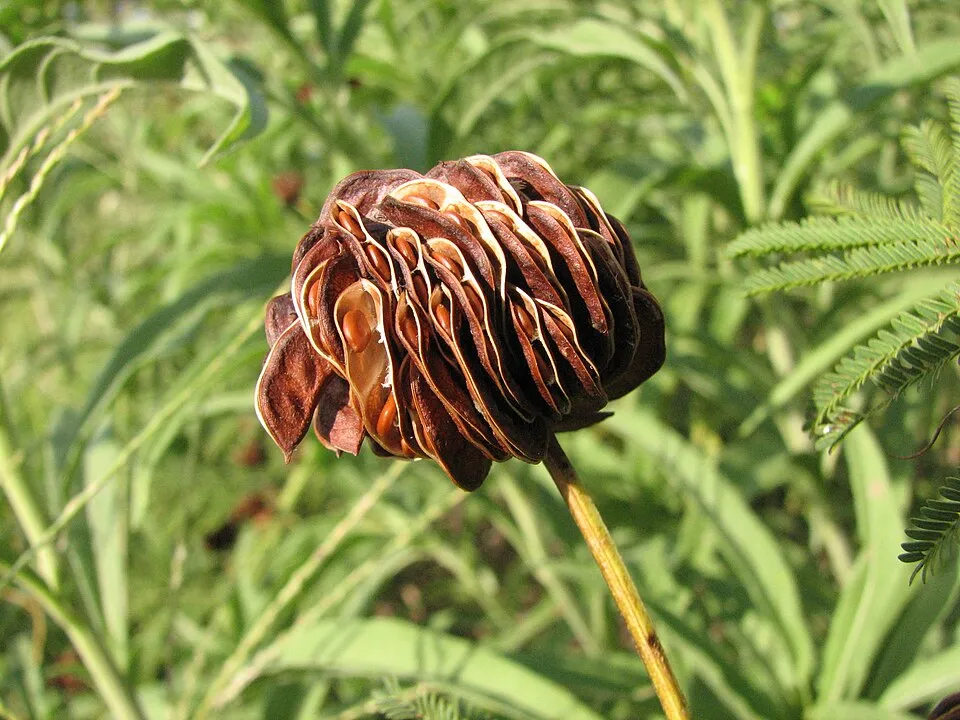
The fruits are the namesake feature: clusters of curved, flat, dark brown seed pods 1–1.5 in long, tightly clustered ("bundled") at the tip of the flower stalk, each pod containing 3–5 seeds. The pods are elastically dehiscent — when fully dry, the two halves twist violently apart, flinging seeds several feet from the parent. Seeds are small (about 2 mm), dark brown, hard, and kidney-shaped with a tiny U-shaped depression (pleurogram) on each side. The genus name Desmanthus comes from the Greek desme (bundle) + anthos (flower), referring to the bundled pods.

Habitat & Range in NE Oklahoma

Desmanthus illinoensis is widely distributed across the tallgrass and mixed-grass prairies of central and eastern North America, from the Great Plains eastward through the Midwest to the Ohio River Valley, south to Texas and the Gulf Coast. In NE Oklahoma, it is a common component of tallgrass prairie remnants, open meadows, old fields, and disturbed ground throughout the Cross Timbers and the broader Arkansas River watershed. It favors full sun and well-drained soils: sandy loam prairies, limestone glade margins, fencerows, railroad rights-of-way, and the sunny edges of post-oak and blackjack-oak savannah.

In the Tulsa region, look for it in the unmowed margins of parks and industrial lots, in CRP (Conservation Reserve Program) grasslands in Osage and Rogers counties, and along the grassy shoulders of rural roads radiating out from town. It often grows in association with big bluestem, indiangrass, switchgrass, and a suite of summer prairie forbs. Bundleflower is more common on neutral to slightly alkaline soils associated with limestone-derived substrates but adapts readily to the acidic sandstone soils of the Cross Timbers.

Ecology & Wildlife Value

[ nitrogen fixation · seed ecology · wildlife · forage ]

Nitrogen Fixation

As a legume, D. illinoensis hosts nitrogen-fixing bacteria in root nodules, converting atmospheric nitrogen into forms available to the plant and, through root turnover and decomposition, to the surrounding soil community. Unlike the massive, long-lived Baptisia species, bundleflower is a shorter-lived perennial (typically 3–5 years in the wild) that cycles nitrogen more rapidly into the soil profile — making it a useful component in prairie restorations where a nitrogen boost is needed early in the succession, before the perennial grasses fully establish.

Pollinators

The spherical, stamen-heavy flower heads attract a range of small to medium-sized bees, wasps, beetles, and flies. Unlike many prairie legumes that require large bumblebees to trip the keel, bundleflower's exposed-reproductive architecture makes it accessible to a broader guild of generalist pollinators. Small sweat bees (Lasioglossum spp.), mining bees (Andrena spp.), hoverflies (Syrphidae), and small solitary wasps are common visitors in NE Oklahoma plantings.

Wildlife Food Source

The high-protein seeds are heavily consumed by gamebirds throughout the plant's range. Northern bobwhite quail feed heavily on bundleflower seeds in late summer and fall; they are a preferred food in the diet of Oklahoma quail populations in CRP grasslands. Wild turkey, mourning doves, and several sparrow species also consume the seeds. The seeds' hard coat allows them to pass intact through the digestive tracts of birds, dispersing the plant across the landscape. Small mammals including deer mice and hispid cotton rats also cache and consume the seeds.

Forage Value

Bundleflower is rated as highly palatable and nutritious forage for cattle, sheep, and goats — the crude protein content of the foliage ranges from 15–22% during the growing season. It is one of the few native legumes that has been actively developed as a forage crop: the USDA NRCS Plant Materials Center has released several cultivars for use in range seedings and pasture improvement. In a permaculture context, it can serve as a rotational forage crop in silvopasture systems beneath widely-spaced oaks and pecans.

Horticulture & Care

[ establishment · seed · care · companion planting ]

Establishment from seed

Bundleflower is almost always grown from seed, and it's one of the easier native legumes to establish. Direct-sow in late fall or early spring onto a prepared, weed-free seedbed. The hard seed coat requires scarification for reliable spring germination: rub seeds between fine sandpaper or soak in hot water (180°F, allowed to cool overnight) before planting. Alternatively, fall-sown seed undergoes natural freeze-thaw scarification over winter. Sow ¼–½ in deep; germination typically occurs in 10–21 days when soil temperatures reach 65–75°F. Seedlings are vigorous and fast-growing compared to most native perennials — plants often reach 12–18 in in their first season and may produce a few blooms.

Care & maintenance

Once established, bundleflower requires essentially no care. It is drought-tolerant, pest-resistant, and self-sufficient. The main management decisions are aesthetic: dead stems can be cut back in late winter or left standing for winter interest and wildlife cover. In rich garden soils, plants may grow taller and more rankly than in native prairie conditions; avoid supplemental fertilization, which suppresses nodulation and encourages weak growth. Bundleflower is not aggressive or weedy in a garden context, though it will self-sow into nearby open ground — a feature, not a bug, in a prairie restoration.

Companion planting

Bundleflower integrates naturally into a tallgrass prairie planting alongside big bluestem, little bluestem, indiangrass, and switchgrass. For a mixed forb-and-grass prairie garden, pair with purple coneflower, black-eyed Susan, wild bergamot, and prairie blazing star. In a silvopasture or food forest, sow in the alleys between tree rows as a nitrogen-fixing understory forage. Bundleflower also works well as a quail habitat planting in combination with partridge pea, purple prairie clover, and rattlesnake master.

Edible & Cultural Uses

The seeds of Desmanthus illinoensis were a significant wild food source for Indigenous peoples across the Great Plains and Eastern Woodlands. Archaeological evidence from rockshelter sites in the Ozarks and the Illinois River valley shows bundleflower seeds being collected, stored, and consumed for thousands of years. The seeds were typically parched (dry-roasted) and ground into a protein-rich meal that could be mixed with water, added to stews, or formed into small cakes. The protein content of bundleflower seeds (>30% by dry weight, higher than common beans) made them a nutritionally important resource, particularly during winter when fresh plant foods were scarce.

The seeds can be eaten today by anyone willing to do the gathering work — harvest pods as they begin to dry and twist open in late summer, thresh to release seeds, and winnow away the chaff. Roast the cleaned seeds in a dry skillet until fragrant, then grind in a grain mill or mortar. The resulting meal has a mild, nutty flavor and can be used as a partial flour substitute in baking or as a protein supplement in soups and porridge. Note: as with all wild legumes, seeds should be cooked (roasted or boiled) before eating to denature anti-nutritional compounds including trypsin inhibitors.

Beyond the protein-rich seeds, Desmanthus illinoensis is well known among ethnobotanists for its root bark, which contains N,N-DMT (dimethyltryptamine) and related tryptamine alkaloids. The use of bundleflower root preparations as an entheogen has been suggested for some Indigenous cultures of the Eastern Woodlands, though the archaeological and ethnographic evidence is debated. This note is included for completeness; the plant is not presented here for this purpose and is not recommended for unsupervised ingestion of root material.

Photo Reference

Close-up of Desmanthus illinoensis spherical white flower heads
// Inflorescence — spherical head of white stamens, the powder-puff bloom
Wikimedia Commons
Wikimedia Commons
Clustered ('bundled') seed pods of Desmanthus illinoensis
// Fruit — the bundled pods that give the plant its common name
Wikimedia Commons
Wikimedia Commons
Illinois Bundleflower plant showing bushy, much-branched form
// Plant habit — much-branched, 2–4 ft tall in full sun
Wikimedia Commons
Wikimedia Commons
Desmanthus illinoensis seeds, small dark brown and kidney-shaped
// Seeds — high-protein (>30%), once a staple wild food of Indigenous peoples
Wikimedia Commons
Wikimedia Commons
Desmanthus illinoensis growing in a tallgrass prairie setting
// In prairie context — bundleflower among big bluestem and switchgrass
Wikimedia Commons
Wikimedia Commons

Sources & Further Reading

  • USDA NRCS PLANTS Database — Desmanthus illinoensis: plants.usda.gov/plant-profile/DEIL
  • USDA NRCS Plant Guide — Illinois Bundleflower (DEIL), Manhattan Plant Materials Center.
  • Lady Bird Johnson Wildflower Center — Native Plant Database: wildflower.org — DEIL
  • Oklahoma State University Extension — Native Warm-Season Grasses and Forbs for Wildlife.
  • Kindscher, K. (1987). Edible Wild Plants of the Prairie. University Press of Kansas.
  • Moerman, D.E. (1998). Native American Ethnobotany. Timber Press.
  • Wikipedia — Desmanthus illinoensis: en.wikipedia.org/wiki/Desmanthus_illinoensis (CC BY-SA 4.0).

Hero photo: Rooted Revival. Strip photos courtesy of Wikimedia Commons contributors under their respective licenses (linked under each image).