// SPECIES PROFILE · GRASS · NATIVE · EMERGENT WETLAND STAPLE
Fox Sedge is the emergent wetland sedge of NE Oklahoma's marshes, pond edges, and roadside ditches — a robust, clump-forming species 1–3 feet tall whose dense, bristly, greenish-brown seed heads resemble a fox's tail, giving the species both its common and scientific names (vulpinoidea = "fox-like"). In the wet meadows and shallow-water margins of ponds, lakes, and slow-moving streams across the Tallgrass Prairie and Green Country regions, Carex vulpinoidea forms conspicuous tussocks that persist for years, their dense root masses stabilizing the soft, saturated soils at the water's edge. This is the sedge for the vegetated shelf of a wildlife pond, the inflow zone of a stormwater retention basin, and the emergent zone of a constructed wetland — a species that bridges the gap between upland sedges and truly aquatic plants more effectively than any other Carex in our region.

[ field key — habit · leaf · inflorescence · distinguishing features ]
Densely caespitose, forming robust tussocks 1–2 feet in diameter from short, stout rhizomes. Individual clumps may contain 50–100+ culms and leaves, creating a substantial, erect mass of vegetation. The flowering culms are stiff, triangular in cross-section (as in all sedges), and rise to 2–3 feet, topped with the characteristic dense, bristly inflorescence. The tussock habit raises the crown of the plant above saturated soil, allowing gas exchange with the root zone even when lower portions of the clump are submerged — a classic adaptation of emergent wetland graminoids.
Leaves are 3–8 mm wide, flat, and medium green, with a distinctly rough (scabrous) margin that is readily felt when stroked upward — a useful field character for sedges in section Multiflorae. The basal sheaths are conspicuously cross-wrinkled (rugose) on the inner (ventral) surface and brown to reddish-brown at the base — another diagnostic feature. Foliage is fully deciduous, dying back after the first hard freeze and remaining as persistent brown standing dead material through winter, providing cover for wildlife.
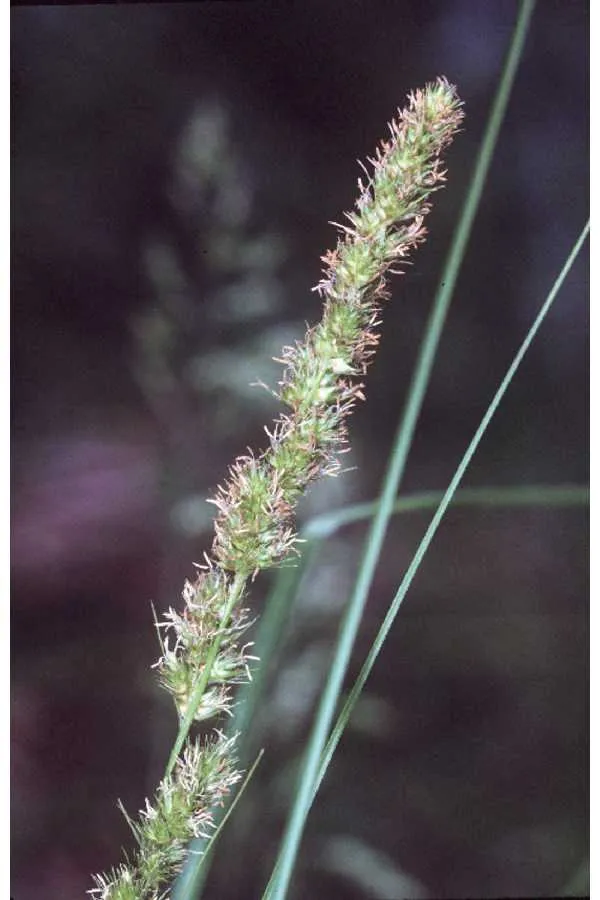
The inflorescence is a dense, compound, bristly-looking head 2–5 inches long, composed of numerous small, androgynous spikelets densely packed along the upper portion of the culm. Each spikelet contains both staminate (male) and pistillate (female) flowers. The perigynia are ovoid to lance-ovoid, 2–3 mm long, prominently nerved on both faces, and taper to a distinctly toothed beak. At maturity, the entire inflorescence turns from green to golden-brown, giving the seed head the appearance of a fox's tail — the feature that inspired Michaux to name the species vulpinoidea in 1803. The perigynia are somewhat inflated compared to the flat perigynia of C. annectens.
In NE Oklahoma, Carex vulpinoidea is part of section Multiflorae, a group of sedges with dense, compound inflorescences. It is most likely to be confused with C. annectens (Yellow-fruited Sedge). Key differences: C. vulpinoidea has perigynia that are greenish-brown (not yellowish) at maturity, somewhat inflated rather than flat, and the overall plant is more robust with a strongly tussock- forming habit. It also tolerates deeper and more prolonged inundation than C. annectens and is more strongly associated with perennial wetlands rather than disturbed, early- successional sites. The cross-wrinkled (rugose) ventral surface of the basal leaf sheaths is a reliable field character for C. vulpinoidea within section Multiflorae.
Carex vulpinoidea is one of the most widely distributed sedge species in North America, occurring in every US state except Hawaii and throughout southern Canada. In NE Oklahoma, it is a characteristic species of marshes, wet meadows, pond and lake margins, and the vegetated edges of streams and rivers throughout the Tallgrass Prairie, Cross Timbers, and Ozark foothills ecoregions. It is particularly common in the shallow-water margins of farm ponds, the vegetated shelves of larger reservoirs (Keystone, Oologah, Skiatook, Fort Gibson), and the extensive wet meadows associated with the floodplains of the Arkansas, Verdigris, and Grand River systems.
The species tolerates a wider range of hydrologic conditions than most wetland sedges: from permanently saturated but unflooded soil to standing water 3–4 inches deep during the growing season. This hydrologic flexibility makes it valuable for the vegetated shelves of wildlife ponds and stormwater retention basins, where water levels fluctuate seasonally and plants must tolerate both inundation during wet periods and drawdown during dry periods. Along Oklahoma's rivers, it occupies the transition zone between the aquatic vegetation of permanent water and the floodplain forest understory, forming a distinct band of herbaceous vegetation that is flooded during high water but exposed for most of the growing season.
[ waterfowl seed · muskrat forage · amphibian habitat · wetland food web ]
The seeds of Fox Sedge are a significant food source for waterfowl, particularly dabbling ducks (mallard, blue-winged teal, northern shoveler) and wood ducks in Oklahoma's wetlands and reservoirs. The seeds float and are consumed from the water surface as well as from standing plants. Marsh birds — sora rails, Virginia rails, common gallinules, and American coots — forage in sedge-dominated wetlands for seeds and invertebrates. The dense tussocks provide nesting cover for red-winged blackbirds, common yellowthroats, and marsh wrens in shallow-water habitats.
Muskrats (Ondatra zibethicus) feed heavily on the basal portions of Fox Sedge stems and rhizomes, and use the leaves in the construction of their lodges. In wetlands across Oklahoma, muskrats are a primary consumer of emergent sedges and play an important role in maintaining open water within sedge marshes by reducing the density of emergent vegetation. White-tailed deer occasionally browse the foliage at the water's edge, though it is not a preferred forage species. Beavers may cut Fox Sedge along with other emergent vegetation for dam and lodge construction.
The dense, emergent tussocks of Fox Sedge provide critical habitat for amphibians at the water's edge. Southern leopard frogs (Lithobates sphenocephalus), bullfrogs (Lithobates catesbeianus), and Blanchard's cricket frogs (Acris blanchardi) use sedge clumps for cover and as calling perches during the breeding season. The complex structure of sedge tussocks at the water-land interface provides basking sites for turtles (particularly red-eared sliders and common snapping turtles) and foraging habitat for watersnakes (Nerodia spp.) in Oklahoma's ponds and wetlands.
Fox Sedge plays a significant role in wetland nutrient cycling and water quality improvement. Its dense root system takes up nitrogen and phosphorus from saturated soils and shallow water, sequestering these nutrients in plant biomass and reducing the nutrient load that would otherwise contribute to algal blooms in ponds and reservoirs. The tussocks also trap sediment and slow water flow at the margins of wetlands and along stream banks, improving water clarity and reducing bank erosion. In constructed wetlands designed for wastewater treatment or stormwater polishing, emergent sedges including C. vulpinoidea are among the most effective plants for nutrient removal.
[ wildlife pond margin · stormwater basin · wetland restoration · emergent zone ]
Fox Sedge requires saturated to shallowly inundated soil to thrive — this is not a sedge for dry or even average garden conditions. Select a site at the margin of a pond, the inflow zone of a stormwater basin, a constructed wetland, or any low-lying area that holds water for extended periods. It tolerates standing water up to 3–4 inches deep during the growing season and saturated soil year-round. In the context of a designed wetland or stormwater feature, this is the emergent zone — the area that transitions from open water to saturated soil.
Plant container-grown stock in spring (April–May) or early summer, after the risk of prolonged flooding has passed. In the context of a wildlife pond, position plants on the vegetated shelf — the flat or gently sloping area between the permanent pool and the upland edge, where water depth is 0–6 inches during the growing season. On pond banks, plant at or slightly above the normal water line.
Cut back dead foliage in late winter (February) if desired for aesthetics; otherwise, leave standing dead material as wildlife cover through winter, cutting just before new growth emerges in spring. In wetland settings, C. vulpinoidea may need to be thinned every 3–5 years to prevent complete dominance of the emergent zone and maintain plant diversity. In ponds and basins where water levels are manipulated, avoid prolonged deep flooding (more than 8–12 inches over the crown) during the growing season, as this can kill the plant.
No significant edible or medicinal uses are recorded for Carex vulpinoidea. The leaves are relatively narrow and less suitable for basketry than broad- leaved sedges, though Indigenous peoples of the Great Lakes and Prairie regions may have used the tough, fibrous leaves for cordage and coarse weaving. The species' primary value is ecological: it is one of the most important emergent graminoids for wetland restoration, wildlife habitat creation, and water quality improvement across its vast North American range.
C. vulpinoidea is one of the most frequently included sedge species in USDA NRCS wetland restoration seed mixes and Conservation Reserve Program (CRP) wetland plantings throughout the Great Plains and Midwest. Its combination of broad geographic distribution, hydrologic flexibility, and wildlife value make it a standard component of wetland conservation plantings from Saskatchewan to Texas.
Hero photo: Rooted Revival. Strip photos via Wikimedia Commons under respective licenses.