// SPECIES PROFILE · GRASS · NATIVE · WOODLAND GROUNDCOVER
Cherokee Sedge is a robust, clump-forming native sedge of the Ozark foothills and bottomland forests of NE Oklahoma — a species that performs beautifully in the kind of moist, shaded ground beneath sycamores and hackberries where lawn grasses refuse to grow. Reaching 1–2 feet tall with broad, light green blades that arch outward from dense crowns, Carex cherokeensis is the native answer to the ubiquitous non-native Liriope planted in every strip-mall landscape. It offers the same tidy, evergreen-until-hard-freeze form but feeds native insects, produces seed for songbirds, and asks for nothing but decent soil and a bit of shade. In the rich alluvial woods of the Illinois River, Spavinaw Creek, and the upland drainages of the western Ozarks, Cherokee Sedge persists in scattered colonies — a quiet reminder that the sedge family produced some of our most useful and overlooked native ornamentals.

[ field key — habit · leaf · inflorescence · distinguishing features ]
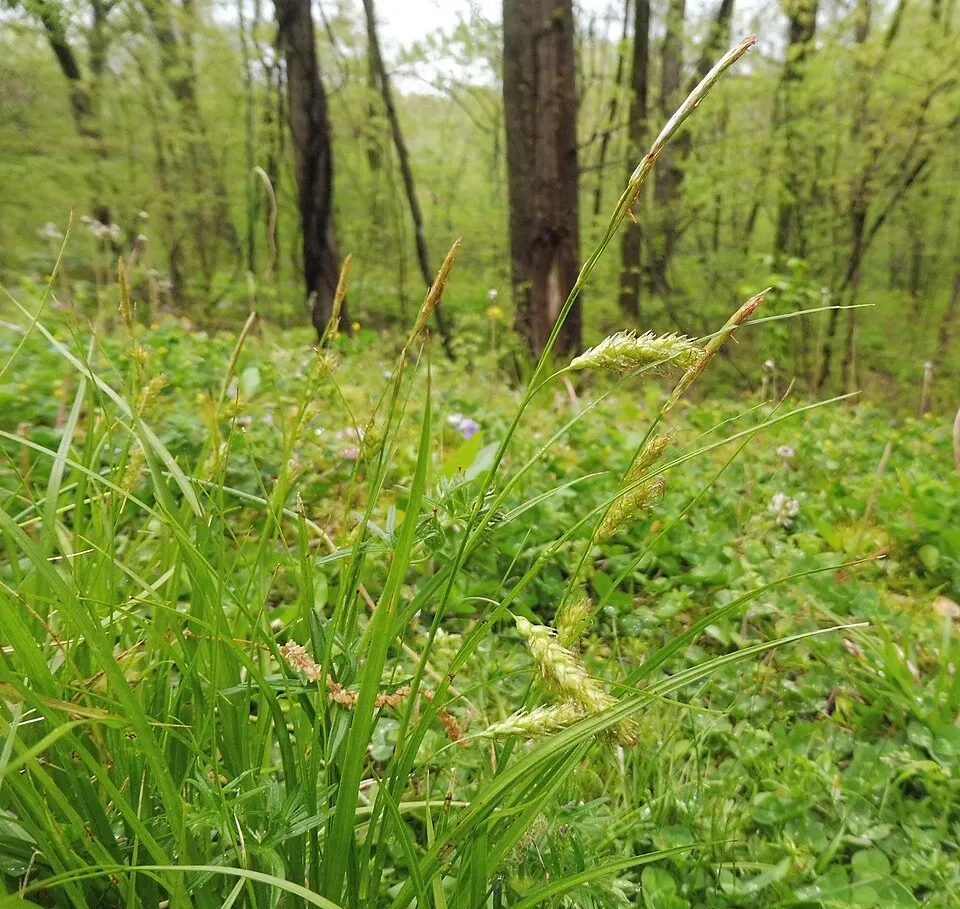
Densely caespitose (clump-forming) perennial sedge with short, stout rhizomes that produce tight, fountain-like crowns 12–18 inches in diameter at maturity. The foliage arches outward and downward from the center, creating a vase-shaped silhouette. Unlike running sedges that form continuous carpets, C. cherokeensis stays put — each plant expands as a discrete tussock. The culms (flowering stems) stand erect and somewhat stiff, rising 6–12 inches above the foliage at flowering.
Leaves are broad for a sedge — blades 4–10 mm wide, flat, light to medium green, with a slightly glaucous or waxy bloom on the underside. The margins are slightly rough (scabrous) to the touch when stroked upward, a subtle but useful field character. Basal sheaths are brown to reddish-brown and persist through the growing season. Foliage remains green well into autumn in NE Oklahoma, often holding through November before going dormant; in mild winters (common in Tulsa's zone 7a urban heat island), some basal leaves may persist as a semi- evergreen rosette through February.
The inflorescence is a loose, nodding panicle of spikes borne on slender, often drooping peduncles. Terminal spike is staminate (male) at the tip with pistillate (female) spikes below — typical of section Hymenochlaenae. Individual perigynia (the papery sacs enclosing each seed) are ovoid, 4–6 mm long, distinctly many-veined (a key diagnostic), with a short, slightly toothed beak. Perigynia mature from green to tan-brown by late May. Achenes are trigonous (three-sided), dark brown, and shed by early summer.
In eastern Oklahoma, Cherokee Sedge is most likely to be confused with Carex amphibola (Creek Sedge), which shares similar broad leaves and moist woodland habitat. Key differences: C. cherokeensis has perigynia with more prominent veins (9–15 vs. 5–9 in C. amphibola), generally taller flowering culms, and a more southerly distribution centered on the Ozark-Ouachita region. The nodding, open panicle with drooping lateral spikes is also characteristic. The common name honors the Cherokee Nation, whose historic range includes the species' core habitat in the southern Appalachians and Cumberland Plateau — regions ecologically linked to the Ozark highlands.
Carex cherokeensis ranges across the southeastern United States from southeastern Missouri and eastern Oklahoma through Arkansas and eastward to the Carolinas, Florida, and eastern Texas. In NE Oklahoma, it occupies the moist alluvial woods and stream terraces of the Ozark foothills and the deeper drainages feeding the Grand River and Illinois River systems. Look for it in rich, shaded bottomlands where American sycamore, black willow, and river birch dominate the overstory — sites with deep alluvial silt loam, reliable subsurface moisture, and dappled to full shade for most of the day.
Within the Ozark foothills ecoregion (Adair, Cherokee, and Delaware Counties), it is an occasional to locally common component of mesic forest understories, especially on north- and east-facing lower slopes above perennial streams. It is less frequent in the drier Cross Timbers woodlands to the west but may appear in moist pockets along creeks draining sandstone and limestone substrates. In Tulsa County, the species is at the western edge of its preferred habitat; remnant populations persist in the shaded ravines and bottomland fragments along Bird Creek, Haikey Creek, and the deeper tributaries of the Verdigris River.
[ songbird seed · ground-nesting cover · Lepidoptera host · sedge-specialist insects ]
The seeds (achenes) of Cherokee Sedge are consumed by a variety of ground-feeding songbirds and game birds. Northern cardinals, song sparrows, dark-eyed juncos (winter residents in NE Oklahoma), and eastern towhees pick through sedge clumps for fallen seeds. Wild turkeys scratch through woodland sedge colonies during late spring and early summer. The dense, vase-shaped foliage provides excellent cover for ground-nesting birds, including ovenbirds (where habitat is sufficiently forested), Kentucky warblers, and white-throated sparrows on migration.
Like most Carex species, Cherokee Sedge serves as a larval host for several satyrid and skipper butterflies. Documented sedge-feeding Lepidoptera genera include Satyrodes (eyed browns), Lethe (pearly-eyes), and various Hesperia skippers. The northern pearly-eye (Lethe anthedon) and Appalachian brown (Satyrodes appalachia) are confirmed users of broad-leaved woodland sedges in the genus. The inflorescences, though visually subtle, attract small native bees (chiefly Halictidae and Andrenidae) and syrphid flies during the brief flowering period in April and May.
Eastern cottontail rabbits browse the tender basal foliage in early spring, though sedge leaves are notably more fibrous and less palatable than many forbs — damage is generally light and well-tolerated. White-footed mice and eastern chipmunks collect fallen achenes from the litter layer. White-tailed deer will sample young growth but seldom target sedges when more palatable browse is available; established clumps are effectively deer-resistant in a landscape setting.
In the alluvial forests where it naturally occurs, Cherokee Sedge functions as a mid-layer groundcover between the bare leaf litter and the shrub understory. Its dense roots and rhizomes help stabilize stream-bank soils against moderate flood scour, and the persistent clumps trap fallen leaf litter that builds organic matter in the A-horizon. Senesced foliage decomposes more slowly than forb leaves, contributing to the slow, steady nutrient cycling characteristic of mesic deciduous forest floors. As a cool-season species, it photosynthesizes actively during the moist Oklahoma spring before canopy closure, effectively capturing solar energy that would otherwise be lost from the system.
[ site selection · planting · maintenance · companion plants · landscape uses ]
Cherokee Sedge is among the easiest native sedges to establish in a cultivated landscape, provided you give it what it needs: shade and moisture. Select a site that receives dappled to full shade, such as the north side of a building, beneath a mature deciduous canopy, or along a shaded stream or drainage swale. Morning sun is acceptable if the soil remains consistently moist. Avoid hot, dry afternoon exposures on west-facing slopes — these will produce stunted, scorched foliage.
Cherokee Sedge is genuinely low-maintenance once established. A single annual task — cutting back the previous year's foliage in late winter (February to early March) before new growth emerges — is all that is required. Use garden shears or a string trimmer set high to avoid damaging the crowns. The old foliage can be left in place through winter for wildlife cover and natural aesthetics, then removed just as new green shoots appear at the base.
In a shaded, moist garden setting, Cherokee Sedge pairs naturally with a suite of native woodland perennials that share its cultural requirements. Under a canopy of Shumard oak, bur oak, or chinkapin oak, combine it with wild ginger (Asarum canadense) as a low foreground carpet, Christmas fern for evergreen structure, and Solomon's seal for vertical contrast with arching stems and pendant white flowers. For spring ephemeral interest, interplant with bloodroot and mayapple, which emerge before the sedge reaches full size. In moist bottomland plantings, American elderberry and spicebush make excellent shrub companions, while cardinal flower provides a vivid red accent at the sunnier edges of the planting.
Cherokee Sedge is most valuable as a native alternative to liriope (Liriope muscari and L. spicata) in shaded landscape beds. It fills the same design niche — a tidy, grass-like clump in the 1–2 ft range that thrives in shade — but offers genuine ecological function. Use it as:
Sedges have a long history of use by Indigenous peoples across North America, primarily for basketry and weaving rather than food or medicine. The Cherokee, whose historic homeland encompasses the core range of this species, wove split sedge leaves and stems into mats, baskets, and cordage. While specific ethnobotanical records for Carex cherokeensis are sparse (the species' recognition as distinct from other broad-leaved woodland sedges is relatively modern), the broader cultural practice of sedge basketry is well-documented among Southeastern and Eastern Woodlands cultures, including the Cherokee, Choctaw, Creek, and Seminole.
Sedge leaves, being fibrous and tough, were split lengthwise into narrow strips, dried, and woven into burden baskets, mats, and storage containers. The broad leaves of C. cherokeensis would have been particularly suitable for this purpose compared to finer-textured species. No significant edible or medicinal uses are recorded for this species; the achenes are small and not harvested for human consumption.
Hero photo: Rooted Revival. Strip photos courtesy of Wikimedia Commons contributors under their respective licenses (linked under each image).