// SPECIES PROFILE · GRASS · NATIVE · WET PRAIRIE PIONEER
Yellow-fruited Sedge is the fast-moving pioneer of NE Oklahoma's wet meadows, roadside swales, and restored wetland margins — a clump- forming sedge 1–2.5 feet tall that colonizes open, moist ground with speed and reliability that few other native sedges can match. In a region where the Tallgrass Prairie once stretched unbroken, with seasonal wet meadows and prairie potholes scattered across the landscape, Carex annectens filled the ecological niche of early-successional graminoid — the first sedge to stake a claim on newly disturbed wet soil, preparing the ground for taller grasses and forbs that would follow. Today, it is one of the best species for rain garden and wetland restoration projects, where its rapid establishment, tolerance of variable water levels, and production of seed for wetland birds make it an indispensable component of green stormwater infrastructure and prairie pothole reconstruction across Green Country.

[ field key — habit · leaf · inflorescence · distinguishing features ]
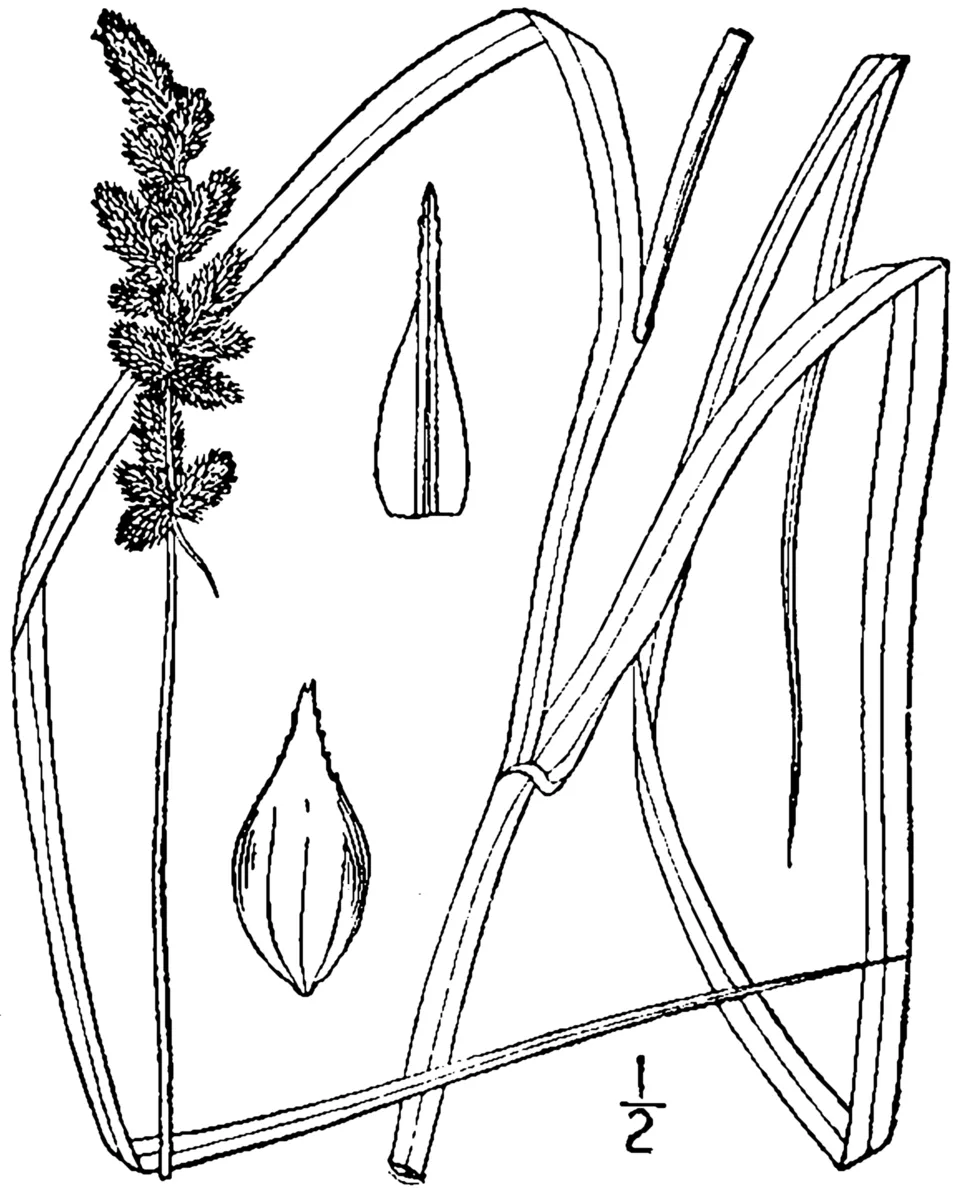
Densely caespitose (clump-forming) with short rhizomes. The foliage arches outward from the crown, creating a rounded, somewhat open tuft 12–18 inches in diameter. Flowering culms are erect, stiff, and rise well above the foliage, reaching 2–2.5 feet in moist, fertile soil. In full sun and wet conditions, the plant is robust and full; in shade or dry conditions, it is more open and lax. As a pioneer species, individual clumps are relatively short-lived (3–5 years) compared to long-lived woodland sedges, but the species maintains its presence through prolific seed production and rapid colonization of bare, wet soil.
Leaves are 3–8 mm wide, flat, and medium green, with a slightly rough (scabrous) margin when stroked upward. The basal sheaths are brown and somewhat fibrous, persisting at the crown. Foliage is fully deciduous in NE Oklahoma, dying back to the ground after the first hard freeze and remaining dormant through winter. The leaves have a more upright, less arching habit than many woodland sedges, reflecting the species' adaptation to open, sunny habitats where light competition is not a primary selective pressure.
The inflorescence is a dense, compound, golden-yellow to yellowish-green panicle of numerous small spikes clustered at the top of the culm. Each spike is androgynous (bearing both staminate and pistillate flowers), a characteristic of the section Multiflorae to which C. annectens belongs. The perigynia are flat, broadly ovate to orbicular, and conspicuously winged, maturing from green to a distinctive yellowish-golden color that is visible from a distance in June and July. This yellow-golden hue at fruit maturity is the most reliable field character and the source of the common name. The perigynia are 3–4 mm long with a short, toothed beak.
In NE Oklahoma, Carex annectens is most often confused with C. vulpinoidea (Fox Sedge), which shares the compound, bristly- looking inflorescence of section Multiflorae. Key differences: C. annectens has yellowish-golden perigynia (vs. greenish-brown in C. vulpinoidea), perigynia that are flat and broadly winged (vs. somewhat inflated in C. vulpinoidea), and a generally more slender, less robust growth habit. It also has a greater tendency to colonize disturbed, open sites as a pioneer, while C. vulpinoidea is more strongly associated with perennial wetland vegetation.
Carex annectens is widespread in eastern and central North America, with Oklahoma lying near the center of its distribution. In NE Oklahoma, it is a characteristic species of open, moist to wet habitats with full sun to partial shade: wet prairie remnants, sedge meadows, roadside ditches, pond margins, seasonally flooded fields, and the disturbed edges of streams and rivers. It is particularly common in the Tallgrass Prairie ecoregion (Osage, Washington, and Nowata Counties) where wet-mesic prairie and prairie pothole complexes provide extensive suitable habitat.
Within the Tulsa metropolitan area, C. annectens is regularly encountered in roadside swales and drainage ditches along highways and county roads, where its bright yellow-green fruiting heads are conspicuous in June. It also colonizes the margins of farm ponds, the wet draws between agricultural fields, and any sunny, low-lying area where water stands for part of the growing season. Its affinity for disturbed, open wet soils has made it an unintentional beneficiary of road construction and agricultural drainage practices across the region.
[ pioneer species · wetland bird seed · restoration ecology · pollinator support ]
The abundant seed production of C. annectens makes it an important food source for wetland and grassland birds. Mallards, blue-winged teal, and other dabbling ducks forage in sedge-dominated wet meadows for seeds and invertebrates. Sora rails and Virginia rails, secretive marsh birds that nest in wet meadows across Oklahoma, consume sedge seeds. Red-winged blackbirds, common grackles, and various sparrows (song sparrow, swamp sparrow, Lincoln's sparrow on migration) feed on the seed heads from late summer through fall.
The inflorescences of C. annectens, like those of most sedges, are wind-pollinated and do not produce nectar. However, small native bees (particularly Halictidae and Andrenidae) collect pollen from the staminate flowers during the flowering period in May and June. Syrphid flies and other small insects also visit the inflorescences, contributing to the invertebrate diversity of wet meadow habitats. The dense clumps provide cover and overwintering sites for ground-dwelling arthropods.
Carex annectens is a larval host for several sedge-feeding butterflies in the satyr and skipper groups. The eyed brown (Satyrodes eurydice), which prefers open, sedge-dominated wetlands, is a likely user. Several species of skipper butterflies (Hesperiinae), including the broad-winged skipper (Poanes viator) and the dion skipper (Euphyes dion), are sedge feeders whose larvae may use C. annectens in Oklahoma's wet meadows and prairie remnants.
The ecological value of C. annectens lies primarily in its role as a pioneer and early-successional stabilizer of wet, disturbed soils. In wetland restoration, it is often among the first species to establish from the seed bank or from direct seeding, rapidly producing biomass that stabilizes soil, moderates surface temperature, and creates microhabitats for slower-establishing species. Its fibrous root system helps bind wet, easily eroded soils on the margins of constructed wetlands, detention basins, and restored prairie potholes. As restoration plantings mature and perennial grasses and forbs become dominant, C. annectens naturally declines, having performed its ecological function as a nurse species.
[ rain garden pioneer · wetland restoration · rapid establishment · seed-grown ]
Yellow-fruited Sedge is a species of full sun and wet, open ground — it is not a woodland sedge and will not perform well in shade. Select a site that receives at least 4–6 hours of direct sun and has consistently moist to wet soil: the bottom of a rain garden, the margin of a pond or detention basin, a roadside swale, or a low-lying wet meadow. Heavy clay is acceptable if moisture is reliable. This is one of the best sedges for poor, compacted, disturbed soils where many other native species struggle to establish.
C. annectens is most commonly established from seed in restoration and large-scale plantings, though container-grown plants are available from native nurseries. Seed should be sown on bare, moist soil in spring (March–April) or fall (October–November). Fall seeding allows natural cold-moist stratification over winter. For container-grown plants, space 12–18 inches apart. Water during establishment if rainfall is inadequate; once established, the species is self-sufficient.
Cut back dead foliage in late winter (February). In a managed rain garden or wetland planting, C. annectens may need to be thinned or partially removed after 3–5 years as it can become dominant, particularly on highly disturbed, nutrient-rich sites. Its prolific seed production means it will self-sow freely — a desirable trait in restoration but potentially requiring management in smaller, designed landscapes. The species is notably free of pests and diseases.
In a rain garden or wet meadow restoration, pair C. annectens with species adapted to similar wet, sunny conditions: Switchgrass and eastern gamagrass for warm-season grass structure, Joe-Pye weed and swamp milkweed for pollinator value, buttonbush for shrub structure, cardinal flower for late-summer color, and Fox Sedge for additional sedge diversity in the wetter zones.
No specific ethnobotanical uses are recorded for Carex annectens. The species' primary cultural value is in ecological restoration, where it has become a staple of wet prairie and wetland reconstruction projects across the Midwest and Great Plains. Its rapid growth, prolific seed production, and tolerance of disturbed, wet soils make it one of the most reliable native sedges for jump-starting the herbaceous component of restored wetland plant communities.
Hero photo: Rooted Revival. Strip photos via Wikimedia Commons under respective licenses.