// SPECIES PROFILE · PERENNIAL · NATIVE · LAWN ALTERNATIVE
Blue-Eyed Grass is not a grass at all — it is a diminutive member of the iris family (Iridaceae), forming small clumps of narrow, iris-like foliage that, in spring, are studded with delicate, star-shaped, violet-blue flowers with golden-yellow centers that are open only a few hours each day. Sisyrinchium angustifolium is one of the most charming and unexpected small plants of the eastern meadow and open woodland, and in NE Oklahoma it is found in moist meadows, prairie edges, and open woods throughout the region. It is perfectly at home in a rock garden, along a path edge, naturalized in a lawn (tolerating occasional mowing), or massed in a sunny border. The flowers are fleeting — each lasts only a day — but the clumps produce them in succession for weeks in April and May, and the foliage remains as a tidy, grass-like accent through the growing season. This is the plant to tuck into the front of a bed, into crevices in a stone wall, or into a bee lawn, where its tiny blue stars will surprise and delight anyone who bothers to look down.

Small, clump-forming perennial 6–12 in tall, resembling a tuft of fine grass. The leaves are narrow, linear, grass-like, 6–12 in long, with parallel veins — classic monocot/Iris-family foliage. They are flattened and often slightly glaucous (blue-green). The clumps expand slowly by short rhizomes.
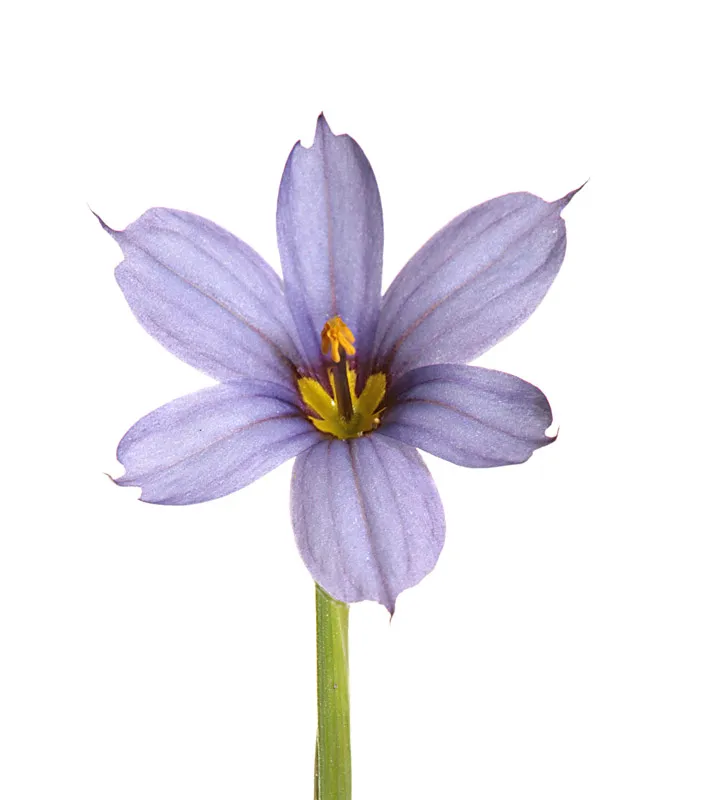
The flowers are the giveaway that this is not a grass: violet-blue, star-shaped, 6-parted (three petals and three petal-like sepals, all identical), about 1⁄2–3⁄4 in across, with a bright golden-yellow center (eye). Each flower lasts only a day, opening in morning sun and closing by afternoon, but the plants produce a succession of blooms from flattened, iris-like spathes at the stem tips over several weeks in April through June. The overall effect is of tiny blue stars hovering above the grass-like foliage.
Sisyrinchium angustifolium is found throughout NE Oklahoma in moist meadows, open woodlands, prairie edges, and streambanks. It prefers consistently moist, well-drained soil but tolerates periods of drought once established. In the garden, it does well in full sun to part shade and is an excellent choice for rock gardens, border edges, and naturalized lawn plantings.
The small, open flowers are pollinated by small native bees, including sweat bees and mining bees, as well as syrphid flies. The flowers produce no nectar, only pollen, and are visited by pollen-collecting bees. While not a pollinator powerhouse on the scale of goldenrods or milkweeds, blue-eyed grass adds valuable early-season diversity to the pollinator forage calendar in meadow and lawn settings.
The seeds are small and dry and are occasionally eaten by ground-feeding songbirds. The foliage provides cover for small ground-dwelling insects. Blue-eyed grass is not a significant Lepidoptera host plant.
Blue-Eyed Grass prefers full sun to part shade and moist, well-drained soil. It is an excellent choice for rock gardens, the front of a sunny border, along paths, in crevices between stones, or naturalized in a bee lawn where it tolerates occasional mowing at a high setting. It will self-sow modestly in favorable conditions.
Beautiful in combination with Wild Columbine, Woodland Phlox, Ohio Spiderwort, Golden Alexanders, Wild Strawberry, Pussytoes, and Buffalograss for a native bee lawn.