home/ plants/ golden-alexanders

// SPECIES PROFILE · PERENNIAL · NATIVE · EARLY BLOOM

Golden Alexanders

Zizia aurea

Golden Alexanders is one of the earliest-blooming members of the carrot family (Apiaceae) in the NE Oklahoma landscape, sending up flat-topped umbels of brilliant golden-yellow flowers in late April and May, weeks before the summer-blooming prairie forbs begin their show. These bright umbels are a critical early-season nectar and pollen source for emerging native bees, small butterflies, and beneficial predatory wasps at a time when relatively few other flowers are available. Zizia aurea is also the larval host plant for the eastern black swallowtail (Papilio polyxenes), whose caterpillars feed on the foliage, along with the Ozark swallowtail. It grows as a clump-forming perennial 1–3 ft tall with compound, toothed leaves and a generous, long-lasting bloom. In NE Oklahoma, you will find it in moist meadows, open woodlands, and stream banks, where it thrives in the rich, damp soil of the Cross Timbers and Ozark foothills. For the butterfly gardener and early-season pollinator steward, Golden Alexanders is an essential plant — one of the first and most reliable yellow blooms of the spring garden.

// QUICK FACTS
Family
Apiaceae (carrot / parsley family)
Life cycle
Herbaceous perennial; clump-forming
Native range
Eastern & central N. America — Canada to Texas, all of OK
USDA hardiness
Zones 3–8 (Tulsa = 7a/7b)
Mature size
1–3 ft tall; 1–2 ft spread
Bloom
April–June (NE OK)
Flower
Flat-topped umbels of bright golden-yellow, 2–3 in across
Sun
Full sun to part shade
Soil
Moist, well-drained; tolerates clay; pH 5.5–7.5
Water
Medium; prefers consistent moisture
Wildlife
Black swallowtail host · early bee nectar · beneficial wasps
Conservation
Secure globally; common in appropriate habitat
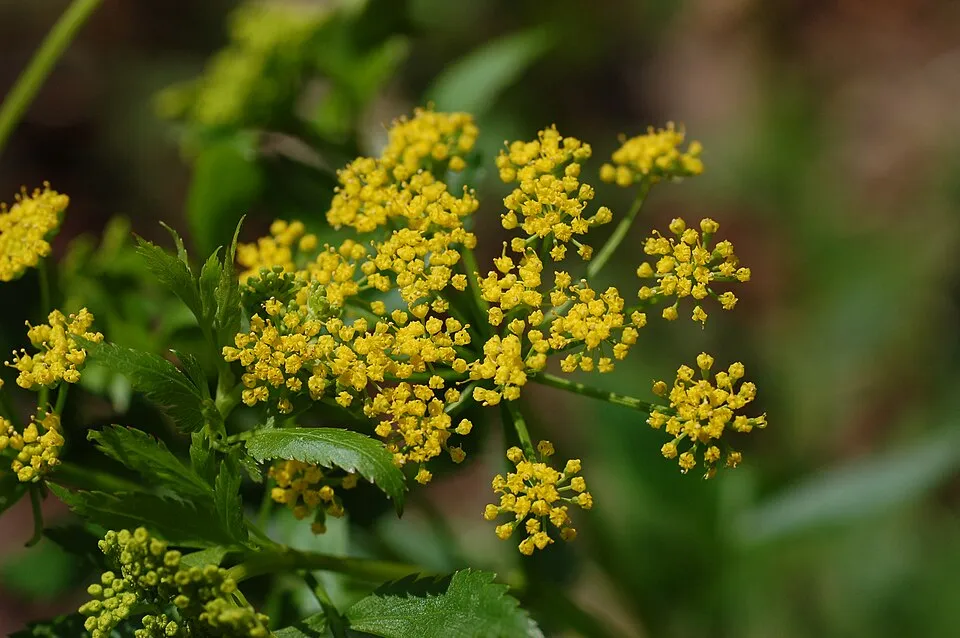
Golden Alexanders (Zizia aurea) with flat-topped umbels of golden-yellow flowers
Zizia aurea in spring bloom — bright golden-yellow umbels, one of the earliest Apiaceae to flower. Photo: Rooted Revival.

Identification

Habit & Leaves

Clump-forming perennial 1–3 ft tall with erect, branching stems. The leaves are compound, with 3–5 toothed, ovate leaflets. Basal leaves are long-stalked and twice-compound; upper stem leaves are smaller and once-compound or simple. Foliage is medium green and nearly hairless. The plant has a tidy, upright appearance.

Flowers

Flat-topped umbels 2–3 in across, composed of many small, bright golden-yellow, five-petaled flowers. The central flower of each umbellet is sessile (stalkless) — a diagnostic trait that separates Zizia from the similar-looking Thaspium (meadow parsnip), where all flowers are stalked. Blooms April through June in NE Oklahoma, with a long flowering period of 4–6 weeks.

Fruit

Small, dry, ribbed schizocarps (splitting fruits) that turn brown as they mature. Seeds self-sow moderately in favorable conditions; not aggressively weedy. Deadheading extends bloom but reduces self-seeding.

Habitat & Range in NE Oklahoma

Zizia aurea is widespread across eastern North America and found throughout Oklahoma. In NE Oklahoma, it grows in moist meadows, open woodlands, stream banks, and prairie edges in the Cross Timbers and Ozark foothills. It prefers consistently moist, rich soil but adapts to average garden conditions with supplemental water. It tolerates partial shade well and is a natural choice for the edge of a woodland garden or rain garden.

Ecology & Wildlife Value

Lepidoptera Host

Golden Alexanders is a larval host for the eastern black swallowtail (Papilio polyxenes) — the caterpillars feed on the foliage and are relatively inconspicuous compared to monarchs on milkweed. It also hosts the Ozark swallowtail (Papilio joanae), a regional specialty. Planting Zizia alongside other Apiaceae like Rattlesnake Master provides a sequence of host plants for swallowtail caterpillars through the season.

Pollinators & Beneficial Insects

The flat, accessible umbels attract an exceptional diversity of small pollinators, including mining bees (Andrena), sweat bees, syrphid flies, small solitary wasps, and beetles. As one of the earliest-blooming Apiaceae, it fills a critical temporal gap for newly emerging native bees in April. The flowers also attract parasitic wasps and tachinid flies that are important natural enemies of garden pests.

Horticulture & Care

Site selection

Golden Alexanders prefers moist, rich soil in full sun to part shade. It is an excellent choice for a rain garden, moist meadow planting, woodland edge, or the wetter parts of a pollinator garden. It tolerates heavy clay if moisture is consistent.

Planting & maintenance

Companion planting

Pair with Wild Columbine, Ohio Spiderwort, Blue-Eyed Grass, Woodland Phlox, and Purple Coneflower for a spring-to-summer pollinator sequence. The golden-yellow umbels are striking against blue spiderwort or phlox.

Photo Reference

Zizia aurea golden-yellow umbels
// Flowers — flat-topped umbels, golden-yellow, 2–3 in
Wikimedia Commons
Wikimedia Commons
Golden Alexanders clump in bloom
// Habit — clump-forming, erect, 1–3 ft, tidy appearance
Wikimedia Commons
Wikimedia Commons
Zizia aurea compound leaves
// Leaves — compound, toothed leaflets, medium green
Wikimedia Commons
Wikimedia Commons
Black swallowtail caterpillar on Golden Alexanders
// Lepidoptera — black swallowtail caterpillar on host foliage
Wikimedia Commons
Wikimedia Commons
Native bee on Golden Alexanders flower
// Pollinator — early-season native bee on golden umbel
Wikimedia Commons
Wikimedia Commons

Sources & Further Reading