// SPECIES PROFILE · PERENNIAL · NATIVE · EDIBLE GROUNDCOVER
Wild Strawberry is the native parent species of the modern garden strawberry (Fragaria × ananassa, a hybrid of F. virginiana and the Chilean F. chiloensis), and like all wild strawberries, it produces small, intensely flavorful red berries that put store-bought fruit to shame. Fragaria virginiana is a low, spreading perennial that forms a dense, attractive groundcover via runners (stolons), with three-parted, toothed leaves and white, five-petaled flowers in spring. In NE Oklahoma, it grows in open woods, meadows, and prairie edges, tolerating dappled shade and a range of soil moisture. The berries are small — dime-sized at most — but their concentrated strawberry flavor is unmatched. For the ecological gardener, this is the ultimate multi-function plant: edible fruit, wildlife forage, pollinator nectar, and a durable, low-growing groundcover that tolerates occasional mowing and can be used as a component of a native bee lawn.

Low, spreading perennial forming a dense mat via slender, above-ground runners (stolons) that root at the nodes. Leaves are basal, three-parted (trifoliate), with each leaflet ovate, 1–2 in long, coarsely toothed, and dark green above, paler below. The leaf surface is softly hairy. The plant is low-growing (4–8 in) and spreads indefinitely.
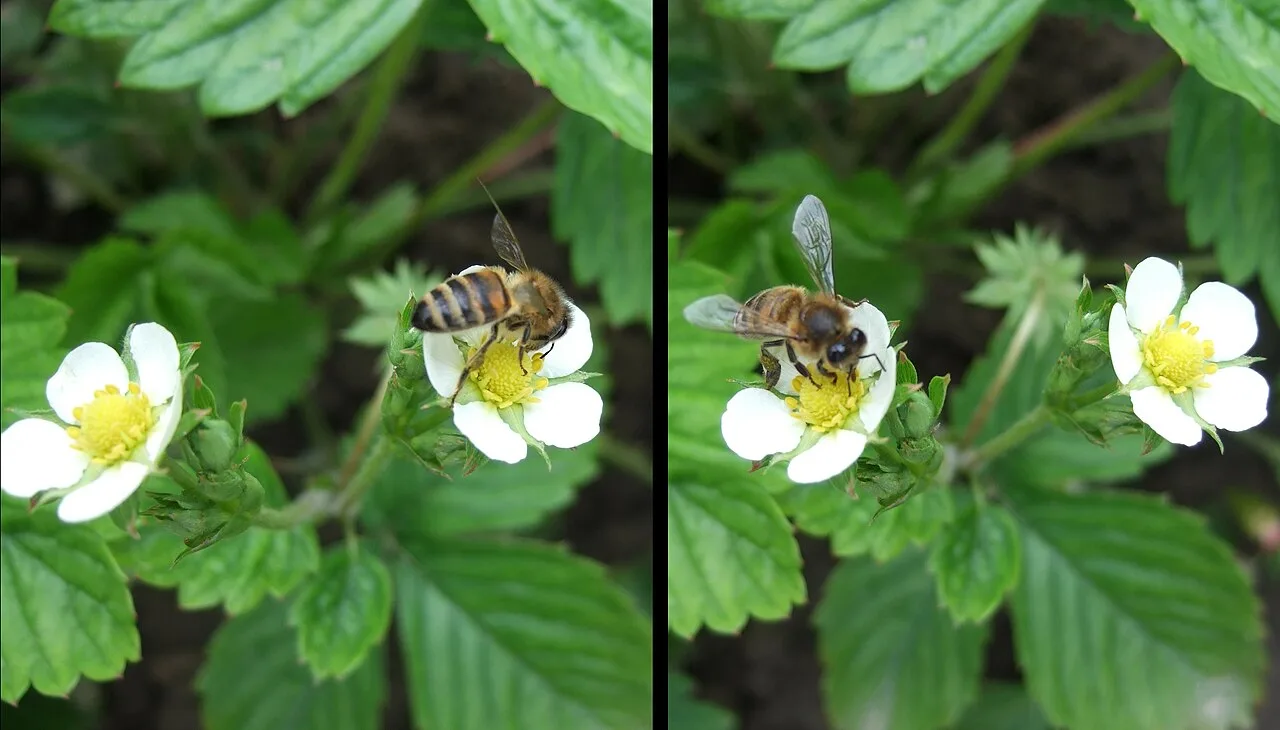
White, five-petaled flowers about 3⁄4 in across, with a yellow center of stamens and pistils, borne in small clusters on short stalks. Blooms April through May. The fruit is a small, conical red strawberry (technically an aggregate accessory fruit), about 1⁄2–3⁄4 in long, with seeds embedded in the surface. The berries ripen in May–June and are intensely fragrant and flavorful.
Fragaria virginiana is found throughout Oklahoma in open woods, meadows, prairie edges, roadsides, and old fields. It tolerates a wide range of soil conditions, from moist loam to dry clay, and grows in full sun to partial shade. It is one of the most adaptable native groundcovers in the eastern US.
The berries are eaten by a long list of wildlife: eastern box turtle, wild turkey, American robin, brown thrasher, eastern bluebird, cedar waxwing, gray catbird, chipmunk, and white-footed mouse. Box turtles in particular are strongly attracted to wild strawberries. The flowers provide nectar for early-season bees and small butterflies.
Wild strawberry is a larval host for the grizzled skipper (Pyrgus centaureae) and several moth species. While not a top-tier caterpillar host like oaks or cherries, it contributes to Lepidoptera diversity in the ground layer.
Wild strawberry accepts full sun to part shade and most soil types, though it prefers well-drained, slightly acidic soil with moderate moisture. It is an excellent choice for a native groundcover under fruit trees, in woodland edges, or as a component of a bee lawn.
Excellent groundcover under Downy Serviceberry, Eastern Redbud, or Pawpaw. Pairs well with Pussytoes, Wild Columbine, Woodland Phlox, and Common Blue Violet.
Wild strawberries are one of the most beloved wild foods in North America. The fruits are small but intensely sweet and aromatic, with a flavor far more concentrated than cultivated strawberries. Indigenous peoples across the continent harvested wild strawberries fresh, dried them for winter, and used them in pemmican, breads, and beverages. The leaves can be used for a mild, strawberry-scented tea. Fragaria virginiana is one of the two parent species of the modern garden strawberry (F. × ananassa), contributing cold-hardiness and flavor to the hybrid. The common name "strawberry" may derive from the practice of mulching plants with straw, or from the Anglo-Saxon streowberie ("strewn berry"), referring to the way the runners spread berries across the ground.